
成都银行

Search documents
A股银行股普涨,宁波银行、杭州银行涨超3%
Ge Long Hui A P P· 2026-01-13 03:43
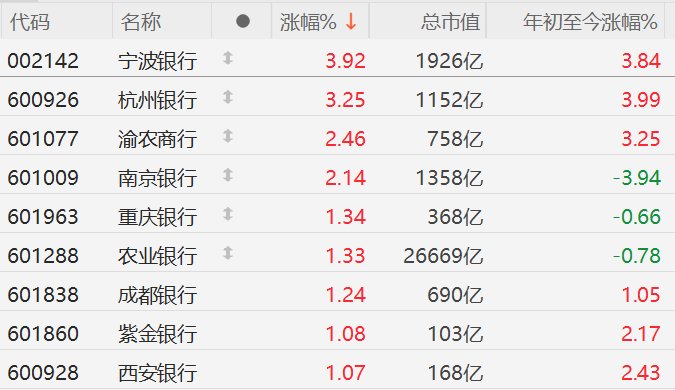
Group 1 - The A-share market saw a general rise in bank stocks, with notable increases in Ningbo Bank and Hangzhou Bank, both rising over 3% [1] - Other banks such as Chongqing Bank, Agricultural Bank, and Xian Bank also experienced gains of over 1% [1] Group 2 - Ningbo Bank's stock increased by 3.92%, with a total market capitalization of 192.6 billion [2] - Hangzhou Bank's stock rose by 3.25%, with a market cap of 115.2 billion [2] - Chongqing Bank and Agricultural Bank saw increases of 1.34% and 1.33% respectively, with market caps of 36.8 billion and 26,669 billion [2] - The year-to-date performance shows that Ningbo Bank and Hangzhou Bank have increased by 3.84% and 3.99% respectively, while Nanjing Bank has decreased by 3.94% [2]





银行股普涨,宁波银行、杭州银行涨超3%
Ge Long Hui· 2026-01-13 03:41
Core Viewpoint - The A-share market saw a significant increase in bank stocks on January 13, with notable gains from several banks, indicating a positive trend in the banking sector [1]. Group 1: Stock Performance - Ningbo Bank (002142) experienced a rise of 3.92%, with a total market capitalization of 192.6 billion [2]. - Hangzhou Bank (600926) increased by 3.25%, with a market cap of 115.2 billion [2]. - Chongqing Rural Commercial Bank (601077) saw a gain of 2.46%, with a market value of 75.8 billion [2]. - Nanjing Bank (601009) rose by 2.14%, but has a year-to-date decline of 3.94%, with a market cap of 135.8 billion [2]. - Agricultural Bank of China (601288) increased by 1.33%, with a substantial market capitalization of 2,666.9 billion [2]. - Other banks such as Chengdu Bank (601838), Zijin Bank (601860), and Xi'an Bank (600928) also reported gains of 1.24%, 1.08%, and 1.07% respectively [2].
严抓不放 常抓不懈 着力推动元旦春节期间风清气正
Xin Lang Cai Jing· 2026-01-12 18:00
Core Viewpoint - The article emphasizes the importance of maintaining a clean political environment during the New Year and Spring Festival periods, focusing on strict adherence to the Central Eight Regulations and combating the "Four Winds" issues [3][4][8]. Group 1: Implementation of Central Eight Regulations - Chengdu's municipal government is reinforcing the implementation of the Central Eight Regulations, particularly during the year-end and New Year period, to prevent corruption and promote a clean political atmosphere [4][8]. - Various district and city-level party secretaries are required to report on their grassroots party building efforts, highlighting the significance of accountability in political responsibilities [3][4]. Group 2: Monitoring and Supervision - The Chengdu Municipal Market Supervision Bureau is actively conducting inspections to address "Four Winds" issues, including excessive gift packaging and price gouging during the festive season [4][5]. - The Sichuan Tianfu New Area's disciplinary inspection committee is utilizing vehicle management platforms to monitor public vehicle usage, aiming to prevent corruption related to public transport [6]. Group 3: Educational Initiatives - The Chengdu Municipal Commission for Discipline Inspection is sending reminders to party members about maintaining discipline during the holidays, emphasizing the importance of resisting "holiday diseases" such as improper gift-giving [5][7]. - Various districts are organizing educational sessions and distributing materials to promote integrity among young cadres, aiming to instill a culture of accountability [7][10]. Group 4: Case Studies and Enforcement - The article outlines several cases of violations of the Central Eight Regulations, detailing the disciplinary actions taken against individuals involved in corrupt practices, including expulsion from the party and criminal prosecution [11][12]. - Chengdu's auditing bodies are conducting regular audits to identify and address "Four Winds" issues, providing guidelines and case studies to enhance oversight [9][10].

成都农商行给王晖的“硬任务”:上市、补短板、协同作战
阿尔法工场研究院· 2026-01-12 00:06
Core Viewpoint - The article discusses the significant transformation of Chengdu Rural Commercial Bank, which is set to become the first non-municipal rural commercial bank in China to exceed a total asset scale of 1 trillion yuan by the end of 2025, breaking the long-standing dominance of direct-controlled city banks in the rural credit system [4][5]. Group 1: Background and Context - The rural credit system in China has traditionally been dominated by banks from direct-controlled municipalities, but this is changing with Chengdu Rural Commercial Bank's entry into the "trillion club" [5]. - The bank's growth comes amid a backdrop of regional economic shifts and narrowing interest margins, raising questions about its ability to maintain stability and governance as it grows [6][7]. Group 2: Governance and Risk Management - Chengdu Rural Commercial Bank has faced a "triangle of impossibility" regarding capital replenishment, governance structure, and risk management, which has historically hindered many rural commercial banks [7][8]. - The bank underwent a significant governance restructuring after a tumultuous period under Anbang Insurance Group, which left it with various issues, including chaotic shareholding structures and uncontrolled related transactions [9]. Group 3: Financial Performance and Challenges - As of mid-2025, Chengdu Rural Commercial Bank reported a non-performing loan ratio of only 1.02% and a provision coverage ratio exceeding 441%, indicating strong risk management [11]. - However, its profitability lags behind peers like Chongqing Rural Commercial Bank and Shanghai Rural Commercial Bank, with a net profit of 6.009 billion yuan in the first three quarters of 2025, showing a single-digit growth rate [11][12]. Group 4: Strategic Direction and Leadership - The appointment of Wang Hui, a seasoned banking executive, as the new chairman is seen as a strategic move to accelerate the bank's IPO process and address its governance and operational challenges [16][17]. - The bank's future strategy will focus on "shortboard supplementation" and rapid progress towards an IPO, with an emphasis on overcoming historical issues related to its complex shareholding structure [17]. Group 5: Regional Financial Landscape - The article highlights the evolving role of Chengdu Rural Commercial Bank within the broader Sichuan financial ecosystem, where it complements the operations of Chengdu Bank and Sichuan Bank, each focusing on different market segments [18][19]. - This collaborative approach aims to avoid vicious competition within the region and enhance overall financial efficiency, particularly in the context of a challenging macroeconomic environment [20]. Group 6: Future Outlook - The next three to five years will be critical for Chengdu Rural Commercial Bank to validate its trillion-yuan asset scale, requiring a shift from mere size expansion to strengthening its operational capabilities through digital transformation and refined management practices [20][21]. - The bank's journey reflects broader themes in the Chinese financial system, including the need to balance scale with quality and to transition from a focus on size to a focus on value creation [23].
金融行业双周报(2025/12/26-2026/1/8):2025年证券行业多项核心指标创历史新高-20260109
Dongguan Securities· 2026-01-09 12:03
Investment Ratings - Banking: Overweight (Maintain) [1] - Securities: Market Weight (Maintain) [1] - Insurance: Overweight (Maintain) [1] Core Insights - The banking sector shows a continued growth trend in social financing, with a marginal decrease in the contribution of government bonds. Corporate bonds increased by 178.8 billion yuan year-on-year, becoming the main increment in social financing. However, the demand for loans remains weak, with a year-on-year decrease of 190 billion yuan in new RMB loans in November [5][44]. - The securities industry has seen multiple core indicators reach historical highs in 2025, with total stock fund transaction volume exceeding 500 trillion yuan, a year-on-year increase of over 70%. The primary market has rebounded, with IPO and refinancing scales increasing by 95.64% and 326.17% respectively, indicating improved market liquidity and financing conditions [3][46]. - The insurance sector reported a total original premium income of 57,629 billion yuan in the first 11 months of 2025, a year-on-year growth of 7.6%. Life insurance companies saw a 9.1% increase in premium income, while property insurance companies grew by 3.9% [4][47]. Summary by Sections Market Review - As of January 8, 2026, the banking, securities, and insurance indices changed by -0.87%, +0.91%, and +1.95% respectively, while the CSI 300 index increased by +2.05%. Among 31 industries, the banking and non-banking sectors ranked 29th and 21st in performance [5][13]. Valuation Situation - As of January 8, 2026, the PB ratio for the banking sector is 0.74, with state-owned banks, joint-stock banks, city commercial banks, and rural commercial banks having PB ratios of 0.79, 0.61, 0.71, and 0.63 respectively. Notably, China Merchants Bank, Agricultural Bank of China, and Ningbo Bank have the highest valuations at 0.96, 0.95, and 0.87 [22][24]. Recent Market Indicators - The one-year MLF operation rate is 2.0%, with LPR rates at 3.0% for one year and 3.50% for five years. The average interbank borrowing rates for one day, seven days, and fourteen days are 1.33%, 1.50%, and 1.60% respectively [29][30]. Industry News - The China Banking and Insurance Regulatory Commission has released guidelines for data classification and grading in the insurance asset management industry, effective January 1, 2026, aimed at enhancing data security management standards [39][40].





成都农商行“万亿圆梦”,新掌门王晖能否带领该行IPO成功?
凤凰网财经· 2026-01-08 15:09
"梦想是要有的,万亿实现了呢!" 新年伊始,成都农商银行在其官方公众号发布主题海报,官宣资产规模突破万亿元,成为全国第五家、中西部首家非直辖城市万亿农商行。 风财眼 . 风财眼致力于银行领域的原创报道,旨在履行媒体监督职责,以期共营健康的金融环境。 以下文章来源于风财眼 ,作者银行财眼 从2020年国资入主完成关键的股权结构调整,五年间,成都农商行实现了从5000亿级跨越至万亿级的规模跃升。 站在新起点,对于接手这家万亿农商行不足半年的新任掌门王晖来讲,能否复刻其推动成都银行上市的成功经验,也同样值得关注。 01 第五家万亿农商行诞生 资料显示,成都农商银行的前身是成都市农村信用社,2010年1月15日完成改制并挂牌开业。2011年,该行通过增资扩股将注册资本增至100亿元;2020年6 月,一场关键的股权结构调整落地,成都市、区两级国资合计持股近80%,成为实际控制人。 回归国有后,成都农商银行驶入规模与效益双升的"快车道"。资产规模方面,从2020年的5000亿级稳步攀升,2024年末已达9142.63亿元;盈利持续保持两 位数的高增长,2021年至2024年净利润同比增幅依次为16.89%、15.25% ...

城商行板块1月8日跌0.89%,重庆银行领跌,主力资金净流入673.97万元
Zheng Xing Xing Ye Ri Bao· 2026-01-08 08:56
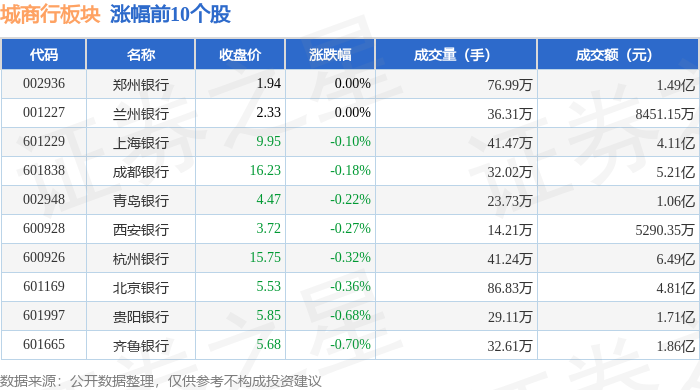
Market Overview - The city commercial bank sector experienced a decline of 0.89% on January 8, with Chongqing Bank leading the drop [1] - The Shanghai Composite Index closed at 4082.98, down 0.07%, while the Shenzhen Component Index closed at 13959.48, down 0.51% [1] Individual Stock Performance - Zhengzhou Bank closed at 1.94 with no change, while Lanzhou Bank also remained unchanged at 2.33 [1] - Shanghai Bank closed at 9.95, down 0.10%, and Chengdu Bank closed at 16.23, down 0.18% [1] - Chongqing Bank saw a significant decline of 2.70%, closing at 10.45, with a trading volume of 99,000 shares [2] Trading Volume and Turnover - The trading volume for Zhengzhou Bank was 769,900 shares with a turnover of 149 million yuan, while Lanzhou Bank had a trading volume of 363,100 shares and a turnover of 84.51 million yuan [1] - The highest turnover was recorded for Nanjing Bank at 1.342 billion yuan with a trading volume of 1,217,000 shares [2] Capital Flow Analysis - The city commercial bank sector saw a net inflow of 6.7397 million yuan from institutional investors, while retail investors experienced a net outflow of 70.5351 million yuan [2] - Chengdu Bank had a net inflow of 87.0825 million yuan from institutional investors, but a net outflow of 46.0321 million yuan from retail investors [3] Summary of Capital Flows - Institutional investors showed a positive net flow for several banks, including Hangzhou Bank with 77.8301 million yuan and Qingdao Bank with 8.4480 million yuan [3] - Conversely, Chongqing Bank had a negative net flow of 535,600 yuan from institutional investors, indicating a lack of confidence [3]
沪指录得K线15连阳 红利低波ETF(512890)近20个交易日逆势2吸金18.08亿元
Xin Lang Cai Jing· 2026-01-08 08:08
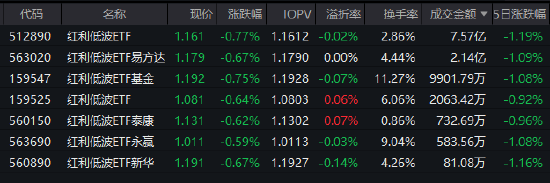
Core Viewpoint - The market is experiencing fluctuations, with the ChiNext Index dropping over 1% and the Shanghai Composite Index down 0.07%, while the Hongli Low Volatility ETF (512890) has seen a decline of 0.77% [1][11]. Fund Performance - The Hongli Low Volatility ETF (512890) is currently priced at 1.161 CNY, with a trading volume of 7.57 billion CNY and a turnover rate of 2.86% [1][11]. - Over the past five trading days, the fund has seen a net inflow of 297 million CNY, with a total net inflow of 1.808 billion CNY over the last 20 days and 5.172 billion CNY over the last 60 days [4][10]. - The fund's total return as of January 7, 2026, is 133.70%, outperforming its benchmark, ranking 98th among 502 funds [6][13]. Market Context - Morgan Stanley predicts that the CSI 300 Index will reach a target of 5200 points in 2026, indicating a potential increase of approximately 13.5% [6][13]. - The current market phase is transitioning from liquidity-driven growth to profit improvement-driven growth, suggesting a favorable environment for cyclical stocks [6][13]. - New regulations are expected to benefit sectors such as banking, public utilities, and coal, which are part of the dividend sector [6][13]. Top Holdings - The top ten holdings of the Hongli Low Volatility ETF include companies like COFCO Sugar, Nanjing Bank, and Agricultural Bank of China, with varying performance among these stocks [3][8].
六大关键词,解码助贷新规下的生存与增长
Nan Fang Du Shi Bao· 2026-01-08 04:47
Core Insights - The Chinese consumer finance industry is at a critical turning point towards high-quality development as of 2025, marked by the implementation of the "Internet Loan Management Measures" on October 1, which introduces a 24% annualized financing cost cap and a "white list" system for loan assistance [1][2] Group 1: Regulatory Changes - The "white list" system has restructured the cooperation ecology within the consumer finance industry, shifting banks from a broad cooperation approach to a more selective one [2][3] - As of October 31, 2025, 119 financial institutions had disclosed their loan assistance "white lists," including various types of banks and financial companies, indicating rapid adoption of the new regulatory framework [2] Group 2: Profitability and Cost Structure - The new regulations have fundamentally altered the industry's profitability logic by imposing a hidden constraint on comprehensive financing costs, which must now include all fees and comply with a 24% cap [4][5] - The previous practice of splitting fees to circumvent interest rate limits has been eliminated, putting pressure on institutions that relied on high-interest business models [5] Group 3: Asset Management Innovations - The trend of "selling without litigation" has become mainstream for managing non-performing assets, with a significant increase in the number of consumer finance companies actively listing bad debt for sale [6][7] - The shift towards quicker asset disposal methods is driven by regulatory encouragement for market-based asset management [7] Group 4: Leadership Changes - A significant turnover in executive leadership has occurred across the consumer finance sector, with at least 25 companies experiencing changes in key positions, reflecting the industry's adaptation to new regulatory and market conditions [8][9] - The new leadership is increasingly composed of professionals with backgrounds in finance and technology, which is seen as essential for enhancing risk management and innovation capabilities [9] Group 5: Capital Increases - A wave of capital increases has been observed in the consumer finance industry, driven by regulatory pressures and competitive market conditions, with several companies raising significant funds to meet new capital requirements [10][11] - Despite the regulatory push, the underlying optimism about the industry's future is evident, as companies seek to strengthen their compliance and operational capabilities [11] Group 6: Strategic Focus on Technology - The implementation of the new regulations has prompted the industry to balance compliance with innovation, emphasizing the need for a "self-operated + technology" approach to enhance operational efficiency and risk management [12][13] - Companies are increasingly investing in technology to optimize risk control and improve service delivery to underserved customer segments [12][13]
陕国投拟8亿“入局”长安银行增资 区域银行资本补充潮起
Jing Ji Guan Cha Wang· 2026-01-08 03:18
Group 1: Core Insights - Shaanxi International Trust Co., Ltd. (Shaanxi Guotou) plans to invest up to 800 million yuan in Chang'an Bank's capital increase, acquiring no more than 209 million shares at a price of 3.83 yuan per share, which will be used to supplement core Tier 1 capital [1] - The capital increase is part of a broader trend where regional banks are receiving shareholder support to strengthen their capital bases amid intensified regulatory constraints and competitive pressures [1][7] - The investment by Shaanxi Guotou reflects a strategic shift from being a provider of financial products to becoming a long-term shareholder in core financial institutions, aiming to stabilize income and enhance influence within the regional financial system [2][3] Group 2: Financial Performance and Challenges - Chang'an Bank faces significant capital pressure, with its core Tier 1 capital adequacy ratio declining from 9.15% at the end of 2024 to 8.23% by September 2025, indicating a growing tension between asset expansion and capital replenishment [4] - The bank's revenue and net profit have shown a downward trend, with revenue decreasing from 9.779 billion yuan in 2023 to 9.461 billion yuan in 2024, and net profit dropping from 2.445 billion yuan in 2023 to 2.315 billion yuan in 2024 [4] - The bank's provision coverage ratio has decreased from 191.15% at the end of 2023 to 151.77% by September 2025, although it remains above regulatory requirements, indicating a buffer against potential asset quality fluctuations [5] Group 3: Strategic Implications - The pricing strategy for the capital increase reflects a discount to the book value, indicating a cautious market valuation of regional bank equities in the current economic environment [6] - The collective action of the Shaanxi state-owned enterprises in this capital increase is not merely a financial investment but a strategic move by the local government to maintain regional financial stability and enhance collaboration between finance and industry [6] - The ongoing capital increase trend among regional banks signifies a shift from "blood transfusion" to "blood production," highlighting the need for banks to convert capital advantages into sustainable competitive strengths amid structural changes in the banking environment [8]
