软通动力

Search documents
“小单快返”时代,谁在用AI,帮客户更快下单?
Sou Hu Cai Jing· 2026-01-06 12:59
Core Insights - The current foreign trade business is not just about profit margins but a competition for survival, driven by de-globalization, small orders, and extreme cost-effectiveness [2] - Sureway has partnered with Lingdi Technology Style3D to reduce costs in the sampling process by 40% through the integration of 3D and AI technologies [2][4] Group 1: Industry Challenges - The traditional bag development process involves multiple steps, leading to high costs, especially with small orders becoming the norm [3] - The fragmentation of orders necessitates a reduction in sample quantities and cycles, making it essential for foreign trade companies to address these challenges [3] Group 2: Technological Implementation - Sureway has transformed its R&D process from a linear model to a digital-first approach, allowing 90% of modifications to be completed in the cloud before physical samples are made [4] - The new process, while seemingly more complex, significantly reduces time and costs compared to the traditional method [4][5] Group 3: Customer Engagement - Sureway has categorized customers based on their openness to new technologies, focusing first on those with the most significant pain points [3] - The company has successfully demonstrated the value of 3D and AI to initial pilot customers, facilitating smoother transitions to later adopters [3] Group 4: Organizational Restructuring - The successful implementation of new technologies requires a reorganization of teams and processes, emphasizing the need for a mix of experienced and innovative personnel [10] - Continuous team motivation and positive feedback from customers are crucial for building a sense of achievement within the team [10] Group 5: Future Outlook - The integration of 3D and AI technologies is expected to revolutionize the fashion industry, moving from linear development to parallel collaboration based on digital twins [8] - The industry is urged to proactively seek technological leverage rather than waiting for complete transparency in the market [14]


人形机器人火爆出圈,高增长潜力股名单揭晓
证券时报· 2026-01-06 08:16
Core Viewpoint - Humanoid robots are emerging as a significant focus in the tech industry, with expectations of mass production and increased market presence by 2026, particularly highlighted at the CES event [4][5][6]. Group 1: Industry Developments - The 2026 CES will showcase numerous humanoid robots, with major companies like Boston Dynamics and Qualcomm presenting their latest innovations [4][5]. - The humanoid robot market is expected to see substantial growth, with Tesla projected to produce between 50,000 to 100,000 units by 2026, marking the beginning of a phase of mass production and commercial exploration [8]. Group 2: Market Potential - The humanoid robot market is forecasted to reach a size of $5 trillion by 2050, with an estimated deployment of 1 billion units, suggesting a potential ownership rate of one humanoid robot per ten people [8]. - A significant number of companies are entering the humanoid robot sector through mergers, fundraising, and strategic collaborations, indicating a rapid acceleration in industry investment and commercialization [7]. Group 3: Investment Opportunities - There are 31 humanoid robot concept stocks predicted to have a net profit growth rate exceeding 20% in both 2026 and 2027, indicating strong investment potential [10]. - Five stocks, including Zhimi Intelligent and Softcom Power, show an upside potential of over 30% based on the latest closing prices compared to target prices set by analysts [11].

金融科技板块尾盘拉升,软件ETF指数(560360)涨超2%冲击8连涨
Xin Lang Cai Jing· 2026-01-06 07:11
Group 1 - The financial technology sector experienced a significant rally, with the China Software Service Index rising by 2.42% and individual stocks like Tonghuashun and Wealth Trend increasing by 9.60% and 9.53% respectively [1] - The People's Bank of China announced that starting January 1, 2026, digital yuan wallet balances will earn interest, making China the first economy to offer interest on central bank digital currency [1] - The National Bureau of Statistics released a draft opinion aimed at enhancing data circulation service capabilities by the end of 2029, which is expected to stimulate the data factor market and improve data utilization across society [1] Group 2 - The domestic information technology innovation (信创) industry is rapidly developing under dual policy and market drivers, with a strategic layout covering key sectors such as government, finance, energy, and transportation [2] - The market for information security is projected to grow at a compound annual growth rate of 35%, potentially reaching 16.6 billion yuan by 2027, with initial applications in boundary security, endpoint security, and cloud security [2] - As of December 31, 2025, the top ten weighted stocks in the China Software Service Index include Keda Xunfei, Kingsoft Office, and Tonghuashun, collectively accounting for 60.89% of the index [2]



人形机器人火爆出圈 高增长潜力股名单揭晓
Zheng Quan Shi Bao Wang· 2026-01-06 05:45
Group 1: Humanoid Robots Industry - Humanoid robots are emerging as one of the most promising frontier fields, attracting attention from global tech giants and investors [2] - The 2026 CES will showcase a significant number of humanoid robots, with companies like Boston Dynamics and others presenting their latest advancements [7] - The market for humanoid robots is expected to grow substantially, with projections indicating a market size of $5 trillion by 2050 and a deployment of 1 billion units [10] Group 2: Market Trends and Developments - The storage chip sector saw a notable rise, with companies like Liyuan Co., Chang Aluminum, and others hitting their daily price limits [3] - A significant price increase for DRAM is anticipated, with Samsung and SK Hynix proposing a 60%-70% price hike for the first quarter of 2026 compared to Q4 2025 [6] - The humanoid robot production year is approaching, with several companies announcing plans for mass production and strategic collaborations to enhance their capabilities [9] Group 3: Investment Opportunities - There are 31 humanoid robot concept stocks predicted to have a net profit growth rate exceeding 20% in 2026 and 2027 [11] - Five stocks, including Zhiwei Intelligent and Softcom Power, show an upside potential of over 30% based on the latest closing prices compared to target prices [12] - Zhiwei Intelligent leads with a projected upside of 46.17%, focusing on embodied intelligence and various robotic applications [12]

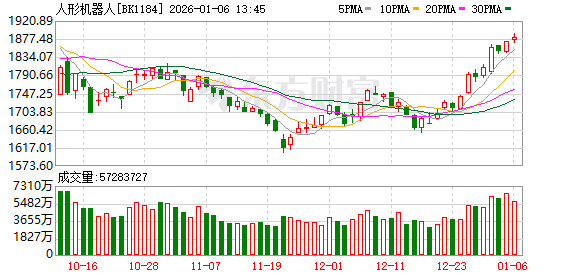
人形机器人火爆出圈,高增长潜力股名单揭晓
Zheng Quan Shi Bao Wang· 2026-01-06 05:13
Group 1 - Humanoid robots are emerging as a highly promising frontier in technology, attracting attention from global tech giants and investors [1] - The 2026 CES will showcase a significant number of humanoid robots, with companies like Boston Dynamics and others presenting their latest advancements [2] - The CEO of Creative Strategies highlighted that the CES will feature a surge in humanoid robots, particularly from China, indicating a robust ecosystem [2] Group 2 - Hyundai Motor Group announced that Boston Dynamics will showcase a mass-produced version of the Atlas humanoid robot at CES 2026, aiming to integrate it into their global network for practical tasks [3] - The humanoid robot industry is entering a mass production phase, with several companies expected to achieve production milestones by 2025 and 2026 [4] - Tesla is projected to produce between 50,000 to 100,000 humanoid robots by 2026, marking the industry’s transition into a phase of mass production and commercial exploration [4] Group 3 - A significant number of A-share market stocks are positioned within the humanoid robot industry, with 31 stocks expected to see net profit growth exceeding 20% in 2026 and 2027 [5] - Stocks such as Zhimi Intelligent and Softcom Power are identified as having substantial upside potential, with predicted price increases exceeding 30% [5] - Zhimi Intelligent leads with a projected upside of 46.17%, focusing on embodied intelligence and various robotic applications [5][6] Group 4 - The rolling P/E ratio for Huqin Technology is noted to be the lowest at 24.3 times, with expectations of continued revenue growth in AI and server sectors [6] - The report indicates that the humanoid robot market is expected to reach a size of $5 trillion by 2050, with a deployment of 1 billion units, suggesting a significant market opportunity [4]



AI应用蓄势待发,软件ETF(159852)聚焦AI软件投资机遇
Xin Lang Cai Jing· 2026-01-06 03:16
Group 1 - The software development sector is showing strength, with the CSI Software Service Index rising by 1.03% as of January 6, 2026, and key stocks like Tonghuashun up by 7.70% and Guiding Compass up by 6.37% [1] - The Ministry of Industry and Information Technology reported that from January to November 2025, China's software and information technology service industry generated revenue of 139,777 billion yuan, a year-on-year increase of 13.3%, with total profits of 16,954 billion yuan, up 6.6% [1] - Software exports reached 568.9 million USD, marking an 8.1% year-on-year growth, maintaining positive growth for nine consecutive months [1] - The Ministry also released guidelines to accelerate the development of new internet exchange centers, focusing on deploying cutting-edge technologies such as AI, quantum communication, and privacy computing [1] - Huazhang Securities highlighted the strong growth potential of the computer and software development industry, supported by policy initiatives and advancements in key areas like AI and quantum technology [1] Group 2 - As of December 31, 2025, the top ten weighted stocks in the CSI Software Service Index include iFlytek, Kingsoft Office, and Tonghuashun, collectively accounting for 60.89% of the index [2] - The Software ETF (159852) tracks the CSI Software Service Index, providing a convenient tool for investing in the computer software industry [3] - Investors can also access AI software investment opportunities through the Software ETF linked fund (012620) [4]
软件ETF(159852)涨超3%! DeepSeek近日发布论文,开启架构新篇章!
Jin Rong Jie· 2026-01-05 06:39
资讯所属栏目还有更多独家策划、专家专栏,免费查阅>> 软件ETF(159852)跟踪中证软件服务指数,前十大权重股分别为科大讯飞、金山办公、同花顺、指南 针、恒生电子、拓维信息、润和软件、三六零、软通动力、深信服,权重合计超60.89%。 软件ETF(159852)当前管理费率为0.50%(每年),托管费率为0.10%(每年),没有股票账户的投资 者还可以通过联接基金(012619.OF,012620.OF,021861.OF)布局板块投资机遇。 声明:市场有风险,投资需谨慎。本文为AI基于第三方数据生成,仅供参考,不构成个人投资建议。 市场1月5日消息,据上交所数据显示,今日上证指数再度站上4000点,截至14:05,上证指数上涨 1.32%,中证软件指数上涨3.41%,个股方面,合合信息涨超7%,科大讯飞涨超6%,指南针、同花顺等 涨超3%。热门ETF方面,软件ETF(159852)涨3.36%。 消息面上,DeepSeek近日发布论文,阐述了一种更为高效的人工智能开发方法。该论文由创始人梁文 锋参与撰写,提出了名为"流形约束超连接"(mHC)的框架。作者称,该框架旨在提升可扩展性,同 时降低训练先进人工 ...

每周股票复盘:软通动力(301236)定增获证监会注册批复
Sou Hu Cai Jing· 2026-01-02 18:26
Group 1 - The core stock price of Softcom Power (301236) closed at 47.43 yuan as of December 31, 2025, reflecting a 1.63% increase from the previous week's 46.67 yuan [1] - The highest intraday price reached 49.26 yuan and the lowest was 47.09 yuan on December 29, 2025 [1] - The current total market capitalization of Softcom Power is 45.198 billion yuan, ranking 5th out of 119 in the IT services sector and 408th out of 5181 in the A-share market [1] Group 2 - Softcom Power plans to raise a total of no more than 334.83203 million yuan through a private placement of shares, aimed at funding several smart manufacturing and computing power projects [2][3] - The issuance has been approved by the Shenzhen Stock Exchange and is pending registration with the China Securities Regulatory Commission (CSRC) [2] - The CSRC has issued a registration approval for the private placement, which is valid for 12 months from the date of approval [2]
中国AI软件如何走出自己的“范式”路线?
Guan Cha Zhe Wang· 2026-01-02 05:56
Core Insights - The article highlights a significant divergence in the global AI software sector, contrasting standardized SaaS giants like Salesforce with customized solution providers like Palantir, which has accelerated revenue growth and stock revaluation amid the AI wave [1][3]. Group 1: Palantir's Business Model and Success - Palantir, originally focused on government and intelligence data analysis, has expanded its capabilities to various industries, integrating data and processes into a "decision operating system" [3][5]. - The company has secured substantial contracts, including a long-term agreement with the U.S. Army worth up to $10 billion, which positions its platform as a central operational hub, leading to significant long-term revenue and high switching costs [3][5]. - Palantir's approach differs fundamentally from Salesforce's standardized model; it embeds AI deeply into clients' operations, making it difficult for clients to switch providers once integrated [5][12]. Group 2: Fourth Paradigm's Position in China - Fourth Paradigm, established in 2014, serves large organizations in sectors like banking and energy, focusing on embedding AI models into specific business scenarios rather than offering general applications [7][12]. - The company has transitioned from project-based delivery to developing a platform called "Prophet," which standardizes and automates the AI deployment process, similar to Palantir's evolution [8][11]. - In the Chinese market, Fourth Paradigm faces unique challenges, such as concentrated budgets on hardware, necessitating a "soft and hard integration" approach to deliver AI solutions effectively [9][12]. Group 3: Market Positioning and Strategy - Fourth Paradigm is positioned as an "organizational-level AI infrastructure provider," distinct from traditional SaaS or IT outsourcing firms, focusing on embedding AI into critical decision-making processes [15][16]. - The company emphasizes the importance of a platform-based approach and partnerships to scale its operations, which is crucial for reducing marginal costs and achieving efficiency [16][17]. - The article suggests that the true competitive advantage lies in how extensively AI is utilized within client operations, rather than just the algorithms themselves [16][17].

心智观察所:中国AI软件如何走出自己的“范式”路线?
Guan Cha Zhe Wang· 2026-01-02 05:56
Core Insights - The article highlights a significant divergence in the global AI software sector, contrasting standardized SaaS giants like Salesforce with Palantir, which has accelerated revenue and stock valuation through customized AI applications [1][3] - AI is fundamentally altering the value delivery of software, with companies like Fourth Paradigm in China being compared to Palantir due to their similar approaches [1][7] Group 1: Palantir's Business Model - Palantir, originally focused on government and intelligence data analysis, has expanded its capabilities to various sectors, integrating data and processes into a "decision operating system" [3][5] - The company has secured substantial government contracts, including a long-term agreement with the U.S. Army worth up to $10 billion over ten years, which provides significant long-term revenue and high switching costs for clients [3][6] - Palantir's approach involves embedding AI deeply into clients' operational systems, making it difficult for clients to switch to competitors once integrated [6][12] Group 2: Fourth Paradigm's Strategy - Fourth Paradigm, established in 2014, focuses on embedding AI models into specific business scenarios for large organizations in sectors like finance and energy [7][9] - The company has transitioned from a project-based model to a platform-based approach, developing an AI platform called "Prophet" that standardizes and automates the AI deployment process [8][11] - Fourth Paradigm's management acknowledges the need for a "soft and hard integration" approach due to the unique challenges in the Chinese market, where hardware budgets are prioritized [9][10] Group 3: Market Positioning - Fourth Paradigm is positioned uniquely in the Chinese software landscape, focusing on embedding AI into complex decision-making processes rather than offering broad SaaS solutions [14][15] - Unlike traditional management software companies, Fourth Paradigm aims to be an "organizational-level AI infrastructure provider," emphasizing deep integration over wide coverage [15][18] - The company is not merely replicating Palantir's model but is exploring a path that aligns with China's specific market conditions and technological landscape [18][17] Group 4: Future Considerations - The article suggests that for Chinese AI application companies to succeed, they must accept the reality of heavier initial delivery and longer cycles due to the current state of technology and processes [17] - Building a platform and partner ecosystem is essential for scaling operations and reducing marginal costs, as demonstrated by Fourth Paradigm's strategy [17] - The true competitive advantage lies in how extensively AI is utilized within client operations, which can redefine business models and valuation logic [17][18]