银华

Search documents
新型浮动费率基金能否赢得投资者的青睐?
Sou Hu Cai Jing· 2025-05-29 22:47
Core Viewpoint - The introduction of 16 new floating-rate funds by various fund companies marks a significant development in the fund market, driven by the recent regulatory changes aimed at linking management fees to fund performance [1][3]. Group 1: New Fund Issuance - A total of 16 floating-rate funds have been launched by 16 different fund companies, with an additional 10 funds expected to be issued soon [1]. - The issuance of these funds is seen as a response to the China Securities Regulatory Commission's new action plan aimed at promoting high-quality development in public funds [1][5]. Group 2: Floating Rate Mechanism - The floating-rate fee structure is designed to tie management fees to the performance of actively managed equity funds, with specific fee rates determined based on the fund's performance relative to a benchmark [1][4]. - The current reform is limited to new funds and does not address existing funds, which may allow fund companies to continue benefiting from a stable income regardless of performance [3][4]. Group 3: Limitations of the Reform - The floating-rate reform does not fundamentally change the existing "guaranteed income" model for fund companies, as they can still charge management fees even if performance is poor, albeit at a lower rate [4][5]. - The emphasis on fund size remains significant, as larger funds can generate higher management fees, which may detract from a focus on performance [4][5]. - The current floating-rate structure does not fully align the interests of fund companies with those of investors, as it does not tie management fees directly to the absolute profits generated by the funds [5].

首发16只浮动费率基金经理画像:中生代为主体,10位任职5-10年
Sou Hu Cai Jing· 2025-05-28 12:15
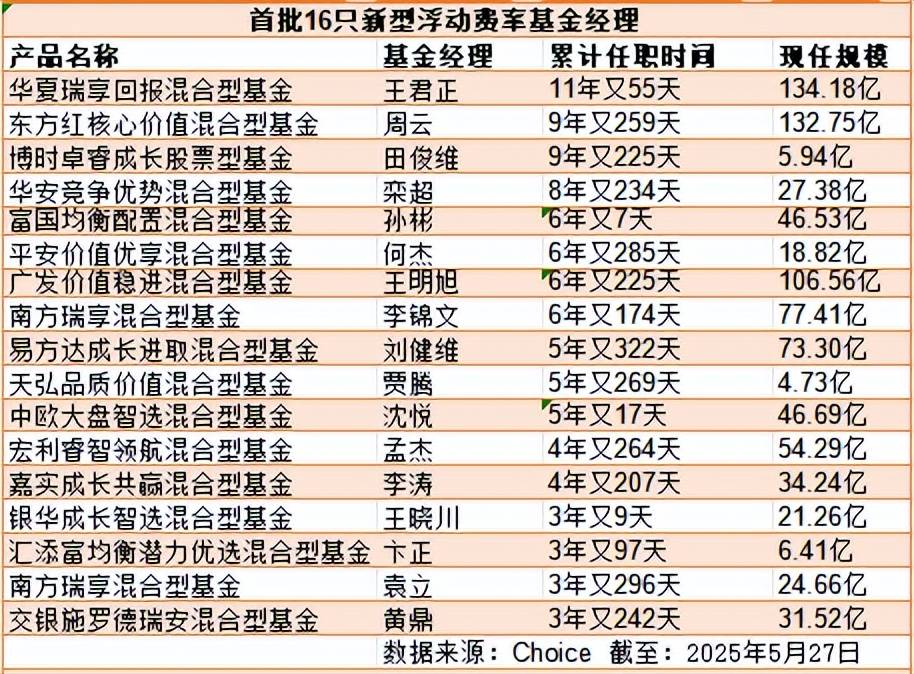
Core Viewpoint - The first batch of 16 new floating rate funds has been launched, with significant expectations from the management for these innovative products [2][5]. Group 1: Fund Manager Selection - The fund managers for these new funds are primarily mid-career professionals, with 10 out of 17 having 5-10 years of experience [2][3]. - There is a notable absence of previously popular star managers or those heavily invested in trending stocks, indicating a focus on experienced managers [2][3]. Group 2: Fund Manager Performance - Among the 17 fund managers, 5 have achieved an annualized return exceeding 10%, while only 1 has a negative performance [5][6]. - The overall performance of these fund managers has outperformed the annualized return of the CSI 300 index, with specific returns of 13.33% for Wang Mingxu from GF Fund and 13.04% for Wang Junzheng from Huaxia Fund [6][7]. Group 3: Fund Management Scale - The current management scale of these fund managers varies, with 3 managing over 10 billion yuan, while 4 manage less than 1 billion yuan [4][6]. - The majority of fund managers have a management scale between 2 billion and 10 billion yuan, indicating a balanced distribution [4]. Group 4: Investment Style - The fund managers exhibit diverse investment styles, with 10 favoring value investing and 7 specializing in growth stocks [9][11]. - Different fund companies offer various styles, allowing investors to choose funds that align with their investment preferences [12].


自购绑定 全员发海报 业绩基准“分水岭” 16只同日冲锋 新型浮动费率基金闪击
Zhong Guo Zheng Quan Bao· 2025-05-27 20:31
Group 1 - The first batch of new floating rate funds was launched on May 27, with 16 products available for subscription, marking a significant transformation in the public fund industry [1][2] - The rapid issuance of these funds occurred just two trading days after receiving approval from the regulatory authority, indicating a swift response from the industry [1][2] - Initial sales were strong, with reports of some products achieving subscription scales exceeding several hundred million yuan on the first day [2] Group 2 - The fund companies have deployed their top-performing fund managers for these new products, emphasizing a balanced and stable investment style [3] - The performance benchmarks for these floating rate funds vary, with many choosing broad market indices like CSI 300 and CSI 500, reflecting the fund managers' market style predictions [4][5] - The management fees for these funds will be dynamically calculated based on the actual returns to investors, introducing a new level of operational and system capability requirements for fund companies [6][7] Group 3 - The floating management fee mechanism links the fee rate to the excess return relative to the performance benchmark, aiming to enhance investor satisfaction and promote long-term investment behavior [7] - The current market environment is viewed as a "golden window" for equity investments, with favorable external conditions and relatively low valuations in both A-share and Hong Kong markets [7]
首批新型浮动费率基金发行:管理人更重持营,销售节奏“细水长流”
2 1 Shi Ji Jing Ji Bao Dao· 2025-05-27 12:46
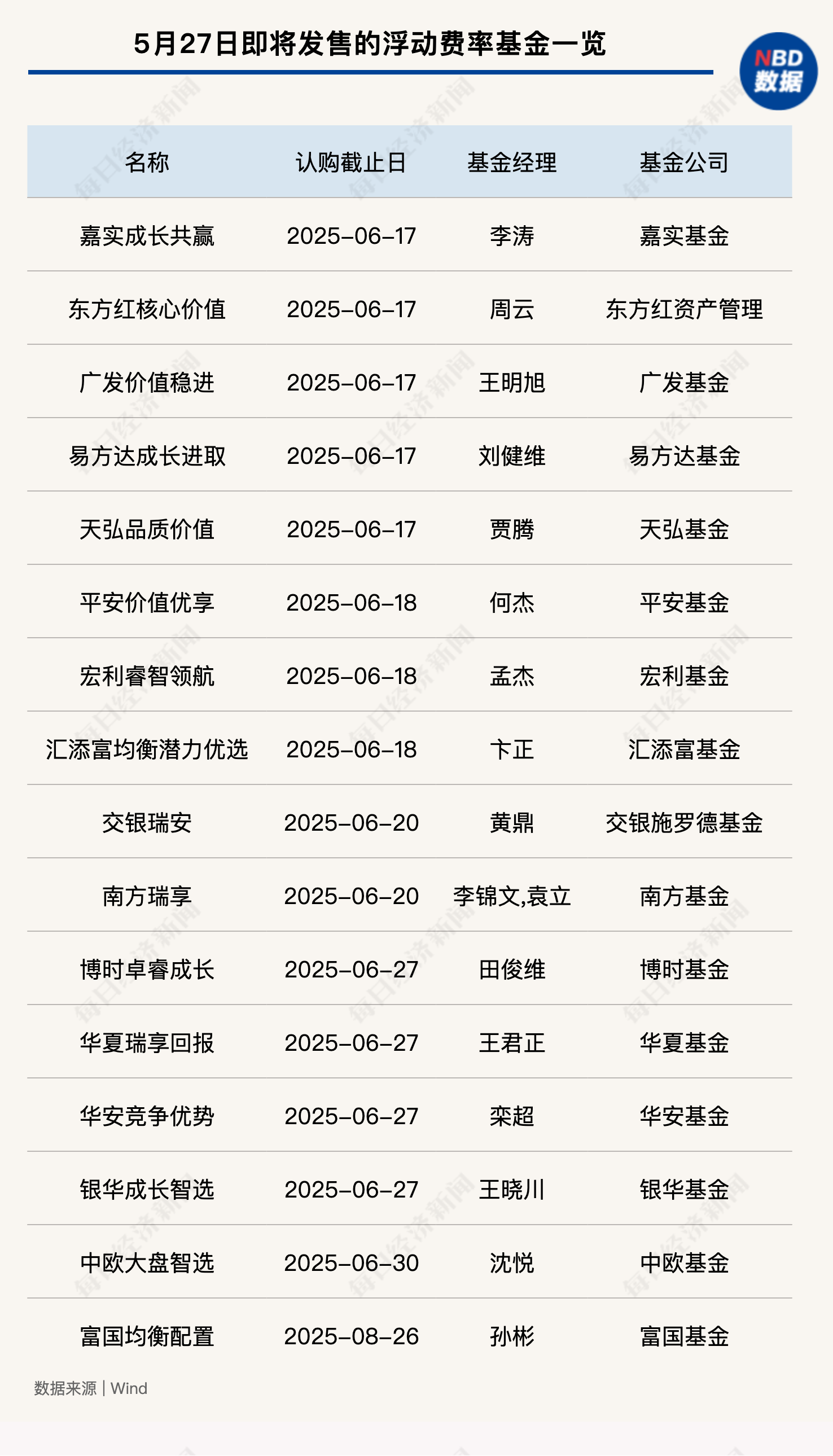
继过去10日内快速经历了申报、受理和获批后,5月27日,首批新型浮动费率基金(下称"浮费基金") 正式开售。 公开信息显示,已获批的26只基金中,5月27日启动发行的共有16只,包括易方达、汇添富、广发、富 国、嘉实、天弘、华夏、平安、南方、宏利、银华、博时、中欧、交银施罗德、华安、东方红旗下产 品。多数产品将于6月中下旬结束认购,在募集目标的设置上,最高有基金设置了80亿元。 作为公募行业开启改革新篇的关键一着,新型浮费产品"千帆竞发"背后,机构在营销上仍然火热。从各 家的营销材料来看,主要的宣传点一在浮动费率的设置科普,二在强调拟任基金经理的主动管理能力, 如选股策略、历史胜率、价值投资等。 平均认购期不到1个月 5月7日,证监会发布《推动公募基金高质量发展行动方案》明确提出,对新设立的主动管理权益类基金 大力推行基于业绩比较基准的浮动管理费收取模式。此后,首批新型浮动费率基金应声落地,标志着基 金业在产品供给侧的又一次深度优化。 渠道方面,一批托管行也正整装待发。在26只获批产品中,建设银行托管了最多的浮费基金,共达7 只,其中包括在5月27日首批发行的华夏、博时、富国、华安、银华旗下的5只。 中国银行 ...
持续上涨!一天8只QDII基金提示溢价风险
Bei Jing Shang Bao· 2025-05-27 12:41
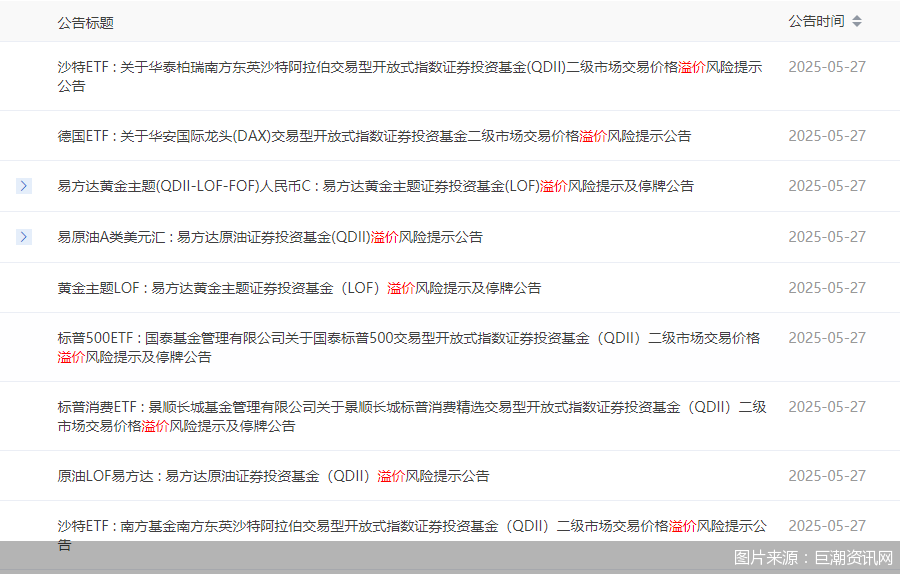
Core Insights - The QDII funds have shown significant performance this year, but many products are frequently warning about premium risks due to price discrepancies between the market and net asset values [1][5] - As of May 27, eight QDII funds issued premium risk alerts, with some funds having issued multiple warnings throughout May [1][2] - Investors are advised to monitor premium rates closely, especially when they exceed 10%, and to wait for a return to reasonable levels before investing [1][5] Performance Overview - As of May 23, out of 650 QDII funds, 425 achieved positive returns this year, representing 65.38% of the total, with 46 funds exceeding a 30% return [4] - The top-performing fund, Huatai-PineBridge Hong Kong Advantage Selection Mixed Fund (QDII), recorded a year-to-date return of 68.45%, while its C-class shares achieved 67.96% [3][4] - The strong performance of QDII funds is largely attributed to investments in the Hong Kong stock market, which has seen significant gains this year [4] Market Context - The Hang Seng Index and the Hang Seng Tech Index have risen by 16.56% and 15.99% respectively since the beginning of the year, contributing to the positive performance of QDII funds focused on Hong Kong stocks [4] - In contrast, some QDII funds investing in US and European markets have reported negative returns, highlighting the variability in performance based on market focus [4]
重磅基金,今日发售!A股还要调整多久?
天天基金网· 2025-05-27 10:58
Core Viewpoint - The A-share market continues to experience fluctuations, with the consumer and pharmaceutical sectors showing resilience, while external disturbances and policy dynamics contribute to ongoing market adjustments [1][2][6]. Market Analysis - The A-share market is currently in a state of rotation, with sectors such as innovative pharmaceuticals and food and beverages performing well, while technology sectors like precious metals, consumer electronics, and semiconductors are experiencing pullbacks [2][6]. - Analysts predict that the current state of market fluctuations may persist until mid-June, influenced by external risks and domestic policy measures [5][6]. - The market is characterized by a cautious sentiment due to external trade tensions and a lack of significant domestic policy surprises, leading to a concentration of funds in high-dividend, low-valuation assets [6]. Structural Opportunities - Analysts from Xingye Securities highlight three key areas for potential investment opportunities: 1. Technology sector, particularly high-tech manufacturing [8]. 2. Domestic demand sector, represented by services [8]. 3. Dividend-focused investments to mitigate market uncertainties [9]. Fund Launch and Features - A new batch of floating fee rate funds has been launched, which ties management fees to performance metrics and holding periods, offering a more dynamic fee structure compared to traditional funds [12][14]. - The floating fee structure allows for varying management fees based on whether the fund outperforms or underperforms its benchmark, providing a more performance-aligned investment approach [14][15][16]. Investment Considerations - Investors are advised to consider various factors beyond fee structures when selecting funds, including the fund's investment style, strategy, and the track record of fund managers [18][19]. - Floating fee rate funds may be particularly suitable for long-term investors and those sensitive to fee structures, as they align management incentives with investor performance [20].

首批16家浮动费率基金开售 首日银行渠道战况:东方红、天弘已申购过亿 宏利相对垫底
Xin Lang Ji Jin· 2025-05-27 10:12
Group 1 - The first batch of 16 floating fee rate funds has been launched, which differ from traditional fixed fee models by adopting a more flexible charging mechanism to attract investor attention [1] - These funds are part of a significant shift in the industry from focusing on scale to prioritizing returns, as indicated by the recent approval of the floating management fee fund model by the China Securities Regulatory Commission [3] - The floating management fee structure includes three tiers: 1.2% (benchmark), 1.5% (upward adjustment), and 0.6% (downward adjustment), which will be adjusted based on the fund's annualized return compared to its performance benchmark after one year of holding [3] Group 2 - As of the report date, various banks have recorded significant sales figures for these funds, with China Bank totaling 140 million, including 59.1 million for E Fund Growth and 29.01 million for GF Value Stable Growth [2] - Other banks, such as Agricultural Bank and Shanghai Pudong Development Bank, also reported sales figures of 892 million and 416 million respectively, indicating strong market interest [2]
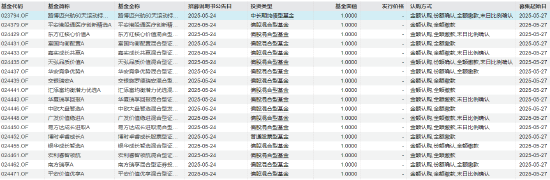
浮动费率型基金明日开卖,只支持现金分红,什么原因?
Mei Ri Jing Ji Xin Wen· 2025-05-26 09:03
比如这些产品的分红方式,都仅支持现金分红这一种,不支持红利再投。业绩比较基准方面,有7只基金选择的是中证800指数和中证800成长指数。 另外,各家基金公司派出的基金经理也是一大看点。基金经理们在管理规模、任职时间以及业绩表现上,也有明显不同。 只支持现金分红 5月27日,公募基金又将出现一批基金同时开售的景象,不同的是,这次的产品是浮动费率型基金。 所谓浮动费率,主要是指基金管理费并不是固定的。而即将开卖的这批基金,管理费主要是跟业绩和持有时间挂钩。 每经记者|黄小聪 每经编辑|肖芮冬 近日,16只浮动费率基金纷纷披露招募书,并将于明日(5月27日)正式发售。除了管理费采用浮动费率方式,《每日经济新闻》记者注意到,这些产品还 有一些比较不一样的看点。 根据基金公告,这些产品的费率设定基本是这样:持有期限不足一年,按1.20%年费率收取管理费;持有期限达到一年及以上,则根据持有期间年化收益 率,分三档收费——相对业绩比较基准的年化超额收益率在-3%及以下,按0.60%年费率;年化超额收益率超过6%且持有收益率为正,按1.50%年费率确认 管理费;其他情形按1.20%年费率确认管理费。 而除了费率浮动这个最大的 ...
首批26只新型浮动费率基金落地
Cai Jing Wang· 2025-05-23 13:46
Core Viewpoint - The first batch of performance-based innovative floating fee rate funds has been officially approved, marking a significant development in the public fund industry in China [1][5]. Group 1: Fund Approval and Structure - The first batch of funds was collectively submitted for approval on May 16, received acceptance on May 19, and was approved on May 23 [2]. - Multiple public fund companies, including E Fund, Fuguo, and Huaxia, will send their top-performing fund managers to manage these funds [1][2]. Group 2: Fee Structure and Management - The approved products feature a three-tier fee structure: 1.2% (base), 1.5% (upward adjustment), and 0.6% (downward adjustment) [3]. - The management fee is determined based on the holding period and the fund's performance relative to a benchmark, with specific conditions for each fee tier [3]. - This innovative fee model aims to align the interests of fund managers and investors, encouraging managers to enhance their investment capabilities and pursue stable, sustainable performance [3][4]. Group 3: Industry Impact and Future Outlook - The floating fee rate funds are expected to benefit long-term investors by optimizing fee structures and reinforcing the alignment of interests between fund managers and investors [3][4]. - The approval of these funds is part of a broader initiative by the China Securities Regulatory Commission to promote high-quality development in the public fund industry [5]. - The public fund industry in China has grown significantly, with a management scale exceeding 32 trillion yuan, indicating its integral role in the capital market and household finance [4].
ETF基金日报丨黄金相关ETF涨幅居前,机构:黄金有望继续维持长期上行趋势
2 1 Shi Ji Jing Ji Bao Dao· 2025-05-22 02:54
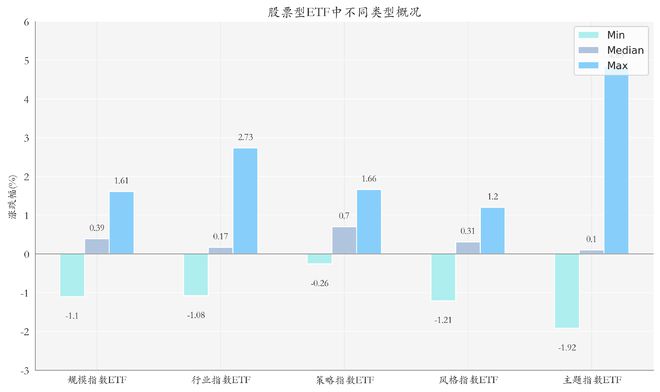
Market Overview - The Shanghai Composite Index rose by 0.21% to close at 3387.57 points, with a daily high of 3394.75 points [1] - The Shenzhen Component Index increased by 0.44% to close at 10294.22 points, reaching a high of 10325.92 points [1] - The ChiNext Index saw a rise of 0.83%, closing at 2065.39 points, with a peak of 2077.48 points [1] ETF Market Performance - The median return of stock ETFs was 0.29%, with the highest return from the ICBC Credit Suisse Shenzhen 100 ETF at 1.61% [2] - The highest performing industry ETF was the Penghua National Securities Nonferrous Metals Industry ETF, which returned 2.73% [2] - The highest return among thematic ETFs was from the Huaxia CSI Hong Kong-Shenzhen Gold Industry ETF at 4.85% [2] ETF Gain and Loss Rankings - The top three ETFs by gain were: - Huaxia CSI Hong Kong-Shenzhen Gold Industry ETF (4.85%) - Yongying CSI Hong Kong-Shenzhen Gold Industry ETF (4.63%) - Ping An CSI Hong Kong-Shenzhen Gold Industry ETF (4.51%) [4][5] - The top three ETFs by loss were: - Guotai MSCI China A-Shares ESG General ETF (-1.92%) - Guoshou Anbao National Securities ChiNext Mid-Cap Selected 88 ETF (-1.21%) - ICBC Credit Suisse National Securities Semiconductor Chip ETF (-1.19%) [4][5] ETF Fund Flow - The top three ETFs by fund inflow were: - Fortune CSI Military Leading ETF (inflow of 473 million yuan) - Penghua CSI National Defense ETF (inflow of 443 million yuan) - Guotai CSI Military ETF (inflow of 430 million yuan) [6][7] - The top three ETFs by fund outflow were: - Huaxia CSI A500 ETF (outflow of 764 million yuan) - Huatai-PB CSI 300 ETF (outflow of 655 million yuan) - Huaxia ChiNext 50 ETF (outflow of 377 million yuan) [6][7] ETF Margin Trading Overview - The top three ETFs by margin buying were: - Huaxia Shanghai Stock Exchange Sci-Tech Innovation Board 50 ETF (358 million yuan) - Huatai-PB CSI 300 ETF (215 million yuan) - E Fund CSI 300 Medical Health ETF (159 million yuan) [8][9] - The top three ETFs by margin selling were: - Southern CSI 500 ETF (29.72 million yuan) - Huatai-PB CSI 300 ETF (28.99 million yuan) - Huaxia Shanghai Stock Exchange 50 ETF (9.35 million yuan) [8][9] Institutional Insights - Founder Securities suggests that gold prices are expected to maintain a long-term upward trend after a phase of correction, driven by factors such as declining dollar credit and ongoing global central bank gold purchases [10] - China Galaxy indicates that A-share gold stocks are currently at a near 10-year low valuation, presenting potential investment opportunities as gold prices rise [11]