
平安银行

Search documents
买买买!险资,持续加仓股市!
证券时报· 2025-11-03 09:00
Core Viewpoint - Insurance capital has entered a "buying" mode in equity investments, significantly increasing their holdings in A-shares as evidenced by the third-quarter reports of listed companies [1][3]. Group 1: Insurance Capital Investment Trends - As of the end of the third quarter, the number of A-shares held by insurance institutions increased by 19% compared to the end of the previous year, with the market value of these holdings rising by 18% [1][3]. - In the third quarter alone, the number of A-shares held by insurance capital grew by 14% compared to the previous quarter, with a total market value exceeding 650 billion yuan [3][6]. - Financial stocks remain a cornerstone of insurance capital investments, with their market value exceeding 300 billion yuan, accounting for nearly 50% of total holdings [3][4]. Group 2: New Investments and Sector Focus - Over 300 new stocks were added to the insurance capital's heavy holdings in the third quarter, with a total market value of over 100 billion yuan [5][6]. - The manufacturing sector accounted for the highest proportion of new investments, with over 200 new stocks and a market value exceeding 45 billion yuan [6]. - Significant new investments were also made in strategic emerging industries and high-tech manufacturing, including sectors like semiconductors and medical devices [6]. Group 3: Performance and Returns - The increase in equity investments has led to substantial returns, contributing to record-high profits for several insurance companies in the third quarter [7][8]. - For instance, China Life reported a net profit of 167.8 billion yuan for the first three quarters, a year-on-year increase of 60.5%, driven by a total investment income of 368.6 billion yuan [8]. - New China Life also saw a net profit increase of 58.9%, with a total investment income reflecting a significant growth trend in the capital market [8].





股份制银行板块11月3日涨1.41%,招商银行领涨,主力资金净流入6.63亿元
Zheng Xing Xing Ye Ri Bao· 2025-11-03 08:43
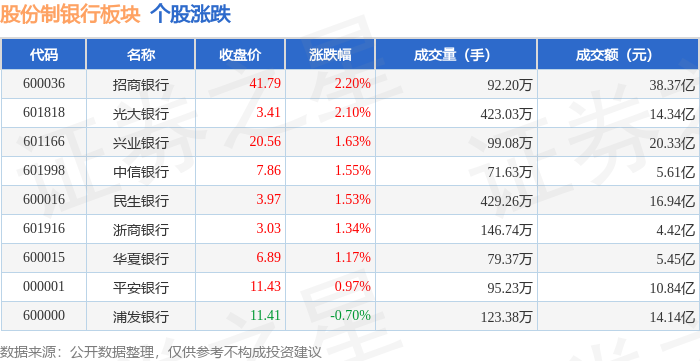
Group 1 - The banking sector saw an increase of 1.41% on November 3, with China Merchants Bank leading the gains [1] - The Shanghai Composite Index closed at 3976.52, up 0.55%, while the Shenzhen Component Index closed at 13404.06, up 0.19% [1] - Major banks such as China Merchants Bank and Everbright Bank reported significant price increases of 2.20% and 2.10% respectively [1] Group 2 - The banking sector experienced a net inflow of 663 million yuan from institutional investors, while retail investors saw a net outflow of 222 million yuan [1] - China Merchants Bank had a net inflow of 2.41 billion yuan from institutional investors, indicating strong institutional interest [1] - Everbright Bank and Minsheng Bank also attracted significant institutional inflows of 1.47 billion yuan and 1.10 billion yuan respectively [1]




多家国有大行暂停黄金积存业务
Sou Hu Cai Jing· 2025-11-03 08:36
Core Viewpoint - Major Chinese banks, including Industrial and Commercial Bank of China (ICBC) and China Construction Bank (CCB), have suspended new gold accumulation business due to macroeconomic policy changes and risk management requirements, impacting various gold investment products and services [1][2]. Group 1: Bank Actions - ICBC has halted the acceptance of new accounts for its "Ruyi Gold Accumulation" program, along with new accumulation plans and physical gold withdrawals, while existing plans will continue to be executed normally [1]. - CCB has suspended real-time purchases and new investment plans for its "Easy Gold" service, as well as physical gold exchanges, but existing customers can still redeem and close accounts [1]. - Other banks, such as Industrial Bank and Ping An Bank, have already raised the minimum investment amounts for gold accumulation products in response to increased trading activity and gold price volatility [2]. Group 2: Tax Policy Changes - A significant change in gold tax policy was announced, effective from November 1, 2025, which aims to optimize the VAT arrangements for gold transactions and clarify the distinction between investment and non-investment uses [2]. - The new tax policy is expected to promote more transparent and regulated gold trading, reducing gray market activities and increasing compliance costs [2]. Group 3: Market Reactions - The international gold price has seen significant fluctuations, with a year-to-date increase exceeding 50%, while domestic gold prices also reached historical highs before experiencing corrections [3]. - Following the announcements from banks, gold retail stocks in Hong Kong and A-share markets faced declines, indicating market sensitivity to these changes [3][4]. Group 4: Risk Management Objectives - The banks' decision to pause new business is aimed at managing three key risks: reducing immediate inventory and delivery pressures during extreme volatility, allowing time for compliance with new tax regulations, and mitigating the impact of emotional trading on business operations [4]. - The new tax policy is expected to enhance the advantages of standardized gold products, leading to a potential rebalancing of channels among banks, platforms, and investors [4]. Group 5: Investor Guidance - Investors are advised to adopt a cautious approach by avoiding high-risk positions and considering gold as a hedging component in their portfolios, while prioritizing compliance and clarity in product offerings [6]. - The current restrictions on new accounts and physical withdrawals may lead to temporary adjustments in trading parameters and potential delays in transactions [6]. Group 6: Future Observations - Key points to monitor include whether more banks will follow suit in suspending new accounts, the impact of the new tax policy on different gold trading channels, and the evolution of price and trading structures in the gold market [8].


42家上市银行信披考评出炉:22家获A,光大、华夏和浙商银行提级
2 1 Shi Ji Jing Ji Bao Dao· 2025-11-03 08:21
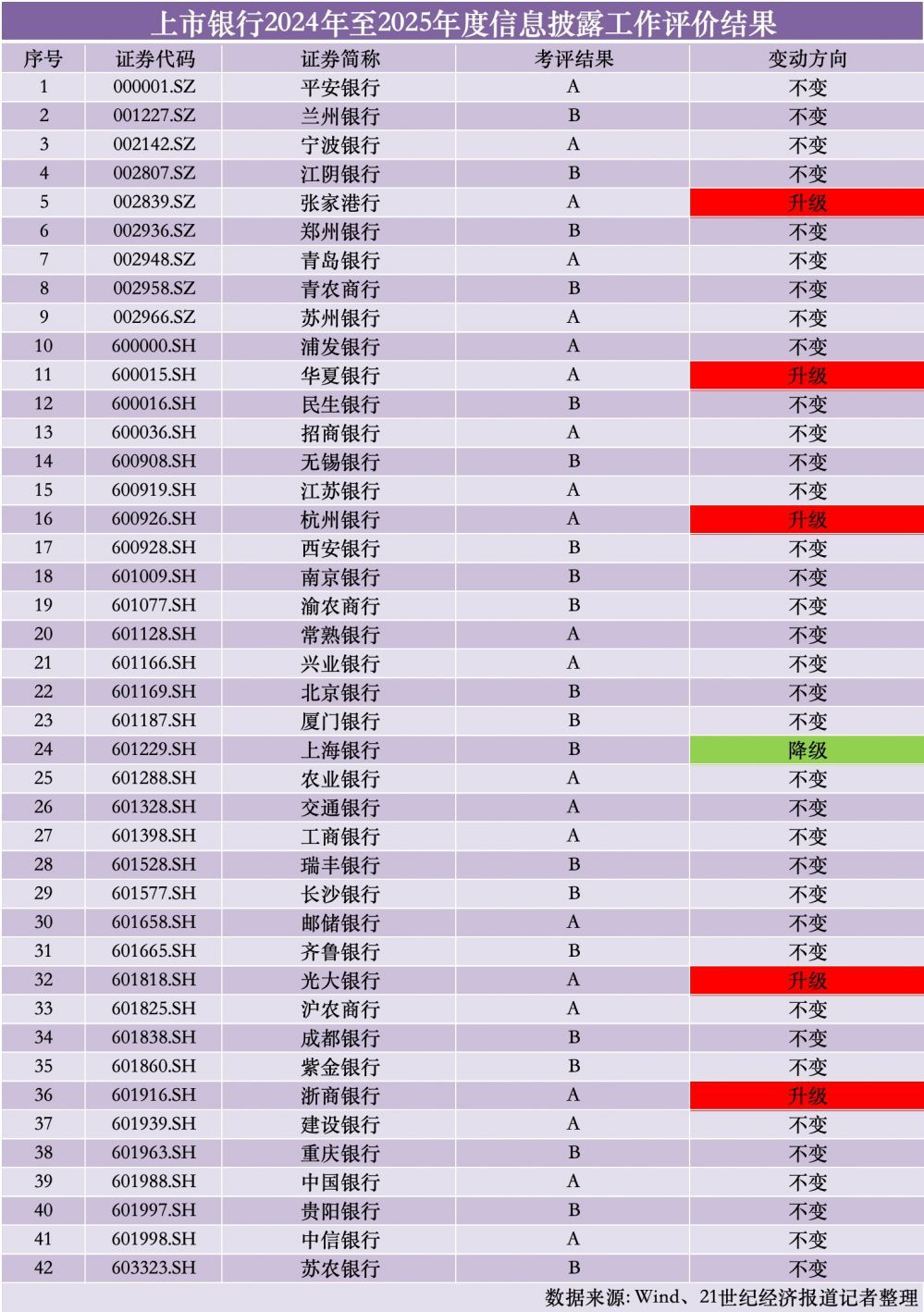
Core Insights - The recent disclosure evaluation results for listed banks in China for the 2024-2025 period show that all listed banks received ratings of B or above, with 22 banks rated A, indicating a strong performance in information disclosure [1] Summary by Category Overall Ratings - All listed banks achieved a rating of B or higher, with 22 banks rated A, reflecting consistent performance compared to the previous year [1] - Only six banks experienced rating changes, with five banks improving their ratings and one bank, Shanghai Bank, experiencing a downgrade [1] Banks with Rating Changes - The following banks improved their ratings: - Zhangjiagang Bank - Hangzhou Bank - Huaxia Bank - Everbright Bank - Zhejiang Commercial Bank [1] - Shanghai Bank was the only bank to see a downgrade in its rating [1] Detailed Ratings - A selection of banks and their ratings includes: - Ping An Bank: A - Ningbo Bank: A - Agricultural Bank of China: A - Industrial and Commercial Bank of China: A - Shanghai Bank: B (downgraded) [2]




中方决定恢复中国公民赴加拿大团队游业务
21世纪经济报道· 2025-11-03 08:15
Group 1 - The Chinese government has decided to resume the operation of group tours for Chinese citizens to Canada, considering the demand for outbound travel and the local tourism environment [1] - This decision is expected to enhance personnel exchanges between China and Canada, fostering mutual understanding and friendship between the two nations [1] - The Chinese side expresses willingness to work with Canada to provide more conveniences for personnel exchanges and hopes Canada will reciprocate by ensuring a safe and comfortable travel environment for Chinese tourists [1] Group 2 - The storage and photovoltaic sectors are showing strength, with stocks related to Jay Chou rising over 10%, while gold stocks are experiencing adjustments [2] - Industrial and Commercial Bank of China has suspended certain gold accumulation services, with other banks like Industrial Bank, Ping An Bank, and Bank of China also taking similar actions [2] - Ten significant policies have been released concerning personnel exchanges between Hong Kong, Macau, Taiwan, and the mainland [2]

中方决定对瑞典免签
21世纪经济报道· 2025-11-03 08:15
Group 1 - The Chinese government has decided to extend the visa-free policy for France and other countries until December 31, 2026 [1] - China will implement a visa-free policy for Sweden from November 10, 2025, to December 31, 2026 [1] Group 2 - The storage and photovoltaic sectors are showing strong performance, with stocks related to Jay Chou rising over 10% [2] - Industrial and commercial banks have suspended certain gold accumulation services, with several banks including Industrial and Commercial Bank of China, Industrial Bank, Ping An Bank, and Bank of China taking action [2] - Ten significant policies have been released concerning personnel exchanges between Hong Kong, Macau, and Taiwan [2]

上市银行中收回暖
券商中国· 2025-11-03 08:06
Core Viewpoint - The net income from fees and commissions of listed banks is gradually recovering this year due to factors such as economic improvement, consumer spending, and a rebound in capital markets [1][2]. Group 1: Revenue Growth - In the first three quarters, the net income from fees and commissions of A-share listed banks totaled 578.2 billion yuan, representing a year-on-year growth of 4.60%, an increase of 1.5 percentage points from the 3.1% growth in the first half of the year [3]. - The number of listed banks with positive year-on-year growth in net income from fees and commissions has expanded to 27, up from 20 in the first quarter and 25 in the second quarter [3]. - In contrast to previous years where many banks experienced negative growth, the trend has shifted this year, with only 22 banks expected to show negative growth in the first quarter of 2025, compared to over 30 in 2023 and 2024 [3]. Group 2: Contribution to Revenue - The improvement in net income from fees and commissions has positively supported overall revenue, effectively offsetting pressures from other revenue sources [7]. - A-share listed banks saw a year-on-year revenue growth of 0.7%, with net income from fees and commissions being a key contributor alongside scale and interest margin [7]. Group 3: Breakdown by Bank Type - Among different types of banks, the growth rates for net income from fees and commissions in the first three quarters were 5.9% for state-owned banks, 1.3% for joint-stock banks, 8.8% for city commercial banks, and 3.9% for rural commercial banks, with city and rural banks showing more significant improvements [6]. Group 4: Wealth Management Performance - The recovery in net income from fees and commissions is largely driven by the rebound in capital markets, which has boosted wealth management income [11]. - For instance, Shanghai Bank reported a 7.78% quarter-on-quarter growth in wealth management income, with significant increases in insurance and fund sales [12]. - The focus on expanding retail wealth management has been emphasized by banks, with some reporting substantial growth in their agency business and overall asset management [12][13].

工行暂停部分黄金积存业务,兴业银行、平安银行、中行等已行动
2 1 Shi Ji Jing Ji Bao Dao· 2025-11-03 05:45
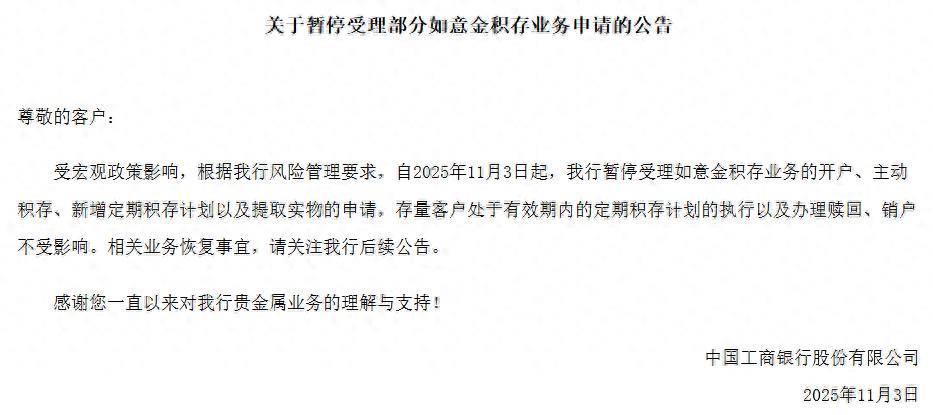
11月3日,工商银行(601398)发布关于暂停受理部分如意金积存业务申请的公告,受宏观政策影响, 根据工商银行风险管理要求,自2025年11月3日起,工商银行暂停受理如意金积存业务的开户、主动积 存、新增定期积存计划以及提取实物的申请,存量客户处于有效期内的定期积存计划的执行以及办理赎 回、销户不受影响。相关业务恢复事宜,请关注工商银行后续公告。 二是重点强化交易所场内交易的税收优惠,引导黄金交易向规范市场集中。 三是明确区分黄金投资性与非投资性用途,同时规范发票管理与合规要求,进一步厘清不同场景下的黄 金交易规则。 受此消息影响,今日(11月3日)早盘黄金零售股出现明显的下跌,港股中六福集团的跌幅最大,早盘 收跌8.44%,周大福跌7.8%;A股潮宏基(002345)逼近跌停,周大生(002867)跌超近4%,曼卡龙 (300945)、老凤祥跌约3%。 如意金积存业务是工商银行推出的一款黄金投资业务,简单来说,就是投资者(甲方)在工行(乙方) 开立专门账户,通过买入工行指定黄金产品并存放,后续可选择提取实物黄金或赎回的业务。 就在工行暂停部分如意积存业务前两天,11月1日,财政部、税务总局联合发布《关于黄 ...
工行暂停部分黄金积存业务,兴业银行、平安银行、中行等已行动
21世纪经济报道· 2025-11-03 05:40
Core Viewpoint - The recent announcement by Industrial and Commercial Bank of China (ICBC) to suspend certain gold accumulation business applications is influenced by macroeconomic policies and risk management requirements, indicating a shift in the banking sector's approach to gold investment products [1][2]. Group 1: ICBC's Announcement - ICBC will suspend the acceptance of new applications for its "Ruyi Gold Accumulation" business starting November 3, 2025, while existing customers can continue their plans without interruption [1]. - The "Ruyi Gold Accumulation" business allows investors to open accounts with ICBC to buy and store designated gold products, with options for physical withdrawal or redemption [1]. Group 2: Tax Policy Changes - On November 1, 2025, the Ministry of Finance and the State Administration of Taxation announced new tax policies for gold, effective until December 31, 2027, aimed at optimizing VAT policies, enhancing tax incentives for exchange trading, and clarifying regulations for different gold transaction scenarios [2]. - Following the announcement, gold retail stocks experienced significant declines, with notable drops in companies like Luk Fook Holdings and Chow Tai Fook [2]. Group 3: Banking Sector Adjustments - Several banks have already begun adjusting their gold accumulation business in response to rising gold prices, with increased minimum investment thresholds implemented by various institutions since October [4][5]. - For instance, ICBC raised its minimum investment amount from 850 RMB to 1000 RMB, while other banks like Ping An Bank and China Bank also adjusted their minimum investment amounts upwards [5]. Group 4: Market Reactions and Investor Behavior - The high volatility in gold prices has led to increased caution among investors, with platforms like Ant Wealth advising diversification and risk management strategies [6][8]. - As of November 3, 2023, gold prices have surged over 53% since the beginning of the year, prompting institutions to warn investors about potential short-term corrections [8].

寻找绩优股:2026年银行业年度策略
GUOTAI HAITONG SECURITIES· 2025-11-03 05:20
Investment Rating - The report indicates a cautious outlook on the credit growth rate, suggesting a shift towards quality improvement, with expectations for a recovery in corporate loan increments by 2026 [5][9]. Core Insights - Credit growth is expected to slow significantly starting in 2024, but the decline in growth rate is anticipated to moderate by 2026, with corporate loans likely to see a year-on-year increase [7][9]. - The relationship between credit growth and economic growth is weakening, emphasizing the need to optimize credit structure and reduce idle financial resources [9]. - The report highlights that the banking sector's total asset growth will outpace loan growth in 2025, driven by government bond supply and fiscal policies [9]. Summary by Sections Credit Growth Forecast - New RMB loans are projected at 21.3 trillion, 23.6 trillion, and 18.9 trillion yuan for 2022, 2023, and 2024 respectively, with a further estimate of 14.7 trillion yuan for the first three quarters of 2025 [9]. - For 2026, new loans are expected to be between 17.2 trillion and 17.7 trillion yuan, corresponding to a growth rate of 6.3% to 6.5% [9]. Loan Composition - In 2023, the total RMB loans are expected to reach 237.59 trillion yuan, with a year-on-year growth rate of 10.6% [8]. - Retail loans are projected to grow from 80.10 trillion yuan in 2023 to 82.84 trillion yuan in 2024, reflecting a growth rate decline from 5.7% to 3.4% [8]. - Corporate loans are anticipated to increase from 157.07 trillion yuan in 2023 to 171.01 trillion yuan in 2024, with a growth rate of 12.7% [8]. Regional Performance - Regions such as Jiangsu, Zhejiang, Sichuan, and Shandong are expected to continue outperforming the national average in loan growth due to strong economic performance and support from new policy financial tools [12]. Banking Sector Dynamics - The report notes that state-owned banks are expected to maintain a competitive edge due to lower funding costs and capital injections from the Ministry of Finance [12]. - The net interest margin is in a downward trend, but the rate of decline is expected to slow starting in 2025, with some smaller banks potentially stabilizing their margins by 2026 [13][17]. Asset Quality - As of Q2 2025, the non-performing loan (NPL) ratio for listed banks is reported at 1.25%, indicating a stable asset quality despite pressures on retail credit [37]. - The report emphasizes that while retail loan NPLs have increased since 2021, corporate loan clearances have improved significantly, providing a buffer against retail risks [37].




