
Samsung

Search documents
每周观察 | 2Q25前五大企业级SSD品牌厂营收;二季度全球智能手机生产总数达3亿支;Micro LED芯片市场;牵引逆变器…
TrendForce集邦· 2025-09-13 02:04
Group 1: Enterprise SSD Market - The revenue of the top five enterprise SSD brands reached over $5.1 billion in Q2 2025, showing a quarter-over-quarter increase of 12.7% [2][3] - Samsung led the market with a revenue of $1,899 million, holding a market share of 34.6%, although it experienced a slight increase of 0.5% compared to the previous quarter [3] - SK Group (SK hynix + Solidigm) saw significant growth with a revenue increase of 47.1%, reaching $1,461.7 million and capturing a market share of 26.7% [3] Group 2: Smartphone Production - Global smartphone production reached 300 million units in Q2 2025, reflecting a quarter-over-quarter increase of approximately 4% and a year-over-year increase of 4.8% [4][5] - Oppo and Transsion brands contributed to the recovery in production after inventory adjustments, indicating a positive trend in the market despite ongoing economic challenges [4] Group 3: Micro LED Technology - The penetration of Micro LED technology in consumer electronics is accelerating, with significant products like the Garmin Fenix 8 Pro smartwatch expected to adopt this technology by 2025 [7] - The Micro LED chip market is projected to grow to $461 million by 2029, driven by the introduction of key products in various sectors [7] Group 4: Electric Vehicle Inverter Market - The global installation of electric vehicle traction inverters reached 7.66 million units in Q2 2025, marking a year-over-year increase of 19% [10] - Battery Electric Vehicles (BEVs) accounted for 52% of the installed inverters, surpassing hybrid vehicles for the second consecutive quarter [10]



2 ‘Pick and Shovel’ Stocks to Buy as the AI Boom Keeps Raging On
Yahoo Finance· 2025-09-12 16:11
Group 1 - The AI boom has significantly benefited semiconductor and software companies, but other essential industries are also crucial for AI development [1][2] - Memory chips, cooling systems, and wafer tools are becoming bottlenecks that will determine the growth rate of the AI industry [2] - DRAM and NAND flash are identified as key bottlenecks, with expectations of undersupply through at least 2026 due to production discipline and increasing data-center demand [3] Group 2 - Micron Technology (MU) is positioned to benefit from the shift in AI companies from training to inferencing, requiring massive amounts of data [5][6] - Micron is the only major domestic producer of DRAM and NAND flash, with a significant market share, benefiting from tariffs on foreign competition [6] - MU stock has surged by 18.8% in the past five days, with Q3 FY 2025 revenue growing 15% sequentially and 37% year-over-year to $9.3 billion, primarily driven by DRAM and NAND flash sales [7]
集邦咨询:受季节性需求带动 第二季全球智能手机生产总数达3亿支 季增约4%
Zhi Tong Cai Jing· 2025-09-12 05:40
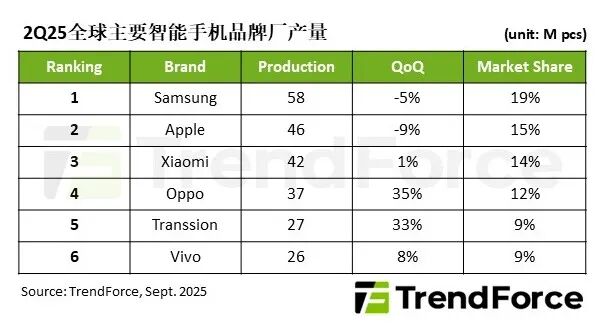
Core Insights - Global smartphone production is projected to reach 300 million units in Q2 2025, driven by seasonal demand and recovery in brands like Oppo and Transsion after inventory adjustments, reflecting a quarter-on-quarter increase of approximately 4% and a year-on-year increase of 4.8% [1] - Despite ongoing economic challenges affecting consumer spending, traditional peak seasons and e-commerce promotions in the second half of the year are expected to support a gradual increase in production throughout the year [1] Production and Market Share - Samsung remains the largest producer with 58 million units, experiencing a quarter-on-quarter decrease of 5%, holding a market share of 19% [2][4] - Apple produced 46 million units, down 9% quarter-on-quarter, but up 4% year-on-year, maintaining a market share of 15% [2][4] - Xiaomi's production totaled 42 million units, showing a slight increase of 1% quarter-on-quarter, with a market share of 14% [2][4] - Oppo's production surged to 37 million units, reflecting a significant quarter-on-quarter increase of 35%, capturing a market share of 12% [2][4] - Transsion produced over 27 million units, marking a 33% increase quarter-on-quarter and a year-on-year growth of 15.7%, with a market share of 9% [2][5] - Vivo's production reached 26 million units, up 8% quarter-on-quarter, also holding a market share of 9% [2][5] Market Dynamics - The Chinese smartphone subsidy policy has temporarily boosted sales of mid-range products and aided in inventory reduction, but its overall impact on annual sales for 2025 is expected to be limited due to constraints on subsidy amounts and product coverage [1] - The top six brands collectively maintain a stable market share of around 80% [4]
Lennox International (NYSE:LII) FY Conference Transcript
2025-09-11 21:52
Summary of Lennox International FY Conference Call (September 11, 2025) Company Overview - **Company**: Lennox International (NYSE:LII) - **Industry**: Residential and light commercial HVAC (Heating, Ventilation, and Air Conditioning) Key Points and Arguments Competitive Advantages - **Direct-to-Contractor Distribution Model**: This model allows Lennox to operate as both a manufacturer and distributor, enhancing profitability through dual margins [3][4] - **Focus on Contractor Support**: Emphasis on fulfillment rates, technical support, and training for contractors to improve their efficiency and market share [4][5] Market Dynamics - **Sell-Through vs. Sell-In**: 75% of sales are direct to contractors (sell-through), while 25% are sell-in. The company has noted volatility in sell-in due to various market pressures [11][12] - **Temporary Market Inflection**: Current challenges are seen as temporary, with expectations of a return to disciplined growth in the long term [12][14] Product Innovation and Technology - **Investment in R&D**: All R&D efforts are focused on HVAC, leading to superior product efficiency across various categories [6][7] - **AI Integration**: AI is being used to enhance customer experience on e-commerce platforms and improve technician support through apps [27][28] M&A Strategy - **Acquisition of NSI Industries**: This acquisition aims to enhance Lennox's parts and accessories offerings, which currently represent 20% of sales, with a goal to reach 40% [29][30] - **Future M&A Plans**: The company intends to pursue further acquisitions in the aftermarket to bolster its distribution capabilities [33] Market Challenges - **Regulatory Changes and Tariffs**: The company is navigating challenges related to tariffs and regulatory changes affecting inventory and pricing strategies [11][41] - **Consumer Sentiment**: Homeowners are currently hesitant due to economic uncertainty, but the company believes that HVAC systems are essential, leading to eventual replacements [16][52] Growth Outlook - **Positive Trajectory in Light Commercial**: The company is seeing recovery in share and growth in emergency replacement initiatives, supported by new factory capacity [18][21] - **Ductless and Water Heater Opportunities**: The company anticipates significant growth in ductless systems and plans to launch water heaters, which are expected to converge with HVAC technologies in the future [47][48] Pricing Strategy - **Rational Pricing Environment**: The industry has maintained rational pricing despite cost pressures, with expectations for price increases in the upcoming year [45][46] Dealer Relationships - **Long-Term Relationships**: The company emphasizes the importance of long-term relationships with dealers, which helps maintain market share and stability [10][53] Additional Important Insights - **Technological Integration**: The company is working on integrating various products into a unified app for easier management by dealers and homeowners [24][25] - **Market Sentiment**: Dealers express confidence in the long-term necessity of HVAC systems despite current market challenges [53][54]

SoundHound AI (NasdaqGM:SOUN) FY Conference Transcript
2025-09-11 20:02
Summary of SoundHound AI FY Conference Call Company Overview - **Company**: SoundHound AI (NasdaqGM:SOUN) - **Date of Conference**: September 11, 2025 - **Industry**: Voice AI and Conversational AI Key Points Technological Differentiation - SoundHound AI's foundation model, Polaris, demonstrates significant technological differentiation with 30% to 40% better accuracy compared to competitors like OpenAI's Whisper and Google [3][4] - Polaris is designed for various environments, including automotive and restaurant sectors, allowing for deployment with lower costs and smaller hardware footprints [4][6] Market Strategy and Acquisitions - The acquisition of Interactions, valued at $60 million upfront, aims to enhance growth potential and customer relationships [12][13] - Interactions has a strong customer base and a patent portfolio that complements SoundHound AI's technology, facilitating faster scaling [11][12] Growth in Conversational AI - The market for conversational AI is rapidly expanding, with a shift towards natural language interactions [8][9] - Voice AI is seen as a "killer app" that will transform human-machine interactions, particularly in customer service environments [9][10] Financial Performance and Projections - SoundHound AI has a bookings backlog exceeding $1 billion, indicating substantial growth potential within existing customer bases [41][42] - The company anticipates strong double-digit growth in the long term, driven by ongoing innovations and market penetration [43][44] Industry Dynamics - The automotive sector is experiencing a shift towards electric vehicles (EVs), which allows for faster deployment of SoundHound AI's solutions [24][26] - The restaurant sector has seen significant deployments, with approximately 14,000 locations utilizing SoundHound AI's technology [28][32] Customer Engagement and Revenue Models - Customers are increasingly focused on both cost savings and revenue uplift through AI solutions, with a dual emphasis on efficiency and upselling opportunities [34][35] - The company is exploring new revenue models, including voice commerce, which integrates restaurant and automotive sectors [36][38] Competitive Landscape - SoundHound AI positions itself against legacy providers and larger tech companies, emphasizing its unique technological capabilities and market focus [32][41] - The company is optimistic about capturing a larger share of the market, particularly in the restaurant and automotive sectors, where it sees substantial growth opportunities [27][33] Future Outlook - SoundHound AI is optimistic about its growth trajectory, with plans to leverage acquisitions and existing customer relationships to drive future success [42][43] - The company is focused on expanding its product offerings and enhancing customer engagement to sustain growth [41][44]

Future iPhones Could Cost $2,000
Bloomberg Technology· 2025-09-11 19:50
Pricing Strategy & Market Trends - Apple is potentially preparing the market for a $2,000 iPhone, evidenced by the iPhone 17 Pro Max with 2 terabytes of storage already reaching this price point in the US [1] - The industry anticipates the era of $2,000 phones is approaching, with competitors like Samsung already offering foldable phones at this price [2][4] - Tariffs are expected to impact Apple's pricing strategy, potentially leading to price increases to maintain margins [3] - Apple's first foldable phone is projected to launch at a base price of $2,000 within the next 12 months [4][5] - The 20th-anniversary iPhone in 2027 is expected to feature advanced technologies and higher prices, similar to the iPhone X launch in 2017 [5] - The $2,000 iPhone tier may become commonplace within the next 12-24 months [6] Product Design & Sales - New iPhone designs, such as the orange color and unibody, are expected to drive sales, despite potentially limited functional differences [7][8] - Pent-up demand from consumers who have held onto their iPhones for 4-5 years due to lack of design changes is anticipated to boost sales [8] Analyst Sentiment - Some Wall Street analysts express a lack of excitement regarding Apple's current offerings [7]

ARM's 11% Rise in Three Months: Should You Buy, Hold, or Sell?
ZACKS· 2025-09-11 16:50
Core Insights - ARM Holdings plc (ARM) shares have increased by 11% over the last three months, underperforming the semiconductor industry's 20% growth, raising questions about the stock's near-term prospects [1] Group 1: Market Position and Competitive Advantage - ARM's power-efficient chip architectures are crucial for its leadership in mobile computing, powering devices from major companies like Apple, Qualcomm, and Samsung, which solidifies ARM's role in modern mobile technology [2] - The demand for high performance with low power consumption continues to drive ARM's dominance in smartphones and tablets, with Apple, Qualcomm, and Samsung relying on ARM's designs for their products [2] Group 2: Growth Opportunities - ARM is becoming a significant player in the AI and IoT sectors, with industry leaders increasingly depending on its energy-efficient architecture for AI-driven innovations across various applications [3] - ARM's chips are designed to meet the rising demand for embedded AI models, with major companies like Apple and Qualcomm enhancing their AI capabilities using ARM technology [3] Group 3: Challenges and Risks - ARM has underperformed compared to the semiconductor industry, facing challenges from rising RISC-V adoption in China, which poses a competitive threat to its market position [5][6] - The Chinese government's promotion of RISC-V development could accelerate the shift away from ARM technologies, impacting ARM's growth in its second-largest market [6] - Analyst sentiment has turned cautious, with four downward revisions to ARM's fiscal 2026 earnings estimates over the past 60 days, indicating concerns about the company's ability to meet expectations [7] Group 4: Financial Metrics and Valuation - The Zacks Consensus Estimate for ARM's earnings has decreased by 2% over the past 60 days, suggesting potential revenue or margin softness [8] - ARM's stock is currently trading at a premium, with a forward P/E ratio of approximately 79.61, significantly higher than the industry average of 39.63 [9] - The trailing 12-month EV-to-EBITDA ratio for ARM is around 124.33, far exceeding the industry's average of 22.32, indicating valuation concerns [9]


Silksong on Android is now a reality, no port required! #TITW
The Verge· 2025-09-11 15:45
Silk Song on Android. This isn't a trick. Today, I'm toying with an actual PC game on my Galaxy S25, and it's so easy to set up that anyone can do it.Again, I'm not streaming this game. I actually installed my Steam copy of Silkong on my phone, complete with my SteamCloud saves. I'm using a Windows emulator called GameHub from Gamepad Maker Game Ser, which just added SteamCloud saves for the very first time.You won't find this app on Google Play, but once you install and log into Steam, it installs the righ ...
Amazon demands proof of authenticity from electronics sellers
Ecommerce News· 2025-09-11 13:53
Core Points - Amazon has implemented new verification requirements for electronics sellers to prove their products come from authorized suppliers, effective September 17, 2025 [1][3] - Sellers must submit recent invoices and detailed supplier information, impacting numerous well-known brands and potentially affecting many sellers [2][3] - The new rules have raised concerns among sellers regarding unclear communication and the risk of losing product listings if documentation is not provided [4][5] Seller Requirements - Sellers are required to submit invoices dated within the last 180 days that include at least 100 units, along with full supplier details [2] - Acceptable document formats include PDF, JPG, PNG, or GIF, and the rules apply across several European countries [2] Impact on Brands and Retailers - The requirement affects major brands such as Samsung, Dyson, Canon, Philips, HP, Sony, and Panasonic, with many sellers potentially facing warnings [3] - Retailers unable to provide the necessary documentation risk losing their product listings, which may lead to the return, destruction, or donation of existing inventory [5] Customer Complaints and Company Justification - Amazon's verification requirement aims to ensure the availability of safe and authentic products, responding to customer complaints regarding product authenticity [6] - The company emphasizes the need for sellers to demonstrate a reliable supply chain to meet these new requirements [6]


又一次巨大飞跃: The Rubin CPX 专用加速器与机框 - 半导体分析
2025-09-11 12:11
Summary of Nvidia's Rubin CPX Announcement Company and Industry - **Company**: Nvidia - **Industry**: Semiconductor and GPU manufacturing, specifically focusing on AI and machine learning hardware solutions Key Points and Arguments 1. **Introduction of Rubin CPX**: Nvidia announced the Rubin CPX, a GPU optimized for the prefill phase of inference, emphasizing compute FLOPS over memory bandwidth, marking a significant advancement in AI processing capabilities [3][54] 2. **Comparison with Competitors**: The design gap between Nvidia and competitors like AMD has widened significantly, with AMD needing to invest heavily to catch up, particularly in developing their own prefill chip [5][6] 3. **Technical Specifications**: The Rubin CPX features 20 PFLOPS of FP dense compute and only 2 TB/s of memory bandwidth, utilizing 128 GB of GDDR7 memory, which is less expensive compared to HBM used in previous models [9][10][17] 4. **Rack Architecture**: The introduction of the Rubin CPX expands Nvidia's rack-scale server offerings into three configurations, allowing for flexible deployment options [11][24] 5. **Cost Efficiency**: By using GDDR7 instead of HBM, the Rubin CPX reduces memory costs by over 50%, making it a more cost-effective solution for AI workloads [17][22] 6. **Disaggregated Serving**: The Rubin CPX enables disaggregated serving, allowing for specialized hardware to handle different phases of inference, which can improve efficiency and performance [54][56] 7. **Impact on Competitors**: The announcement is expected to force Nvidia's competitors to rethink their roadmaps and strategies, as failing to release a comparable prefill specialized chip could lead to inefficiencies in their offerings [56][57] 8. **Performance Characteristics**: The prefill phase is compute-intensive, while the decode phase is memory-bound. The Rubin CPX is designed to optimize performance for the prefill phase, reducing waste associated with underutilized memory bandwidth [59][62] 9. **Future Roadmap**: The introduction of the Rubin CPX is seen as a pivotal moment that could reshape the competitive landscape in the AI hardware market, pushing other companies to innovate or risk falling behind [56][68] Other Important but Possibly Overlooked Content 1. **Memory Utilization**: The report highlights the inefficiencies in traditional systems where both prefill and decode phases are processed on the same hardware, leading to resource wastage [62][66] 2. **Cooling Solutions**: The new rack designs incorporate advanced cooling solutions to manage the increased power density and heat generated by the new GPUs [39][43] 3. **Modular Design**: The new compute trays feature a modular design that enhances serviceability and reduces potential points of failure compared to previous designs [50][52] 4. **Power Budget**: The power budget for the new racks is significantly higher, indicating the increased performance capabilities of the new hardware [29][39] This summary encapsulates the critical aspects of Nvidia's announcement regarding the Rubin CPX, its implications for the industry, and the technical advancements that set it apart from competitors.