
OpenAI

Search documents
AI淘金热变成AI恐慌潮!华尔街新共识:躲开一切可能被颠覆的公司
硬AI· 2026-02-11 08:40
Core Viewpoint - Investors are shifting from seeking AI winners to rapidly selling stocks of companies that may be disrupted by AI, leading to a panic selling mentality across various sectors, including software, financial services, wealth management, insurance brokerage, and legal services [2][3]. Group 1: Market Reaction to AI Disruption - The latest wave of selling was triggered by the launch of a tax strategy tool, Hazel, by Altruist Corp., which caused significant stock price drops of over 7% for wealth management firms like Charles Schwab, Raymond James Financial Inc., and LPL Financial Holdings Inc., marking the largest decline since the market crash in April [3][5]. - The panic began when Anthropic introduced a new tool that led to a deep correction in software, financial services, asset management, and legal services sectors, indicating a turning point in market sentiment [6][8]. - The insurance brokerage sector was also heavily impacted after Insurify launched a new application using ChatGPT to compare auto insurance rates, resulting in substantial stock losses for U.S. insurance brokers [6][8]. Group 2: Concerns Over AI's Impact - The introduction of AI tools like Hazel highlights deep-seated anxieties about AI disrupting traditional financial services, as these tools can perform tasks that typically require entire teams, with costs as low as $100 per month [5][6]. - Market participants are increasingly concerned that any intermediary services that could be replaced by AI face existential threats, leading to widespread selling [6][8]. Group 3: Diverging Market Opinions - Despite the prevailing panic, some market analysts express skepticism about the speed and extent of AI disruption, suggesting that technological upheaval often takes longer to materialize than anticipated [8]. - Historical context indicates that industries like banking have faced challenges from emerging technologies, such as cryptocurrencies and electronic services, but these have not significantly undermined their dominance [8]. Group 4: Market Sensitivity and Valuation Concerns - The current sell-off reflects broader anxieties regarding elevated stock valuations, which have been pushed up by a surge in AI spending and unexpected economic resilience in the U.S., making investors highly sensitive to negative signals [10]. - In a tense market environment, even minor product launches from small startups can lead to significant volatility in large public companies, as investors prefer to err on the side of caution regarding potential AI disruptions [10].



春节见?DeepSeek下一代模型:“高性价比”创新架构,助力中国突破“算力芯片和内存”瓶颈
硬AI· 2026-02-11 08:40
Core Viewpoint - Nomura Securities believes that DeepSeek's upcoming next-generation model V4 may further reduce training and inference costs through innovative architectures mHC and Engram technology, accelerating the innovation cycle of China's AI value chain [2][4][5]. Group 1: Innovation in Technology Architecture - The report indicates that computing chips and memory have been bottlenecks for China's large models, and V4 is expected to introduce two key technologies—mHC and Engram—to optimize these constraints from both algorithmic and engineering perspectives [7]. - mHC, or "Manifold Constraint Hyperconnection," aims to address the bottleneck of information flow and training instability in deep Transformer models, enhancing the communication between neural network layers [8]. - Engram is a "conditional memory" module designed to decouple "memory" from "computation," allowing static knowledge to be stored in a sparse memory table, which can be quickly accessed during inference, thus freeing up expensive GPU memory for dynamic calculations [11]. Group 2: Impact on AI Development - The combination of these two technologies is significant for China's AI development, as mHC provides a more stable training process to compensate for potential shortcomings in domestic chips, while Engram smartly manages memory to bypass HBM capacity and bandwidth limitations [13]. - Nomura emphasizes that the most direct commercial impact of V4 will be a further reduction in the training and inference costs of large models, stimulating demand and benefiting Chinese AI hardware companies through an accelerated investment cycle [13][14]. Group 3: Market Dynamics and Competition - Nomura believes that major global cloud service providers are still in a race for general artificial intelligence, and the capital expenditure competition is far from over, suggesting that V4 is unlikely to create the same level of shockwaves in the global AI infrastructure market as last year [15]. - However, global large model and application developers are facing increasing capital expenditure burdens, and if V4 can significantly lower training and inference costs while maintaining high performance, it will serve as a strong boost for these players [15][16]. - The report reviews the market landscape one year after the release of DeepSeek's V3 and R1 models, noting that these models accelerated the development of Chinese LLMs and applications, altering the competitive landscape and increasing attention on open-source models [16]. Group 4: Software Evolution - On the application side, the more powerful and efficient V4 is expected to give rise to more capable AI agents, transitioning from "dialogue tools" to "AI assistants" that can handle complex tasks [20][21]. - This shift will require more frequent interactions with underlying large models, increasing token consumption and thereby raising computing demand [21]. - Consequently, the enhancement of model efficiency is not expected to "kill software," but rather create value for leading software companies that can leverage the capabilities of the new generation of large models to develop disruptive AI-native applications or agents [22].

Seedance 2.0真正的考验,将来自“地表最强法务部”
凤凰网财经· 2026-02-11 08:23
Core Viewpoint - The article discusses the rapid rise of Seedance 2.0 and the ensuing copyright concerns, particularly highlighted by the backlash from copyright holders like Stephen Chow's representatives, indicating a growing anxiety within the content industry regarding the unchecked growth of AI technologies [3][6][10]. Group 1: Seedance 2.0 and Its Features - Seedance 2.0 allows users to easily create videos featuring iconic characters from popular IPs, such as those from Stephen Chow's films, by simply inputting basic materials [4][11]. - The generated videos are noted for their high quality, fluid movements, and expressive features, effectively capturing the essence of the original characters [5][11]. - The platform's appeal lies in its "unrestricted" creative freedom, enabling users to generate content that heavily relies on well-known IPs [11][12]. Group 2: Copyright Issues and Industry Response - The surge in AI-generated content has led to significant copyright concerns, with Stephen Chow's management publicly questioning the legality of the widespread use of his characters [6][10]. - The article emphasizes that Seedance 2.0 lacks adequate copyright protection measures, allowing users to generate videos featuring characters from major franchises like Disney and Dragon Ball without authorization [17][18]. - The content generated by Seedance 2.0 poses a higher risk of copyright infringement compared to static images, as the videos can closely replicate the original characters' actions and expressions [26][28]. Group 3: Legal Precedents and Implications - Disney has been proactive in protecting its IP, having filed lawsuits against various AI companies for unauthorized use of its characters, highlighting a broader concern for the film industry regarding AI's impact on copyright [21][24]. - The legal strategies employed by Disney include seeking economic compensation and establishing industry standards for copyright protection in AI technologies [24][25]. - The article suggests that Seedance 2.0 may face similar legal challenges as other AI platforms, given its ability to generate content that closely resembles copyrighted material [26][30]. Group 4: Potential Paths Forward for ByteDance - The article outlines several potential strategies for ByteDance, including litigation and settlement, proactive licensing agreements, or implementing technical measures to avoid copyright infringement [47][49]. - A historical perspective is provided, noting that ByteDance has previously navigated copyright disputes, but the current landscape may present more complex challenges due to the nature of AI-generated content [40][42]. - The company is advised to consider proactive engagement with copyright holders rather than waiting for legal action, as the stakes in the current environment are significantly higher [60][61].


2026重塑营销与商业的十大趋势
Jing Ji Guan Cha Bao· 2026-02-11 08:22
Core Insights - The narrative around AI has shifted from merely a story of "capabilities" to one of "operational models" as evidenced by discussions at major events like CES and the Davos Forum Group 1: Trends Reshaping Marketing - The collapse of professional identity will precede organizational restructuring, as AI rapidly erodes the "middle layer" of marketing organizations, leading to role confusion and a loss of confidence among marketing professionals [1] - AI is no longer an abstract concept, yet planning within marketing organizations remains stagnant, treating AI as a mere tool upgrade rather than a transformative force [2] - Brands will passively inherit ethical risks as marketing departments become the first line of defense against ethical dilemmas posed by AI interactions [3] Group 2: Challenges in AI Adoption - Many companies will stagnate in the "medium trap" of AI maturity, where tools increase but workflows and productivity remain unchanged, allowing "native AI" competitors to gain an advantage [4] - The market will be flooded with AI-generated creative content, leading to a devaluation of "good ideas" as the abundance of content diminishes its perceived value [5][6] - Answer Engine Optimization (AEO) and Generative Engine Optimization (GEO) will disrupt traditional traffic discovery mechanisms, as AI-mediated answers replace search-driven discovery [7] Group 3: Strategic Shifts in Marketing Leadership - Smart marketers will transition from "discrete tools" to "interconnected workflows," managing AI systems in a coordinated manner rather than treating them as separate tools [8] - The quality of leadership will become the most significant performance variable, as leaders' judgment will differentiate success in the AI era [9] - CMOs will be compelled to make fewer but more challenging strategic bets, focusing on critical decisions regarding automation and human involvement [10] Group 4: Emerging Risks and Opportunities - Uneven AI capabilities will create new "invisible failure modes," where over-reliance and under-trust coexist within organizations, leading to quiet and inconsistent failures [11]
X @Avi Chawla
Avi Chawla· 2026-02-11 08:10
Google.OpenAI.Anthropic.They're all working on the same problem for agents.How to let agents control the UI layer at runtime, rather than just output text.That's Generative UI, and it's built on three parts:Anthropic's MCP Apps + Google's A2UI + CopilotKit's AG-UIThese are the building blocks that power Generative UI behind agentic apps like Claude.Until now, bringing them into your app has been complex, with no clear resources to follow.But I found 2 resources that cover everything you need to get started. ...

硬刚OpenAI,中国团队杀入Agentic AI全球前二,一战封神
3 6 Ke· 2026-02-11 08:04
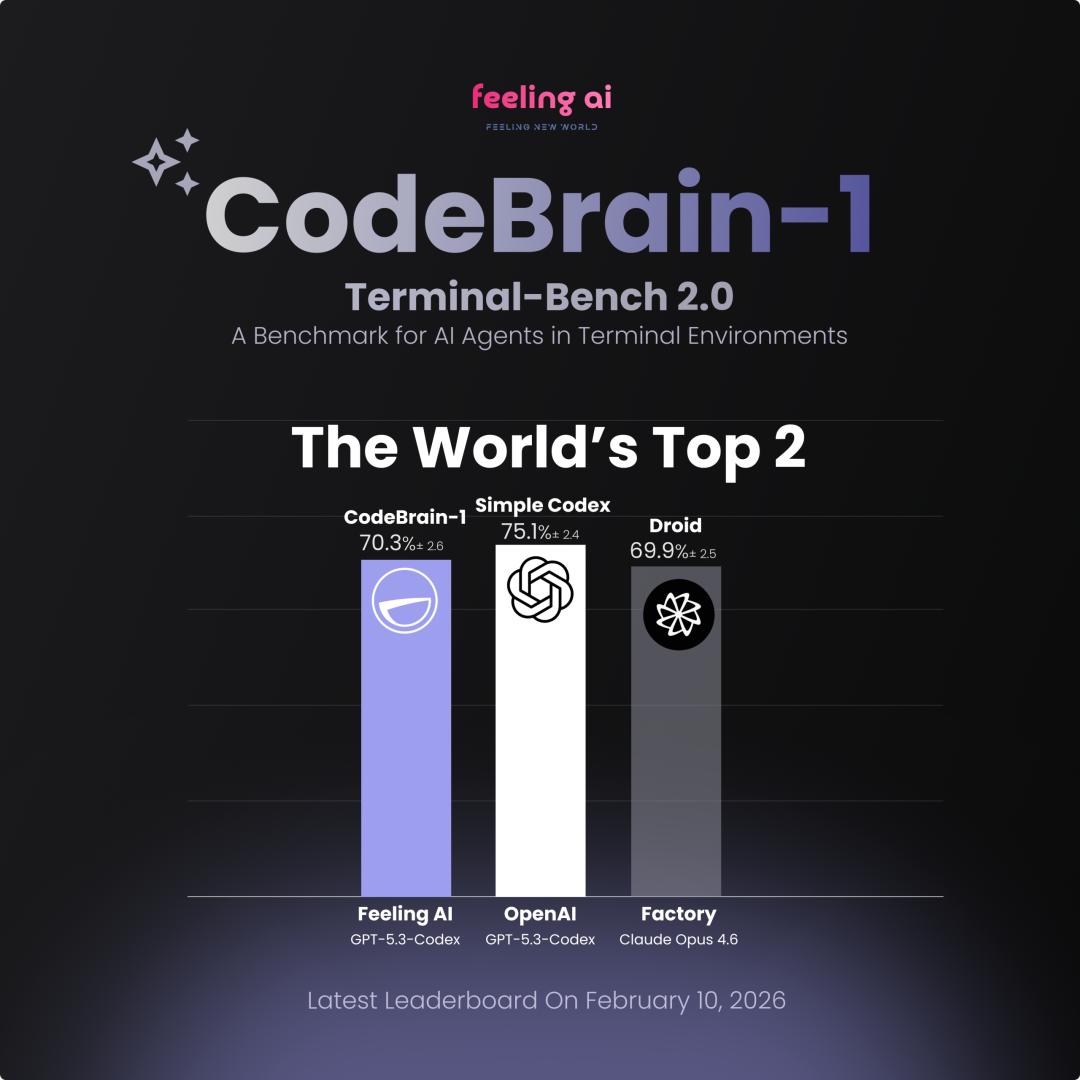
Core Insights - Feeling AI's CodeBrain-1 has achieved a remarkable second place in the Terminal-Bench 2.0 ranking, just behind OpenAI's latest flagship model, indicating a significant advancement in China's capabilities in Agentic AI and autonomous coding [1][6][27] - The competition between AI giants has shifted from mere parameter optimization to practical application in real-world scenarios, emphasizing the importance of model architecture and long-term operational sustainability [4][10] Company Performance - CodeBrain-1 scored 72.9% in the Agentic Terminal Coding Task, showcasing its superior coding capabilities, while OpenAI's 5.3-Codex achieved a score of 77.3% [4][11] - Feeling AI's recent release of MemBrain 1.0 has set new SOTA records in various memory benchmarks, significantly outperforming existing systems [8][10] Technological Advancements - CodeBrain-1 focuses on two critical aspects: Useful Context Searching and Validation Feedback, which enhance task completion efficiency and error correction [14][16] - The model's ability to dynamically adjust plans and strategies allows it to operate effectively in real terminal environments, improving success rates in task execution [16][25] Market Positioning - The Terminal-Bench 2.0 serves as a rigorous benchmark for AI models, requiring them to perform complex tasks in a closed-loop environment, which distinguishes it from traditional coding tests [21][22] - Feeling AI's performance in this competitive landscape highlights the potential for Chinese teams to redefine engineering standards in AI, positioning them as key players in the global market [27][28]
超越CLIP,北大开源细粒度视觉识别大模型,每类识别训练仅需4张图像
3 6 Ke· 2026-02-11 08:03
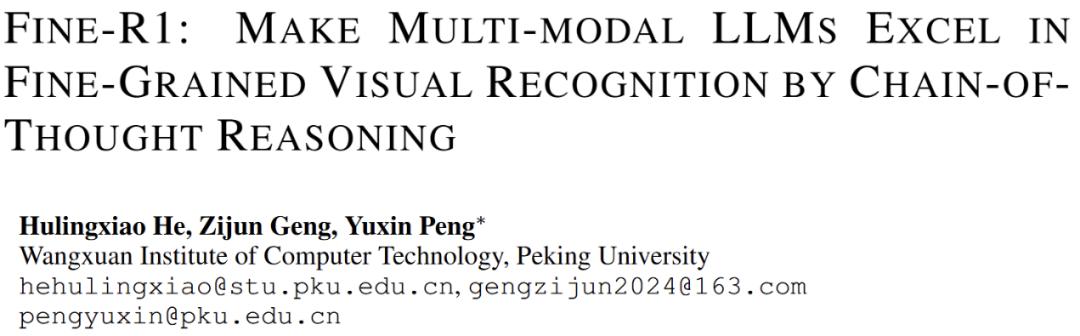
Core Insights - The research team led by Professor Peng Yuxin from Peking University has made significant advancements in fine-grained visual recognition using multi-modal large models, with their latest paper accepted at ICLR 2026 and made open-source [1][19]. Group 1: Fine-Grained Visual Recognition - The real world exhibits fine-grained characteristics, with objects often containing a rich hierarchy of categories, such as the classification of aircraft into specific models like Boeing 707, 717, and 727, with over 500 types of fixed-wing aircraft recorded globally [2]. - The Fine-R1 model aims to leverage the extensive knowledge of fine-grained subcategories contained within multi-modal large models to achieve fine-grained recognition of visual objects in open domains, overcoming the limitations of traditional methods that focus on a closed set of categories [4]. Group 2: Model Development and Methodology - The Fine-R1 model employs a two-phase approach: 1. Chain-of-thought supervised fine-tuning, which simulates human reasoning to enhance the model's inference capabilities [7]. 2. Triplet enhancement strategy optimization, which improves the model's robustness to intra-class variations and its ability to distinguish between different classes [8]. - The model demonstrates superior performance, achieving higher accuracy in recognizing both seen and unseen subcategories with only four training images per class, surpassing models like OpenAI's CLIP and Google's DeepMind's SigLIP [13][14]. Group 3: Experimental Results - Experimental results indicate that Fine-R1 outperforms various models in both closed-set and open-set recognition tasks, showcasing its effectiveness in fine-grained visual recognition [14][16]. - The model's enhancements are attributed primarily to its improved ability to utilize fine-grained subcategory knowledge rather than merely optimizing visual representations or increasing knowledge reserves [16].
当国外的AI在砸钱搞研发时,国内的AI还在砸钱搞用户
Sou Hu Cai Jing· 2026-02-11 07:54
对用户来说,这是继"外卖大战"后又一次巨大的白嫖机会;但从行业的角度来看,过去互联网砸钱圈地的"野蛮时代",早已经过去。 上一次喝到免费的奶茶,还是好几个月前的外卖大战。我原以为可能再也没有这样的机会,没想到仅仅几个月后,巨头们就再一次砸钱下场。 而这一次,针对不再是即时零售,而是AI。 AI是新机会,是新的未来和风口,这在今天已经成了几乎所有人的共识。但在共识之外,AI到底应该如何落地,如何收费,甚至是如何"盈利"仍然没有一个 较好的模式,但这丝毫不妨碍巨头们砸钱吸引用户。 这一点和国外形成了鲜明的对比;自从ChatGPT横空出世以来,巨大的流量和媒体的曝光,让吸引用户不再需要付费,随后国外几大科技公司的入场,先天 自带的用户群体,似乎也不需要靠砸钱来吸引用户。 当国内的AI在砸钱搞用户的时候,国外的AI则更多把钱用在了技术上,这两者之间的差别,背后暴露出的其实还是用户对AI的不同态度。 先说一点,本文探讨的并非是非对错,而是从一个更为宏观的角度来看,为什么国内的AI公司需要靠砸钱来吸引用户。 毕竟从研发的角度来看,国内的AI公司研发强度其实并不低。 先看美国,其中微软2025财年计划投资800亿美元用于A ...

US stock market | Wall Street’s new trade is dumping any stock in AI’s crosshairs
The Economic Times· 2026-02-11 07:53
Core Viewpoint - The recent selloff in the stock market, particularly affecting companies at risk of disruption from AI technologies, reflects a growing anxiety among investors about the potential impact of AI on various industries [1][14]. Group 1: Market Reaction - The selloff was triggered by the launch of a tax-strategy tool by Altruist Corp., which caused shares of major firms like Charles Schwab Corp. to drop by 7% or more, marking the deepest decline since the trade-war meltdown in April [1][14]. - Investors are adopting a "sell-first, ask-questions-later" mentality, leading to indiscriminate selling of companies perceived to have any disruption risk [2][14]. - The stock market's reaction has wiped billions of dollars off the market values of several investment firms, indicating a strong signal about the competitive threat posed by new AI products [8][14]. Group 2: Industry Impact - The software industry has been particularly affected, with fears spreading to sectors such as financial services, asset management, and legal services following the introduction of new AI tools [6][14]. - The launch of Insurify's application using ChatGPT to compare auto-insurance rates also negatively impacted shares of US insurance brokers [7][14]. - Altruist's product, Hazel, which personalizes strategies for financial advisers, exemplifies how AI can potentially replace entire teams in wealth management for a fraction of the cost [9][14]. Group 3: Investor Sentiment - Investors are now more focused on avoiding companies that could be displaced by AI rather than identifying potential winners in the market [5][14]. - There is skepticism about the speed at which AI will disrupt industries, with some experts suggesting that tech disruption often takes longer to materialize than anticipated [10][11]. - The recent pullbacks in stock prices may also reflect broader concerns about high valuations following a rally driven by AI spending and a resilient US economy [11][12].

软件开发步入“黑盒”时代?GitHub前掌门人:未来没人会去查阅AI写的代码
Hua Er Jie Jian Wen· 2026-02-11 07:40
Core Insights - The software development industry is on the brink of a transformation where human programmers may no longer need to review code directly, as AI takes over this task [1] - Entire, a company founded by former GitHub CEO Thomas Dohmke, aims to provide infrastructure for a future where humans do not need to look at code, having raised $60 million in seed funding with a valuation of $300 million [1] - The shift towards AI-generated code raises compliance challenges for businesses, as releasing "unreviewed code" poses significant legal risks [2] Group 1: Company Overview - Entire's mission is to bridge the gap between the efficiency of AI programming and the necessary transparency for enterprises [2] - The company has launched its first product, Checkpoints, which records AI agents' operations in real-time, allowing developers to understand AI's actions without delving into the code [3][4] - Checkpoints supports AI models from various manufacturers, including Anthropic's Claude Code and Google's Gemini CLI, aiming to monitor multiple AI agents [4] Group 2: Industry Trends - The emergence of Entire signifies the intensifying competition in the "AgentOps" sector, which focuses on monitoring AI agent behavior [5] - Major players like Microsoft and OpenAI are actively promoting new monitoring products to capture market share in this rapidly growing field [5] - Entire's strategy involves launching open-source tools first, with plans to introduce a cloud-hosted subscription service in the coming months [5] Group 3: Founder Insights - Dohmke's inspiration for founding Entire stemmed from observing the strong momentum of AI coding tools at GitHub, leading him to leave Microsoft and pursue this opportunity [7] - He believes that the world of software development and development tools is about to undergo significant changes, indicating a paradigm shift in the software engineering field [7]