中国人民银行

Search documents
强化金融稳定保障体系 护航高质量发展新征程——《金融时报》访中国人民银行金融稳定局负责人
Jin Rong Shi Bao· 2025-10-18 01:12
Core Insights - The People's Bank of China has achieved significant results in preventing and mitigating financial risks since the start of the 14th Five-Year Plan, ensuring the overall stability of the financial system and protecting the interests of depositors and small investors [1][2] Financial Stability Measures - The People's Bank of China has implemented a series of measures to strengthen the financial stability guarantee system, focusing on risk prevention and management, which is crucial for building a strong financial nation [2] - The approach includes precise handling of major financial risks, cleaning up shadow banking risks, and enhancing financial regulation and governance [2][3] Legislative and Institutional Developments - Significant progress has been made in financial stability legislation, with the draft Financial Stability Law under review by the National People's Congress [3] - The establishment of the Macro-Prudential and Financial Stability Committee aims to improve risk monitoring, assessment, and early warning systems [3] Deposit Insurance and Risk Management - The deposit insurance system has been operating smoothly since 2015, with a high protection level that covers over 99% of depositors with a compensation limit of 500,000 yuan [3] - The introduction of a risk-differentiated premium system encourages prudent management among financial institutions [3] Future Challenges and Strategies - The financial sector faces complex challenges, and the focus will be on reinforcing the financial stability guarantee system and expanding the sources of risk disposal funds [4][6] - The implementation of the "early identification, early warning, early exposure, and early disposal" strategy is crucial for effective risk management [5][6] Balancing Growth and Risk - The relationship between economic growth and financial risk is emphasized, with a need for a dynamic balance between economic development and risk prevention [7][8] - The central bank aims to enhance macro-prudential management and improve the toolkit for maintaining financial stability [8]


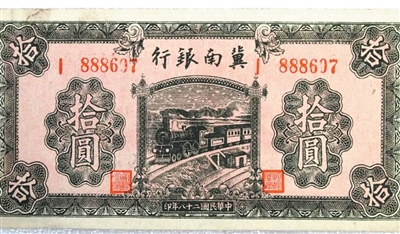
从冀南币到人民币(以物鉴史)
Ren Min Ri Bao· 2025-10-17 22:13
Core Insights - The exhibition "Mountains and Rivers Forever - Revolutionary Cultural Relics of the Anti-Japanese Base in Jin, Ji, Lu, and Yu" at the Hebei Museum highlights the significance of the Jinan Bank as a witness to the financial struggles during the Anti-Japanese War under the leadership of the Communist Party of China [1][2] - The establishment of the Jinan Bank in 1939 was a strategic decision to create a financial system that could support the war effort against Japanese invaders, amidst severe economic challenges and military threats [1][2] Group 1 - The Jinan Bank was founded in October 1939 in Hebei and Shanxi, with its first president being Gao Jiecheng, and it aimed to establish a financial network across three strategic areas [1][2] - The bank's operations were characterized by extreme conditions, including the use of makeshift facilities and local resources to produce currency, reflecting the resilience and adaptability of its founders [1][2][3] - The bank's staff were primarily seasoned revolutionaries who viewed their work as a crucial part of the anti-Japanese struggle, earning it nicknames like "Horseback Bank" and "Backpack Bank" due to the nature of their operations [2][3] Group 2 - The Jinan Bank utilized strategic resources as reserves and actively managed prices to stabilize the currency, combating the Japanese currency policies and promoting the circulation of its own currency, Jinan currency [3] - During the Anti-Japanese War, nearly half of the bank's issuance was allocated to support military and civilian finances in the base areas, reinforcing the economic resistance against the enemy [3] - After the victory in 1945, the Jinan Bank's role expanded, eventually merging with other banks to form the People's Bank of China, which began issuing the first set of Renminbi [3][4] Group 3 - The transition from Jinan currency to Renminbi marks a significant evolution in China's financial history, with the Jinan Bank being recognized as the "cradle of new China's finance" [4] - Artifacts from the Jinan Bank and the People's Bank of China serve as historical evidence and a source of inspiration for future generations to uphold the revolutionary spirit [4]
中国人民银行:进一步完善企业境外上市资金管理政策
Bei Jing Shang Bao· 2025-10-17 14:41
Core Viewpoint - The People's Bank of China (PBOC) emphasizes the natural progression of the cross-border use of the Renminbi (RMB) as the international monetary system diversifies and the demand for RMB increases among business entities [1] Group 1: Cross-Border RMB Usage - The PBOC plans to create a better environment for domestic and foreign entities to hold and use RMB, in line with directives from the central government [1] - There is an increasing endogenous demand for RMB usage among business entities as the pace of international monetary system diversification accelerates [1] Group 2: Policy Enhancements - The PBOC aims to enhance services for the real economy and facilitate trade and investment by optimizing and integrating policies related to cross-border trade and investment RMB settlements [1] - The PBOC will improve policies governing overseas listing funds and optimize policies related to multinational corporate group funding pools [1] Group 3: Financial Services Improvement - The PBOC will guide commercial banks to enhance their cross-border financial service capabilities, including incorporating more qualified enterprises into a premium enterprise list [1] - Efforts will be made to streamline business processing and improve the efficiency of RMB fund transfers [1]
中国人民银行:离岸人民币债券及境外机构发行的熊猫债存量规模约2万亿元
Bei Jing Shang Bao· 2025-10-17 14:41
Core Viewpoint - The People's Bank of China (PBOC) highlights the steady opening of China's financial market and the healthy development of the offshore RMB market, indicating a significant increase in the global attractiveness of RMB assets [1] Group 1: Financial Market Development - The total value of RMB financial assets held by foreign entities exceeds 10 trillion yuan [1] - Central banks or monetary authorities from over 80 countries and regions have included RMB in their foreign exchange reserves [1] - RMB bonds and stocks have been incorporated into mainstream global asset trading indices [1] Group 2: Offshore RMB Market - The interconnection between mainland and Hong Kong financial markets is deepening, with Hong Kong emerging as a core hub for offshore RMB business [1] - Major offshore RMB markets such as London, Singapore, and Dubai have developed unique characteristics [1] - The total amount of RMB deposits in major offshore markets reaches 1.6 trillion yuan [1] - The stock of offshore RMB bonds and Panda bonds issued by foreign institutions is approximately 2 trillion yuan [1]
中国人民银行:吸引更多境外机构有序投资境内市场
Bei Jing Shang Bao· 2025-10-17 14:41
Core Viewpoint - The People's Bank of China (PBOC) is committed to promoting a high-level two-way opening of the financial market, enhancing transparency, rules, and predictability to improve trading efficiency and liquidity [1] Group 1: Financial Market Development - The PBOC aims to attract more foreign institutions to invest in the domestic market through appropriate integration of investment channels [1] - There is a focus on supporting the construction of Shanghai as an international financial center, positioning it as a hub for RMB financial asset allocation and risk management [1]
中国人民银行:支持境内外各类机构在境外发行、交易人民币资产
Bei Jing Shang Bao· 2025-10-17 14:41
Core Viewpoint - The People's Bank of China is actively supporting the development of the offshore RMB market by enhancing cross-border RMB liquidity supply arrangements and optimizing the layout of clearing institutions [1] Group 1: Policy Support - The central bank will continue to strengthen liquidity support for clearing institutions [1] - There will be ongoing issuance of central bank bills to enrich liquidity management and risk management tools [1] - The aim is to consolidate and enhance Hong Kong's status as an international financial center and offshore RMB business hub [1] Group 2: Market Development - The central bank encourages domestic and foreign institutions to issue and trade RMB assets overseas [1] - The focus is on creating a more robust framework for cross-border RMB transactions [1]
中国人民银行:鼓励和支持更多符合条件的境外机构在境内发行熊猫债
Bei Jing Shang Bao· 2025-10-17 14:41
Core Viewpoint - The People's Bank of China (PBOC) aims to deepen the currency function of the Renminbi (RMB) and enhance various RMB financing support policies and tools [1] Group 1: RMB Financing Support - The PBOC will continue to improve RMB financing support policies and tools to better utilize the central bank's currency swap mechanism for cross-border use of the RMB [1] - There is an emphasis on enhancing the management of cross-border interbank RMB financing [1] Group 2: Panda Bonds - The PBOC encourages and supports more eligible foreign institutions to issue Panda bonds in the domestic market [1]
中国人民银行:将有序扩大货币互换合作覆盖面,促进贸易投资便利化
Bei Jing Shang Bao· 2025-10-17 14:41
Core Viewpoint - The People's Bank of China (PBOC) has established a significant network of currency swap agreements with various central banks globally, enhancing financial stability and supporting trade and investment [1][2]. Group 1: Currency Swap Agreements - The PBOC has signed 32 effective currency swap agreements with central banks or monetary authorities from regions including the European Central Bank, New Zealand, South Korea, Indonesia, Brazil, and Saudi Arabia, covering major economies across six continents [1]. - The total scale of these agreements amounts to approximately 4.5 trillion RMB [1]. Group 2: Functions of Currency Swaps - Currency swaps provide liquidity to financial markets, which is crucial for maintaining stability, especially highlighted during the 2008 financial crisis when many countries sought liquidity support from China [2]. - These swaps support the real economy by allowing central banks to provide funds through commercial banks to enterprises, facilitating bilateral trade and investment [2]. - Currency swaps are integral to financial cooperation between countries, encouraging financial institutions to offer bilateral currency settlement services, thus reducing exchange costs and mitigating exchange rate risks for businesses [2]. Group 3: Future Plans - The PBOC plans to gradually expand the coverage of currency swap cooperation, focusing on countries and regions with close economic ties to China, effectively utilizing swap funds to enhance liquidity supply and promote trade and investment facilitation [2].
中国人民银行:上半年人民币跨境收付金额合计为35万亿元,同比增长14%
Bei Jing Shang Bao· 2025-10-17 14:37
人民币跨境贸易和投融资大幅增长,服务实体经济能效显著增强。通过持续完善政策框架,深化高水平 贸易投资便利化试点,人民币国际使用的网络效应逐步显现。 2025年上半年,人民币跨境收付金额合计为35万亿元,同比增长14%,其中货物贸易跨境人民币收付金 额合计为6.4万亿元,占同期本外币跨境收付的比重为28%,收付金额和占比均处历史最好水平。在汇 率弹性增强的背景下,更多企业愿意使用人民币进行跨境结算,以规避汇兑风险,降低财务成本。 北京商报讯(记者刘四红)10月17日,据中国人民银行官微,中国人民银行宏观审慎管理局负责人近日在 接受《金融时报》采访时介绍,目前,人民币已成为我国对外收支第一大结算货币、全球第二大贸易融 资货币、第三大支付货币,在国际货币基金组织特别提款权(SDR)货币篮子中的权重位列第三。 ...
央行:支持境内外各类机构在境外发行、交易人民币资产|快讯
Hua Xia Shi Bao· 2025-10-17 13:38
Core Viewpoint - The People's Bank of China (PBOC) is advancing the internationalization of the Renminbi (RMB) during the 14th Five-Year Plan, aiming to enhance its quality and level of use in cross-border transactions, thereby increasing its global status and influence [2]. Group 1: Enhancing RMB Usage in Trade and Investment - The PBOC emphasizes that the cross-border use of RMB is a natural progression, driven by the diversification of the international monetary system and the growing endogenous demand for RMB among business entities [2]. - Key initiatives include better serving the real economy and facilitating trade and investment by optimizing cross-border RMB settlement policies and enhancing the financial services capabilities of commercial banks [2]. Group 2: Deepening RMB Financing Functions - The PBOC plans to improve RMB financing support policies and tools, leveraging currency swap agreements to support cross-border RMB usage and encouraging eligible foreign institutions to issue Panda bonds in China [3]. Group 3: Promoting High-Level Financial Market Openness - The PBOC aims to enhance the transparency, regulatory framework, and predictability of financial markets, thereby improving trading efficiency and liquidity, while attracting more foreign institutions to invest in domestic markets [3]. Group 4: Supporting Offshore RMB Market Development - The PBOC is focused on optimizing cross-border RMB liquidity supply arrangements and supporting various institutions in issuing and trading RMB assets abroad, while reinforcing Hong Kong's status as an international financial center and offshore RMB business hub [4].