中国卫星

Search documents
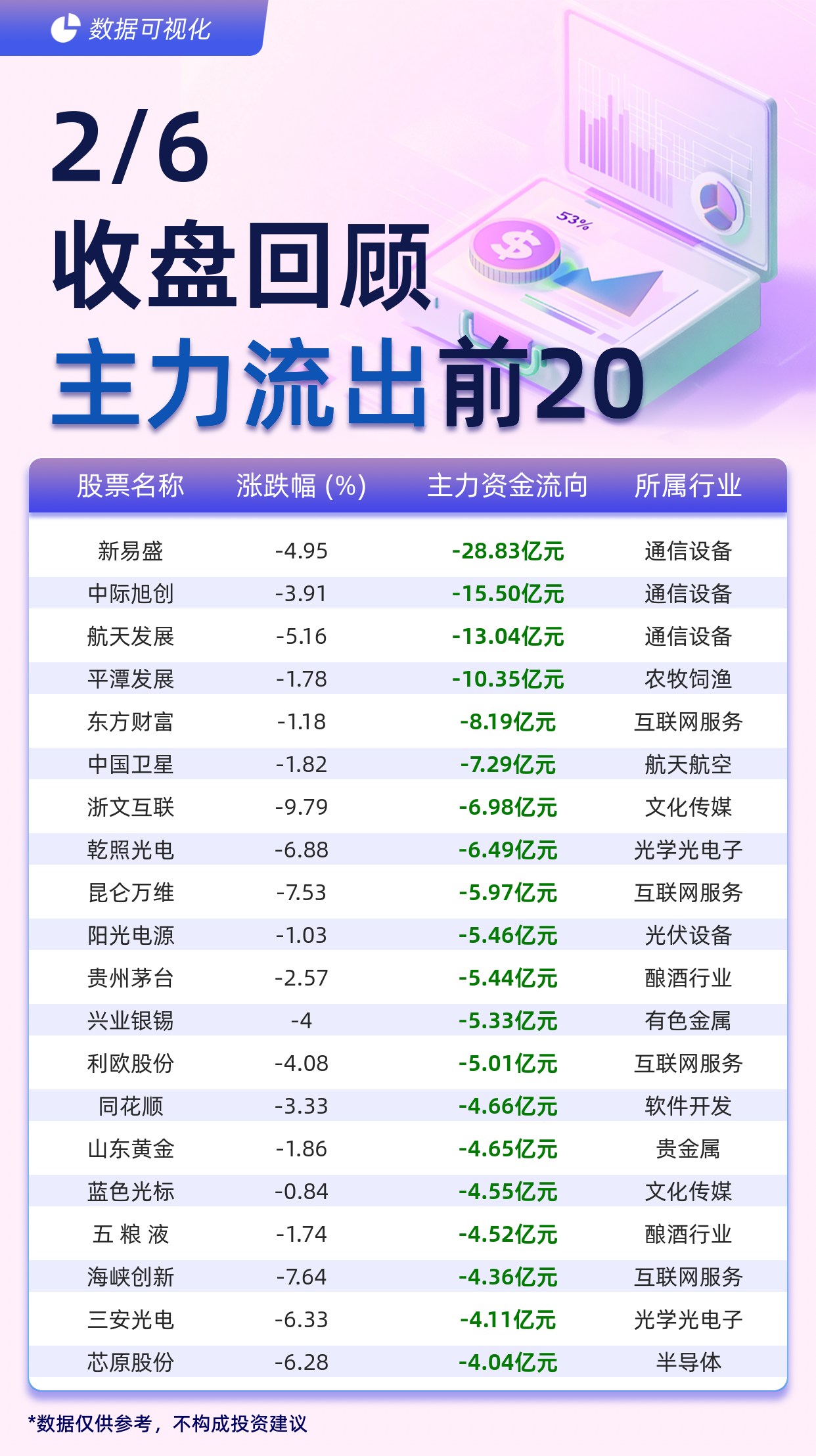
主力个股资金流出前20:新易盛流出28.83亿元、中际旭创流出15.50亿元
Jin Rong Jie· 2026-02-06 07:29
Group 1 - The main stocks with significant capital outflows include Xinyi Technology (-28.83 billion), Zhongji Xuchuang (-15.50 billion), and Aerospace Development (-13.04 billion) [1] - The sectors affected by the capital outflows primarily include communication equipment, internet services, and optical electronics [2][3] - The largest percentage decline in stock prices was observed in Zhejiang Wenlian, which fell by 9.79% [2] Group 2 - Other notable stocks with substantial capital outflows include Guizhou Moutai (-5.44 billion), Sunshine Power (-5.46 billion), and Sanan Optoelectronics (-4.11 billion) [1][3] - The overall trend indicates a negative sentiment in the market, particularly in the communication equipment and internet service sectors [2][3] - The data reflects a broader market trend of capital withdrawal, impacting various industries including agriculture, aerospace, and cultural media [1][2]


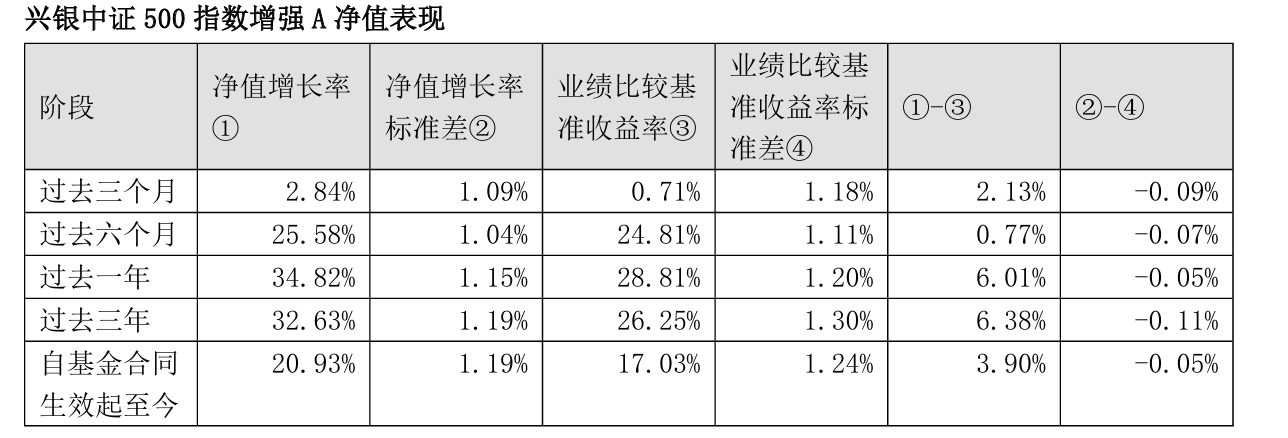
兴银中证500指数增强A(010253)四季报超额收益突出,同类表现领先!
Jin Rong Jie· 2026-02-06 06:53
Group 1 - The core viewpoint of the news is that the Xingyin CSI 500 Index Enhanced A fund has shown strong performance, with a recent net value of 1.3146 yuan and a six-month return of 27.88%, ranking 127th out of 757 in its category [1] - As of December 31, 2025, the fund achieved a one-year return of 34.82%, exceeding the benchmark return by 6.01%, and a three-year return of 32.63%, surpassing the benchmark return rate by 6.38% [1][2] Group 2 - The Xingyin Enhanced A fund is positioned as an index-enhanced equity fund, closely tracking the CSI 500 Index while optimizing component stock weights through quantitative models [2] - The fund's asset allocation shows a stock position of 92.18%, with only 0.71% in bonds and 6.53% in cash [2] - The manufacturing sector dominates the fund's industry allocation, accounting for 60.39% of net value, followed by information technology and finance at 4.53% and 4.34%, respectively [2] Group 3 - The top ten holdings of the fund are all CSI 500 Index component stocks, collectively representing approximately 7.24% of the fund's net asset value, indicating a diversified overall holding [2] - The fund actively invests in growth sectors, including information technology (e.g., Giant Network, Crystal Optoelectronics), high-end manufacturing (e.g., Lead Intelligent, Goldwind Technology), aerospace (e.g., China Satellite, Aerospace Electronics), and electronics (e.g., Jingwang Electronics, Xingsen Technology) [2] Group 4 - Fund manager Weng Zichen noted that the CSI 500 Index performed strongly in the fourth quarter, and despite the pressure on enhanced index products, the fund achieved stable excess returns through strict style exposure control and optimization using the Barra multi-factor model [5] - The strategy emphasizes controlling the volatility of excess returns and improving the Sharpe ratio to ensure consistent and stable performance across different market cycles [5] - Looking ahead to 2026, the CSI 500 Index will remain a key tool for investing in quality mid-cap growth stocks, with the fund continuing to leverage its quantitative model for risk control and alpha generation [5]
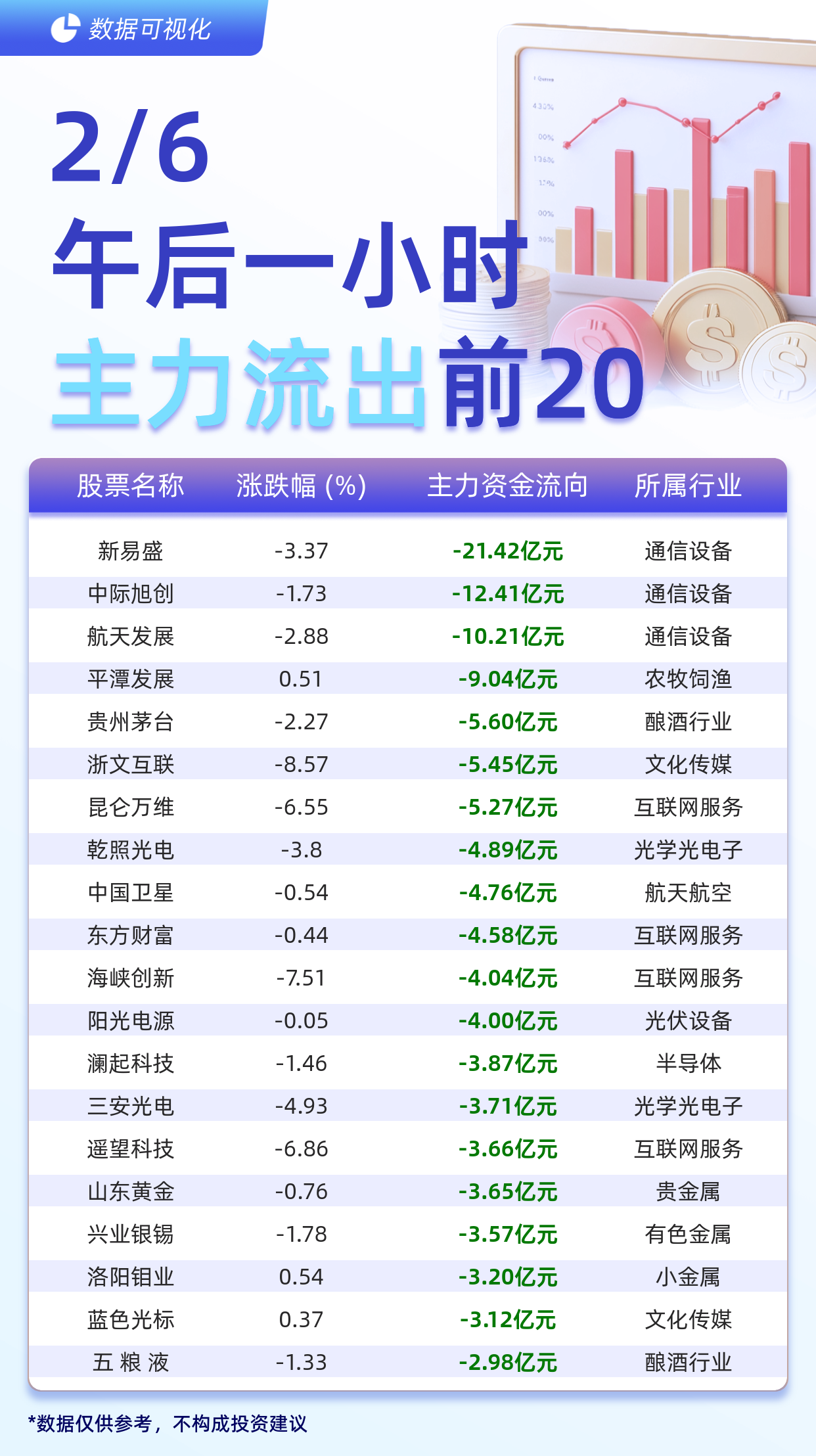
主力个股资金流出前20:新易盛流出21.42亿元、中际旭创流出12.41亿元
Jin Rong Jie· 2026-02-06 06:27
Main Points - The main focus of the news is on the significant outflow of capital from various stocks, highlighting the top 20 stocks with the largest capital outflows as of February 6, with New Yisheng leading at -21.42 billion yuan [1][2][3] Group 1: Stock Performance - New Yisheng experienced a capital outflow of -21.42 billion yuan, indicating a strong sell-off in the communication equipment sector [1][2] - Zhongji Xuchuang saw a capital outflow of -12.41 billion yuan, also within the communication equipment industry [1][2] - Aerospace Development had a capital outflow of -10.21 billion yuan, reflecting investor sentiment in the communication equipment sector [1][2] - Pingtan Development reported a capital outflow of -9.04 billion yuan, indicating challenges in the agriculture and animal husbandry sector [1][2] - Kweichow Moutai faced a capital outflow of -5.60 billion yuan, suggesting potential concerns in the liquor industry [1][2] Group 2: Sector Analysis - The communication equipment sector is notably affected, with three companies (New Yisheng, Zhongji Xuchuang, and Aerospace Development) among the top outflows [1][2] - The liquor industry, represented by Kweichow Moutai, shows a significant outflow, which may indicate market volatility or changing consumer preferences [1][2] - The internet services sector is also impacted, with companies like Kunlun Wanwei and Dongfang Caifu experiencing outflows of -5.27 billion yuan and -4.58 billion yuan respectively [1][2][3] Group 3: Additional Stocks - Other notable stocks with significant outflows include Sunshine Power (-4.00 billion yuan) in the photovoltaic equipment sector and Sanan Optoelectronics (-3.71 billion yuan) in the optical and optoelectronic sector [1][3] - The precious metals sector, represented by Shandong Gold, saw an outflow of -3.65 billion yuan, indicating potential investor caution [1][3] - The cultural media sector, with companies like Zhejiang Wenlian and Blue Focus, also faced outflows of -5.45 billion yuan and -3.12 billion yuan respectively, reflecting market dynamics in this industry [1][3]



2026年商业航天迎密集催化,产业奇点时刻已至,关注航空航天ETF(159227)回调布局机会
Mei Ri Jing Ji Xin Wen· 2026-02-06 04:29
Group 1 - The A-share market showed mixed performance on February 6, with the aerospace sector experiencing a pullback, as evidenced by the aerospace ETF (159227) declining by 1.29% and achieving a trading volume of 202 million yuan, maintaining its position as the leader in its category [1] - Recent trends indicate a "buy the dip" strategy among investors, with the aerospace ETF seeing net inflows in 8 out of the last 10 trading days, totaling 548 million yuan, bringing its latest scale to 3.473 billion yuan, the largest among its peers [1] - The commercial aerospace sector is witnessing significant developments, including the FCC's acceptance of SpaceX's proposal for a non-geostationary satellite system, which could enable the deployment of up to one million satellites for AI model training [1] Group 2 - According to Dongwu Securities, by 2026, the commercial aerospace sector is expected to experience a convergence of technological closure, order releases, and capital premiums, with China's commercial aerospace industry entering a rapid acceleration phase to catch up [2] - The aerospace ETF (159227) ranks first in its category, closely tracking the National Aerospace Index, covering a full industry chain from fighter jets to satellites, with a high commercial aerospace content of 69.65% [2] - The top ten holdings of the aerospace ETF include industry leaders such as Aerospace Development, China Satellite, and Aviation Industry Corporation of China [2]
商业航天利好不断,航空航天ETF(159227)持续获资金布局
Xin Lang Cai Jing· 2026-02-06 03:37
Core Viewpoint - The aerospace industry is experiencing positive momentum with significant investments and developments in commercial space, driven by advancements in technology and military trade expectations [1][2]. Group 1: Market Performance - The CN5082 aerospace industry index shows mixed performance among its constituent stocks, with Changyingtong leading at a 5.37% increase, while Beimo Gaoke is the biggest loser [1]. - The Aerospace ETF (159227) is currently priced at 1.46 yuan, reflecting active trading with a turnover rate of 6.18% and a transaction volume of 2.12 billion yuan [1]. Group 2: Investment Trends - There has been a net inflow of 1.05 billion yuan into the Aerospace ETF over the past five trading days, averaging a daily net inflow of 21.08 million yuan [1]. - The commercial space sector is attracting capital despite market fluctuations, indicating strong investor interest [1]. Group 3: Future Outlook - Shanxi Securities highlights increasing expectations for military trade, with a significant number of rocket launches planned by the end of 2025 and accelerated deployment of satellite internet [1]. - The year 2026 is projected to be pivotal for the aerospace industry, with multiple new medium and large rockets set for their inaugural flights and advancements in reusable technology [1]. - The commercial aerospace sector is anticipated to enter a period of explosive growth as capacity constraints are effectively addressed [1]. Group 4: ETF Composition - The Aerospace ETF closely tracks the CN5082 index, covering critical segments such as aerospace equipment, satellite navigation, and new materials, with commercial aerospace concepts accounting for 70% of its weight [2]. - The top ten holdings include industry leaders like Aerospace Development, China Satellite, and AVIC [2].
卫星ETF鹏华(563790)涨近1%,马斯克称太空将成为AI部署的最廉价选择
Xin Lang Cai Jing· 2026-02-06 02:11
Group 1 - The core viewpoint of the article highlights the potential for AI in space operations to become the most cost-effective solution within the next 30 to 36 months, as stated by Elon Musk during a podcast appearance [1] - Shanxi Securities predicts a surge in the commercial aerospace sector by the end of 2025, driven by a rapid increase in rocket launches and satellite internet deployment, with multiple new medium to large rockets expected to debut in 2026 [1] - The China Satellite Industry Index (931594) saw a 0.82% increase, with notable stock performances from companies such as Changjiang Communication (+10.01%), Xinwei Communication (+6.91%), and Hailanxin (+4.07%) [1] Group 2 - As of January 30, 2026, the top ten weighted stocks in the China Satellite Industry Index (931594) include Aerospace Electronics, China Satellite, and Zhenlei Technology, collectively accounting for 64.36% of the index [2]
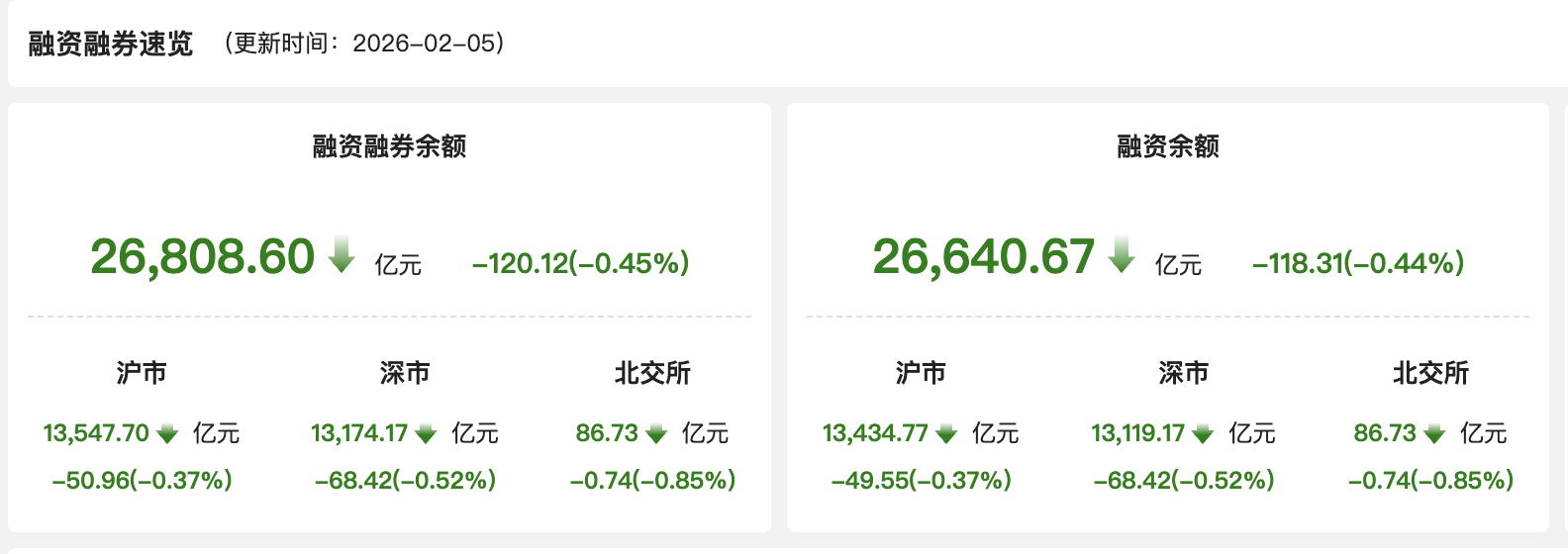
5日两融余额减少120.12亿元 公用事业行业获融资净买入居首
Sou Hu Cai Jing· 2026-02-06 01:52
Core Viewpoint - The total margin financing and securities lending balance in A-shares decreased to 26,808.60 billion yuan, a reduction of 120.12 billion yuan from the previous trading day, representing 2.62% of the A-share circulating market value [1] Group 1: Margin Financing and Securities Lending - The margin financing and securities lending balance is 26,808.60 billion yuan, down by 120.12 billion yuan (-0.45%) from the previous day [2] - The trading volume for margin financing and securities lending was 1,993.51 billion yuan, a decrease of 260.13 billion yuan, accounting for 9.08% of the total A-share trading volume [1] Group 2: Industry and Stock Performance - Among the 31 primary industries, 9 industries experienced net financing inflows, with the public utilities sector leading with a net inflow of 3.86 billion yuan [2] - The coal, construction decoration, and basic chemicals industries also saw significant net financing inflows [2] - A total of 20 stocks had net financing inflows exceeding 1 billion yuan, with Zhongji Xuchuang leading at 9.44 billion yuan [2][3] - Other notable stocks with high net financing inflows include Hikvision, SMIC, Shiyun Circuit, Bosheng New Materials, China Railway, Shanxi Black Cat, Pingtan Development, China Satellite, and Dongshan Precision [2][3]



单笔最大融资,北京、广州投了国内激光通信黑马
3 6 Ke· 2026-02-06 01:46
Group 1 - Elon Musk has announced plans to deploy and operate up to 1 million satellites and has acquired xAI to integrate AI with commercial space, marking a significant development in the industry [1] - The Chinese National Space Administration has established a Commercial Space Administration and released a plan for high-quality and safe development of commercial space from 2025 to 2027, indicating a systematic approach to industry growth [1] - The plan includes launching over 10,000 low-orbit satellites between 2026 and 2030, accelerating market maturity [1] Group 2 - Beijing Aurora Starlink Technology Co., Ltd. has completed a Series A4 financing round, raising nearly 300 million RMB, setting a record for the largest single financing in China's space laser communication sector [2] - The funds will be used for the R&D of next-generation space laser communication products, automation production line construction, and upgrading on-orbit technology verification capabilities [2] Group 3 - The founder of Aurora Starlink, Wu Shaojun, transitioned from a stable career in aerospace research to entrepreneurship, recognizing the historic opportunity in commercial space [3] - The company aims to provide affordable and effective space laser communication products, facilitating the construction of a space-based communication network [5] Group 4 - Aurora Starlink's technology team comprises experts from prestigious institutions, enhancing its competitive edge in the laser communication market [4] - The company has developed a full autonomous technology system covering all aspects of laser communication product R&D and production capabilities [6] Group 5 - The competition in the laser communication field has shifted from pure research to commercial viability, with Aurora Starlink positioned to capitalize on the growing demand for laser communication technology [4][6] - The company has launched multiple satellite terminal products and is focusing on high-value starborne applications, with over 80% of resources dedicated to satellite-based solutions [7] Group 6 - Local governments are increasingly investing in commercial space, with various regions establishing funds and policies to support the industry, indicating a strategic focus on space technology [9][10] - Beijing's investment fund is actively supporting Aurora Starlink, recognizing the strategic importance of space laser communication for national infrastructure [10]
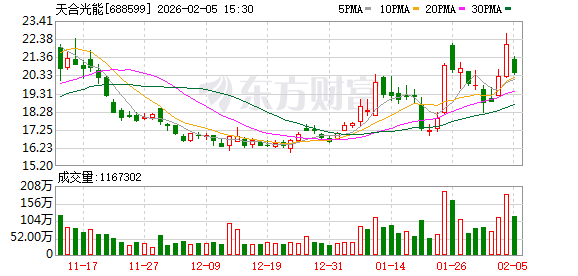
事关“太空光伏” 天合光能、协鑫集成回应
2 1 Shi Ji Jing Ji Bao Dao· 2026-02-05 15:41
Core Viewpoint - The recent visit of SpaceX to several Chinese photovoltaic companies led to a surge in the space photovoltaic concept stocks on February 4, but the momentum could not be sustained, resulting in a significant decline in the space photovoltaic index on February 5 [2][3]. Group 1: Market Performance - On February 5, the space photovoltaic index (8841929) dropped by 4.86%, closing at 3837.43, with notable declines in stocks such as JunDa Co., JinCheng Co., and Shuangliang Energy, which hit the daily limit down [2][3]. - Other companies like GaoCe Co., JieJia WeiChuang, MaiWei Co., JingSheng JiDian, and HaiYou New Materials saw declines exceeding 9%, while Trina Solar fell over 7% and JinkoSolar dropped over 6% [2][4]. Group 2: Company Announcements - Trina Solar announced that it has not engaged in any cooperation with SpaceX and has no related orders in the "space photovoltaic" sector, clarifying that its main products are focused on ground photovoltaic applications [5][6]. - GCL-Poly Energy stated that it has not received any orders in the "space photovoltaic" field and emphasized that the technology is still in the exploratory phase, with uncertain commercial prospects [8]. - JinkoSolar confirmed it has not collaborated with SpaceX and highlighted that the "space photovoltaic" concept remains in the early exploration stage [10]. - Other companies like Guosheng Technology, Shuangliang Energy, and JingSheng JiDian also reported no involvement in "space photovoltaic" business, reiterating the uncertainty surrounding the commercialization of this technology [11][12][13]. Group 3: Financial Forecasts - Trina Solar projected a net loss of between 6.5 billion to 7.5 billion yuan for the year 2025 [7]. - GCL-Poly Energy expects a net loss of between 890 million to 1.29 billion yuan for the same year [8].




受中国刺激了?马斯克公司申请发射100万颗卫星打造“太空大脑”
Sou Hu Cai Jing· 2026-02-05 12:35
2026年1月底,马斯克主导的SpaceX公司向美国联邦通信委员会(FCC)提交申请,计划部署至多100万颗具备计算能力的卫星,意欲打造"轨道数据中心"以 支撑全球AI算力需求;而且大约一个月前,我国一些公司向国际电信联盟(ITU)申报约20.3万颗低轨卫星,目前来看中美之间一场围绕太空资源与未来算 力的全球竞赛,正以"卫星数量竞赛"的热闹形式拉开序幕,后续欧洲、俄罗斯、日本、印度等国家和地区也会参与进来。 要理解这场太空较量,得先把双方的"手牌"摊开看——毕竟卫星数量不是"报菜名",每一个数字背后都是战略盘算。 马斯克的SpaceX这次玩得相当"激进"。根据FCC文件,这100万颗卫星要部署在500-2000公里轨道,挤在宽度仅50公里的"轨道壳层"里,用太阳能供电、激 光链路连星链,最终目标是成为"太空AI数据中心"。用马斯克的话说,这是迈向"卡达尔舍夫2型文明"(能充分利用太阳能)的第一步,可谓是把"狂想+务 实"的反差感拉满。 而中国这边的操作更像"精准卡位"。2025年12月底,我国一次性向ITU申报20.3万颗低轨卫星,覆盖14个星座,其中无线电创新院一家就申报了近19.4万 颗。这不是"拍脑袋报 ...