珀莱雅

Search documents
半亩花田IPO,“流量依赖 + 质量争议”双重困局如何破解?
Sou Hu Cai Jing· 2026-01-23 15:28
Core Viewpoint - The company, 半亩花田, is attempting to become the first domestic beauty brand listed on the Hong Kong Stock Exchange, showcasing impressive revenue growth but facing significant challenges related to high marketing costs, declining R&D investment, and product quality complaints [1][4][18]. Financial Performance - For the first three quarters of 2023, 半亩花田 reported a revenue of 18.95 billion RMB, with a net profit increase of 197.2% [1]. - The company's revenue for 2023, 2024, and the first nine months of 2025 is approximately 11.98 billion RMB, 14.99 billion RMB, and 18.95 billion RMB, respectively [4][5]. - The gross profit margin has consistently remained above 60%, but the adjusted net profit margin has not exceeded 10%, standing at about 7.8% [4][5]. Marketing and Sales Strategy - 半亩花田's marketing strategy relies heavily on celebrity endorsements, KOL collaborations, and social media promotions, with marketing expenses accounting for nearly 50% of total revenue [1][2]. - Monthly marketing expenses approached 1 billion RMB in the first three quarters of 2025, while the cost of acquiring customers on platforms like Douyin has increased by over 30% [3]. R&D Investment - R&D expenditure has been declining, with its proportion of total revenue dropping from 2.4% to 1.5% between 2023 and 2025 [3][4]. - In contrast, leading domestic brands like 珀莱雅 and 薇诺娜 invest 3%-5% of their revenue in R&D, creating a competitive edge [7]. Cash Flow and Financial Health - As of September 2025, the company's asset-liability ratio was 67.6%, indicating high financial leverage [8]. - The operating cash flow for the first nine months of 2025 was approximately 1.37 billion RMB, but financing cash flow turned negative starting in 2024 [8][9]. - The company has a total of about 1.47 billion RMB in bank loans and liabilities, while cash reserves are only 1.62 billion RMB, indicating tight liquidity [8]. Quality Control and Consumer Complaints - The company has faced quality control issues, including a significant number of consumer complaints related to product safety and effectiveness, with 280 complaints recorded on the Black Cat complaint platform [12][16]. - Regulatory inspections have revealed non-compliance with safety standards, which could harm the brand's reputation [12][18].

半亩花田母公司赴港上市:聚焦个护品类 净利润率面临压力
Zhong Guo Jing Ying Bao· 2026-01-23 11:51
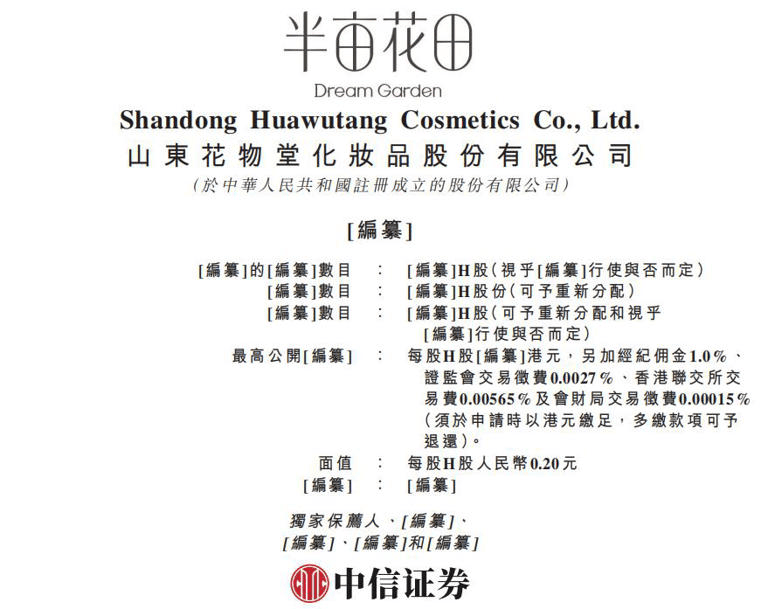
Core Viewpoint - The domestic personal care brand, Banmu Huatian, is preparing for an IPO in Hong Kong, amidst a competitive landscape in the personal care industry, particularly with the entry of leading companies like Proya into the hair care segment [1][6]. Company Overview - Banmu Huatian was established in 2010 in Shandong and is recognized as the leading domestic brand in body lotion, body scrub, and facial cleansing mousse, based on retail sales projections for 2024 [2]. - The company's revenue for the first nine months of 2023, 2024, and 2025 is reported at 1.199 billion, 1.499 billion, and 1.895 billion yuan respectively, with adjusted net profits of 24 million, 83 million, and 148 million yuan [2]. Product Structure - As of the first three quarters of 2025, Banmu Huatian's revenue from body care, hair care, and facial care products is 791 million, 482 million, and 463 million yuan, accounting for 41.8%, 25.4%, and 24.4% of total revenue respectively [2]. - The hair care segment has shown significant growth, with a year-on-year increase of 496.1%, becoming a second growth curve for the company [2]. Channel Strategy - The company initially focused on e-commerce channels, avoiding competition in traditional retail spaces, and has since expanded into content-driven e-commerce platforms like Xiaohongshu and Douyin [2]. - Online sales accounted for 76.3% of total sales in the first three quarters of 2025, while offline channel share increased from 13.9% in 2023 to 23.5% in the first three quarters of 2025 [3]. Marketing and R&D Expenses - Banmu Huatian's sales and marketing expenses are substantial, projected at 677 million yuan in 2024, representing 45.2% of revenue, and increasing to 896 million yuan (47.3% of revenue) in the first three quarters of 2025 [3]. - R&D expenses are relatively low, at 32.02 million and 28.14 million yuan for 2024 and the first three quarters of 2025, accounting for 2.1% and 1.5% of revenue respectively [3][4]. Profitability Challenges - The average selling prices for body care, hair care, and facial care products are 23 yuan, 20.8 yuan, and 16.5 yuan respectively, leading to lower net profit margins compared to competitors like Proya and Shiseido [5]. - Adjusted net profit margins for 2024 and the first half of 2025 are 5.5% and 7.8%, which are lower than Proya's margins of 14.7% and 15.4% during the same periods [5]. Industry Competition - The personal care market in China is projected to grow from 111 billion yuan in 2024 to 145.5 billion yuan by 2029, with a compound annual growth rate of 5.6% [6]. - Increased competition is noted as leading companies like Proya and Shiseido enter the personal care space, intensifying the market dynamics [6][7]. Future Development - Banmu Huatian is encouraged to enhance product innovation and expand its product range to improve competitiveness and mitigate risks [7]. - There is potential for the company to explore unique Chinese plant-based ingredients and invest in technological advancements in the personal care sector [7].
戴可思回应违规?美宝莲被抵制?欧舒丹拟美股上市?|美周热点
Sou Hu Cai Jing· 2026-01-23 08:37
Industry Overview - The beauty retail sector in China experienced a year-on-year growth of 5.1%, with total retail sales reaching 465.3 billion yuan in 2025, significantly outperforming the overall retail market which grew by 3.7% [2] - December 2025 saw a notable increase in cosmetic retail sales, reaching 38 billion yuan, marking an 8.8% year-on-year growth, driven by year-end consumer demand and promotional activities [2] Brand Developments - Maybelline faced backlash after announcing a partnership with the youth group "Times Youth" as brand ambassadors, leading to consumer dissatisfaction and low sales figures [3] - Dakeci responded to an investigation regarding misleading advertising of its children's lip balm, clarifying that it did not promote the product as "food-grade" despite previous claims on e-commerce platforms [4] - The first "youthful needle" for temporal filling was approved in China, marking a significant advancement in aesthetic medicine [5] - The high-end fragrance brand Wenxian opened its first pop-up store in Shanghai, focusing on traditional incense culture [6][7] - Proya launched a new medical skincare series targeting post-surgery and specialized skin care, planning to enter OTC channels [8] - The UK brand Indu exited the color cosmetics market to focus on skincare, citing higher consumer loyalty in that segment [9] - Sephora announced a strategic partnership with Olive Young to create a dedicated K-beauty section, set to launch in North America and Singapore [10] - Valentino Beauty exited the South Korean market due to limited distribution and competition from local brands [11] - Patrick Ta Beauty entered the Middle Eastern market through a partnership with Sephora, launching in several countries [12] - Douglas reported a slight increase in Q1 sales but faced pressure on profit margins due to consumer price sensitivity [13][14] Regulatory and Market Trends - Recent reports highlighted the discovery of banned substances in children's creams, prompting regulatory investigations and product recalls [15] - Unilever Ventures invested in two Indian beauty brands, indicating confidence in the high-end, clean beauty market in India [16] - China Duty Free Group announced a significant acquisition of DFS assets for approximately 3.95 billion USD, enhancing its presence in the Greater Bay Area [17] - Saks Global filed for Chapter 11 bankruptcy, marking a significant event in the luxury retail sector [18] - L'Occitane is exploring a potential IPO in the US market, having previously been privatized in 2024 [20] - Shandong Province initiated a pilot program for electronic labels on cosmetics, aimed at improving product traceability and compliance [21] - New cosmetic testing standards are being proposed in China to enhance safety and regulatory compliance [22]



“港股国货个护第一股”!半亩花田赴港IPO,76%高增长背后收入砸营销
Sou Hu Cai Jing· 2026-01-23 08:31
Core Viewpoint - The company, 半亩花田, is preparing for an IPO in Hong Kong, aiming to become the leading domestic personal care brand in the market, with a strong revenue growth of 76.7% in the first nine months of 2025, driven largely by high marketing expenditures [4][6][7]. Financial Performance - The company's revenue for 2023 and 2024 is projected to be 1.199 billion RMB and 1.499 billion RMB, respectively, with a growth rate of 25.05% [6][7]. - In the first nine months of 2025, revenue reached 1.895 billion RMB, marking a year-on-year increase of 76.7% [6][7]. - Adjusted net profit (non-IFRS) is expected to grow from 23.71 million RMB in 2023 to 82.83 million RMB in 2024, and further to 148 million RMB in the first nine months of 2025, reflecting a growth of 197.41% [8]. Marketing and Sales Strategy - The company allocates a significant portion of its revenue to marketing, with expenses reaching 637 million RMB in 2023, 677 million RMB in 2024, and 896 million RMB in the first nine months of 2025, accounting for 53.2%, 45.2%, and 47.3% of total revenue, respectively [10][11]. - The marketing strategy includes collaborations with KOLs and celebrities, which has proven effective in driving sales, with monthly marketing expenses nearing 1 billion RMB in 2025 [16][17]. Product and Market Position - 半亩花田 is recognized as the leading domestic brand in body care products, with a strong market presence in body lotion, body scrub, and facial cleansing mousse [7][21]. - The company’s product pricing strategy remains competitive, with average prices around 20 RMB, while maintaining a gross margin above 60% [15][21]. Challenges and Risks - The company faces challenges due to a high dependency on online sales channels, which accounted for 85.7% of total revenue in 2023, making it sensitive to changes in platform policies and rising customer acquisition costs [20][21]. - R&D investment is notably low, with expenses constituting only 2.39% to 1.49% of total revenue from 2023 to 2025, raising concerns about the company's technological competitiveness [11][22]. Future Outlook - The company plans to use the funds raised from the IPO to expand sales channels, increase R&D investment, build a global talent team, and enhance digital and intelligent upgrades [28]. - The competitive landscape in the personal care market is intensifying, with both international giants and emerging domestic brands posing significant challenges [21][22].
申万宏源研究晨会报告-20260123
Shenwan Hongyuan Securities· 2026-01-23 01:10
Group 1: Gold Market Analysis - The bull market for gold is not over, with macro factors remaining optimistic and short-term fluctuations driven by geopolitical events [3][11][13] - Key macro pricing factors for gold have not changed, indicating a sustained upward potential in the medium to long term [3][13] - Micro indicators show that while gold price deviations are high, the RSI is healthy, and ETF inflows continue to rise, suggesting no clear direction for gold prices [3][13] Group 2: Semiconductor Industry Insights - TSMC's revenue for December 2025 is projected to grow by 20.4% year-on-year, driven by high-margin advanced processes and strong demand from AI/HPC sectors [4][12] - The advanced process capacity is fully loaded, with HPC accounting for 55% of revenue and 3nm technology representing 28% of wafer revenue [4][12] - TSMC's guidance for Q1 2026 indicates revenue between $34.6 billion and $35.8 billion, with a gross margin of 63%-65%, reflecting strong demand visibility in AI [4][14] Group 3: Beauty Industry Trends - The South Korean beauty market has undergone several growth and decline phases, with the current phase focusing on global market expansion and reducing reliance on China [18][20] - New brands like APR and Silicon2 are outperforming traditional giants, indicating a shift in market dynamics and consumer preferences [20] - The report highlights the importance of innovation in product formulation and packaging, with South Korean brands leading in areas like cushion packaging and functional skincare products [20]
2026年第3周:美妆行业周度市场观察
艾瑞咨询· 2026-01-23 00:05
Group 1: Industry Environment - The beauty industry is facing significant challenges in 2025, including market contraction, the end of traffic dividends, and intensified competition, leading to many brands closing or exiting the market. While leading companies show some resilience due to scale and R&D advantages, smaller brands struggle due to limited resources [3][4] - The luxury goods sector is witnessing a trend where high-end malls are losing luxury brands due to low foot traffic and high brand overlap, prompting a shift towards online channels and new consumer brands to attract customers [5] - The global beauty industry is entering a transformation phase in 2025, with growth rates slowing from 7% to 5%. The market is shifting towards segmentation and premiumization, with major players like L'Oréal and Estée Lauder focusing on high-end fragrance lines and digitalization [6] Group 2: Market Trends and Innovations - The implementation of the new cosmetic supervision regulations in May 2021 has led to a significant increase in the registration of new plant-based raw materials, with nearly 25% of the 370 registered materials being plant-based by the end of 2025 [7] - The application of generative AI in the fragrance industry is projected to contribute $9-10 billion in value by 2025, enhancing product development, marketing insights, and customer experience [9] - The Chinese cosmetics market is undergoing structural changes, with over 30 international beauty brands exiting the market in 2025, primarily from Japan and South Korea, due to the rise of domestic brands and changing consumer demands [10] Group 3: Company Dynamics - Aldi's beauty brand Lacura has gained popularity by offering high-quality products at low prices, leveraging its supermarket distribution model to attract young consumers [11][12] - Lin Qingxuan has successfully listed on the Hong Kong Stock Exchange, becoming the first high-end domestic skincare brand to do so, with a focus on research and global expansion [13] - The brand Hai Gui Ba Ba has innovatively transformed acne treatment into a cultural and emotional marketing strategy, engaging with young consumers through festive themes and collaborations [15][16]

从韩国美妆发展看如何重建新增长动能:品牌格局重塑,全球战略扩张
Shenwan Hongyuan Securities· 2026-01-22 11:06
业 研 究 / 行 业 点 相关研究 行 业 及 产 业 美容护理 2026 年 01 月 22 日 证 券 研 究 报 告 证券分析师 王立平 A0230511040052 wanglp@swsresearch.com 聂霜 A0230524120002 nieshuang@swsresearch.com 联系人 聂霜 A0230524120002 nieshuang@swsresearch.com 品牌格局重塑,全球战略扩张 看好 ——从韩国美妆发展看如何重建新增长动能 本期投资提示: 请务必仔细阅读正文之后的各项信息披露与声明 本研究报告仅通过邮件提供给 中庚基金 使用。1 ⚫ 韩国美妆市场相对成熟,进行国际化探索早,并随着自身国家综合实力、本土需求与国 际市场需求的变化,发展经历数次沉浮,其展现的发展路径值得国货公司参考借鉴。我 们通过对韩国美妆市场的研究,探索韩国美妆在不同的发展阶段,崛起的美妆集团组织 架构的特点,如何在需求端快速变化的产品领域加速推新,在新成分、新剂型等领域如 何走在全球市场前端,以及拥抱全球市场背后所需要的能力。 ⚫ 韩国美妆四大成长与衰退阶段,把握低谷紧抓转型,再临高峰。韩国 ...
2025年防晒产品电商消费趋势
知行咨询· 2026-01-22 09:10
Investment Rating - The report does not explicitly provide an investment rating for the sunscreen industry [2] Core Insights - The sunscreen e-commerce market is experiencing a slowdown in growth, with Tmall's sales declining and market share dropping to 35.4%. In contrast, Douyin's sales surged by 58% in 2023, capturing a market share of 52.4% [8][9] - The overall sales of sunscreen products on Taobao are projected to decline by 17.9% in 2024, with significant drops in specific categories such as sunscreen sprays and other products [11] - Douyin is emerging as a dominant platform for sunscreen sales, with sunscreen cream sales reaching 51.8 billion, a 40.1% increase year-on-year [16] Summary by Sections E-commerce Trends - Tmall's sales are declining, with a 20% drop expected in 2024, while Douyin is rapidly gaining market share [8][9] - The sales figures for 2022 to 2024 show a stark contrast between platforms, with Douyin's growth outpacing Tmall and JD [10] Product Categories - Sunscreen cream remains the leading category with a projected sales figure of 33.5 billion in 2024, but it is expected to decline by 13.6% [11] - Sunscreen sprays are facing a significant decline of 38.2% in sales [11] Brand Performance - The top brands in the sunscreen market include Mistine, Anessa, and Cosme Decorte, with varying growth rates. Mistine is projected to have a sales figure of 6.4 billion in Douyin, showing a growth of 58.7% [19] - In Tmall, Mistine and Anessa are also leading but are experiencing declines in sales [21] - JD's top brand, Anessa, is expected to see a sales drop of 28.6% [24] Market Dynamics - The report highlights a shift in consumer preferences towards platforms like Douyin, which is reshaping the competitive landscape of the sunscreen market [8][16] - The overall market is characterized by a mix of declining sales in traditional platforms and robust growth in emerging channels [8][11]
化妆品板块1月22日跌0.44%,贝泰妮领跌,主力资金净流出5488.34万元
Zheng Xing Xing Ye Ri Bao· 2026-01-22 09:02
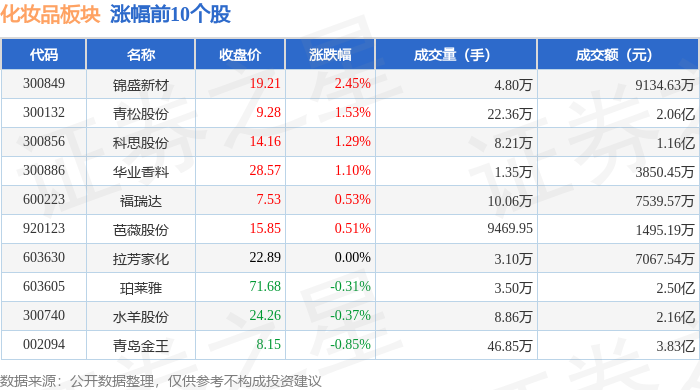
Market Overview - The cosmetics sector experienced a decline of 0.44% on January 22, with Betaini leading the drop [1] - The Shanghai Composite Index closed at 4122.58, up 0.14%, while the Shenzhen Component Index closed at 14327.05, up 0.5% [1] Individual Stock Performance - Notable gainers included: - Jingsheng New Materials (300849) with a closing price of 19.21, up 2.45% on a trading volume of 48,000 shares and a turnover of 91.35 million yuan [1] - Qingsong Co. (300132) closed at 9.28, up 1.53% with a trading volume of 223,600 shares and a turnover of 206 million yuan [1] - Kesheng Co. (300856) closed at 14.16, up 1.29% with a trading volume of 82,100 shares and a turnover of 116 million yuan [1] - Decliners included: - Betaini (300957) closed at 42.37, down 1.42% with a trading volume of 71,400 shares [2] - Jiahen Home (300955) closed at 37.20, down 1.30% with a trading volume of 19,000 shares and a turnover of 71.10 million yuan [2] - Shanghai Jahwa (600315) closed at 23.41, down 1.22% with a trading volume of 89,200 shares [2] Capital Flow Analysis - The cosmetics sector saw a net outflow of 54.88 million yuan from institutional investors, while retail investors experienced a net inflow of 82.39 million yuan [2] - Key stocks with significant capital flow include: - Kesheng Co. (300856) with a net inflow of 12.48 million yuan from institutional investors [3] - Qingsong Co. (300132) with a net inflow of 9.15 million yuan from institutional investors [3] - Shanghai Jahwa (600315) had a net inflow of 4.16 million yuan from institutional investors [3]
香氛、唇膏、护手霜,美妆产品在“包”上出道了
2 1 Shi Ji Jing Ji Bao Dao· 2026-01-22 08:01
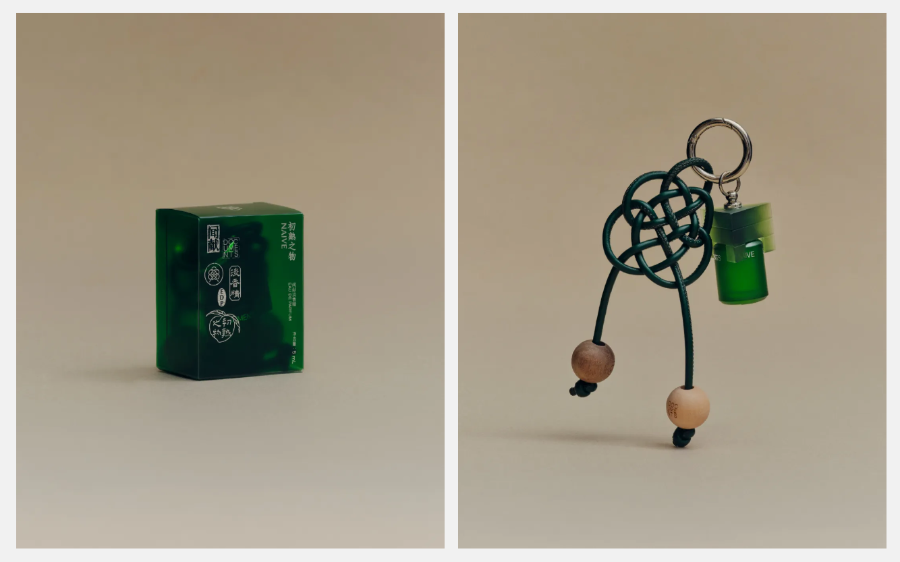
21世纪经济报道记者朱艺艺报道 从国产香氛品牌闻献的"Q香绳结包挂",到新锐个护品牌摇滚动物园联名茉莉奶白的挂链护手霜,越来越多美妆产品开始"跳 出"化妆包,争先在"包"上出道。 这些挂件式美妆产品,已从最初的香水香氛,逐渐渗透至唇膏、护手霜、防晒霜等多个品类,一方面实现美妆产品即时取用、 随时补护的场景自由,另一方面展现出年轻消费群体希望"被看见又不张扬"的个性表达。 在这股"包挂"热潮下,许多美妆品牌试图打开新的市场空间,寻求业绩增量,但目前来看,市场体量还未成气候。 美妆上"包" Z世代对于"颜值即正义"的消费心理,推动挂件式美妆产品悄然走红。 一个挂在"痛包"上的护手霜、一个引发朋友圈话题的戒指唇膏……护手霜、唇膏、防晒霜、粉饼等美妆产品,正通过挂链、环 扣、编绳等多种形态,与包具、衣服等日常物品搭配,成为年轻人新的社交货币。 根据用户说研究中心数据,2025年1月1日-12月31日,以"挂饰/挂绳/链条与护肤/彩妆/香水相关包装设计组合"为关键词的"挂饰 美妆"声量在近一年内增长迅速,声量破21.8万,同比增长高达41.8%。 这一数据印证了挂件美妆潮流的强劲势头,在这股"包挂"热潮下,不少品牌纷纷 ...