
泸州老窖

Search documents
张坤三季报:在“老登股”的坚守中业绩超预期,港股暴涨带来及时雨
市值风云· 2025-11-24 10:10
Core Viewpoint - The article highlights the impressive performance of Zhang Kun, a prominent fund manager, in the third quarter, with significant gains in his managed funds driven by a rebound in long-held "old economy stocks" and strong performance in Hong Kong tech and consumer stocks [3][4][9]. Fund Performance - Zhang Kun's managed fund, E Fund Asia Select Stock, saw a net value increase of 17.6% in Q3, while E Fund Quality Enterprises Three-Year Holding Mixed Fund grew by 15.8%, marking a recovery from previous quarters [4][5][7]. - Despite underperforming the CSI 300 index's 17.9% growth during the same period, Q3 was the best-performing quarter for these funds [7]. Stock Performance - Key stocks in Zhang Kun's portfolio, including Tencent Holdings, Alibaba-W, and JD Health, experienced substantial gains of 31.8%, 61.2%, and 54.7% respectively in Q3, contributing significantly to the fund's net value [9]. - The top holdings in his portfolio include Tencent Holdings (10.67%), Alibaba-W (10.67%), and Kweichow Moutai (10.45%), among others, with a total portfolio value of approximately 34.66 billion yuan [10]. Investment Strategy - Zhang Kun has consistently increased his holdings in liquor stocks, particularly Kweichow Moutai and Yum China, indicating a strong commitment to the consumer sector [11]. - He expressed a positive outlook on the long-term growth of Chinese consumption, predicting that China's consumption growth will outpace both GDP growth in China and globally [13][14]. Market Insights - The article emphasizes that China's per capita GDP remains below the global average, suggesting significant growth potential [14]. - It also notes that the proportion of household consumption to GDP in China is among the lowest globally, indicating a higher likelihood of increase rather than decrease [15]. - Zhang Kun highlighted the scale effect of China's unified market, which can amplify product, research, and sales advantages for companies operating within it [15]. Valuation Perspective - The article points out that the liquor sector, represented by "old economy stocks," is currently undervalued, with a price-to-earnings ratio at its lowest since 2020 and a dividend yield returning to a high of 4% [15]. - Zhang Kun's investment philosophy reflects a long-term perspective, balancing growth and defensive strategies, and emphasizing the importance of free cash flow generation for valuation [16].


11只白酒股上涨贵州茅台1452元/股收盘
Xin Lang Cai Jing· 2025-11-24 09:05
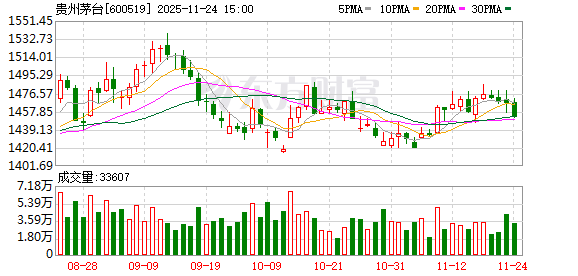
Group 1 - The core viewpoint of the article highlights the launch of a new platform "Wine Price Insider" by Sina Finance, which aims to provide real-time market prices for well-known liquor brands [1] - The Shanghai Composite Index closed at 3836.77 points, up 0.05%, while the liquor sector index closed at 2248.25 points, up 0.17%, with 11 liquor stocks experiencing gains [1] Group 2 - Individual stock performance shows that Kweichow Moutai closed at 1452.00 CNY per share, down 1.00%; Wuliangye closed at 118.52 CNY per share, down 0.97%; Shanxi Fenjiu closed at 192.40 CNY per share, down 0.31%; and Luzhou Laojiao closed at 132.92 CNY per share [2] - Citic Securities noted in its report that the food and beverage sector is currently undergoing a correction, with valuations at relatively low historical levels and weak market expectations [2] - The liquor industry is experiencing a bottoming out in sales, with Moutai addressing e-commerce chaos to stabilize price expectations, supported by strong brand power and performance to clear burdens [2]




白酒行业即时零售“热赛道”难解渠道“冷难题”?
Mei Ri Jing Ji Xin Wen· 2025-11-24 09:00
Core Insights - The annual "Double 11" shopping festival has highlighted the contrasting experiences of retailers in the liquor industry, with some like Li Mu opting to withdraw from instant retail platforms due to low profitability despite high sales volumes [1][2][4] - The liquor instant retail market is recognized as a new consumption trend, but many retailers remain cautious and hesitant to fully engage due to profitability concerns and operational challenges [2][4][16] Group 1: Market Dynamics - Instant retail platforms have reported explosive growth in sales during promotional periods, with significant year-on-year increases in transaction volumes for premium liquor brands [1][10] - The market for liquor instant retail is projected to grow substantially, with estimates suggesting a penetration rate increase from 1% in 2023 to 6% by 2027, potentially exceeding a market size of 100 billion [10][11] Group 2: Retailer Challenges - Many liquor retailers, especially smaller ones, are struggling with cash flow pressures and high inventory levels, leading to a situation where over 40% of distributors report financial strain [4][8] - Retailers face difficulties in maintaining profitability due to high logistics costs and platform commission fees, which can significantly erode margins [16][18] Group 3: Consumer Behavior - The rise of instant retail is driven by changing consumer habits, with younger consumers seeking convenience and quick delivery options for liquor purchases [9][13] - Instant retail has become a preferred choice for many consumers, with the ability to receive orders within 30 minutes enhancing the appeal of this shopping method [9][10] Group 4: Industry Perspectives - Industry experts acknowledge the potential of instant retail but caution that the current price competition and low-margin environment could disrupt traditional distribution channels and pricing structures [16][18] - There is a growing consensus that the future of instant retail in the liquor sector will require a shift from price competition to value creation, emphasizing the need for a sustainable business model that balances consumer demand with brand integrity [18][19]

11只白酒股上涨 贵州茅台1452元/股收盘
Bei Jing Shang Bao· 2025-11-24 08:05
Core Viewpoint - The liquor sector, particularly the baijiu industry, is experiencing a market correction with valuations at relatively low historical levels, while market expectations remain weak [2] Group 1: Market Performance - On November 24, the Shanghai Composite Index closed at 3836.77 points, up 0.05% [2] - The baijiu sector closed at 2248.25 points, increasing by 0.17%, with 11 baijiu stocks rising [2] Group 2: Individual Stock Performance - Kweichow Moutai closed at 1452.00 CNY per share, down 1.00% [2] - Wuliangye closed at 118.52 CNY per share, down 0.97% [2] - Shanxi Fenjiu closed at 192.40 CNY per share, down 0.31% [2] - Luzhou Laojiao closed at 132.92 CNY per share, down 0.95% [2] - Yanghe Brewery closed at 66.50 CNY per share, down 0.67% [2] Group 3: Industry Insights - CITIC Securities noted that the baijiu industry is currently in a phase of bottoming out, with ongoing sales struggles [2] - Moutai is addressing e-commerce chaos to stabilize price expectations, supported by performance-driven strategies and strong brand influence [2] - The industry is exploring new marketing models while leveraging strong operational capabilities to enhance channel performance [2]

A股白酒年报图鉴:最“有钱”的不是茅台 酒鬼酒等股价增长3倍的逻辑在哪
Mei Ri Jing Ji Xin Wen· 2025-11-24 07:53
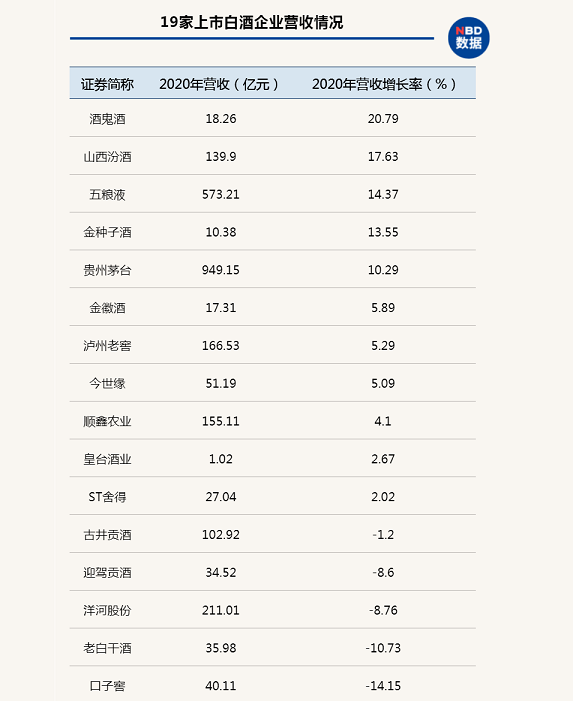
Core Insights - The Chinese liquor market, particularly the baijiu sector, experienced significant growth in 2020, with A-shares leading globally. The overall revenue for 19 listed baijiu companies reached 258.94 billion yuan, a year-on-year increase of 6.58% [1][5] - The net profit attributable to shareholders for these companies totaled 92.068 billion yuan, reflecting a growth of 11.95% compared to the previous year [1][5] - There is a notable divergence in performance among baijiu companies, with leading brands like Moutai and Wuliangye achieving double-digit growth, while some smaller brands faced significant declines [4][9] Revenue Performance - In 2020, 19 listed baijiu companies reported a total revenue of 258.94 billion yuan, with 11 companies showing positive growth and 8 experiencing negative growth [2][5] - The highest revenue growth was recorded by Jiugui Liquor at 20.79%, while Qingqing Qiao experienced a decline of 39.07%, marking a difference of 59.86 percentage points [2][3] - The top three companies by revenue were Moutai (94.915 billion yuan), Wuliangye (57.321 billion yuan), and Yanghe (21.101 billion yuan) [4] Profit Analysis - The six leading baijiu companies accounted for over 90% of the total profits in the sector, with Moutai alone contributing more than 36% of total revenue and over 50% of total profits [7][9] - Moutai's net profit reached 46.697 billion yuan, with a growth rate of 13.33%, while Wuliangye's net profit was 19.955 billion yuan, growing by 14.67% [6][7] - Jiugui Liquor showed remarkable performance with a net profit growth of 64.15%, while Qingqing Qiao reported a significant loss of 1.15 billion yuan [6][7] Market Dynamics - The pandemic initially impacted the baijiu industry negatively, but leading brands demonstrated resilience, with Moutai, Wuliangye, and Shanxi Fenjiu achieving substantial growth [9] - The disparity in performance is evident, with some companies like Shanxi Fenjiu and Jiugui Liquor seeing stock prices increase over threefold, while others struggled [9][11] - The overall tax contributions from the baijiu sector increased significantly, with a 48% rise in the first quarter of 2021 compared to the previous year, attributed to a recovery from the pandemic [14][15] Financial Health - As of March 2021, Wuliangye had the highest cash reserves among listed baijiu companies, totaling 73.38 billion yuan, while Moutai had approximately 50.743 billion yuan [17][18] - The financial strength of these companies is crucial for their ability to invest and expand in a competitive market [17] Compensation Trends - Moutai reported the highest average employee salary in the sector at over 300,000 yuan, while the lowest was at less than 52,000 yuan for Huangtai Liquor [19][20] - The management compensation for Moutai was relatively low compared to other companies, with total management salaries below 3.72 million yuan [21][23]

酒业遇冷并不奇怪, “老天爷赏饭”的时代该换玩法了
Sou Hu Cai Jing· 2025-11-24 07:37
Core Insights - The Chinese liquor industry is undergoing significant transformation due to structural contradictions that have emerged, particularly in the context of high inventory levels and changing consumer preferences [1][2][9] Group 1: Industry Challenges - The liquor industry is facing a surplus of production capacity that has not translated into market value, leading to high social inventory and a disconnect between production and actual consumption [2][4] - The traditional distribution model, characterized by a "press goods - collect payments" logic, is no longer sustainable, necessitating a shift towards a new collaborative model between manufacturers and distributors [5][8] - The average inventory turnover days in the industry are alarmingly high at 900 days, indicating inefficiencies in the supply chain [8] Group 2: Changing Consumer Behavior - Traditional consumption scenarios in the liquor industry, such as business banquets and gift-giving, are shrinking due to changing social norms and the rise of younger consumers who prefer casual drinking experiences [9][11] - Younger consumers are increasingly viewing traditional liquor brands as outdated, leading to a disconnect between the industry's offerings and the preferences of the new generation [15][18] - The success of brands like Bubble Mart highlights a shift in consumer values from status symbols to emotional connections, indicating a need for the liquor industry to adapt to these new consumer expectations [20][21] Group 3: Innovative Strategies - Leading liquor companies are beginning to explore new distribution strategies, such as trial sales and commission-based models, to better align with market demands and reduce inventory risks [7][8] - Innovative marketing approaches, such as integrating liquor into social and artistic experiences, are being adopted to attract younger consumers and create new consumption scenarios [13][14] - The industry's future growth lies in understanding and catering to the emotional needs of consumers, moving away from traditional identity-based marketing to a focus on lifestyle and personal experiences [21]
泸州老窖旗下金舵投资增资至约31.7亿
Sou Hu Cai Jing· 2025-11-24 07:34
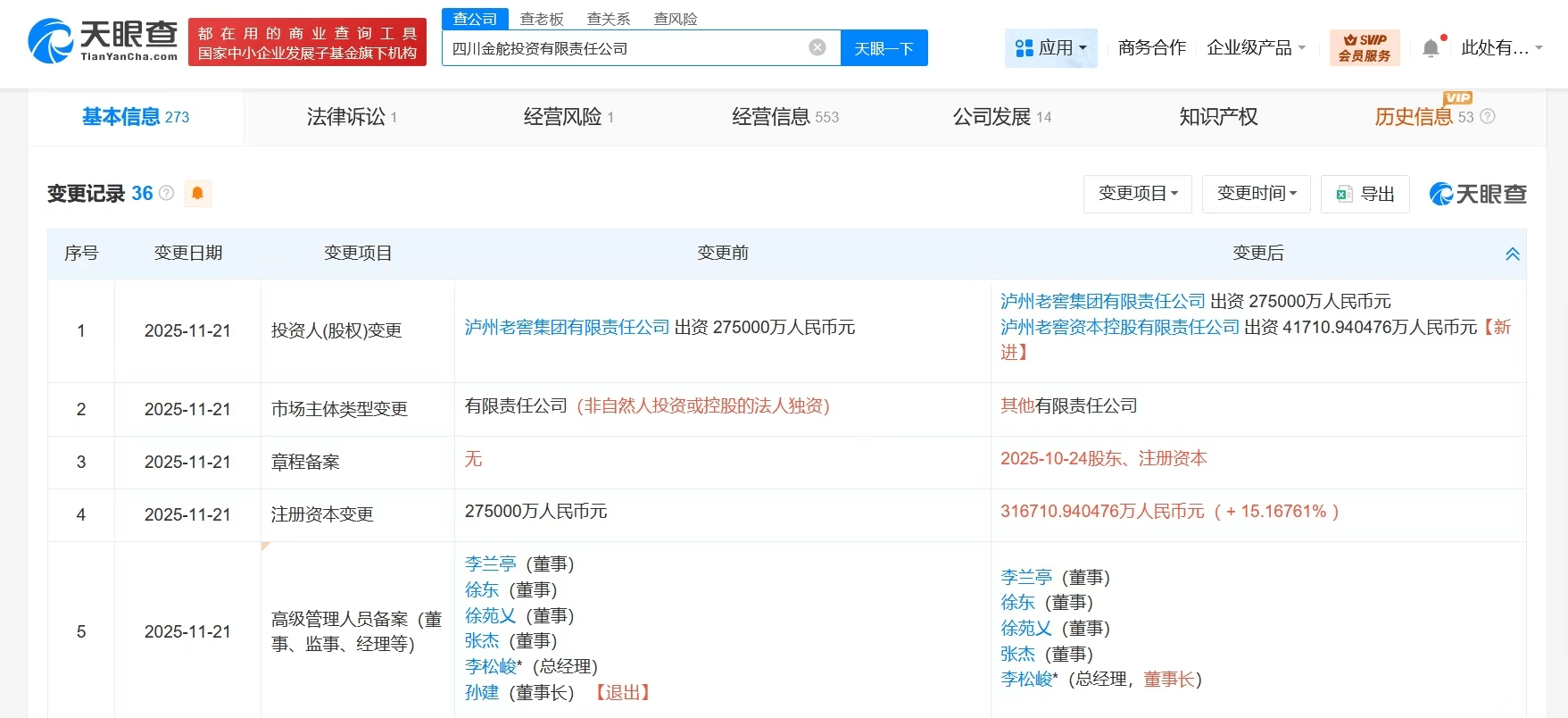
Group 1 - The core point of the article is that Sichuan Jinjue Investment Co., Ltd. has undergone a business change, with Luzhou Laojiao Capital Holding Co., Ltd. becoming a new shareholder and the registered capital increasing from 2.75 billion RMB to approximately 3.17 billion RMB, representing a growth of about 15% [1] - The company was established in January 2017 and is engaged in investment and asset management, equity investment, debt investment, corporate mergers and acquisitions, investment information consulting, and corporate management consulting [1] - The legal representative of Sichuan Jinjue Investment Co., Ltd. is Li Songjun, who has taken over the position of chairman from Sun Jian [1] Group 2 - The shareholder information indicates that the company is now jointly held by Luzhou Laojiao Group Co., Ltd. and Luzhou Laojiao Capital Holding Co., Ltd. [1] - The business change was officially recorded on November 21, 2025, which included changes in the investor (equity) and the market entity type [2] - The previous registered capital was 2.75 billion RMB, and the change in senior management included the exit of Sun Jian as chairman [2]
食品饮料行业周报:大众品成长优先,白酒预期先行-20251124
Haitong Securities International· 2025-11-24 07:10
Investment Rating - Investment advice indicates a focus on growth and supply-demand inflection points, with a positive outlook for the sector driven by recent CPI data [5][18]. Core Insights - The report emphasizes the recovery of traditional consumer leaders with strong long-term growth certainty, highlighting Yili's shareholder return plan as a sign of stability [1][10]. - The baijiu sector is expected to benefit from market style shifts, with notable sales growth during promotional events, indicating a potential recovery in demand [6][19]. - Consumer goods are showing structural prosperity, particularly in beverages, snacks, and food ingredients, with companies that innovate and expand channels having growth advantages [8][20]. Summary by Sections Investment Recommendations - Focus on growth opportunities in the baijiu sector, with key companies such as Shanxi Xinghuacun Fen Wine Factory, Gujing Distillery, and stable targets like Kweichow Moutai and Wuliangye [5][18]. - Highlighting structural growth in beverages with a focus on companies like Eastroc Beverage and Nongfu Spring, as well as low valuation and high dividend stocks such as China Foods and Tingyi [5][18]. - Emphasis on snack and food ingredient companies like Shandong Bailong Chuangyuan and Three Squirrels, alongside beer companies like Yanjing Brewery and Tsingtao Brewery [5][18]. Baijiu Sector Analysis - The baijiu market is experiencing a bottoming phase, with improved expectations driven by recent CPI data and accelerated inventory clearance [6][19]. - Notable sales growth of 18% year-on-year during the Double 11 promotion for alcohol products, with major brands showing double-digit growth [6][19]. Consumer Goods Overview - The consumer goods sector is expected to recover before the baijiu sector, with clear structural differences and growth potential in beverages, snacks, and health products [8][20]. - Yili's announcement of a dividend ratio of at least 75% for 2025-2027, with a per-share dividend of no less than RMB 1.22, reflects a commitment to shareholder returns [10][20].

机构称白酒板块已接近左侧布局区间,消费ETF嘉实(512600)一键布局消费复苏行情
Xin Lang Cai Jing· 2025-11-24 05:26
开源证券指出,展望2026年全年,食品饮料行业主线是底部回暖复苏,复苏节奏及力度与宏观经济相关 性较大。产业层面白酒企业已进入深度调整期,行业需求下行的结果已由终端经渠道传导至厂家,体现 为酒企公司报表业绩增速放缓。当前白酒板块已接近左侧布局区间,当前可逐步开展配置,优先选择业 绩出清或底部确认标的。 数据显示,截至2025年10月31日,中证主要消费指数前十大权重股分别为贵州茅台、五粮液、伊利股 份、牧原股份、泸州老窖、温氏股份、山西汾酒、海天味业、东鹏饮料、海大集团,前十大权重股合计 占比68.28%。 截至2025年11月24日 13:02,中证主要消费指数下跌0.16%。成分股方面涨跌互现,牧原股份领涨 2.61%,新诺威上涨1.65%,华熙生物上涨1.51%;梅花生物领跌,海南橡胶、中粮糖业跟跌。 展望后市,湘财证券表示,三季报收官,白酒持续出清,压力释放。目前板块估值分位数处于较低位 置,估值相对具有性价比,建议把握绩优股的alpha机遇。消费变革下,既要关注品类、渠道、消费场 景的创新机会,又要关注传统消费领域中积极求变及低估值的配置机会。 消费ETF嘉实(512600)跟踪中证主要消费指数,该 ...
通胀温和回升,食品饮料板块迎来价值重估契机
Mei Ri Jing Ji Xin Wen· 2025-11-24 05:24
近期公布的宏观经济数据为市场注入了一剂强心针。10月份CPI同比增速转正,核心CPI同比涨幅更是 连续六个月扩大,清晰地表明国内物价水平正步入企稳回升的通道。专家普遍认为,未来CPI将保持温 和上涨,尤其以食品和核心服务价格的复苏势头最为明确。 这一宏观背景为食品饮料板块的估值修复提供了坚实的逻辑基础。作为与居民消费价格关系最为直接的 行业,食品饮料企业将直接受益于整体价格中枢的上行,这有助于改善企业盈利能力与毛利率水平。回 顾8月以来的物价走势,从CPI同比降幅收窄到转正,经济内生动能的修复正在为消费板块创造有利环 境。 此前,由于市场对消费复苏力度的担忧,食品饮料板块经历了长时间的调整,估值已回落至历史低位。 如今,在宏观"暖风"的吹拂下,板块的防御属性与修复潜力凸显,其价值重估的窗口期正在打开。投资 者应关注这一宏观趋势性变化,把握板块在悲观情绪消退后的投资机遇。 食品饮料ETF(515170)跟踪中证细分食品饮料产业主题指数,聚焦白酒、饮料乳品、调味发酵品等高壁 垒、强韧性板块,前十大成分股囊括"茅五泸汾洋",帮助投资者一键配置"吃喝板块"核心资产。相较于 其成分股动辄数万、数十万的最低投资门槛,ET ...