成长主线

Search documents
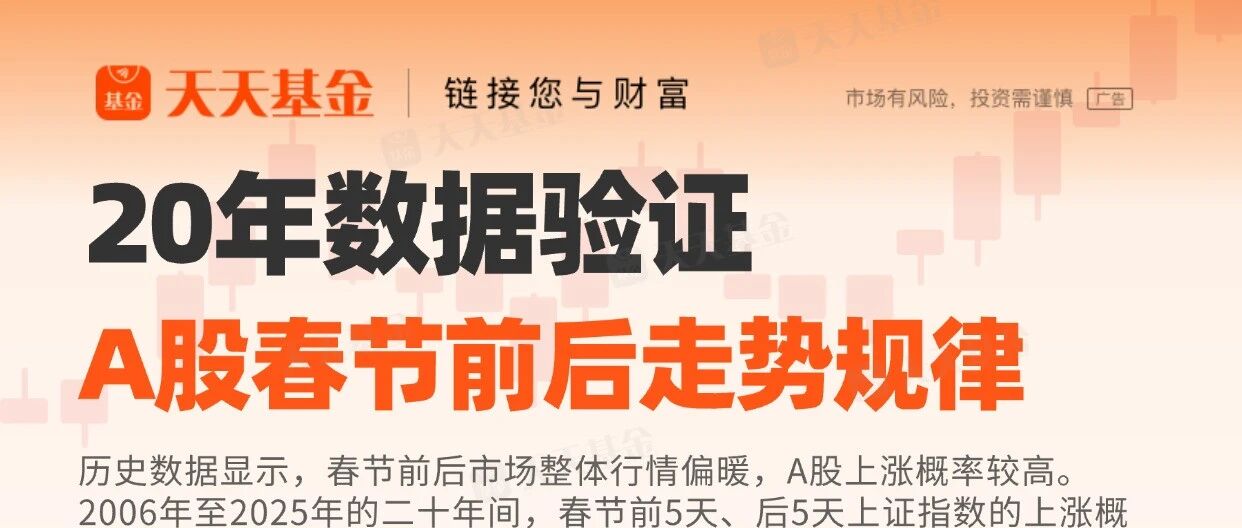
20年数据验证,春节前后的市场行情有何规律?
天天基金网· 2026-02-05 08:43
Core Viewpoint - The article discusses the "Spring Festival Effect" in the A-share market, highlighting the historical performance of the Shanghai Composite Index before and after the Spring Festival, indicating a tendency for positive market movements during this period [9]. Group 1: Historical Performance Data - Historical data from 2006 to 2025 shows that the probability of the Shanghai Composite Index rising in the five days before the Spring Festival is 80%, while the probability for the five days after is 75% [9]. - Specific annual performance data indicates fluctuations, with notable years such as 2024 showing a 3.43% increase in the five days before the festival and a 4.85% increase in the five days after [2][3]. Group 2: Market Outlook and Analysis - Analysts predict that the A-share market will experience structural fluctuations in the short term, with expectations of stronger performance in major indices after the Spring Festival compared to before [11]. - The market is currently characterized by cautious trading sentiment as investors focus on verifying company performance and fundamental conditions [5][11]. - The article emphasizes the importance of understanding the "Spring Festival Effect" for developing reasonable investment strategies, suggesting that investors should avoid panic selling during pre-festival adjustments [10]. Group 3: Sector and Investment Strategy - Investment firms suggest that sectors such as non-bank financials, metals, and automotive are expected to perform well, with a focus on structural opportunities during the pre-festival market rotation [11][12]. - The article highlights that the current market conditions may lead to a short-term correction before a potential rebound post-festival, with a recommendation for investors to hold positions through the holiday [12].

光大策略:关注业绩,持股过节,春节后A股或迎来新一轮的上涨行情
Xin Lang Cai Jing· 2026-02-01 11:42
Group 1 - The A-share market experienced a volatile upward trend in January 2026, with major indices showing gains, particularly the ChiNext 50 and CSI 500, while the Shanghai Composite Index rose by 3.8% [6][12][22] - The market is expected to enter a short-term correction phase before the Spring Festival, influenced by tightening liquidity and reduced trading enthusiasm among investors [4][38] - Historical data indicates that the A-share market typically performs better in the 20 trading days following the Spring Festival, with a 75% probability of gains compared to less than 45% before the holiday [38][40] Group 2 - In the upcoming spring market, small-cap stocks are anticipated to outperform, driven by increased risk appetite and the influx of retail investor capital [52][54] - The focus should be on growth and cyclical sectors, with industries such as electronics, power equipment, machinery, non-ferrous metals, and communications expected to perform well in February [2][54] - The Hong Kong market is advised to adopt a "growth + value" strategy, benefiting from earnings recovery, improved liquidity, and supportive policies [2][65] Group 3 - The spring market is characterized by a dual focus on growth and cyclical sectors, with historical trends showing that both categories often perform well during this period [54][61] - The technology sector, particularly AI and commercial aerospace, is highlighted as a key area for investment, with potential catalysts expected to drive performance [61][64] - The overall sentiment in the market is shifting from being driven by capital to being driven by earnings, indicating a transition towards long-term value investing [2][65]

公募基金年底发行大战如火如荼
Zhong Guo Zheng Quan Bao· 2025-12-03 20:28
Group 1 - The issuance of new funds remains strong in December, with over 60 products starting or about to start issuance, and a total of more than 1400 new funds issued this year, surpassing last year's total of 1143 and reaching a three-year high [1][2] - Equity products are the main focus of new fund issuances, with 26 stock funds and 16 mixed funds launched in December, including several managed by well-known fund managers [1][2] - The majority of new funds are being issued by large and medium-sized institutions, with several companies launching multiple new products simultaneously [2][3] Group 2 - The total issuance of new funds this year has reached 1450, with a combined share of 10,359.09 million units, marking a significant increase compared to last year [2][3] - Among the newly issued funds, 795 are stock funds and 251 are equity-mixed funds, accounting for over 70% of the total, with index products dominating the market [3] - The public fund industry is innovating continuously, introducing various new products such as credit bond ETFs and floating rate funds, enhancing the investment landscape for investors [3] Group 3 - The outlook for the market remains positive, with expectations of economic improvement and a downward trend in risk-free interest rates, although short-term disturbances may still exist [4] - Fund companies suggest a balanced allocation strategy to navigate market volatility, with recommendations to increase exposure to stable dividend assets and sectors with growth potential [4] - The bond market is expected to maintain a narrow fluctuation pattern in the short term, influenced by new sales regulations and interest rate expectations [4]
食品饮料行业周报:大众品成长优先,白酒预期先行-20251124
Haitong Securities International· 2025-11-24 07:10
Investment Rating - Investment advice indicates a focus on growth and supply-demand inflection points, with a positive outlook for the sector driven by recent CPI data [5][18]. Core Insights - The report emphasizes the recovery of traditional consumer leaders with strong long-term growth certainty, highlighting Yili's shareholder return plan as a sign of stability [1][10]. - The baijiu sector is expected to benefit from market style shifts, with notable sales growth during promotional events, indicating a potential recovery in demand [6][19]. - Consumer goods are showing structural prosperity, particularly in beverages, snacks, and food ingredients, with companies that innovate and expand channels having growth advantages [8][20]. Summary by Sections Investment Recommendations - Focus on growth opportunities in the baijiu sector, with key companies such as Shanxi Xinghuacun Fen Wine Factory, Gujing Distillery, and stable targets like Kweichow Moutai and Wuliangye [5][18]. - Highlighting structural growth in beverages with a focus on companies like Eastroc Beverage and Nongfu Spring, as well as low valuation and high dividend stocks such as China Foods and Tingyi [5][18]. - Emphasis on snack and food ingredient companies like Shandong Bailong Chuangyuan and Three Squirrels, alongside beer companies like Yanjing Brewery and Tsingtao Brewery [5][18]. Baijiu Sector Analysis - The baijiu market is experiencing a bottoming phase, with improved expectations driven by recent CPI data and accelerated inventory clearance [6][19]. - Notable sales growth of 18% year-on-year during the Double 11 promotion for alcohol products, with major brands showing double-digit growth [6][19]. Consumer Goods Overview - The consumer goods sector is expected to recover before the baijiu sector, with clear structural differences and growth potential in beverages, snacks, and health products [8][20]. - Yili's announcement of a dividend ratio of at least 75% for 2025-2027, with a per-share dividend of no less than RMB 1.22, reflects a commitment to shareholder returns [10][20].





【策略】等待业绩破局——2025年10月策略观点(张宇生/郭磊/王国兴)
光大证券研究· 2025-10-09 23:08
Core Viewpoints - The market may enter a phase of wide fluctuations, with major indices showing mixed performance in September. The current market still holds certain value based on equity risk premium, supported by a continuous "profit-making effect" that attracts short-term capital inflows. Individual investors are still in the process of entering the market, and there may be an increase in participation through funds and wealth management products in the future, although the inflow rate of medium to long-term capital may slow down, it remains a stabilizer for the market [4][5]. - Corporate earnings are still stabilizing, with the economic recovery in the third quarter progressing relatively slowly. However, some sectors have shown improvement, such as the cumulative year-on-year growth rate of industrial enterprise profits from January to August rebounding and a narrowing decline in the year-on-year PPI in August. Domestic exports are expected to remain resilient, and the sustainability of domestic demand improvement may exceed expectations. Overall, with policy support, A-share earnings are expected to see slight recovery in the fourth quarter, adding new momentum to the market [5][6]. - In a liquidity-driven market, TMT (Technology, Media, and Telecommunications) is likely to become a main line, with many catalysts present in this sector. If the market shifts to a fundamental-driven phase, advanced manufacturing should be a key focus. Additionally, if market fluctuations occur, attention should be paid to sectors that are lagging behind, such as high-dividend and consumer sectors [6][7]. Market Style and Industry Recommendations - The market is expected to rotate between "weak reality, strong sentiment" and "strong reality, strong sentiment," corresponding to the rotation of growth and balanced styles. In October, industry allocation should focus on electronics, power equipment, communications, media, and machinery equipment [7]. - Although the Hong Kong stock market has performed well this year, it still holds certain value. In addition to the inflow of southbound funds, a potential interest rate cut by the Federal Reserve may further enhance the external liquidity environment, leading to good performance of the index. Focus should be on Hong Kong stocks in the internet, automotive, and service consumption sectors [8].