中国国航

Search documents
港股收评:探底回升!新消费股涨势继续,半导体股低迷
Ge Long Hui· 2025-11-11 08:45
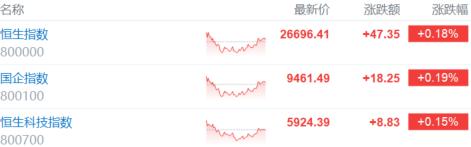
Market Overview - The Hong Kong stock market showed a rebound after hitting a low, with the Hang Seng Index closing up 0.18% at 26,696 points, the Hang Seng China Enterprises Index up 0.19%, and the Hang Seng Tech Index up 0.15% [1][2] - Overall market sentiment remained stable, with various sectors experiencing mixed performances [1] Sector Performance - Large tech stocks had mixed results, with Baidu rising over 2%, while Alibaba, Bilibili, and Meituan fell over 1% [4] - Consumer stocks, including retail, pork, and dining sectors, continued to rise, while semiconductor stocks generally performed weakly [2][4] - The film industry saw significant gains, with Huayi Brothers rising over 16% and Cat's Eye Entertainment up over 5%, driven by upcoming film releases [6][7] Investment Insights - The AI technology investment landscape is growing, with expectations for significant capital expenditure increases among major tech firms [4] - New consumption trends are emerging, focusing on brand expansion, emotional value, functional value, and channel transformation [5] - The aviation sector is expected to enter a super cycle, with high passenger load factors and low ticket prices driving profitability [9] Notable Stock Movements - Xpeng Motors surged over 17%, while other new consumption stocks like Nayuki Tea and Xiaomi also saw gains [6][5] - Property management and real estate stocks strengthened, with Kaisa Group rising over 5% [8] - Semiconductor stocks faced declines, with Huahong Semiconductor down over 3% and SMIC down over 2% [10] Capital Flows - Southbound funds recorded a net inflow of HKD 4.467 billion, indicating strong interest in Hong Kong stocks [12] Future Outlook - Analysts suggest that the Hong Kong market may reach new highs in the medium term, driven by increased capital inflows and the concentration of quality assets [13]

航空机场板块11月11日涨0.27%,吉祥航空领涨,主力资金净流出1.32亿元
Zheng Xing Xing Ye Ri Bao· 2025-11-11 08:39
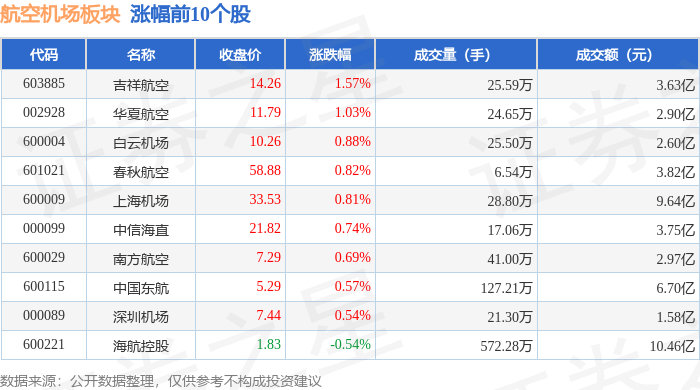
Core Insights - The aviation and airport sector saw a slight increase of 0.27% on November 11, with Juneyao Airlines leading the gains [1] - The Shanghai Composite Index closed at 4002.76, down 0.39%, while the Shenzhen Component Index closed at 13289.0, down 1.03% [1] Stock Performance - Juneyao Airlines (603885) closed at 14.26, up 1.57% with a trading volume of 255,900 shares and a transaction value of 363 million yuan [1] - Xiamen Airport (600897) experienced a decline of 2.26%, closing at 16.85 with a trading volume of 87,700 shares and a transaction value of 148 million yuan [2] - China Eastern Airlines (600115) closed at 5.29, up 0.57% with a trading volume of 1,272,100 shares and a transaction value of 670 million yuan [2] Capital Flow - The aviation and airport sector experienced a net outflow of 132 million yuan from institutional investors, while retail investors saw a net inflow of 1.29 billion yuan [2][3] - China Eastern Airlines had a net inflow of 71.39 million yuan from institutional investors, but a net outflow of 39.65 million yuan from retail investors [3] - Xiamen Airport saw a net outflow of 12.81 million yuan from institutional investors, while retail investors contributed a net inflow of 12.27 million yuan [3]






两大航司8年“联姻”落幕,一场没有输家的告别?
Guan Cha Zhe Wang· 2025-11-11 08:31
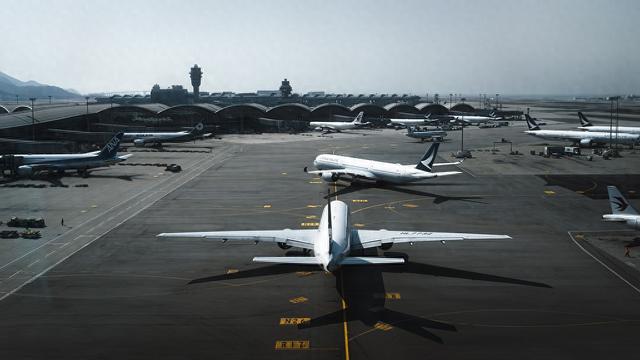
Core Viewpoint - Qatar Airways and Cathay Pacific Airways have officially ended their nearly eight-year equity investment relationship, with Cathay Pacific planning to repurchase 643 million shares from Qatar Airways at a price of HKD 10.8374 per share, totaling approximately HKD 69.69 billion [1][3]. Summary by Sections Transaction Details - Cathay Pacific will buy back 9.57% of its shares from Qatar Airways for a total of approximately HKD 69.69 billion (around RMB 63.83 billion) using internal funds and existing credit lines [1][3]. - The buyback is intended to facilitate Qatar Airways' orderly exit and minimize potential market volatility from share sales [1][3]. Financial Performance - Cathay Pacific reported a net profit of HKD 97.9 billion (approximately RMB 89.6 billion) in 2023, with projections of HKD 98.88 billion (approximately RMB 90.49 billion) for 2024 and HKD 36.51 billion (approximately RMB 32.59 billion) for the first half of 2025 [3]. - The stock price of Cathay Pacific has increased by over 31% since 2025 [3]. Shareholder Structure - Post-buyback, the combined shareholding of the two main shareholders, Swire Group and Air China, is expected to rise to nearly 80% [5]. - Air China's stake will increase from 28.74% to 31.78%, surpassing the 30% threshold set by the Hong Kong Stock Exchange [5]. Market Strategy and Future Outlook - Analysts suggest that Qatar Airways' decision to divest may align with its strategy to focus on emerging markets in Africa and Australia, as well as a reassessment of its investments in regional airlines [4]. - The buyback may provide Cathay Pacific with a more concentrated shareholder structure, enhancing strategic flexibility while facing global aviation industry challenges [6]. Stock Market Reaction - Following the announcement of the buyback plan, Cathay Pacific's stock price has shown an upward trend, closing at HKD 11.84 on November 10 [6].

港股航空股继续上涨行情,中国东方航空盘初涨超4%
Mei Ri Jing Ji Xin Wen· 2025-11-11 02:09
Core Viewpoint - The Hong Kong aviation stocks continue to rise, with China Eastern Airlines hitting a new high, indicating positive market sentiment in the aviation sector [1] Group 1: Company Performance - China Eastern Airlines saw an increase of over 4% in early trading, reaching a new phase high [1] - China Southern Airlines is up by 1.5% [1] - Air China has increased by 1% [1] - Cathay Pacific is also experiencing a rise [1]
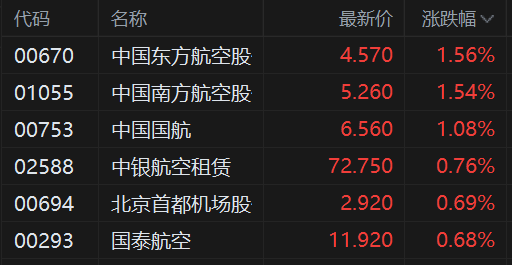
港股异动丨航空股继续上涨 东航盘初涨超4%续刷阶段新高 机构指航空业超级周期或将开启
Ge Long Hui A P P· 2025-11-11 02:01
Group 1 - The core viewpoint of the article highlights a bullish trend in the Hong Kong aviation sector, with significant stock price increases for major airlines such as China Eastern Airlines and China Southern Airlines, indicating a potential super cycle in the aviation industry [1] - Cathay Pacific's research report maintains a bullish outlook on aviation fuel transportation, predicting that the industry will experience record high profitability in Q4, driven by high passenger load factors and low ticket prices [1] - The report suggests that the recent seasonal transition has had a weaker impact than in previous years, with business travel remaining active and supporting a year-on-year increase in both volume and price [1] Group 2 - The article mentions that the U.S. government is likely to end its shutdown, with President Trump stating that all air traffic controllers must return to work immediately, which could positively impact the aviation sector [1] - The stock performance of various airlines is noted, with China Eastern Airlines up 4.56%, China Southern Airlines up 1.54%, and Air China up 1.08%, reflecting strong market sentiment [1] - The MACD golden cross signal formation indicates a positive trend for these stocks, suggesting continued upward momentum in the aviation sector [1]
跨越拐点的顺周期航空,新变化新看点
2025-11-11 01:01
Summary of Airline Industry Conference Call Industry Overview - The airline industry is experiencing a recovery in fundamentals, outperforming other cyclical consumer sectors, with continuous profit improvement in the first three quarters of the year, and an expectation of profitability for the entire year due to declining oil prices and increased passenger load factors [1][3][5]. Key Factors Influencing Profitability - Key factors affecting airline profitability include ticket prices, passenger load factors, and oil prices. A 1% increase in passenger load factor has a more significant impact on overall industry profitability than a 1% increase in ticket prices [1][5]. - The decline in Brent crude oil prices has contributed to lower fuel costs, aiding profitability [1][5]. Future Expectations - Despite a challenging macro environment, the airline industry has achieved profitability, indicating substantial future growth potential. Ticket prices are expected to rise in 2026, further driving profit growth [1][6]. - The current macro environment shows that travelers are price-sensitive, leading to cautious pricing strategies. The turning point in supply and demand is expected to manifest more in passenger load factors rather than ticket price increases in 2025, with a higher likelihood of price increases in 2026 [1][7]. Supply and Demand Dynamics - Since 2019, the fleet size of airlines has expanded by over 20%. Currently, demand growth exceeds supply growth, which may eventually reflect in ticket prices [1][8]. - The recovery of international flights to 85% capacity has become a significant growth factor, with airlines reallocating more capacity to international markets, resulting in tighter domestic supply [3][9]. Ticket Price Trends - In 2025, ticket prices showed strong performance during the off-peak season, while peak season prices were weaker compared to previous years. This trend indicates a gradual recovery in business travel demand [11]. - The correlation between domestic ticket prices and commercial real estate metrics in major cities suggests that business travel activity significantly influences ticket pricing [11]. Historical Performance and Future Outlook - Historically, airline stocks have performed well in the fourth quarter, with 14 out of the last 20 years showing increases, often driven by macroeconomic expectations or specific policy changes [12]. - The fundamentals of airline stocks are gradually becoming clearer, with a significant increase in operational scale, indicating a more optimistic profitability outlook for the next two to three years [13][16]. Investment Strategy - For investment, airlines with relatively low valuations and lagging performance, such as China Southern Airlines and Spring Airlines, are recommended. For those seeking cyclical elasticity, Air China and China Eastern Airlines are preferred due to their significant marginal improvements and greater profit elasticity [18]. Conclusion - The airline industry is positioned for growth, with improving fundamentals, a favorable supply-demand dynamic, and potential for increased ticket prices in the near future. Investors are encouraged to consider cyclical stocks within this sector as they may offer substantial returns in the upcoming quarters [1][6][17].
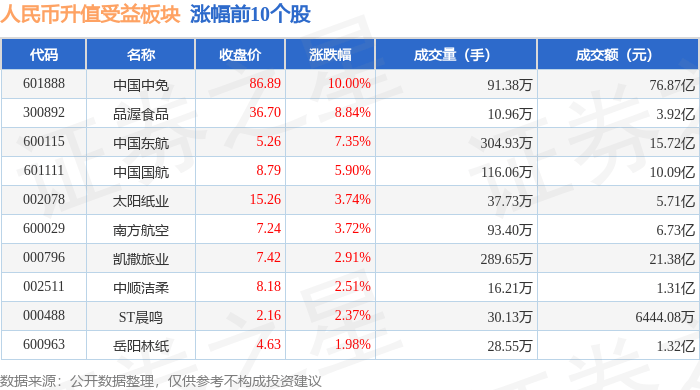
人民币升值受益板块11月10日涨3.62%,中国中免领涨,主力资金净流入8.76亿元
Sou Hu Cai Jing· 2025-11-10 09:04
Core Insights - The appreciation of the Renminbi has led to a significant increase in the related sectors, with a 3.62% rise in the Renminbi appreciation beneficiary sector on the previous trading day [1] - Major stocks benefiting from the Renminbi appreciation include China Duty Free Group, which surged by 10% [1] Market Performance - The Shanghai Composite Index closed at 4018.6, up 0.53%, while the Shenzhen Component Index closed at 13427.61, up 0.18% [1] - Key stocks and their performance include: - China Duty Free Group (601888): Closed at 86.89, up 10.00% with a trading volume of 913,800 shares and a transaction value of 7.687 billion [1] - Pinwa Food (300892): Closed at 36.70, up 8.84% with a trading volume of 109,600 shares and a transaction value of 392 million [1] - China Eastern Airlines (600115): Closed at 5.26, up 7.35% with a trading volume of 3,049,300 shares and a transaction value of 1.572 billion [1] Capital Flow - The Renminbi appreciation beneficiary sector saw a net inflow of 876 million in main funds, while retail investors experienced a net outflow of 392 million [2][3] - Specific stock capital flows include: - China Duty Free Group: Main funds net inflow of 113.8 million, retail net outflow of 45.2 million [3] - Sun Paper (002078): Main funds net inflow of 85.86 million, retail net outflow of 52.24 million [3] - China National Airlines (601111): Main funds net inflow of 28.98 million, retail net outflow of 57.41 million [3]
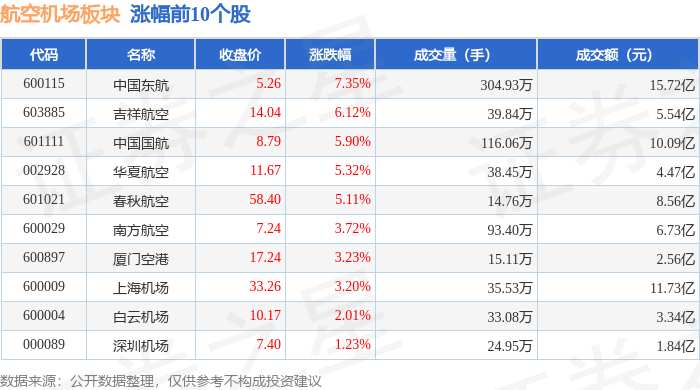
航空机场板块11月10日涨4.31%,中国东航领涨,主力资金净流出3.13亿元
Zheng Xing Xing Ye Ri Bao· 2025-11-10 08:48
Core Insights - The aviation and airport sector experienced a significant increase of 4.31% on November 10, with China Eastern Airlines leading the gains [1] - The Shanghai Composite Index closed at 4018.6, up 0.53%, while the Shenzhen Component Index closed at 13427.61, up 0.18% [1] Stock Performance - China Eastern Airlines (600115) closed at 5.26, with a rise of 7.35% and a trading volume of 3.0493 million shares, amounting to 1.572 billion yuan [1] - Other notable performers included: - Juneyao Airlines (603885) at 14.04, up 6.12% [1] - Air China (601111) at 8.79, up 5.90% [1] - China Southern Airlines (600029) at 7.24, up 3.72% [1] Capital Flow - The aviation and airport sector saw a net outflow of 313 million yuan from institutional investors, while retail investors contributed a net inflow of 7.8603 million yuan [1] - The detailed capital flow for selected stocks included: - HNA Holding (600221) with a net inflow of 80.7268 million yuan from institutional investors [2] - Shanghai Airport (600009) with a net inflow of 68.0565 million yuan from institutional investors [2] - China Southern Airlines (600029) with a net outflow of 48.7018 million yuan from institutional investors [2]

智通港股52周新高、新低统计|11月10日



智通财经网· 2025-11-10 08:42
Core Insights - As of November 10, a total of 108 stocks reached their 52-week highs, with notable performers including Taijin Holdings (08321), OKURA HOLDINGS (01655), and Hejia Holdings (00704) achieving high rates of 125.00%, 84.90%, and 53.57% respectively [1] Summary by Category 52-Week Highs - Taijin Holdings (08321) closed at 0.620 with a peak price of 0.900, marking a 125.00% increase - OKURA HOLDINGS (01655) reached a closing price of 0.280 and a high of 0.355, reflecting an 84.90% rise - Hejia Holdings (00704) had a closing price of 0.345 and a peak of 0.430, showing a 53.57% increase - Other notable stocks include Sanhe Chemical (00301) with a 41.67% increase and Aide New Energy (02623) with a 36.25% rise [1] 52-Week Lows - Wangshan Wangshui-B (02630) recorded a closing price of 52.850 and a low of 51.000, resulting in a -21.84% decrease - Eight Horses Tea (06980) had a closing price of 52.850 and a low of 51.100, reflecting a -10.98% decline - New Enjoy Times (08519) reached a low of 0.270, marking a -10.00% drop - Other significant declines include Jiujiang Bank (06190) at -8.99% and Kun Group (00924) at -6.98% [3][4]
纪念“两航起义”76周年主题活动在天津举行
Zhong Guo Xin Wen Wang· 2025-11-10 08:32
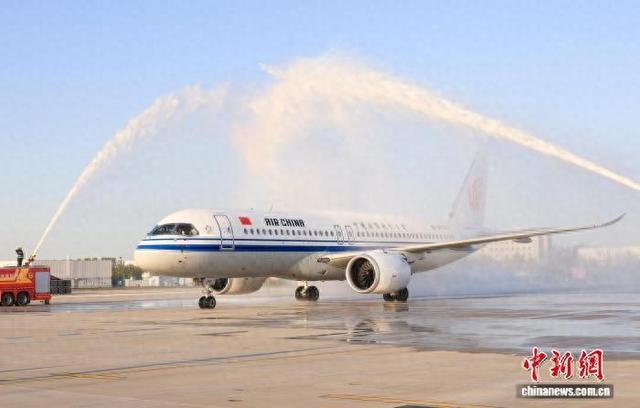
中新网天津11月10日电 (记者 贾天勇)9日,为纪念"两航起义"76周年,传承弘扬爱国主义精神,"翼展爱 国光辉载旗荣耀北飞——国航C919重飞'两航起义'北飞光辉航程"系列主题活动在天津举行。此次活动 通过国航C919重飞"两航起义"航线主题航班和天津"两航起义"展馆首展"空地联动",追溯新中国民航事 业的开端,致敬"两航起义"的爱国壮举,礼赞中国民航事业的先驱者与奠基人,生动呈现了新时代民航 建设的跨越式发展。 由原先张 贵庄机场候机楼改建而成的两航起义展馆外景。记者 贾天勇 摄 飞机到达后不久,由天津张贵庄老候机楼改建而成的"两航起义"展馆进行首展启幕,来自中国民用航空 局、天津市政府、国务院国资委、香港爱国主义教育工作小组、香港民航处、香港"两航"联谊会、香港 民航工会、中航集团及媒体代表等180人共同参加首展。中国航空集团有限公司党组书记刘铁祥,香港 爱国主义教育工作小组成员邝美云,香港民航处处长廖志勇,中国民用航空局总飞行师熊杰等嘉宾致 辞。仪式上播放了"两航起义"历史短片,多位两航起义亲历者的后代捐赠了珍贵历史物件,两位年近百 岁的起义亲历者王惠德先生、丁裕康先生亲临现场,深情回望那段峥嵘岁月 ...