
宁波银行

Search documents
厦门金龙汽车集团股份有限公司关于2025年7-9月份委托理财情况的公告
Zhong Guo Zheng Quan Bao - Zhong Zheng Wang· 2025-10-21 10:42
Core Viewpoint - The company aims to enhance the efficiency of fund utilization and reduce financial costs through entrusted wealth management while ensuring the safety of funds [5][4]. Group 1: Overview of Entrusted Wealth Management - The total amount for entrusted wealth management is 498,900 million yuan [3]. - The entrusted wealth management products include various structured deposits linked to gold and exchange rates from multiple banks [3]. - The duration for entrusted wealth management is within one year [4]. Group 2: Purpose and Source of Funds - The purpose of the entrusted wealth management is to ensure fund safety while improving fund utilization efficiency and obtaining certain investment returns [5]. - The source of funds for the entrusted wealth management is the temporarily idle self-owned funds of the company and its subsidiaries [6]. Group 3: Risk Control and Management - The company will conduct strict evaluations and selections of wealth management products, focusing on high safety, good liquidity, and low-risk principal-protected products [7]. - The company aims to avoid investment risks associated with policy changes by selecting short-term bank wealth management products [8]. Group 4: Impact on the Company - The wealth management activities are designed to improve the efficiency of idle funds without affecting the company's main business operations, thus benefiting the overall returns for the company and its shareholders [12]. - The accounting treatment for the wealth management products will be reported under "trading financial assets" according to the new financial instrument standards issued by the Ministry of Finance [12]. Group 5: Decision-Making Process - The decision to conduct wealth management was approved by the company's board of directors and the annual general meeting, emphasizing the importance of fund safety and efficiency [14]. - Independent directors believe that using temporarily idle self-owned funds for low-risk financial institution products aligns with the interests of the company and all shareholders [14].





两家股份行同日宣布上调积存金起购金额,最高调整至1200元
Cai Jing Wang· 2025-10-21 09:11
Core Viewpoint - The continuous rise in gold prices has led several banks to adjust their minimum purchase amounts for gold accumulation products, reflecting the market's response to price fluctuations [1][2]. Group 1: Gold Price Trends - As of October 20, COMEX gold futures rose by 3.82%, reaching a record high of $4,374.3 per ounce [1]. - The increase in gold prices has prompted at least seven banks to raise the minimum purchase thresholds for gold accumulation products in the past two weeks [2]. Group 2: Bank Adjustments - Industrial Bank and Ping An Bank announced an increase in their gold accumulation business minimum purchase amounts by 200 yuan, marking the largest adjustment of the year [1]. - Industrial Bank's new minimum purchase amount for gold accumulation is set at 1,200 yuan, while Ping An Bank's is now 1,100 yuan, effective from October 24, 2025 [1]. - Other banks, including Urumqi Bank, Ningbo Bank, and Agricultural Bank, have also raised their minimum purchase amounts, with most banks now setting thresholds around 1,000 yuan [2]. Group 3: Risk Awareness - In light of the volatile gold prices, seven major national banks have issued risk alerts, advising investors to be cautious and to manage their gold asset allocations wisely [3]. - China Construction Bank has issued multiple risk warnings, emphasizing the need for clients to monitor their positions and margin balances closely [3].




中国总会计师协会财务管理专业委员会2025年秋季论坛成功举办
Xin Jing Bao· 2025-10-21 02:08
Core Insights - The forum focused on the transformation of financial management in the era of artificial intelligence, emphasizing the shift from traditional accounting to value creation and proactive risk management [1][2]. Group 1: Forum Overview - The "2025 Autumn Forum" was successfully held in Beijing, organized by the Chinese Institute of Certified Public Accountants, with a theme centered on "Deep Language Models (DeepSeek) and Penetrative Financial Management" [1]. - Keynote speeches highlighted the importance of deep learning models in reshaping financial management practices across various sectors, including state-owned enterprises and financial institutions [2][3]. Group 2: Key Presentations - Experts from different fields shared insights on the application of technology in financial risk management, with a focus on proactive measures rather than mere compliance [3][4]. - The presentations included practical applications of DeepSeek in financial scenarios such as intelligent reconciliation, risk warning, and cash flow forecasting [3][4]. Group 3: Roundtable Discussion - A roundtable discussion addressed the challenges and opportunities in AI-driven financial management, emphasizing the need for high-quality data and skilled professionals [5][6]. - Participants discussed the significance of contract-based cash flow management in enhancing overall funding efficiency within organizations [6]. Group 4: Future Directions - The forum concluded with a call for continued collaboration among industry peers to leverage deep learning technologies for greater value creation in financial management [7]. - Ningbo Bank expressed its commitment to fostering partnerships and developing a new ecosystem for intelligent finance in the era of big models [7].

中国金融-2025 年第四季度及 2026 年第一季度是回归银行股的时机-China Financials-Time to get back to banks in 4Q25 and 1Q26
2025-10-21 01:52
Summary of Key Points from the Conference Call Industry Overview - The focus is on the **Chinese banking sector**, with a positive outlook for banks in **4Q25** and **1Q26** due to several supportive factors [1][7]. Core Insights and Arguments 1. **Investment Opportunities**: The upcoming dividend payments and stable interest rates are expected to create good opportunities for bank stocks in the fourth quarter of 2025 [1][2]. 2. **Supportive Financial Policies**: The introduction of **Rmb500 billion** in structural financial policy tools is anticipated to bolster credit demand and mitigate downside risks, particularly if the Loan Prime Rate (LPR) remains stable throughout 2025 [2][15]. 3. **Earnings Expectations**: The third-quarter earnings are viewed as critical indicators for stock selection among banks, with expectations of modest pressure on Net Interest Margins (NIM) and a rebound in fee income, despite potential volatility in investment income due to rising government bond yields [3][27]. 4. **Sustainable Policy Path**: The current approach to managing industrial investments and credit supply is expected to reduce financial risks and support asset yields over time, contributing to a favorable environment for bank stocks [4][53]. 5. **Key Bank Recommendations**: Specific banks highlighted for their improving earnings and attractive dividends include **CCB-H**, **ICBC-H**, **Ningbo**, **Industrial**, and **CITIC-H**, which are expected to outperform their peers in the upcoming quarters [5][28]. Additional Important Insights 1. **Household Financial Assets Growth**: Household financial assets in China grew by **12% YoY** in **2Q25**, reaching approximately **Rmb297 trillion**, driven primarily by insurance and deposits [11][13]. 2. **Stable LPR Impact**: The LPR has seen only a **10 basis points** cut year-to-date, which is significantly lower than previous years, indicating a stable lending environment that could support bank profitability [15][20]. 3. **Credit Demand and Economic Growth**: There is evidence of a gradual improvement in industrial corporate profits and a moderation in the Producer Price Index (PPI), suggesting a more sustainable economic growth path without excessive stimulus [42][44]. 4. **Market Sentiment**: The sentiment in the banking sector is bolstered by strong household financial assets and a reduction in alternative investment options, particularly following regulatory changes affecting shadow banking and the housing market [58]. Conclusion - The Chinese banking sector is positioned for a positive outlook in the near term, supported by stable financial policies, improving earnings, and strong household financial growth. Key banks are recommended for investment based on their potential for above-peer performance in the upcoming quarters.
中国银行业-市场反馈:板块轮动是投资者关注的关键-China Banks-Marketing feedback sector rotation a key investor watch
2025-10-21 01:52
Summary of Key Points from the Conference Call Industry Overview - **Industry**: China Banks - **Investor Sentiment**: There is decent investor interest in China banks amid market consolidation, with approximately 80% of institutions met being long-only funds [2][3] Core Insights and Arguments - **Sector Rotation**: Investors are more focused on sector rotation rather than fundamentals, with potential buying flows expected from insurers. The sustainability of dividend payouts (DPS) is a key concern [2][3] - **Dividend Yield**: A 6% dividend yield in the H-share banks universe is viewed as a good entry point for investors [2] - **Macro Trends**: Overall sentiment is stabilizing, with less concern about the property downturn and local government financing vehicle (LGFV) debt risk. The upcoming 4th Plenary Session and interest rate outlook are frequently discussed, although policy expectations remain low [3] - **Positive Upside Cases**: Investors are looking for potential upside cases, including government initiatives to combat economic stagnation, migration of retail deposits to stock markets, and positive wealth effects from strong stock markets [3] Bank-Specific Insights - **Fundamentals**: Investors are less bearish on banks following asymmetric rate cuts in May, which positively impacted net interest margins (NIM). Concerns over asset quality related to developer loans and LGFV debt have eased [4] - **China Merchants Bank (CMB)**: Investor opinions are divided; some are optimistic about the rebound of retail deposit CASA ratios, while others are concerned about earnings growth being on par with state-owned enterprises (SOEs) and the lack of an increase in payout ratios [4] - **Preferred Banks**: Analysts remain constructive on defensive names, expecting SOE banks to report positive year-over-year growth in revenue and earnings in Q3. Preferred banks include CITIC-H, CCB-H, BOC-H, and ICBC-H [5] Risks Identified - **Asset Quality**: Deterioration in asset quality remains a significant risk, influenced by a soft macro environment and domestic property market activity [8] - **Capital Adequacy**: Risks related to capital adequacy and potential dilution from refinancing are highlighted [8] - **Interest Rate Pressure**: Downside risks in interest rates could pressure bank profitability [8] Additional Important Points - **Investor Focus**: There is a notable shift in investor focus towards defensive names due to ongoing macro uncertainties and trade tensions [5] - **Market Dynamics**: The report indicates that the market is currently in a phase where banks are being evaluated based on their dividend yields and potential for growth, rather than solely on traditional financial metrics [4][5] This summary encapsulates the key points discussed in the conference call regarding the China banking sector, highlighting investor sentiment, macroeconomic factors, bank-specific insights, and identified risks.


金价狂飙!银行密集提示市场风险,专家建议投资者考虑战略配置而非押注涨跌
Xin Lang Cai Jing· 2025-10-21 00:46
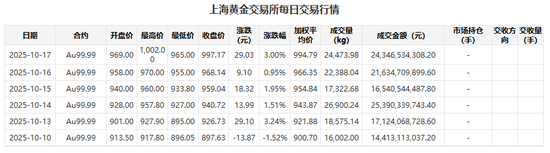
Core Insights - The precious metals market is experiencing increased volatility, prompting banks and exchanges to issue risk warnings [1][7][8] - Gold prices recently hit a historical peak, with spot gold reaching $4380.79 per ounce on October 17, marking a year-to-date increase of over 60% [3][2] - Financial institutions are raising thresholds for gold accumulation and adjusting margin requirements due to market fluctuations [10][6] Group 1: Market Performance - On October 20, gold prices fell below $4230 per ounce, a drop of over $45 from the day's high, yet remained at historically high levels [1] - The price of gold in the Shanghai Gold Exchange reached a record high of 997.17 yuan per gram on October 17 [3] - Brand gold jewelry prices have also surged, with Chow Tai Fook's gold jewelry priced at 1279 yuan per gram, an increase of 32 yuan from the previous day [4][5] Group 2: Institutional Responses - Major banks, including China Construction Bank and China Merchants Bank, have issued multiple risk warnings regarding precious metals trading [8][10] - The Shanghai Gold Exchange and Shanghai Futures Exchange have advised members to enhance risk management practices due to market instability [7] - Several banks have raised the minimum purchase amounts for gold accumulation products, with China Bank adjusting its minimum from 850 yuan to 950 yuan [10] Group 3: Investment Strategies - Bridgewater Associates founder Ray Dalio suggests that gold should be viewed from a strategic allocation perspective rather than a speculative one, recommending a portfolio allocation of 10% to 15% in gold [14][11] - Despite warnings from financial institutions, there is a growing trend of investors engaging in risky behaviors, such as using loans to purchase gold [12][13] - Experts caution that while gold has strong liquidity, extreme market conditions could lead to liquidity issues, and using borrowed funds for investment purposes may violate regulations [12][13]

银行优先股赎回潮涌 加速资本结构重塑
Zhong Guo Jing Ying Bao· 2025-10-20 11:43
Core Viewpoint - Ningbo Bank plans to fully redeem 100 million shares of non-publicly issued preferred stock, amounting to RMB 10 billion, reflecting a broader trend among banks to adjust or redeem high-yield preferred stocks amid narrowing net interest margins and increasing profitability pressures [1][2][3] Group 1: Redemption of High-Yield Preferred Stocks - Ningbo Bank's preferred stock redemption is set for November 7, 2025, with a face value of RMB 100 per share and a coupon rate adjustment from 5.30% to 4.50% starting November 7, 2023 [2] - Other banks, including Industrial and Commercial Bank of China, are also redeeming high-yield preferred stocks issued before 2020, which typically have interest rates above 4% [2][3] - The trend indicates banks are replacing high-yield capital tools with lower-cost options to optimize their capital structure and reduce funding costs [3][4] Group 2: Market Conditions and Capital Tool Replacement - The banking sector is experiencing continuous pressure on net interest margins, prompting banks to seek lower-cost capital tools such as perpetual bonds and secondary capital bonds [6][7] - The average dividend yield of previously issued preferred stocks is around 5.04%, significantly higher than that of perpetual bonds, highlighting the need for banks to adjust their capital strategies [4][6] - The current market environment, characterized by ample liquidity and narrow credit spreads, is favorable for banks to issue new capital tools at lower costs [6][7] Group 3: Investor Sentiment and Regulatory Considerations - Investor risk preferences have become more differentiated, with a higher demand for returns from smaller banks and increased scrutiny on structural terms of new capital instruments [7] - Banks must balance innovation in capital tools with maintaining investor confidence, particularly in light of recent credit events affecting certain banks [7]
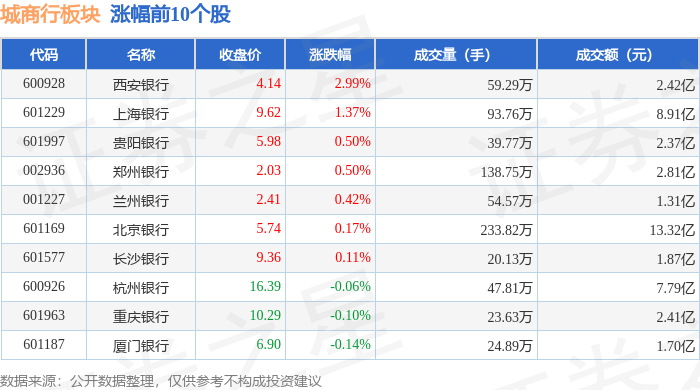
城商行板块10月20日跌0.32%,江苏银行领跌,主力资金净流入2317.93万元
Zheng Xing Xing Ye Ri Bao· 2025-10-20 08:27
Core Insights - The city commercial bank sector experienced a decline of 0.32% on October 20, with Jiangsu Bank leading the drop [1] - The Shanghai Composite Index closed at 3863.89, up 0.63%, while the Shenzhen Component Index closed at 12813.21, up 0.98% [1] Stock Performance - Xi'an Bank (600928) closed at 4.14, up 2.99% with a trading volume of 592,900 shares and a transaction value of 242 million [1] - Shanghai Bank (601229) closed at 9.62, up 1.37% with a trading volume of 937,600 shares and a transaction value of 891 million [1] - Jiangsu Bank (616009) closed at 10.79, down 1.82% with a trading volume of 1,603,000 shares and a transaction value of 173.3 million [2] Capital Flow - The city commercial bank sector saw a net inflow of 23.18 million from institutional investors, while retail investors contributed a net inflow of 52.95 million [2] - The sector experienced a net outflow of 76.12 million from speculative funds [2] Individual Stock Capital Flow - Qilu Bank (601665) had a net inflow of 63.84 million from institutional investors, while it faced a net outflow of 17.01 million from speculative funds [3] - Shanghai Bank (601229) saw a net inflow of 54.98 million from institutional investors, with a net outflow of 18.63 million from speculative funds [3] - Ningbo Bank (002142) recorded a net inflow of 51.83 million from institutional investors, while speculative funds had a net outflow of 45.06 million [3]



多家银行抬高积存金门槛
Jing Ji Wang· 2025-10-20 02:27
"后续,我行将持续关注贵金属市场波动情况,适时对如意金积存业务最低投资额进行调整,具体调整 情况将通过中国工商银行网站另行发布。"工商银行在《关于调整如意金积存业务最低投资额的通告》 提示。 进入10月,随着金价进一步走高,多家银行相继宣布上调积存金门槛,部分银行起购金额突破千元大 关。 中国银行自10月15日起调整了积存金产品的购买条件,按金额购买积存金产品或创建积存定投计划时, 最小购买金额由850元调整为950元,追加购买金额维持200元整数倍不变,已在执行中的定投计划不受 影响;按克重购买积存金产品或创建积存定投计划时,最小购买克重维持为1克不变,追加克重维持为1 克整数倍不变。 这是中国银行今年以来第四次调整积存金购买门槛。2月7日,该行公告称,自2月10日起,按金额购买 积存金产品或创建积存定投计划时,最小购买金额由650元调整为700元;4月,该行又两度提高积存金 起购金额,先后将最小购买金额由700元调整为750元、由750元调整为850元。 工商银行也自10月13日起将如意金积存业务最低投资额由850元上调至1000元,按克数积存的积存起点 仍为1克。该行表示,调整前已设置成功的定期积存计划 ...
新型政策性金融工具快评:宽信用又添工具,银行信贷受益
Guoxin Securities· 2025-10-20 01:14
Investment Rating - The investment rating for the banking industry is "Outperform the Market" (maintained) [2][3]. Core Viewpoints - The introduction of a new policy financial tool with a total scale of 500 billion yuan is expected to positively impact social financing and bank credit demand in the coming years [4][9]. - The new financial tool will be used entirely to supplement project capital, which can leverage additional loans and enhance bank credit demand [12]. Summary by Sections New Policy Financial Tool - The new policy financial tool, announced on September 29, has a total scale of 500 billion yuan, aimed at supplementing project capital [4][5]. - Historical precedents for similar tools include the special construction fund in 2015 and the policy development financial tool in 2022 [5]. Impact on Social Financing and Bank Credit - The 500 billion yuan will be injected into projects through entrusted loans, directly increasing social financing [12]. - The capital can leverage additional loans, potentially leading to an investment of 4-5 trillion yuan and corresponding credit demand of approximately 3-4 trillion yuan [12]. Investment Recommendations - The report suggests selecting high-quality stocks that are likely to show early signs of recovery, with a focus on Ningbo Bank and China Merchants Bank, while also monitoring Changshu Bank, Changsha Bank, and Chongqing Rural Commercial Bank [9]. - For conservative investors seeking absolute returns, stocks with stable performance and high dividends, such as China Merchants Bank and Jiangsu Bank, are recommended [9].