
浦发银行

Search documents
京东支付11.11放大招:支付免单、银行特惠、积分抵现激发消费新动力
Zhong Jin Zai Xian· 2025-11-12 06:31
Core Insights - JD.com achieved a record high transaction volume during the 2025 11.11 shopping festival, simplifying promotional strategies to enhance consumer shopping experiences [1] Payment Experience - JD.com Payment collaborated with over 80,000 merchants and more than 120 banks, offering various benefits such as "payment waivers," cash back, and discounts using digital RMB, leading to a 40% year-on-year increase in quick payment transaction volume [1] - The number of JD.com Payment users reached 650 million, with nearly 10 million users participating in the "payment waiver" activity [1][4] - The "post-payment cash back" initiative significantly boosted sales, with transaction volumes for partnered products doubling year-on-year [1] Bank Marketing Strategies - The 11.11 shopping event saw diverse bank marketing strategies, enhancing user engagement and transaction volumes through initiatives like "bank category days" and "credit card points redemption" [5][6] - Specific promotional days were created in collaboration with various banks, offering exclusive discounts and incentives, which resulted in an average order volume increase of over 138% for participating banks [8] Credit Card Points Utilization - The integration of credit card points for cash redemption on JD.com has expanded, allowing users to effectively utilize previously idle points, with over 30 million users having access to this feature [9] - During the 11.11 event, the number of transactions using points redemption doubled year-on-year, with a 70% increase in transaction volume [9] Digital RMB Adoption - The use of digital RMB has gained traction, with JD.com promoting its adoption through various discounts and campaigns, resulting in an 80% year-on-year increase in user activity and transaction volume [10] Collaborative Ecosystem - JD.com Payment has expanded its partnerships across various sectors, enhancing payment options in travel, dining, and e-commerce, creating a positive feedback loop that benefits users, banks, and the platform [11]


已有7家银行私银客户超10万户
2 1 Shi Ji Jing Ji Bao Dao· 2025-11-12 05:45
Core Insights - The private banking sector has seen significant growth in the first three quarters of this year, with seven listed banks reporting over 100,000 private banking clients as of September 30, 2023, indicating a rising demand for wealth management services among high-net-worth individuals [2][4][5] Group 1: Growth in Private Banking Clients - Multiple banks reported a client growth rate exceeding 10%, with Minsheng Bank, Beijing Bank, and Nanjing Bank showing increases over 15% [4] - Minsheng Bank had the fastest growth, reaching 73,409 private banking clients, an increase of 18.21% from the end of last year [5] - Beijing Bank reported 20,586 private banking clients, up 17.9%, and an asset under management (AUM) of 224 billion yuan, a 14.39% increase [5][6] Group 2: Market Position of Major Banks - State-owned banks continue to dominate the private banking market, with Agricultural Bank of China leading at 279,000 clients, followed by China Construction Bank and Bank of China [6] - China Merchants Bank and Ping An Bank have also joined the "100,000 club," with Ping An Bank reaching 103,300 clients, marking its first entry into this category [6][7] Group 3: Challenges and Opportunities in Wealth Management - The growth in private banking clients is attributed to the expanding base of high-net-worth individuals and the upgrading of banking services [9] - The Hu Run Wealth Report indicates that the total wealth of China's 6 million affluent families has reached 150 trillion yuan, with ultra-high-net-worth families holding 87 trillion yuan, an increase from 56% to 58% of total wealth [9] - The private banking sector is facing challenges such as economic shifts, declining risk-free returns, and reduced investor confidence, necessitating a transformation in wealth management services [10][11]







已有7家银行私银客户超10万户
21世纪经济报道· 2025-11-12 05:38
Core Insights - The private banking business has seen significant growth in the first three quarters of this year, with seven listed banks surpassing 100,000 private banking clients as of September 30, 2023, driven by the increasing number of high-net-worth individuals and evolving wealth management needs [1][3][6] Growth of Private Banking Clients - Several banks reported a client growth rate exceeding 10%, with Minsheng Bank, Beijing Bank, and Nanjing Bank showing increases over 15%. Minsheng Bank led with an 18.21% growth, reaching 73,409 clients [3][6] - Beijing Bank's private banking clients grew by 17.9% to 20,586, with total assets under management (AUM) increasing by 14.39% to 224 billion yuan [3][6] - Nanjing Bank also reported a 15.43% increase in private banking clients [3] Dominance of State-Owned Banks - State-owned banks continue to lead in absolute numbers, with Agricultural Bank of China having 279,000 clients, followed by China Construction Bank with 265,500 clients [4] - China Merchants Bank and Ping An Bank have also joined the "100,000 club," with Ping An Bank reaching 103,300 clients, marking its first time surpassing this threshold [4][6] Market Dynamics and Competition - The private banking market is characterized by a competitive landscape where state-owned banks leverage their scale, while joint-stock banks focus on differentiated services and operational efficiency [7] - The growth of high-net-worth individuals is expected to drive competition towards service quality and asset allocation capabilities [7] Challenges in Wealth Management - The wealth management sector faces three main challenges: economic growth slowdown, declining risk-free returns, and reduced investor confidence [10][11] - Banks are urged to upgrade their wealth management services to meet clients' real needs and utilize various financial tools for comprehensive solutions [11] Changing Client Demographics - The core client base for private banking is shifting from traditional business owners to new economy groups, with a notable increase in demand for comprehensive wealth management services [9] - Banks are redefining their target clients based on their strengths, with some focusing on family wealth transfer and others on retirement financial management [9]




境外机构跨境配置中国债券的通道比较与投资行为分析
Sou Hu Cai Jing· 2025-11-12 03:13
Core Viewpoint - China's bond market is becoming an important option for foreign institutions as the country accelerates its financial opening, with various investment channels influencing foreign investment behavior [1][2]. Overview of Foreign Investment Channels in China's Bond Market - The QFII system, established in 2002, was the first major channel for foreign institutions to invest in China's capital market, initially having high entry barriers which have been gradually relaxed [3]. - The RQFII system, launched in 2011, supports the internationalization of the RMB by allowing foreign institutions to invest in the domestic market using RMB funds, with recent expansions in its scope [4]. - CIBM Direct, initiated in 2016, allows foreign institutions to enter the interbank bond market without prior approval, becoming a major channel for foreign investment [5]. - The "Bond Connect," established in 2017, facilitates access to the interbank bond market through Hong Kong, simplifying the process for foreign investors and enhancing market participation [6]. Comparison of Foreign Institutions' Investment Behavior - Different channels attract various types of foreign institutions, with QFII primarily attracting large international financial institutions, while RQFII is favored by institutions holding offshore RMB [7][8]. - CIBM Direct has broadened the types of foreign institutions participating, including central banks and sovereign wealth funds, while "Bond Connect" has attracted a wider range of institutions, including smaller asset management firms [8][9]. Investment Scale and Trends - As of August 2025, foreign institutions held approximately 3.83 trillion yuan in interbank bonds, with CIBM Direct accounting for 77.08% of the holdings, while "Bond Connect" represented about 22.92% [9][10]. - The trading volume through "Bond Connect" has surpassed that of CIBM Direct, indicating a more active trading behavior among smaller institutions [9]. Preference for Bond Types - Foreign institutions generally prefer interest rate bonds, particularly government and policy bank bonds, with government bonds holding a 72.6% share of their holdings as of August 2025 [10][11]. Preference for Bond Maturity - Investment strategies vary by channel, with QFII and RQFII focusing on flexible duration strategies, while CIBM Direct participants, such as central banks, prefer medium to long-term bonds [12]. Factors Influencing Investment Behavior - Foreign institutions' investment decisions are influenced by policy regulations, market conditions, investor attributes, and limitations of each investment channel [13][14]. - The regulatory environment, including entry barriers and operational processes, significantly impacts the depth and breadth of foreign investment [14]. - Market conditions, such as macroeconomic stability and interest rate differentials, also play a crucial role in shaping investment behavior [15]. Conclusion and Policy Recommendations - To enhance the attractiveness of China's bond market for foreign investors, recommendations include improving asset quality, streamlining cross-border custody standards, and optimizing tax processes [20][21][22][23].

银行ETF指数(512730)涨近1%,险资加力布局银行板块
Xin Lang Cai Jing· 2025-11-12 02:22
Group 1 - The China Banking Index (399986) increased by 0.86% as of November 12, 2025, with notable gains from Agricultural Bank (601288) up 2.65%, Chongqing Rural Commercial Bank (601077) up 2.01%, and others [1] - As of Q3 2025, insurance capital's holding in banks was at 27.95%, with a market value accounting for 3.99% of the circulating A-shares, reflecting a decrease of -0.29 percentage points and -2.52 percentage points respectively from the previous quarter [1] - Insurance capital increased its holdings by 8.36 billion shares in the banking sector, with 23 banks being allocated by insurance capital as of the end of September, an increase of 2 banks from the previous quarter [1] Group 2 - China Galaxy Securities noted that factors such as new premium inflows, increased equity investment ratios, and strengthened long-term assessments provide room for growth in insurance capital's allocation to the banking sector [1] - The banking sector is favored for its stable dividends and low valuation, with a continued advantage in dividend yield [1] - The top ten weighted stocks in the China Banking Index as of October 31, 2025, accounted for 64.87% of the index, including major banks like China Merchants Bank (600036) and Industrial and Commercial Bank of China (601398) [2]
农行、工行,创历史新高
Di Yi Cai Jing Zi Xun· 2025-11-12 02:07
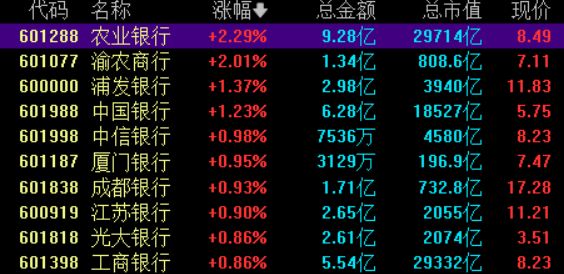
Group 1 - The banking sector showed resilience, with Agricultural Bank of China and Industrial and Commercial Bank of China reaching historical highs in stock prices [1] - Agricultural Bank of China and Chongqing Rural Commercial Bank both increased by over 2%, while other banks like Shanghai Pudong Development Bank and Bank of China rose by over 1% [1] - The stock performance of various banks indicates a positive trend, with several banks showing significant gains [2] Group 2 - Agricultural Bank of China (601288) saw a price increase of 2.29%, with a market capitalization of 2.97 trillion [2][3] - Chongqing Rural Commercial Bank (601077) increased by 2.01%, with a market capitalization of 808.6 billion [2] - Other banks such as Shanghai Pudong Development Bank (6000000) and Bank of China (601988) also reported gains of 1.37% and 1.23% respectively, with market capitalizations of 3940 billion and 1852.7 billion [2]
银行业全方位做好十五运会服务保障
Jin Rong Shi Bao· 2025-11-12 01:21
Core Insights - The 15th National Games has officially commenced in Guangdong, marking the first joint hosting by Guangdong, Hong Kong, and Macau, and initiating a deep integration of finance, sports, and technology [1] Group 1: Financial Services and Technology Integration - The Industrial and Commercial Bank of China (ICBC) has established a digital command center for the National Games, showcasing real-time data on service efficiency and product promotion, enhancing operational responsiveness [2] - Security measures for the event have incorporated advanced technology, with Guangzhou Chengzhi Intelligent Machine Technology Co., Ltd. utilizing drone security technology supported by ICBC's financial backing [2] Group 2: Payment Solutions and Consumer Experience - During the National Games, banks have upgraded payment solutions to facilitate spectator spending, with Bank of China Guangdong Province launching a green channel for cash exchange and offering credit card products for seamless cross-border transactions [3] - ICBC has provided hands-on assistance to Hong Kong residents at the Luohu Port, helping them navigate electronic payment processes, thereby enhancing their experience during the event [3] Group 3: Comprehensive Service Network - ICBC has created a comprehensive service network in the Greater Bay Area, with approximately 1,500 branches offering priority services for athletes and volunteers, and over 4,500 self-service banking devices supporting foreign card transactions [4] Group 4: Cultural Promotion and Community Engagement - Financial institutions are extending their services beyond the event, with initiatives aimed at promoting sports culture and community engagement, such as the "Play the National Games" section on ICBC's mobile banking app, which has attracted over 4 million visits [6] - Partnerships with companies like Decathlon by SPD Bank have led to the establishment of "small community sports stations," promoting sports participation through financial incentives [6]
全仓登新增6个金属品种仓单登记业务
Qi Huo Ri Bao Wang· 2025-11-11 23:30
Core Insights - The conference held in Shanghai focused on exploring a credible collaborative model for the allocation of bulk commodity resources, emphasizing the importance of credit construction and collaborative innovation in the bulk commodity market [1] Group 1: Conference Highlights - The event was supported by the Shanghai Municipal Commission of Commerce and aimed to showcase significant practical achievements in building an integrated collaborative system of "registration + storage + finance" for bulk commodities [1] - Liu Min, Deputy Director of the Shanghai Municipal Commission of Commerce, highlighted the high proportion of bulk commodities in both domestic and foreign trade, underlining their importance for supply chain security and enhancing urban core functions [1] Group 2: Registration System Expansion - The national bulk commodity warehouse receipt registration center (全仓登) expanded its registration scope by adding six non-ferrous metal varieties, including aluminum, lead, zinc, tin, nickel, and silver, bringing the total registered varieties to 13 with over 12.1 million tons of registered warehouse receipts and inventory [2] - The center awarded licenses to major domestic logistics groups for the first batch of cooperative warehouses, establishing a credible warehousing network to ensure the safety and ownership of goods corresponding to electronic warehouse receipts [2] Group 3: Financial Collaboration - A strategic cooperation agreement was signed between the national bulk commodity warehouse receipt registration center and the Shanghai Clearing House to explore a safe and efficient clearing model for warehouse receipt transfers [3] - Major banks, including Industrial and Commercial Bank of China, Bank of Communications, Shanghai Pudong Development Bank, and Jiangsu Bank, signed agreements to expand financing scenarios for warehouse receipt pledges, thereby broadening financing channels for industry chain enterprises [3] Group 4: Future Directions - The establishment of a trade, finance, and data infrastructure centered on warehouse receipt registration is viewed as a key measure for upgrading the bulk commodity market [4] - The national bulk commodity warehouse receipt registration center aims to create a credible trading environment for bulk commodities, facilitating Shanghai's development as a global resource allocation hub and supporting the construction of a unified national market [4]
上海浦东发展银行股份有限公司深圳分行与中国信达资产管理股份有限公司深圳市分公司债权转让通知暨债务催收联合公告
Jing Ji Ri Bao· 2025-11-11 22:11
Core Viewpoint - Shanghai Pudong Development Bank Shenzhen Branch has signed an agreement with China Cinda Asset Management Shenzhen Branch for the transfer of non-performing assets, indicating a strategic move to manage and offload bad debts [1][3]. Summary by Sections Agreement Details - The agreement, numbered 【信深-A-2025-0055】, was signed on September 23, 2025, and involves the transfer of principal debts and related rights from Shanghai Pudong Development Bank to China Cinda Asset Management [1]. - Borrowers and guarantors are required to fulfill their repayment obligations to China Cinda Asset Management as per the original contracts [1][3]. Financial Obligations - The announcement specifies that the listed borrowers and guarantors must pay interest, penalties, and other dues according to the loan and guarantee contracts, as well as relevant regulations from the People's Bank of China [3]. - The principal and interest balances as of the transfer benchmark date (July 22, 2025) are detailed for each borrower, indicating the financial scope of the transfer [4][5]. Borrower and Guarantor Information - A list of borrowers and their respective guarantors is provided, along with the principal amounts and interest owed. For example, Shenzhen Haojingfeng Industrial Development Co., Ltd. owes a principal of 29,892,678.72 yuan and interest of 1,196,308.93 yuan [4][5]. - Other notable borrowers include Shenzhen Rui Dong Xusheng Industrial Trade Co., Ltd. with a principal of 17,200,000.00 yuan and interest of 1,221,708.00 yuan, and Shenzhen Wanhu Supply Chain Co., Ltd. with a principal of 49,713,133.39 yuan and interest of 8,249,213.84 yuan [5].
股市必读:春立医疗(688236)11月11日主力资金净流入314.55万元,占总成交额3.91%
Sou Hu Cai Jing· 2025-11-11 20:05
Trading Information Summary - On November 11, 2025, the stock of Chunli Medical (688236) closed at 27.09 CNY, down 3.25%, with a turnover rate of 1.02% and a trading volume of 29,400 shares, resulting in a transaction amount of 80.51 million CNY [1][2] - On the same day, the net inflow of main funds was 3.15 million CNY, accounting for 3.91% of the total transaction amount [2] Company Announcement Summary - Chunli Medical entered into three structured deposit agreements on November 11, 2025, using a total of 790 million CNY from temporarily idle funds raised from A-share public offerings and internal resources to subscribe to structured deposit products from Beijing Bank [1][2] - These transactions are classified as disclosable transactions but are exempt from shareholder approval [1][2] - The company acknowledged a prior failure to timely disclose related transactions and will enhance internal compliance management [1]
