
平安银行

Search documents
年终“清仓”!银行密集上架不良资产包
Guo Ji Jin Rong Bao· 2025-10-16 15:17
Core Viewpoint - The banking sector is experiencing a surge in the transfer of non-performing asset packages as it approaches the fourth quarter, driven by regulatory cycles, financial needs, and market supply and demand dynamics [1][4][6] Group 1: Non-Performing Asset Transfers - In the week following the "Eleven" holiday, at least 19 non-performing asset packages were listed by 11 banks, primarily from the construction, manufacturing, retail credit, and small and micro enterprise loans sectors [1][3] - Recent asset packages listed are substantial, with some exceeding 100 million yuan, and include both corporate and personal loans, with overdue periods varying significantly [3][5] - The transfer of non-performing assets is expected to peak in the fourth quarter, with a notable increase in the number of projects being listed for transfer over the past three years [5][6] Group 2: Regulatory and Financial Implications - The concentration of non-performing asset transfers in the fourth quarter is a strategic move by banks to lower non-performing loan balances, meet regulatory requirements for provision coverage ratios, and improve capital adequacy ratios [4][6] - The overall non-performing loan rate for commercial banks has shown a declining trend over the past two years, with rates recorded at 1.49% as of the second quarter of 2025 [5][6] Group 3: Risk Analysis and Recommendations - The primary sectors for non-performing loans include construction, manufacturing, retail credit, and small and micro enterprises, with varying levels of risk associated with each sector [5][7] - Recommendations for banks include integrating legal and financial technologies to create a dynamic non-performing asset management system, focusing on pre-loan risk assessment and post-loan monitoring [7]
银行连续走强,风格切换真的来了?39亿资金加码百亿银行ETF,创新药强催化,高纯度520880上探4%
Xin Lang Ji Jin· 2025-10-16 11:56
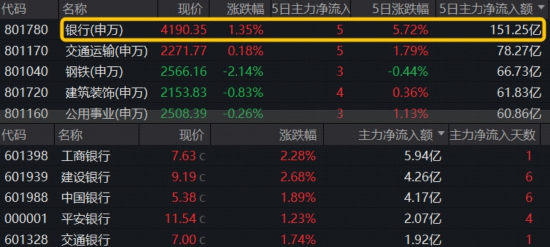
Market Overview - On October 16, the market experienced a pullback after an initial rise, with the three major indices briefly turning negative. The Shanghai Composite Index closed up 0.1% at 3916.23 points, with total trading volume in the two markets dropping below 2 trillion yuan to 1.93 trillion yuan [1] - The banking sector showed strength, with Agricultural Bank of China rising over 3%, approaching historical highs. The top-performing bank ETF (512800) continued to rise, gaining 1.48% and marking a strong six-day upward trend [1][11] Banking Sector Insights - The latest scale of the bank ETF (512800) reached 18.4 billion yuan, setting a new historical high, with an average daily trading volume exceeding 700 million yuan this year, making it the largest and most liquid among the 10 bank ETFs in A-shares [1][18] - In the past five days, the banking sector attracted a net inflow of 15.125 billion yuan from major funds, leading all sectors in the Shenwan first-level industry classification [1][16] - Major banks such as Industrial and Commercial Bank of China and China Construction Bank saw significant gains, with several banks reporting increases of over 2% [11][12] Food and Beverage Sector Performance - The food and beverage sector, represented by the food ETF (515710), saw a notable increase of over 1% at the close, with key stocks in the liquor segment performing well, including Guizhou Moutai and Shanxi Fenjiu [1][20] - The food ETF has attracted significant capital inflows, with a net subscription of 32.91 million yuan over the past five trading days and over 180 million yuan in the last 20 trading days [20] - The valuation of the food sector remains low, with the food ETF's underlying index trading at a price-to-earnings ratio of 20.58, indicating a favorable long-term investment opportunity [20][21] Innovation Drug Sector Highlights - The Hong Kong stock market saw a pullback, but the innovative drug sector led gains, with the Hong Kong Stock Connect Innovative Drug ETF (520880) rising by 2.42% [3][4] - The upcoming European Society for Medical Oncology (ESMO) annual meeting is expected to be a significant event for the Chinese innovative drug sector, potentially leading to new business development (BD) authorizations [3][8] - The innovative drug ETF covers 37 companies, with a strong performance from major stocks like Innovent Biologics and CanSino Biologics, which saw increases of 3.68% and 4.75%, respectively [6][9]







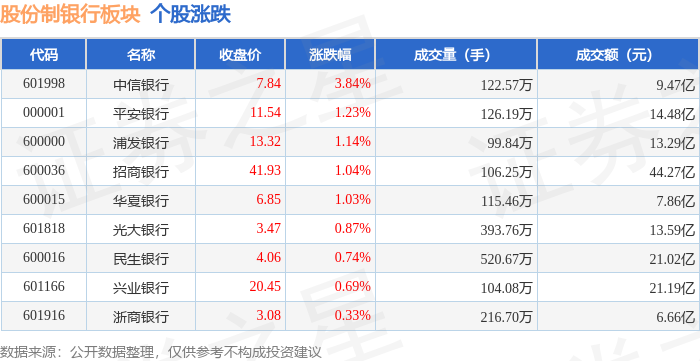
股份制银行板块10月16日涨1.29%,中信银行领涨,主力资金净流出2.4亿元
Zheng Xing Xing Ye Ri Bao· 2025-10-16 08:27
证券之星消息,10月16日股份制银行板块较上一交易日上涨1.29%,中信银行领涨。当日上证指数报收 于3916.23,上涨0.1%。深证成指报收于13086.41,下跌0.25%。股份制银行板块个股涨跌见下表: 从资金流向上来看,当日股份制银行板块主力资金净流出2.4亿元,游资资金净流出1783.73万元,散户 资金净流入2.58亿元。股份制银行板块个股资金流向见下表: 以上内容为证券之星据公开信息整理,由AI算法生成(网信算备310104345710301240019号),不构成投资建议。 | 代码 | 名称 | 收盘价 | 涨跌幅 | 成交量(手) | 成交额(元) | | --- | --- | --- | --- | --- | --- | | 601998 | 中信银行 | 7.84 | 3.84% | 122.57万 | 9.471Z | | 000001 | 平安银行 | 11.54 | 1.23% | 126.19万 | 14.48 Z | | 600000 | 浦发银行 | 13.32 | 1.14% | 99.84万 | 13.29亿 | | 600036 | 招商银行 | 41.93 | ...




银行业9月金融数据点评:楼市回暖,资金活化度继续上升
Huachuang Securities· 2025-10-16 07:25
Investment Rating - The industry investment rating is "Recommended," indicating an expected increase in the industry index exceeding the benchmark index by more than 5% in the next 3-6 months [26]. Core Insights - The financial data for September 2025 shows a new social financing scale of 3.53 trillion yuan, a year-on-year decrease of 229.7 billion yuan, with a year-on-year growth rate of 8.7%, down 0.1 percentage points from the previous month [2][7]. - New RMB loans amounted to 1.29 trillion yuan in September, a year-on-year decrease of 300 billion yuan, continuing the trend from August [2][7]. - The report highlights a recovery in the real estate market, with a notable improvement in the sales of commercial housing in major cities, which positively impacted the growth of medium to long-term loans for residents [7]. Summary by Sections Financial Data Overview - In September 2025, the new social financing scale was 3.53 trillion yuan, with a year-on-year decrease of 229.7 billion yuan. The stock of social financing grew at a rate of 8.7% year-on-year, which is a decrease of 0.1 percentage points from the previous month [2][8]. - The new RMB loans for September were 1.29 trillion yuan, reflecting a year-on-year decrease of 300 billion yuan [2][8]. Loan Structure Analysis - The report indicates that corporate loans in September amounted to 1.22 trillion yuan, a year-on-year decrease of 270 billion yuan, while medium to long-term loans for residents showed improvement due to a recovery in the housing market [7][8]. - The report notes that the demand for credit remains relatively weak compared to the first half of the year, with banks being more cautious in their lending practices [7]. Market Performance - The absolute performance of the banking sector showed a decline of 0.7% over the past month, but a positive trend over 6 months (7.5%) and 12 months (16.0%) [5]. - The report emphasizes the importance of long-term investment strategies in the banking sector, suggesting that banks with high dividend yields and strong asset quality present good investment opportunities [7].
银行ETF指数(512730)冲击六连阳,国有六大行分红总额超2000亿
Xin Lang Cai Jing· 2025-10-16 02:39
Group 1 - The China Banking Index (399986) increased by 0.50%, with notable gains from Chongqing Bank (1.69%), Suzhou Bank (1.54%), and others [1] - The Bank ETF Index (512730) rose by 0.60%, marking a six-day consecutive increase, with the latest price at 1.67 yuan [1] - Eight listed banks have implemented mid-term dividends, with the total dividend amount from the six major state-owned banks expected to reach 204.657 billion yuan [1] Group 2 - As of September 30, 2025, the top ten weighted stocks in the China Banking Index accounted for 64.6% of the index, including major banks like China Merchants Bank and Industrial and Commercial Bank of China [2] - The China Banking Index is designed to reflect the overall performance of different industry companies within the China Securities Index [2]
中国金融业 - 尽管社会融资规模增速放缓,9 月 M1 增速仍进一步回升-一个关键的积极信号-China Financials-Further pickup in M1 growth in September despite moderating TSF – a key positive
2025-10-16 01:48
Summary of Key Points from the Conference Call Industry Overview - **Industry**: China Financials - **Date**: October 15, 2025 - **Analyst**: Richard Xu, CFA; Chiyao Huang; Chenqian Liu Core Insights 1. **M1 Growth**: There was a further pickup in M1 growth in September, reaching 7.2% year-over-year (YoY), compared to 6% in August, indicating improved liquidity and corporate sentiment despite moderating Total Social Financing (TSF) [3][8][10] 2. **Loan Growth Trends**: RMB loan growth moderated to 6.4% YoY from 6.6% the previous month, influenced by reduced window guidance and ongoing local government financing vehicle (LGFV) debt swaps [2][8] 3. **Corporate Loans**: Corporate loans remained the primary driver of loan growth, although there is a rationalization in industrial capital expenditure (capex) growth, leading to further moderation in medium- and long-term corporate loan growth [2][8] 4. **Government Bonds**: Government bonds added RMB 1.19 trillion in September, which is RMB 346 billion lower YoY, with a year-to-date (YTD) total of RMB 11.46 trillion [8][10] 5. **Corporate Deposits**: Corporate deposits grew by 4.2% YoY, with demand deposits rebounding to 6.7% YoY from 5.2% the previous month, indicating a recovery in corporate demand [3][8] Additional Important Points 1. **TSF Growth**: Headline TSF growth slowed to 8.7% YoY in September from 8.8% in August, reflecting a continued slowdown in loan growth and less support from government bonds [8][9] 2. **Household Loan Demand**: There was a modest pickup in long-term household loan growth, suggesting some recovery in mortgage loan demand, although overall household loan growth remains weak [2][8] 3. **Investment Sentiment**: The notably higher M1 growth is viewed as a positive sign indicating improved liquidity and corporate sentiment, which may help in moderating financial risks [3][8] 4. **Market Outlook**: The overall view of the China financials industry remains attractive, with expectations of continued recovery in financial metrics [5] Conclusion The conference call highlighted a mixed but cautiously optimistic outlook for the China financials sector, with signs of recovery in M1 growth and corporate deposits, while loan growth remains moderated due to tighter risk standards and reduced policy support. The industry is viewed as attractive, suggesting potential investment opportunities amidst the current economic landscape.
取消本市缴存限制 成都“商转公”政策受益范围再扩大
Si Chuan Ri Bao· 2025-10-16 01:44
Core Points - The Chengdu Housing Provident Fund Management Committee has revised the management measures for converting commercial housing loans to provident fund loans, extending the policy's validity to five years [1][2] - The revision aims to expand the policy's beneficiary scope and optimize the experience for the public [1] Group 1: Policy Expansion - The policy removes the local contribution restriction, allowing individuals who have made contributions elsewhere to apply for the conversion loan when purchasing property in Chengdu, benefiting those working away from home and returning to buy property [1] - The range of banks eligible to process the conversion loans has been broadened, with any commercial bank that signs a cooperation agreement with the Chengdu Provident Fund Center now able to offer these loans [1] Group 2: Streamlining Processes - The application process has been simplified significantly, with the number of required documents reduced from 11 to 3, achieving a nearly 73% reduction in documentation burden for applicants [1] - The Chengdu Provident Fund Center will implement a "zero data" service for information that can be shared through government data channels, further easing the application process [1] Group 3: Market Impact - The extension of the policy's validity from one year to five years is expected to stabilize market expectations and encourage individuals who have not previously contributed to the housing provident fund to start doing so [2] - Analysts believe that the policy revision will enhance the willingness of individuals with contributions from other locations to purchase property in Chengdu, thereby increasing market activity and alleviating the repayment burden on contributors [2]
不良资产加速“甩卖” 资产质量与盈利压力下中小银行谋求主动优化
Zhong Guo Zheng Quan Bao· 2025-10-15 23:13
Core Viewpoint - The banking sector is accelerating the disposal of non-performing assets, with significant transactions occurring in the fourth quarter, indicating a proactive approach to improve asset quality and capital adequacy [1][2][4]. Summary by Sections Non-Performing Asset Transfers - Several banks, including Bohai Bank and Guangzhou Rural Commercial Bank, are actively transferring large non-performing asset packages, with Bohai Bank planning to transfer approximately 700 billion yuan in debt assets [2][4]. - The trend of non-performing loan transfers has been increasing, with 25 announcements made in just six working days in October [2][3]. Financial Impact - The transfer of non-performing assets is expected to lower the non-performing loan ratio and improve capital adequacy ratios, providing banks with more room for new loans [4][5]. - The average discount rate for personal non-performing loans has been declining, indicating a challenging market for asset recovery [8]. Asset Quality and Structure - The majority of the assets being transferred have long aging periods, which contributes to their lower liquidity [5][6]. - The transfer process allows banks to convert illiquid assets into cash, enabling them to invest in higher-quality assets and improve overall returns [6][7]. Market Potential and Strategies - The non-performing asset disposal market is expected to grow, with banks encouraged to adopt diversified and specialized asset disposal strategies [7][9]. - Analysts suggest that banks should enhance their asset management capabilities and utilize technology for better risk prediction and management [9].
不良资产加速“甩卖”背后: 资产质量与盈利压力下中小银行谋求主动优化
Zhong Guo Zheng Quan Bao· 2025-10-15 22:39
Core Insights - The banking sector is accelerating the disposal of non-performing assets (NPAs) as they face pressure on asset quality, capital adequacy, and profitability, with significant transactions of over 100 billion yuan becoming frequent [1][2][4] Group 1: Non-Performing Asset Transfers - Several banks, including Bohai Bank and Guangzhou Rural Commercial Bank, are actively transferring large NPA packages, with Bohai Bank planning to transfer approximately 700 billion yuan in debt assets [2][4] - The NPA transfer announcements have surged, with 25 disclosures reported in just six working days in October, involving various banking institutions and consumer finance companies [2][3] Group 2: Financial Metrics and Impacts - The transfer of NPAs is expected to directly lower the non-performing loan ratio and improve asset quality, thereby enhancing capital adequacy ratios and liquidity for banks [4][5] - The average discount rate for personal NPA transfers has been declining, with some asset packages starting below 10% of their original value, indicating a challenging market environment [7] Group 3: Strategic Approaches to Asset Management - The banking industry is encouraged to adopt diversified and specialized asset disposal strategies, transitioning from passive risk management to proactive asset management [6][8] - Utilizing advanced technologies such as big data and AI for better prediction of recovery rates and disposal cycles is recommended to mitigate risks associated with NPAs [8]
不良资产加速“甩卖”背后:资产质量与盈利压力下中小银行谋求主动优化
Zhong Guo Zheng Quan Bao· 2025-10-15 20:15
Core Viewpoint - In the fourth quarter, several banks are accelerating the disposal of high capital-occupying and low liquidity non-performing assets, with large-scale debt asset transfers becoming frequent, indicating a significant market potential for non-performing asset disposal [1][3]. Group 1: Asset Transfer Activities - Bohai Bank plans to publicly transfer approximately 700 billion yuan of debt assets, primarily loans, with a book value of about 483.1 billion yuan [2]. - Guangzhou Rural Commercial Bank announced the transfer of credit assets with a book value of 121.32 billion yuan, mainly from the leasing, real estate, and wholesale and retail sectors [2]. - As of mid-October, there have been 25 announcements of non-performing loan transfers from various banks and financial institutions, indicating a broad participation in the market [2]. Group 2: Market Trends and Statistics - In the second quarter of this year, the scale of non-performing loan transfers saw significant growth, with the total unpaid principal amount reaching 667 billion yuan, a year-on-year increase of 108.8% [3]. - The main participants in non-performing loan transfers are joint-stock banks, with increased efforts from city commercial banks and consumer finance companies [3]. - The demand for non-performing asset disposal is urgent, as it can directly lower banks' non-performing loan ratios and improve asset quality [3][4]. Group 3: Impact on Capital Adequacy and Profitability - Transferring non-performing assets can enhance banks' capital adequacy ratios and liquidity by reducing the risk-weighted assets in their calculations [4]. - The transfer of illiquid assets allows banks to utilize funds for other projects, improving operational flexibility and potentially enhancing profitability [5]. - The financial impact of asset transfers can be positive if the transfer price exceeds the book value, leading to gains in financial statements [6]. Group 4: Future Directions and Strategies - The non-performing asset disposal market is expected to grow steadily, with banks shifting from passive risk disposal to proactive asset management [6]. - Banks are encouraged to explore diversified and specialized asset disposal models to improve their capital adequacy and competitive edge [6][8]. - Analysts suggest that banks should enhance their asset value management capabilities throughout the asset lifecycle, utilizing data analytics and AI for better risk prediction and management [8].