德勤

Search documents
赋能增长:数字时代市场经理的核心能力重构与提升路径
Sou Hu Cai Jing· 2025-10-13 02:45
Core Competencies of Modern Marketing Managers - Digital marketing skills are now essential, including SEO/SEM, social media marketing, content marketing, and email marketing, with a focus on channel integration for enhanced effectiveness [3] - Data analysis capabilities are crucial for decision-making, moving from basic conversion tracking to complex attribution analysis [3] - Brand management skills encompass brand positioning, image building, and asset management, serving as a competitive advantage [3] Business Insights - Understanding the company's profit model, cost structure, and market competition is vital for marketing managers to enhance their influence [5] - Customer insights require a deep understanding of customer demographics, needs, pain points, and decision-making processes, with regular customer interviews being essential [6] - Financial knowledge is necessary for creating marketing budgets and evaluating ROI, transforming marketing expenses into investments [7] Leadership and Soft Skills - Strategic thinking aligns marketing activities with overall company strategy, avoiding distractions from daily tasks [9] - Cross-department collaboration is critical, requiring trust and influence among marketing, sales, product, and technology teams [9] - Project management skills ensure that marketing activities are completed on time, within quality standards, and budget [9] - Adaptability and continuous learning are essential due to the rapid evolution of platforms, tools, and trends in marketing [9] Growth Path for Marketing Managers - Junior Marketing Managers (1-3 years) focus on executing specific marketing tasks and mastering tools and channels [11] - Intermediate Marketing Managers (3-6 years) manage entire marketing channels, optimizing resources and integrating strategies [11] - Senior Marketing Managers/Directors (6+ years) develop marketing strategies, drive business growth, and build marketing teams [12] Professional Certifications - Digital marketing certifications, such as Google Analytics and Google Ads, are foundational for understanding traffic acquisition and conversion optimization [14] - Content marketing certification from HubSpot enhances content strategy, creation, and distribution skills [15] - CDA Data Analyst certification is valuable for data-driven marketing decisions, ROI quantification, and establishing competitive advantages [16][17][18] - The CDA certification is highly recognized in the industry, aiding job prospects and career advancement [19][22] Employment and Salary Insights - Job opportunities for CDA holders include roles in data analysis, financial technology, market research, and operations, with starting salaries around 15K+ [24]


史诗级大跌,“这简直是残酷的一天”!比特币闪崩13%,稳定币脱锚,160万投资者爆仓离场,发生了什么?
Mei Ri Jing Ji Xin Wen· 2025-10-12 05:44
Core Viewpoint - The cryptocurrency market experienced a significant crash on October 11, with Bitcoin dropping over 13% within 24 hours, reaching a low of approximately $105,900, marking a 20% decline from its recent peak of $126,250. This event triggered a massive sell-off, reminiscent of previous market crashes [1][3][10]. Market Dynamics - The crash resulted in over 1.6 million investors being liquidated, with a total liquidation amount reaching $19.358 billion, the largest single-day deleveraging in cryptocurrency history [5][10]. - Major cryptocurrencies like Ethereum saw even steeper declines, with Ethereum dropping over 20% to around $3,380, while other notable tokens like XRP, BNB, and Dogecoin fell by more than 30% [3][5]. Causes of the Crash - Analysts pointed to high leverage and speculative capital as primary factors contributing to the crash. Many investors had shifted from spot markets to high-leverage contracts, amplifying risks [4][5]. - The market's rapid decline triggered a chain reaction of forced liquidations as key technical support levels were breached, leading to a snowball effect of selling pressure [3][4]. Impact on Stablecoins - The crash also affected stablecoins, particularly the synthetic stablecoin USDe issued by Ethena Labs, which saw its price drop to as low as $0.62, a 38% depeg from the dollar [1][5]. - The depeg was attributed to panic selling, insufficient liquidity, and the collapse of leveraged positions that relied on USDe for borrowing [6][10]. Historical Context - The recent crash has drawn comparisons to previous significant downturns in the cryptocurrency market, highlighting a pattern where high leverage leads to rapid liquidations and market instability [7][10]. - Historical events such as the "Black Thursday" in March 2020 and other notable crashes in 2021 illustrate the recurring theme of high volatility and structural weaknesses in the cryptocurrency market [8][9]. Future Outlook - Despite the recent downturn, there are indications of a potential recovery, with Bitcoin's price rebounding to around $112,000 shortly after the crash. However, market sentiment has shifted from greed to caution [10][12]. - The narrative of Bitcoin as a safe-haven asset is being questioned, as its price movements have shown a strong correlation with risk assets like U.S. tech stocks, rather than traditional safe havens like gold [12][16].

比特币闪崩13% 稳定币脱锚 193亿美元连环爆仓!四次“历史性大跌”暴露加密货币内在缺陷
Sou Hu Cai Jing· 2025-10-12 02:47
Core Insights - The cryptocurrency market experienced a significant crash on October 11, with Bitcoin dropping over 13% within 24 hours, reaching a low of approximately $105,930, marking a 20% decline from its recent peak of $126,250 [1][2] - The crash led to over 1.6 million investors being liquidated, resulting in a total liquidation amount of $19.358 billion, the largest single-day deleveraging in cryptocurrency history [2][3] - The volatility and high leverage in the market have raised concerns about Bitcoin's suitability as a reserve asset, as highlighted by experts who noted its instability and liquidity issues [1][13] Market Reaction - The crash was characterized by a rapid sell-off, with Ethereum and other major cryptocurrencies experiencing even steeper declines, with Ethereum dropping over 20% to around $3,380 [2] - Smaller altcoins faced catastrophic losses, with many nearly reaching zero in value within minutes [2] - The event has been compared to previous market crashes, indicating a recurring pattern of high leverage leading to rapid liquidations during downturns [6][7] DeFi Impact - The crash also affected decentralized finance (DeFi), particularly the synthetic stablecoin USDe, which saw its price drop to as low as $0.62, a 38% deviation from the dollar [4][5] - The reasons for USDe's depegging included panic selling, insufficient liquidity, and the collapse of leveraged positions that relied on USDe for borrowing [5] Historical Context - Historical comparisons were made to past crashes, such as the March 2020 crash and the May 2021 downturn, which also involved high leverage and rapid liquidations [6][7] - Each major downturn has shown that high leverage and market panic lead to significant liquidity evaporation and a swift shift in investor sentiment from greed to fear [7] Future Outlook - Despite the recent crash, Bitcoin's price showed signs of recovery, briefly rising above $113,000, but overall market sentiment has shifted to a more cautious stance [8][10] - Analysts suggest that Bitcoin's correlation with risk assets, particularly U.S. tech stocks, undermines its narrative as a safe-haven asset, especially when compared to gold [10][11] - The Deutsche Bank report predicting Bitcoin's potential as a central bank reserve asset by 2030 faces skepticism due to its current volatility and structural weaknesses [11][13]
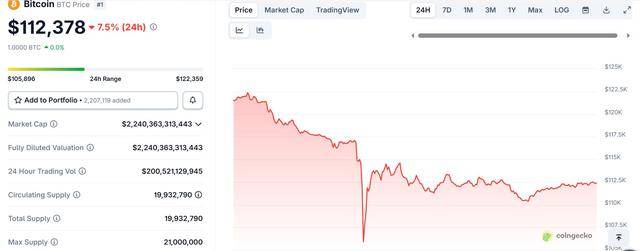
比特币闪崩13%,稳定币脱锚,193亿美元连环爆仓!
Mei Ri Jing Ji Xin Wen· 2025-10-11 14:56
Core Viewpoint - The cryptocurrency market experienced a significant crash on October 11, with Bitcoin dropping over 13% within 24 hours, reaching a low of approximately $105,900, despite Deutsche Bank's optimistic report predicting Bitcoin could become a key reserve asset by 2030 alongside gold [1][12]. Market Reaction - Bitcoin's price fell sharply from a high of $126,250 earlier in the week, marking a 20% retracement and the largest sell-off since April [1][3]. - Ethereum and other major cryptocurrencies faced even steeper declines, with Ethereum dropping over 20% to around $3,380, and smaller altcoins experiencing drastic price drops, some nearing zero [3][4]. - The crash led to over 1.66 million investors being liquidated, with a total liquidation amount reaching approximately $19.36 billion, marking the largest single-day deleveraging in cryptocurrency history [4]. Causes of the Crash - Analysts had warned of increasing leverage and crowded bullish positions, indicating growing short-term vulnerability in the market [4]. - Speculative capital, driven by high leverage through contract trading and liquidity mining, flooded into the market, making it susceptible to rapid sell-offs when negative news emerged [3][4]. - The crash was exacerbated by algorithmic trading and trading bots, which intensified the market chaos [4]. Impact on Stablecoins - The crash also affected decentralized finance (DeFi), particularly the synthetic stablecoin USDe, which saw its price drop to as low as $0.62, a 38% de-pegging from the dollar [5]. - The de-pegging was attributed to panic selling, insufficient liquidity, and the collapse of leveraged positions that relied on USDe for borrowing [5][6]. Historical Context - The recent crash has drawn comparisons to previous significant downturns in the cryptocurrency market, highlighting a consistent pattern of high leverage leading to rapid liquidations and market panic [7][10]. - Historical events such as the "312" crash in March 2020 and the "222" crash in February 2021 illustrate similar market reactions to external shocks, emphasizing the fragility of the cryptocurrency market [9][10]. Future Outlook - Despite the recent downturn, there are indications of a potential recovery, with Bitcoin's price rebounding to around $112,000, and increased bullish bets in the options market [11]. - However, the recent events have raised questions about Bitcoin's status as a safe-haven asset, as its price movements have shown a strong correlation with risk assets like U.S. tech stocks [11][15]. - Experts suggest that Bitcoin's volatility and structural weaknesses hinder its potential to become a reserve asset, with concerns about liquidity and security risks remaining prevalent [12][14].

运营经理的核心竞争力是什么?从执行到战略的进阶指南
Sou Hu Cai Jing· 2025-10-11 12:45
Core Insights - The role of operations managers has evolved beyond traditional tasks, becoming essential for driving growth and innovation in a rapidly changing business environment [1] - The most critical skill for operations managers is "data-driven decision-making," which allows them to transition from intuition-based approaches to evidence-based strategies [3] Importance of Data-Driven Decision-Making - Operations encompass various aspects such as user growth, event planning, process optimization, and cost control, making data reliance crucial for effective decision-making [4] - Without data support, operations can be ineffective, as highlighted by the analogy of dancing in the dark, where actions may be beautiful but lack impact [4] Phased Approach to Enhancing Data-Driven Decision-Making Skills - **Stage 1: Foundation (0-1 year)** - Focus on developing data awareness, identifying issues through data analysis, quantifying results, and predicting trends [5][6] - **Stage 2: Intermediate (1-3 years)** - Transition from execution to analysis, enhancing analytical depth to support decision-making [8] - **Stage 3: Advanced (3-5 years)** - Aim to become a team leader, using data capabilities for strategic planning and influencing business direction [9][10] Certification Recommendations - Obtaining certifications, such as the CDA Data Analyst, serves as an "accelerator" for career growth, providing structured learning and enhancing credibility in the job market [12][14] - The CDA certification is particularly relevant in the context of big data and AI, making it a valuable asset for operations managers [16][18] Summary of Learning Path - The growth of operations managers is a long-term journey, with data-driven decision-making as a core competency, complemented by soft skills like communication and leadership [20] - The CDA course integrates AI and big data case studies, emphasizing practical applications in real business scenarios [21]
如何提升个人技能顺利转岗市场运营
Sou Hu Cai Jing· 2025-10-11 06:56
Core Insights - The article emphasizes the growing trend of career transitions into market operations, highlighting the importance of acquiring the right skill set and certifications like the CDA (Certified Data Analyst) to facilitate this shift [1][4]. Group 1: Core Competencies in Market Operations - Data analysis skills are essential for collecting, organizing, and interpreting market data to optimize operational strategies [3]. - User insight capabilities are crucial for understanding user needs, behavior patterns, and psychological motivations [3]. - Content creation skills are necessary for effective content planning and copywriting [3]. - Channel management skills involve familiarity with the operational rules and optimization methods of major traffic platforms [3]. - Strategic planning abilities are required to develop comprehensive marketing plans and brand communication strategies [3]. Group 2: CDA Certification as a Career Accelerator - The CDA certification is a powerful tool for transitioning into market operations, providing a data-driven operational mindset [4][6]. - It equips individuals with essential tools for market operations, including Excel for data analysis, SQL for user behavior data extraction, and Python for market trend forecasting [6]. - CDA-certified professionals can enhance cross-departmental collaboration, effectively communicating data needs and business logic with technical and product teams [6]. Group 3: Recognition and Employment Opportunities - The CDA certification is highly regarded in the data field, comparable to CPA and CFA certifications, and is recommended by authoritative media [7]. - Many companies prioritize CDA-certified candidates during recruitment, especially in technical roles within banks and financial institutions [10]. - Job opportunities for CDA holders include positions as data analysts in major internet companies, technical roles in finance, business intelligence consultants, market researchers, and operational roles [12]. Group 4: Dual-Track CDA and Market Operations Skills Development - The first phase focuses on foundational skills, including obtaining CDA Level 1 certification and learning basic statistics, Excel, and SQL [12][14]. - The second phase emphasizes practical skill enhancement, applying CDA knowledge in market operations, and building a personal project portfolio [14]. - The final phase involves job preparation and networking, optimizing resumes to highlight CDA certification and data analysis skills [14][15]. Group 5: Strategies to Overcome Transition Challenges - To address experience gaps, individuals can build portfolios through personal projects, freelance work, and volunteer opportunities [15]. - For knowledge gaps, utilizing online courses, industry reports, and professional literature is recommended [15]. - To expand networking resources, active participation in industry communities and sharing valuable insights can help establish connections [15].

APP运营新人怎样快速提升自己的技能
Sou Hu Cai Jing· 2025-10-10 22:59
Core Insights - The article emphasizes the importance of data analysis skills for APP operation newcomers, highlighting the CDA Data Analyst certification as a valuable asset in the digital economy and AI development trend [1][18]. Group 1: APP Operation Core Work and Skill Requirements - APP operation encompasses user operation, content operation, activity operation, and data analysis, requiring skills in user psychology, copywriting, event planning, and data problem-solving [1][4]. - Essential skills include communication, copywriting, event planning, data analysis tool usage (such as Excel, SQL, and basic Python), and market sensitivity [1][4]. Group 2: Skill Enhancement Stages for APP Operation Newcomers - The skill enhancement process is divided into three stages: Basic Entry Period (0-6 months), Capability Strengthening Period (6-12 months), and Advanced Breakthrough Period (1 year and beyond) [3][9]. Basic Entry Period (0-6 months) - Focus on familiarizing with work processes and mastering basic tools, establishing operational thinking [5][6]. - Specific actions include learning company products and industry knowledge, mastering basic tools like Excel and SQL, and participating in team collaboration [6][7]. Capability Strengthening Period (6-12 months) - Aim to independently manage small modules and enhance data-driven decision-making abilities [10][11]. - Specific actions involve strengthening data analysis skills, improving event planning and execution, and enhancing copywriting and user communication [11][12]. Advanced Breakthrough Period (1 year and beyond) - Target becoming a core team member with strategic vision [13][14]. - Specific actions include learning advanced data analysis, expanding management and leadership skills, and continuously learning about industry innovations [14][15]. Group 3: Importance of CDA Data Analyst Certification - The CDA Data Analyst certification is highlighted as a crucial skill enhancement tool, enabling precise user problem identification, activity optimization, and market trend prediction [18][23]. - The certification is recognized by many companies, providing a competitive edge in job applications, especially in data-driven roles [20][22]. - The certification is particularly suitable for APP operators, aligning with big data and AI trends, and offers practical applications relevant to operational challenges [23][25].
品牌运营如何快速提升自身技能
Sou Hu Cai Jing· 2025-10-10 21:50
Core Insights - Brand operation plays a crucial role in shaping a brand's "soul and reputation," focusing on conveying brand values, managing user interactions, and optimizing strategies through data analysis [1] - Many new brand operators fall into the trap of "self-indulgent operation," spending excessive time on posters and copywriting without understanding user recognition and brand growth impact [1] - The key to rapid improvement is shifting from "emotional creativity" to "rational operation," focusing on the core logic of "brand recognition - user interaction - data review" [1] Core Skills Breakdown - Core Skill 1: Brand copywriting should focus on "precisely conveying value" rather than using ornate language, with practical methods for improvement [7] - Core Skill 2: Brand reputation management is essential, requiring both amplification of positive feedback and timely handling of negative reviews, with actionable methods for monitoring and responding [7] - Core Skill 3: Understanding core brand data is vital, including recognition, interaction, and conversion metrics, with practical methods for data review and optimization [7] Certification Support - The CDA Data Analyst certification is highly recommended for brand operators, recognized for its value in the digital economy and AI development, with a friendly entry barrier and high industry recognition [2][3][6] - The CDA certification is equivalent in recognition to CPA and CFA, frequently mentioned in job descriptions by major companies, indicating its importance in the job market [3][9] - The certification process helps individuals systematize their skills, transforming scattered knowledge into a comprehensive understanding of data analysis and brand strategy [14] Employment Opportunities - Job prospects for CDA-certified individuals include roles in major internet companies, financial institutions, and various data analysis positions, with starting salaries around 15K+ [11] - Many companies prioritize CDA certification in their hiring processes, enhancing job seekers' competitiveness in the market [9] Summary of Brand Operation Improvement - Effective brand operation relies on logic and data rather than mere inspiration, emphasizing a structured approach to execution, optimization, and strategic thinking [13] - The certification process aids in connecting fragmented skills into a cohesive knowledge system, enhancing the ability to analyze data and guide strategies [14]

倒计时2天!2025年《财富》可持续发展峰会即将开幕
财富FORTUNE· 2025-10-08 13:47
智能时代的浪潮,既为可持续发展注入澎湃动力,也裹挟着具有破坏力的暗流。智慧医疗与数字能源网 络等全球实践证明,数字化与智能化技术已经从辅助工具进化为驱动可持续发展的核心引擎;然而数据 中心能耗激增、算法参与决策、机器取代劳力,又向我们发出全新的拷问:技术进步能否推动人类福祉 的"净增长"? "智惠共生"的价值在当下凸显:它要求将环境永续、社会公平、人类福祉和尊严铸入科技演进与商业转 型的核心,技术应普惠大众,为人类所利用、为人类所掌控。 本次峰会将汇集来自《财富》500强、最具创新精神公司的可持续践行者和专家学者,共同探讨科技赋 能下的可持续发展路径,凝聚共识并展开创新合作,令智能技术真正惠及人类命运。 本次峰会将深入探讨可持续发展领域的当下重点议题,具体包括: 议题 · 创新、效率与责任交织的"共生网络" · 全球化企业的ESG实践:多元文化中的责任公约数 · 负责任矿产的"中国叙事" · 从瓦特到比特:绿电驱动算力革命 · 可持续消费觉醒:买家投票权和企业答卷 · 为大自然定价:资本重塑生态保护 · 启动创新医疗的可持续发展"齿轮" · 供应链革命:全球布局与绿色尽责 · 前沿科技在ESG中的应用 · 重 ...

特朗普宣布对进口中型和重型卡车征收25%关税|首席资讯日报
首席商业评论· 2025-10-08 02:28
Group 1 - The U.S. Supreme Court has denied Google's request to pause a key part of a judge's order requiring significant modifications to the Play Store in the antitrust case brought by Epic [3] - OpenAI's CEO Sam Altman announced the release of a smaller voice model, GPT-5Pro, in the API, indicating that voice interaction will become a primary way for users to engage with AI [3] - Deloitte has partnered with Anthropic to deploy its AI model Claude to over 470,000 employees globally, marking the largest enterprise deployment for Anthropic to date [4] Group 2 - President Trump announced a 25% tariff on imports of medium and heavy trucks starting November 1, 2025, following a previous announcement of a similar tariff on heavy trucks effective October 1 [4] - Boeing plans to increase the production of its 737 Max to 42 units per month as early as October, with further increases planned by the end of 2026 [5][6] - The Indian Pilots Association has called for a comprehensive inspection of all Boeing 787 aircraft in India following an incident where an emergency system activated unexpectedly during landing [7] Group 3 - Fifth Third Bancorp has agreed to acquire Comerica Inc. in a stock transaction valued at approximately $10.9 billion, creating the ninth-largest bank in the U.S. with assets of about $288 billion [8] - The Shanghai Tourism Festival has set new records for both the number of visitors and total tourism consumption, indicating a strong recovery in urban tourism [9] - xAI plans to spend over $18 billion on the Colossus2 project in Memphis, purchasing around 300,000 Nvidia chips, as part of a larger initiative to acquire 550,000 chips [10]