
邮储银行

Search documents
系统重要性银行名单公布 新增浙商银行
Zhong Guo Zheng Quan Bao· 2026-02-14 00:32
Core Insights - The People's Bank of China and the National Financial Regulatory Administration have conducted an assessment for the 2025 systemically important banks, identifying 21 domestic banks as systemically important [1] Group 1: Systemically Important Banks - The assessment categorized the 21 banks into five groups based on their systemic importance scores, with the first group consisting of 11 banks including China Minsheng Bank, China Everbright Bank, Ping An Bank, and others [1] - The second group includes 4 banks: Industrial Bank, China CITIC Bank, Shanghai Pudong Development Bank, and China Postal Savings Bank [1] - The third group has 2 banks: Bank of Communications and China Merchants Bank [1] - The fourth group consists of 4 major banks: Industrial and Commercial Bank of China, Bank of China, China Construction Bank, and Agricultural Bank of China [1] - No banks were placed in the fifth group [1] Group 2: Changes and Future Directions - Compared to the 2023 list of systemically important banks, Zhejiang Commercial Bank is a new addition [1] - The People's Bank of China and the National Financial Regulatory Administration plan to enhance macro-prudential management and micro-prudential supervision to ensure the safe and sound operation of systemically important banks [1] - The goal is to better support the high-quality development of the real economy [1]

港股市场 重要调整
Zhong Guo Zheng Quan Bao· 2026-02-14 00:23
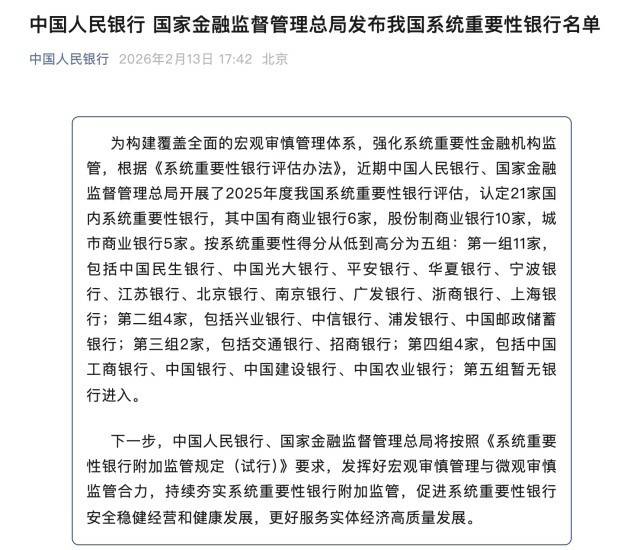
重要新闻提示 6. 中国人民银行2月13日消息,为构建覆盖全面的宏观审慎管理体系,强化系统重要性金融机构监管, 根据《系统重要性银行评估办法》,近期中国人民银行、国家金融监督管理总局开展了2025年度我国系 统重要性银行评估,认定21家国内系统重要性银行,其中国有商业银行6家,股份制商业银行10家,城 市商业银行5家。 按系统重要性得分从低到高分为五组:第一组11家,包括中国民生银行、中国光大银行、平安银行、华 夏银行、宁波银行、江苏银行、北京银行、南京银行、广发银行、浙商银行、上海银行;第二组4家, 包括兴业银行、中信银行、浦发银行、中国邮政储蓄银行;第三组2家,包括交通银行、招商银行;第 四组4家,包括中国工商银行、中国银行、中国建设银行、中国农业银行;第五组暂无银行进入。 央行:1月末,社会融资规模同比增长8.2%,广义货币供应量(M2)同比增长9.0% 恒生指数成分股调整,宁德时代、洛阳钼业、老铺黄金被纳入 证监会对天风证券作出行政处罚及市场禁入事先告知 财经新闻 1. 中国人民银行2月13日发布2026年1月金融统计数据报告。数据显示,1月末,社会融资规模同比增长 8.2%,广义货币供应量(M2)同 ...
车贷“长跑”开启,汽车金融驶入共赢新赛道
Xin Lang Cai Jing· 2026-02-14 00:15
Core Insights - The automotive market is experiencing a shift in competitive dynamics with the introduction of long-term financing options such as "0 down payment" and "7-year ultra-low interest" loans, moving away from cash discounts [1][8][9] Group 1: Long-term Financing Options - Companies like Tesla, Xiaomi, and Li Auto have launched 7-year low-interest car loan products to attract new customer segments [2][10] - For instance, Xiaopeng Motors offers a 7-year financing plan with monthly payments starting at 1,355 yuan, while Xiaomi's new plan requires a down payment of 99,900 yuan with monthly payments starting at 1,931 yuan [2][10] - Nissan has also introduced an 8-year low-interest loan option, highlighting the trend towards extended loan terms in the market [2][10] Group 2: Consumer Demographics - The primary customers opting for these long-term loans include young individuals with limited savings, those facing existing financial pressures, and customers looking to replace their vehicles [3][11] - The extended repayment periods lower the barrier to entry for first-time buyers, particularly young families and those interested in electric vehicles [1][9] Group 3: Market Dynamics and Competition - The introduction of ultra-long-term loans is seen as a competitive strategy for automakers to stimulate demand and alleviate financial pressure on consumers [4][12] - The market for new energy vehicles (NEVs) is projected to grow significantly, with NEV sales expected to account for 47.9% of total new car sales by 2025, reflecting a 7% increase from 2024 [4][12] Group 4: Banking Sector Involvement - Banks are increasingly viewing high-quality auto loans as a key area for business expansion, collaborating with automakers to offer long-term low-interest products [5][13] - The regulatory environment is supportive, with policies allowing banks to extend personal loan terms from 5 to 7 years for long-term consumer needs [5][12] Group 5: Risk Management and Future Strategies - The shift to long-term loans raises concerns about asset depreciation and credit risk, particularly for electric vehicles, which may have lower resale values compared to traditional vehicles [6][15] - Financial institutions are encouraged to enhance risk management capabilities and develop a comprehensive service ecosystem that integrates vehicle financing with additional services [16][14]
共计21家!我国系统重要性银行名单发布
Sou Hu Cai Jing· 2026-02-13 23:52
Core Viewpoint - The People's Bank of China and the National Financial Regulatory Administration have conducted an assessment of systemically important banks for 2025, identifying 21 domestic banks and aiming to enhance macro-prudential management and supervision of these institutions [1] Group 1: Identification of Systemically Important Banks - A total of 21 domestic systemically important banks have been recognized, including 6 state-owned commercial banks, 10 joint-stock commercial banks, and 5 city commercial banks [1] - The banks are categorized into five groups based on their systemic importance scores, with the first group consisting of 11 banks, the second group having 4 banks, the third group with 2 banks, the fourth group containing 4 banks, and no banks in the fifth group [1] Group 2: Breakdown of Banks by Group - **First Group (11 banks)**: China Minsheng Bank, China Everbright Bank, Ping An Bank, Huaxia Bank, Ningbo Bank, Jiangsu Bank, Beijing Bank, Nanjing Bank, Guangfa Bank, Zheshang Bank, Shanghai Bank [1] - **Second Group (4 banks)**: Industrial Bank, China CITIC Bank, Shanghai Pudong Development Bank, China Postal Savings Bank [1] - **Third Group (2 banks)**: Bank of Communications, China Merchants Bank [1] - **Fourth Group (4 banks)**: Industrial and Commercial Bank of China, Bank of China, China Construction Bank, Agricultural Bank of China [1] - **Fifth Group**: No banks are included [1] Group 3: Future Regulatory Actions - The People's Bank of China and the National Financial Regulatory Administration will implement additional regulatory measures as per the "Regulations on Additional Supervision of Systemically Important Banks (Trial)" to ensure the safe and sound operation of these banks [1] - The aim is to strengthen the collaboration between macro-prudential management and micro-prudential supervision, thereby supporting the high-quality development of the real economy [1]

商业银行2025年累计实现净利润2.4万亿元
Zheng Quan Ri Bao· 2026-02-13 22:45
南开大学金融学教授田利辉对《证券日报》记者表示,2025年四季度银行业交出了一份总量稳、结构 优、质量实的成绩单。总资产保持增长且继续向大型银行集中,这是市场选择与监管引导共同作用的结 果。普惠小微贷款余额同比实现较快增长,金融服务实体经济质效提升。 从经营效益指标来看,2025年全年,商业银行累计实现净利润2.4万亿元。截至2025年四季度末,商业 银行平均资本利润率为7.78%,平均资产利润率为0.60%,整体延续下降态势。净息差方面,截至2025 年四季度末,商业银行净息差为1.42%,较2025年三季度末、二季度末持平。 分不同类型银行来看,截至2025年四季度末,除了大型商业银行、外资银行的净息差较2025年三季度末 有所下滑,股份制商业银行、城商行、民营银行、农商行的净息差均较2025年三季度末持平或有所回 升。 本报记者 熊 悦 2月12日,国家金融监督管理总局发布2025年四季度银行业主要监管指标数据情况。总体来看,我国银 行业总资产保持增长。截至2025年四季度末,我国银行业金融机构资产总额为480万亿元,同比增长 8.0%。其中,商业银行的总资产为414.79万亿元,同比增长9.0%,占银 ...
21家国内系统重要性银行 名单公布
Zhong Guo Zheng Quan Bao· 2026-02-13 22:20
按系统重要性得分从低到高分为五组:第一组11家,包括中国民生银行、中国光大银行、平安银行 (000001)、华夏银行(600015)、宁波银行(002142)、江苏银行(600919)、北京银行 (601169)、南京银行(601009)、广发银行、浙商银行(601916)、上海银行(601229);第二组4 家,包括兴业银行(601166)、中信银行(601998)、浦发银行(600000)、中国邮政储蓄银行;第三 组2家,包括交通银行(601328)、招商银行(600036);第四组4家,包括中国工商银行、中国银行 (601988)、中国建设银行(601939)、中国农业银行;第五组暂无银行进入。 记者梳理发现,与2023年发布的国内系统重要性银行名单相比,本次新增浙商银行。 中国人民银行、国家金融监督管理总局表示,下一步,将按照《系统重要性银行附加监管规定(试 行)》要求,发挥好宏观审慎管理与微观审慎监管合力,持续夯实系统重要性银行附加监管,促进系统 重要性银行安全稳健经营和健康发展,更好服务实体经济高质量发展。 中国人民银行2月13日消息,为构建覆盖全面的宏观审慎管理体系,强化系统重要性金融机构监管, ...
5年前买的金条卖出赚近196万!这差距谁不羡慕?
Sou Hu Cai Jing· 2026-02-13 19:20
五年前埋下的时间胶囊,在2026年的春天裂开了一道缝。 透出来的,是金灿灿的光。 一百九十六万,扣除手续费之后,净利润为一百九十六万,两千七百克,在五年之前以每克三百八十八 元的价格买入,在前几天以每克一千一百一十二元的价格卖出,那个来自武汉的人步入商场之际,手中 拎着的并非金条,那是这五年当中我们所有人都错失的某种物件,其到底是什么呢。 羡慕吗?当然羡慕。 足够一场疫情来了又走,走了又来,最后变成生活的一部分。 也足够让2700克金属,变成196万人民币的差价。 可你认真去思索,在2021年之际,那时我们正在做些什么,疫情持续不断,出门之时还必须佩戴口罩, 哪会有人存有心思去购置什么金条,那时的金价尚未达到400,认为已然不算低廉了,谁又能够预料到 它竟会涨至1100? 没人能想到。 五年,足够发生什么? 足够一个孩子从出生到会打酱油。 足够一段婚姻从热烈到平淡,或者从平淡到破裂。 五年前,那位选择进行买入行为的顾客所处之时,黄金价格为每克388.5元。当时的年份,是处于2021 年,此际国际黄金价格尚处于蛰伏的时期阶段,彼时拜登方才开始上台执政,同时疫情依旧处于肆意流 行、严重危害的状态,在那个时候没有哪 ...

系统重要性银行名单出炉
Shang Hai Zheng Quan Bao· 2026-02-13 17:01
Core Viewpoint - The People's Bank of China has identified 21 domestic systemically important banks for the year 2025, aiming to enhance macro-prudential management and regulatory oversight of these institutions [1] Group 1: Identification of Systemically Important Banks - A total of 21 banks have been recognized as systemically important, including 6 state-owned commercial banks, 10 joint-stock commercial banks, and 5 city commercial banks [1] - The banks are categorized into five groups based on their systemic importance scores, with the first group containing 11 banks, the second group 4 banks, the third group 2 banks, the fourth group 4 banks, and the fifth group having no banks [1] Group 2: Breakdown of Bank Groups - Group 1 includes: China Minsheng Bank, China Everbright Bank, Ping An Bank, Huaxia Bank, Ningbo Bank, Jiangsu Bank, Beijing Bank, Nanjing Bank, Guangfa Bank, Zheshang Bank, and Shanghai Bank [1] - Group 2 consists of: Industrial Bank, China CITIC Bank, Shanghai Pudong Development Bank, and China Postal Savings Bank [1] - Group 3 includes: Bank of Communications and China Merchants Bank [1] - Group 4 comprises: Industrial and Commercial Bank of China, Bank of China, China Construction Bank, and Agricultural Bank of China [1] Group 3: Future Regulatory Actions - The People's Bank of China and the financial regulatory authority will implement additional regulatory measures as per the "Regulations on Additional Supervision of Systemically Important Banks (Trial)" to ensure the safe and sound operation of these banks [1] - The aim is to strengthen the macro-prudential management and micro-prudential regulatory synergy, promoting the healthy development of systemically important banks to better serve the high-quality development of the real economy [1]




乳山:小牡蛎撬动大经济
Zheng Quan Ri Bao· 2026-02-13 16:22
北纬37°,黄海之滨。清晨六点,一艘艘满载牡蛎的渔船陆续靠港。码头上,工人们熟练地卸货、分 拣、装箱,一派热火朝天的繁忙景象。这里是"中国牡蛎之乡"——山东乳山,一座因"鲜"而兴、 因"链"而强的城市。 《证券日报》记者近日实地探访乳山,目睹了这场"鲜"味十足的产业脉动,探寻一颗牡蛎如何从海洋走 向餐桌,又如何在金融活水的精准滴灌下,成长为年产值超百亿元的现代化海洋产业。 从海浪到流水线 鲜味的标准化之旅 走进乳山牡蛎加工厂,流水线上工人们正熟练地分拣、清洗、包装,空气中弥漫着海水的咸鲜味。 "毛料(刚从海里打捞上来、未经任何人工处理的原始牡蛎)回来从这儿直接清洗,在这3台机器分拣, 规格从一两到八两都有。"在乳山市渔汇电子商务有限公司的生产车间里,经理于慧慧的嗓音几乎被传 送带和机器的轰鸣声淹没。 据了解,春节是海鲜消费的绝对旺季,为了保障从高端餐厅到寻常百姓家的"年夜鲜",许多工人最晚大 年初四就要返岗。同时,车间也将在春节期间保持运转。"虽然假期短了,但想到咱乳山生蚝能端上全 国人民的年夜饭餐桌,心里特别有成就感。"一位正在打包的工人向记者表示。 这份"成就感"有着沉甸甸的数据支撑。据威海海关统计,20 ...
车贷“长跑”开启 汽车金融驶入共赢新赛道
Zheng Quan Ri Bao· 2026-02-13 15:43
Core Viewpoint - The automotive market is experiencing a shift in competitive dynamics as long-term financing options like "0 down payment" and "7-year ultra-low interest" loans become more prevalent, moving away from cash discounts [1][4]. Group 1: Long-term Financing Options - Companies such as Tesla, Xiaomi, and Li Auto have introduced 7-year low-interest car loan products to attract new customers with lower entry barriers [2][4]. - The extended repayment periods allow first-time buyers, particularly young families, to experience electric vehicles sooner, effectively lowering the cost of ownership [1][4]. - The introduction of these financing options is seen as a strategy to stimulate demand and alleviate financial pressure on consumers [4][5]. Group 2: Market Dynamics and Competition - The competition in the automotive market is intensifying, particularly in the electric vehicle sector, with projections indicating that by 2025, new energy vehicles will account for 47.9% of total new car sales in China [4]. - The long-term loan offerings serve as a differentiation strategy for automakers, enabling them to secure long-term customer relationships and create opportunities for additional services [4][5]. Group 3: Banking Sector Involvement - Banks are increasingly viewing high-quality auto loans as a key growth area, responding to government policies aimed at boosting consumer spending [5][6]. - Collaborations between banks and automakers on long-term low-interest products allow banks to access quality customer resources while mitigating risks through interest subsidies from car manufacturers [5][6]. - Financial institutions are encouraged to enhance their risk management capabilities and customer credit assessment systems to adapt to the long-term nature of these loans [5][6]. Group 4: Future Ecosystem Development - There is a potential shift from traditional lending to a comprehensive service model that encompasses the entire lifecycle of vehicle ownership, including financing, insurance, and maintenance [6][7]. - Banks are advised to establish data-sharing mechanisms with automakers to create integrated financial products that cater to various customer needs throughout the vehicle ownership experience [7]. - The goal is to transition from one-time transactions to long-term customer engagement, fostering a win-win ecosystem for banks, automakers, and consumers [7].