浦发银行

Search documents
厦门银行浦发银行青岛银行跌幅居银行板块前三
Zhong Guo Jing Ji Wang· 2025-11-06 09:00
Group 1 - Xiamen Bank's stock price fell to 7.16 yuan, a decrease of 2.59% [1] - Shanghai Pudong Development Bank's stock closed at 11.66 yuan, down by 1.69% [1] - Qingdao Bank's stock price decreased to 5.06 yuan, with a drop of 1.36% [1] Group 2 - The banking sector overall declined by 0.26% today [1] - Xiamen Bank, Shanghai Pudong Development Bank, and Qingdao Bank were the largest decliners in the banking sector [1]

浦发银行淮安分行被罚 违反信用信息采集等管理规定
Zhong Guo Jing Ji Wang· 2025-11-06 08:59
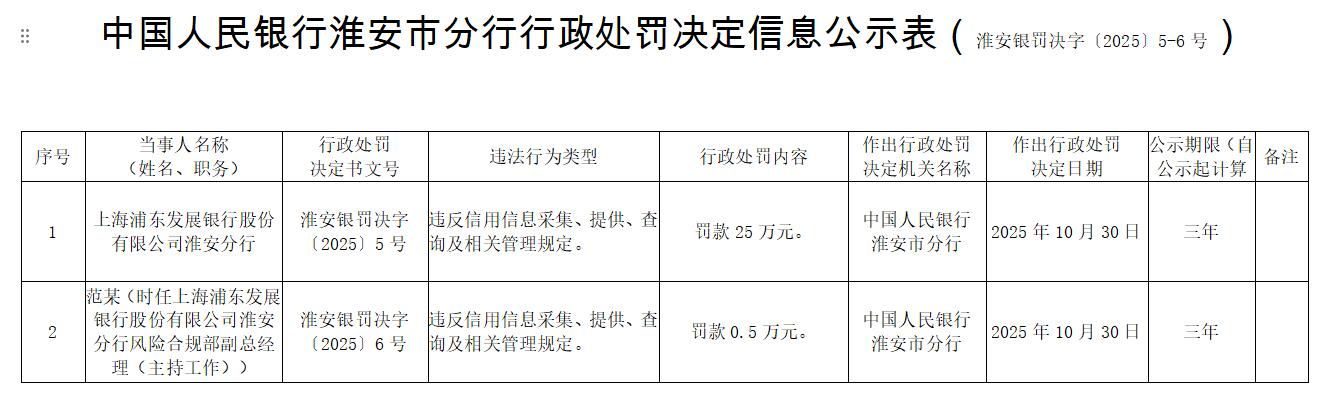
原文如下: 中国经济网北京11月6日讯 中国人民银行淮安市分行近日公布行政处罚决定信息公示表(淮安银罚决字〔2025〕5-6号)显示,上海浦东发展银行股份 有限公司淮安分行违反信用信息采集、提供、查询及相关管理规定。中国人民银行淮安市分行对其罚款25万元。 范某(时任上海浦东发展银行股份有限公司淮安分行风险合规部副总经理(主持工作))被罚款0.5万元。 | 序号 | 当事人名称 | 行政处罚 | 违法行为类型 | 行政处罚内容 | 作出行政处罚 | 作出行政处 | | --- | --- | --- | --- | --- | --- | --- | | | (姓名、职务) | 决定书文号 | | | 决定机关名称 | 决定日期 | | | 上海浦东发展银行股份 | 淮安银罚决字 | 违反信用信息采集、提供、查 | 罚款 25 万元。 | 中国人民银行 | 2025年10月 | | | 有限公司淮安分行 | (2025) 5 号 | 询及相关管理规定。 | | 淮安市分行 | | | 2 | 范某(时任上海浦东发展 银行股份有限公司 淮安 | 淮安银罚决字 | 违反信用信息采集、提供、查 | 罚款 0.5 万 ...

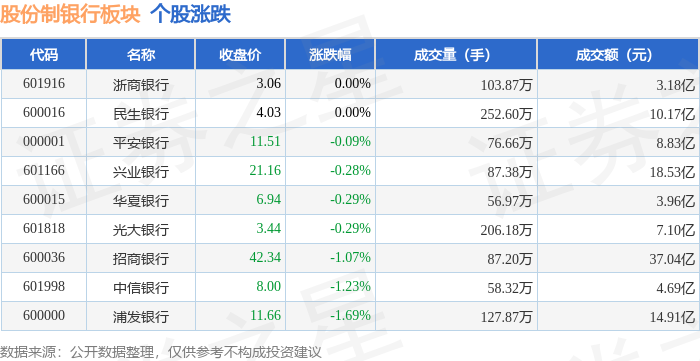
股份制银行板块11月6日跌0.81%,浦发银行领跌,主力资金净流出5.41亿元
Zheng Xing Xing Ye Ri Bao· 2025-11-06 08:51
Market Overview - On November 6, the shareholding banks sector declined by 0.81%, with Pudong Development Bank leading the drop [1] - The Shanghai Composite Index closed at 4007.76, up 0.97%, while the Shenzhen Component Index closed at 13452.42, up 1.73% [1] Individual Bank Performance - The closing prices and performance of key banks are as follows: - Zheshang Bank: 3.06, unchanged - Minsheng Bank: 4.03, unchanged - Ping An Bank: 11.51, down 0.09% - Industrial Bank: 21.16, down 0.28% - Huaxia Bank: 6.94, down 0.29% - Everbright Bank: 3.44, down 0.29% - China Merchants Bank: 42.34, down 1.07% - CITIC Bank: 8.00, down 1.23% - Pudong Development Bank: 11.66, down 1.69% [1] Capital Flow Analysis - The shareholding banks sector experienced a net outflow of 541 million yuan from main funds, while retail investors saw a net inflow of 463 million yuan [1] - The following table summarizes the capital flow for individual banks: - CITIC Bank: Main net inflow of 27.51 million yuan, retail net inflow of 11.20 million yuan - Huaxia Bank: Main net inflow of 23.08 million yuan, retail net outflow of 27.16 million yuan - Zheshang Bank: Main net inflow of 7.26 million yuan, retail net inflow of 5.91 million yuan - Everbright Bank: Main net inflow of 1.13 million yuan, retail net inflow of 15.17 million yuan - Pudong Development Bank: Main net inflow of 0.08 million yuan, retail net outflow of 0.76 million yuan - Industrial Bank: Main net outflow of 1.74 million yuan, retail net inflow of 80.35 million yuan - Minsheng Bank: Main net outflow of 73.74 million yuan, retail net inflow of 80.06 million yuan - Ping An Bank: Main net outflow of 87.51 million yuan, retail net inflow of 55.48 million yuan - China Merchants Bank: Main net outflow of 437 million yuan, retail net inflow of 25 million yuan [2]
南威软件股份有限公司 关于为全资子公司固定资产项目贷款提供担保的公告
Zhong Guo Zheng Quan Bao - Zhong Zheng Wang· 2025-11-06 03:42
登录新浪财经APP 搜索【信披】查看更多考评等级 | 序号 | 发起人姓名戒名称 | | 认购股份载 | 当资时间 | | --- | --- | --- | --- | --- | | 1 | 吴志瑾 | | 57,305,250 | 2010/12/31 | | 2 | 大津市制 信全解版权投资 | | 7.448.250 | 2010/12/31 | | | (SARE) TO SEREN | | | | | 3 | 福州市晋安区德弘惠业 授学中心〈有限合伙〉 | | 3,000,000 | 2010/12/31 | | | 福州型本成长创业投资 | | | | | 4 | 有限公司 | | 2,250,000 | 2010/12/31 | | 5 | 厦门东方汇富版权投资 | | 2,250,000 | 2010/12/31 | | | (关业业(点保合伙) | | | | | 6 | 临新理 | | 699,000 | 2010/12/31 | | -1 | ■关三 | | 279,750 | 2010/12/31 | | 8 | 中次世 | | 210.000 | 2010/12/31 | | 9 ...

中国与太平洋岛国深化经贸合作!价值ETF(510030)涨0.55%!
Xin Lang Ji Jin· 2025-11-06 02:29
Group 1 - The core viewpoint of the article highlights the stable performance of the Value ETF (510030) with a 0.55% increase and a trading volume of 3.68 million yuan, while the fund's latest scale is 169 million yuan [1] - Among the constituent stocks, China Power Construction, Huayu Automotive, and New China Life Insurance showed the strongest performance with increases of 5.11%, 3.56%, and 2.85% respectively, while Shanghai Pudong Development Bank and Agricultural Bank of China experienced declines of over 1% [1] - The signing of the Economic Partnership Framework Agreement between China and several Pacific island countries on November 4, 2025, aims to deepen trade cooperation [1] Group 2 - The 180 Value Index constituent stock, Industrial Bank, has been approved to issue 50 billion yuan in green financial bonds to support clean energy and environmental projects [1] - Guohai Securities indicates that the growth theme is expected to continue in the coming month, with the current TMT industry crowding at approximately 35%, and a warning for style switching if it reaches 40% [1] - The Value ETF (510030) and its linked funds passively track the 180 Value Index, with the top ten weighted stocks including China Ping An, China Merchants Bank, and Industrial Bank [1]

翻遍9家银行财报,我发现行业洗牌的秘密藏在这些数字里
3 6 Ke· 2025-11-06 02:03
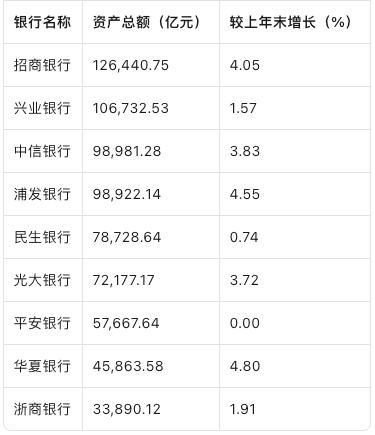
Core Insights - The overall performance of the nine listed joint-stock banks in China showed a decline in both revenue and net profit for the first three quarters of the year, with total operating income at 1.12 trillion yuan, down 2.56% year-on-year, and net profit at 406.1 billion yuan, down nearly 1% [1][3] Group 1: Performance Overview - Among the nine banks, four experienced declines in both revenue and net profit, while some banks managed to achieve growth in both metrics [1][4] - The top joint-stock banks by asset size are China Merchants Bank (12.64 trillion yuan), Industrial Bank (10.67 trillion yuan), and CITIC Bank, with Shanghai Pudong Development Bank showing the fastest growth rate at 4.55% [1][2] Group 2: Revenue and Profit Analysis - Only Minsheng Bank and Shanghai Pudong Development Bank reported year-on-year revenue growth, with increases of 6.74% and 1.88%, respectively; the remaining seven banks saw revenue declines, with Ping An Bank experiencing the largest drop at 9.8% [3][4] - In terms of net profit, only four banks, including Shanghai Pudong Development Bank, reported growth, with the latter achieving a 10.21% increase, making it the leader in profit growth among joint-stock banks [4] Group 3: Net Interest Income and Margin - Net interest income, a key indicator of banks' operating income, showed mixed results, with only three banks reporting growth; China Merchants Bank led with 160.04 billion yuan, up 1.74% [5][6] - The net interest margin (NIM) faced pressure, with most banks experiencing declines; China Merchants Bank maintained the highest NIM at 1.87%, while CITIC Bank saw the largest drop of 16 basis points [7] Group 4: Asset Quality and Risk Management - The non-performing loan (NPL) ratio improved for most banks, with China Merchants Bank having the lowest NPL ratio at 0.94% [9][10] - However, the provision coverage ratio decreased for seven banks, with Ping An Bank showing the largest decline of 21.11 percentage points; Shanghai Pudong Development Bank's coverage ratio increased by 11.08 percentage points, indicating enhanced risk mitigation [10][11]





小鹏剑指 2026 高阶人形机器人量产,进博会上王兴兴谈具身智能挑战!
Mei Ri Jing Ji Xin Wen· 2025-11-06 01:16
Market Review - The Huaxia Sci-Tech AI ETF (89010) closed at 1.374 CNY, down 0.94%, following a decline in the Sci-Tech AI Index (-1.01%) [1] - The ETF showed a recovery after a low opening, indicating short-term support [1] - Among the constituent stocks, 5 increased while 25 decreased, with Weisheng Information and Tianzhun Technology leading the gains, while Fuxin Software and Fudan Microelectronics saw significant declines, reflecting pressure on AI applications and computing power [1] - The Robot ETF (562500) closed at 0.996 CNY, down 0.50%, fluctuating between 0.984 and 0.999 CNY throughout the day [1] - The trading volume exceeded 900 million CNY, maintaining stable trading activity [1] Hot News - Xiaopeng aims to achieve large-scale production of advanced humanoid robots by the end of 2026 [2] - At the 8th China International Import Expo, Wang Xingxing, founder of Yushu Technology, commented on the development speed of embodied intelligent models, noting that while there has been significant progress in some areas this year, the pace of advancement in large models is slightly slower than expected [2] - Jindi Co. announced innovations in the development of robot harmonic reducer flexible wheel products, successfully achieving import substitution through precision stamping [2] Institutional Views - Guojin Securities emphasizes the importance of new technology iterations and component ticket pricing, highlighting the competitive advantages of automotive manufacturers and brands that understand demand scenarios and hardware supply chains [3] - The report suggests focusing on the "ticket pricing" and technological iterations, particularly in the supply chain related to Tesla and its components [3] - Key recommendations include the full-size humanoid robot UM Ningbo Huaxiang and attention to the development of dexterous hands and motors [3] Popular ETFs - The Robot ETF (562500) is the only ETF in the market with a scale exceeding 20 billion CNY, offering the best liquidity and comprehensive coverage of the Chinese robotics industry [4] - The Huaxia Sci-Tech AI ETF (589010) is positioned as the "brain" of robotics, with a 20% fluctuation limit and flexibility in small and mid-cap stocks, aiming to capture the "singularity moment" in the AI industry [4]


五家银行跻身绿色信贷“万亿俱乐部” 绿色债券存量规模近2万亿
2 1 Shi Ji Jing Ji Bao Dao· 2025-11-05 23:42
Core Insights - Green finance has transitioned from an optional choice to a mandatory requirement for the banking industry, serving as a new engine for strategic transformation and a blue ocean market for future growth [1] - The balance of green financing at Industrial Bank has reached nearly 2.5 trillion yuan, with green loans exceeding 1 trillion yuan and a non-performing loan rate of only 0.57% [1] - The People's Bank of China and other departments have issued a unified policy framework for green finance, effective from October 1, 2025, to standardize various financial products [2] Group 1: Green Credit Growth - As of the end of 2024, the total balance of green credit among 42 A-share listed banks exceeded 27 trillion yuan, reflecting a year-on-year growth of approximately 20% [3] - State-owned banks dominate the green credit market, with the six major state-owned banks accounting for over 21 trillion yuan, representing 77.6% of the total [3] - Industrial Bank's green loan balance has risen to 1.08 trillion yuan, joining the "trillion club" [3] Group 2: Performance and Sector Focus - The average growth rate of green credit for A-share listed banks in 2024 was 20.6%, a slowdown from approximately 28% in 2023, yet leading institutions maintained strong growth [4] - The focus of green credit issuance is concentrated in four key areas: clean energy, green transportation, energy conservation and environmental protection, and green buildings [4] - The Yangtze River Delta, Guangdong-Hong Kong-Macau Greater Bay Area, and Chengdu-Chongqing Economic Circle are identified as core regions for green credit [4] Group 3: Product Innovation - A-share listed banks are deepening innovation in green financial products, creating a multi-dimensional product system that includes loans, bonds, asset securitization, insurance, and carbon finance [5] - Sustainable Development Linked Loans (SLL), carbon emission rights pledge financing, and environmental rights collateral loans are gaining traction [5] - Industrial Bank has launched the first green loan with biodiversity protection insurance, while Bohai Bank introduced a green loan linked to data center energy efficiency [6] Group 4: Broader Financial Tools - The issuance of green bonds has expanded, with the cumulative issuance of labeled green bonds in 2024 surpassing 4 trillion yuan [6] - Banks are actively participating in green wealth management and fund products, enhancing investor engagement through innovative offerings [6] - Carbon finance tools are transitioning from pilot programs to broader applications, with various banks introducing carbon emission rights pledge financing products [6] Group 5: Future Directions - The banking industry is expected to continue innovating green financial products to support sustainable economic development, moving beyond traditional green credit [7] - The development of ESG-linked loans and financing models using carbon emission rights as collateral will be explored [7] - These innovations will not only assist in achieving national carbon reduction goals but also cultivate new growth momentum for banks [7]



陕西省“基金+项目”投融资对接活动在沪举办
Shan Xi Ri Bao· 2025-11-05 23:13
Core Insights - The event held on November 4 in Shanghai aimed to deepen financial and industrial collaboration between Shaanxi Province and developed regions, attracting investment to boost local industry development [1] Group 1: Event Overview - The "Fund + Project" investment and financing matchmaking event was organized by the Shaanxi provincial government, with support from various provincial departments [1] - The event included strategic signing and project roadshow segments to facilitate capital cooperation [1] Group 2: Strategic Partnerships - Shaanxi Caijin Investment Management Co., Ltd. signed strategic cooperation agreements with Shanghai Pudong Development Bank and Guotai Junan Securities [1] - Shaanxi Provincial Government Investment Guidance Fund Management Co., Ltd. entered into fund cooperation agreements with several firms, including Xingsheng Innovation Capital Management and Bank of China International, with a total scale of 3 billion yuan [1] Group 3: Investment Focus - The funds will primarily target sectors such as biomedicine, innovative manufacturing, and artificial intelligence, which are considered hard technology fields [1] Group 4: Project Roadshow - The project roadshow featured high-quality sci-tech projects and investment opportunities that attracted attention from numerous investment institutions in the Yangtze River Delta [1] Group 5: Future Outlook - The Shaanxi Provincial Government Investment Guidance Fund aims to attract more funds and projects to the province through market-oriented operations, laying the groundwork for precise cooperation between the two regions [1]

翻遍9家银行财报,我发现行业洗牌的秘密藏在这些数字里
凤凰网财经· 2025-11-05 13:27
Core Viewpoint - The overall performance of the nine listed joint-stock banks in China showed a decline in both revenue and net profit for the first three quarters, indicating a challenging environment for the banking sector [2][5]. Group 1: Overall Performance - The nine joint-stock banks collectively achieved an operating income of 1.12 trillion yuan, a year-on-year decrease of 2.56%, and a net profit of 406.1 billion yuan, down nearly 1% year-on-year [2][5]. - There is a notable divergence in performance among the banks, with four banks experiencing declines in both revenue and profit, while others managed to achieve growth [2][5]. Group 2: Individual Bank Performance - As of the end of Q3, China Merchants Bank led with total assets of 12.64 trillion yuan, followed by Industrial Bank at 10.67 trillion yuan, with Shanghai Pudong Development Bank showing the fastest growth rate of 4.55% [3][4]. - Only Minsheng Bank and Shanghai Pudong Development Bank reported year-on-year revenue growth of 6.74% and 1.88%, respectively, while the remaining seven banks saw declines, with Ping An Bank experiencing the largest drop at 9.8% [7][8]. Group 3: Net Interest Income - Among the nine banks, only three reported an increase in net interest income, with China Merchants Bank leading at 160.04 billion yuan, a growth of 1.74% [11][12]. - The net interest margin pressure remains a common challenge, with most banks experiencing a decline in this metric, except for Minsheng Bank, which saw a slight increase [13][14]. Group 4: Asset Quality - Most banks reported a decrease in non-performing loan (NPL) ratios, with China Merchants Bank having the lowest at 0.94%, while the others ranged between 1% and 1.5% [15][16]. - The provision coverage ratio decreased for most banks, with Ping An Bank showing the largest decline of 21.11 percentage points [17]. Group 5: Future Outlook - The banks face challenges in narrowing net interest margins in a low-interest-rate environment, and the potential impact of "deposit migration" due to stock market recovery will test their adaptability [17].