顺丰控股

Search documents
顺丰控股(06936.HK)11月13日耗资4614.55万元回购114.26万股A股

Ge Long Hui· 2025-11-13 09:16
Group 1 - The company, SF Holding (06936.HK), announced a share buyback plan on November 13, 2025, involving an expenditure of RMB 46.1455 million to repurchase 1.1426 million A-shares [1] - The buyback price per share is set between RMB 40.26 and RMB 40.49 [1]
顺丰控股(06936) - 翌日披露报表
2025-11-13 09:08
FF305 翌日披露報表 (股份發行人 ── 已發行股份或庫存股份變動、股份購回及/或在場内出售庫存股份) 表格類別: 股票 狀態: 新提交 公司名稱: 順豐控股股份有限公司(於中華人民共和國註冊成立的股份有限公司) FF305 呈交日期: 2025年11月13日 如上市發行人的已發行股份或庫存股份出現變動而須根據《香港聯合交易所有限公司(「香港聯交所」)證券上市規則》(「《主板上市規則》」)第13.25A條 / 《香港聯合交易所有限公司GEM證券 上市規則》(「《GEM上市規則》」)第17.27A條作出披露,必須填妥第一章節 。 | 第一章節 | | | | | | | | --- | --- | --- | --- | --- | --- | --- | | 1. 股份分類 | 普通股 | 股份類別 A | | 於香港聯交所上市 | 否 | | | 證券代號 (如上市) | 002352 | 說明 | A股(於深圳交易所上市) | | | | | A. 已發行股份或庫存股份變動 | | | | | | | | | | 已發行股份(不包括庫存股份)變動 | | 庫存股份變動 | | | | | 事件 | 已 ...
【宝藏】数币优惠来袭 惊喜“豪”礼送不停
中国建设银行· 2025-11-13 06:14
Core Points - The article discusses various promotional activities related to digital currency payments offered by China Construction Bank in collaboration with several brands, including Luckin Coffee and Haokang [4][6][12]. Group 1: Promotions and Discounts - Luckin Coffee offers a new customer red envelope worth 10 yuan and a monthly discount of 5 yuan for the first order over 9 yuan during the promotional period from November 1 to November 30, 2025 [6]. - Haokang provides discounts for home service purchases made through its app, with a reduction of 5 yuan for orders over 100 yuan and 10 yuan for orders over 300 yuan, valid from September 16 to December 31, 2025 [12][13]. - The total number of discounts available for Haokang is limited to 50,000 instances, with a total discount cap of 500,000 yuan [13]. Group 2: Additional Offers - Other brands participating in the digital currency promotions include Vipshop and Miniso, with specific promotional periods and conditions outlined for each [14][18]. - The digital currency payment system is designed to enhance customer experience and encourage the use of digital wallets for transactions across various platforms [4][21].


2026年交通运输行业投资策略报告:反内卷、历史新高船龄和供求共振-20251113
Western Securities· 2025-11-13 06:06
Group 1: Express Delivery Industry - The express delivery sector is expected to benefit from anti-involution policies, with prices starting to rise since July 2025 due to government measures against low-price and disorderly competition [13][15][20] - In September 2025, major express companies reported a year-on-year increase in single ticket prices, indicating the initial success of the anti-involution policies [24][21] - The express delivery volume is projected to maintain good growth, with a compound annual growth rate of 11.6% from 2023 to 2028 [34][32] Group 2: Oil Transportation Industry - The average age of VLCC (Very Large Crude Carrier) ships reached a historical high of 13 years in August 2025, indicating a need for capacity renewal [52][51] - There is a significant gap between the number of new orders and the required capacity updates, with only 112 VLCCs expected to be delivered by 2029 against a potential scrapping of 319 older vessels [58][56] - Global oil production and consumption are expected to grow in the coming years, which may positively impact oil transportation demand [43][42] Group 3: Aviation Industry - The aviation sector is anticipated to enter a supply-demand resonance cycle, with a projected low growth rate in aircraft supply over the next eight years [71][73] - Most airlines are expected to see good growth in passenger numbers in 2025, with overall load factors remaining high [80][84] - Government policies aimed at promoting consumption and addressing competition in the aviation sector are expected to boost demand in 2026 [90][92]
多家公司年内推出两期回购方案,美的集团单月回购再超20亿元!
Mei Ri Jing Ji Xin Wen· 2025-11-13 03:59
Group 1 - In October, A-share listed companies continued to implement share buyback plans, with companies like Aibijungguang, Jiuan Medical, COSCO Shipping Holdings, Fujilai, and Minsheng Health announcing their second buyback plans of the year, while Zhijiang Biology launched its third buyback plan for the year, indicating a strategic approach to long-term market value management [1] - Jiuan Medical has been actively maintaining its market value through share buybacks, having executed five buyback plans since 2021, with a total expenditure of 2.879 billion yuan (including some transaction costs) and a cumulative repurchase of 94.9214 million shares [1] - As of the end of October, approximately 348 companies that are currently implementing buybacks have disclosed their progress, with around 137 companies meeting the lower limit of their buyback plans, indicating a relatively fast overall pace [1] Group 2 - Midea Group's buyback efforts have exceeded expectations, with a single-month buyback of 2.466 billion yuan in October, marking the second consecutive month of over 2 billion yuan in buybacks, bringing the total for the year close to 10 billion yuan, making it one of the most active companies in the A-share market for buybacks [2] - Other companies with significant buyback amounts in October include GoerTek, Runze Technology, Youngor, Hengrui Medicine, SF Holding, and Chengde Lululemon, with buyback amounts of 430 million yuan, 351 million yuan, 229 million yuan, 220 million yuan, 200 million yuan, and 153 million yuan respectively [2] - Companies with the highest cumulative buyback ratios as of the end of October include Kejie Intelligent, Huamao Technology, Jingxin Pharmaceutical, and Zhezhong Co., with ratios of 6.66%, 6.42%, 5.49%, and 5% respectively [2]

有色行业大幅反弹,重仓有色金属行业的自由现金流ETF基金(159233)备受关注
Xin Lang Cai Jing· 2025-11-13 03:16
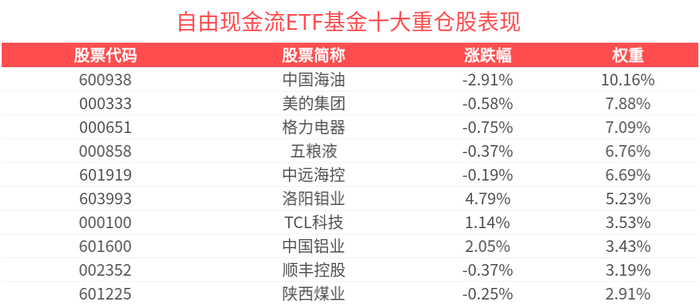
Core Insights - The China Securities Index Free Cash Flow Index (932365) has shown a 0.30% increase as of November 13, 2025, with notable gains in constituent stocks such as Furui Co., Ltd. (10.05%) and Yilong Co., Ltd. (7.47%) [1] - The Free Cash Flow ETF (159233) has experienced a 0.16% rise, with a recent price of 1.23 yuan, and a cumulative increase of 4.41% over the past week [1] - The Free Cash Flow ETF has seen continuous net inflows for 11 days, totaling 81.15 million yuan, with a peak single-day net inflow of 10.59 million yuan [1] Performance Metrics - Since its inception, the Free Cash Flow ETF has achieved a maximum monthly return of 7.80% and a longest consecutive monthly gain of 5 months, with an average monthly return of 3.35% [2] - The maximum drawdown since inception is 3.76%, with a recovery time of 35 days [2] Fee Structure - The management fee for the Free Cash Flow ETF is 0.50%, while the custody fee is 0.10% [3] Tracking Accuracy - The Free Cash Flow ETF has a tracking error of 0.076% over the past three months, closely following the China Securities Index Free Cash Flow Index [4] - The top ten weighted stocks in the index account for 56.53% of the total, including companies like China National Offshore Oil Corporation and Midea Group [4][6] Fund Size and Activity - The Free Cash Flow ETF has reached a new high in size at 453 million yuan and a new high in shares at 369 million [1][8] - The fund has seen an average daily transaction volume of 19.95 million yuan over the past year [1]
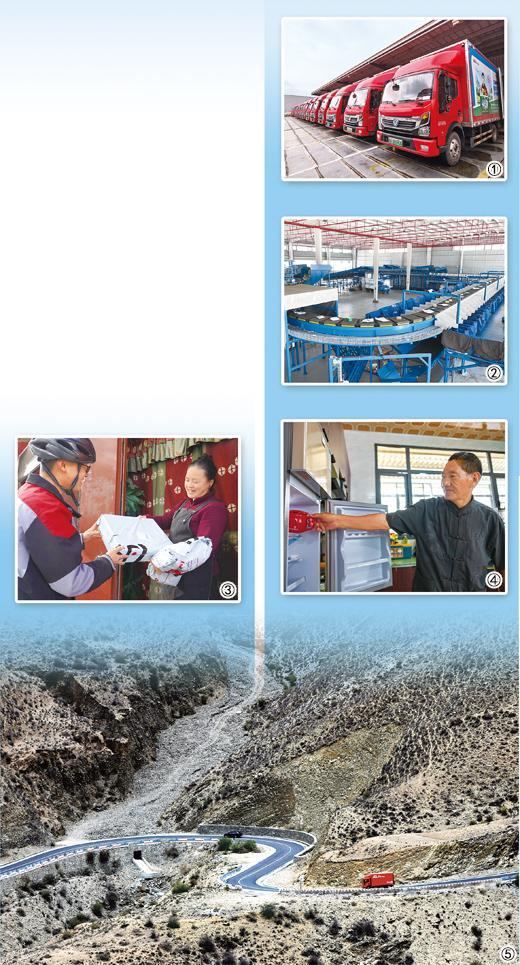
珠峰脚下也能包邮了
Ren Min Ri Bao Hai Wai Ban· 2025-11-13 02:09
Core Insights - The rapid growth of e-commerce and logistics in Tibet is transforming consumer behavior, with a significant increase in online shopping and delivery efficiency [2][5][6] E-commerce Growth - The number of packages processed at delivery stations has surged from about 10 per week to around 100 per day, indicating a growing trend in online shopping among local residents [2][4] - In the first half of this year, Tibet's online retail sales reached 18.07 billion yuan, marking a year-on-year increase of 38.6%, with physical goods accounting for 86.1% of this total [5] Logistics Improvements - The establishment of local warehouses has significantly improved delivery times, with many products now shipped directly from local warehouses, achieving same-day delivery in some cases [4][5] - The logistics network has been enhanced through government support and innovative mechanisms, allowing for a comprehensive delivery service across rural areas [6][8] Transportation Infrastructure - The improvement of transportation infrastructure, including the Qinghai-Tibet Railway, has reduced delivery times from approximately 60 hours to under 48 hours for e-commerce shipments [9][10] - The opening of direct transport routes from Chengdu to Lhasa has further expedited delivery, with a reduction in transit time by about 24 hours [10]
今年“双11”,快递更便捷抵达雪域高原——珠峰脚下也能包邮了
Xin Hua Wang· 2025-11-13 01:29
Core Insights - The logistics and e-commerce landscape in Tibet has significantly improved, with a notable increase in package deliveries and a shift in consumer behavior towards online shopping [2][5][6] Group 1: E-commerce Growth - The number of packages processed at a local delivery station has increased from a few dozen per week to around 100 per day, indicating a growing trend in online shopping among local residents [2][4] - In the first half of this year, Tibet's online retail sales reached 18.07 billion yuan, marking a year-on-year growth of 38.6%, with physical goods accounting for 86.1% of this total, also showing a 39.3% increase [5] Group 2: Logistics Improvements - The establishment of local warehouses has enhanced delivery efficiency, with many products now shipped from local warehouses, allowing for faster delivery times [4][5] - The integration of postal and express delivery services has improved logistics in rural areas, with over 577 villages in Shannan City achieving full delivery service coverage [8] Group 3: Transportation Enhancements - The Qinghai-Tibet Railway has become a crucial logistics channel, reducing transportation time for e-commerce goods from approximately 60 hours to under 48 hours [9][11] - The opening of direct transport routes from Chengdu to Lhasa has further improved delivery times, with some routes now taking around 40 hours, a reduction of about 24 hours compared to previous methods [11]
优必选:Walker系列累计订单超8亿元,S2开启量产交付
Xin Lang Ke Ji· 2025-11-13 01:20
Core Insights - UBTECH has commenced mass production and delivery of its full-size industrial humanoid robot Walker S2, marking a significant step towards achieving its goal of delivering 500 units within the year [1] - The cumulative order value for the Walker series humanoid robots has exceeded 800 million yuan since early 2025, indicating UBTECH's leadership in the commercialization of humanoid robots [1] - UBTECH has established partnerships with several leading companies, including BYD, Dongfeng Liuzhou Motor, Geely, FAW-Volkswagen Qingdao, Audi FAW, BAIC New Energy, Foxconn, and SF Express, covering key sectors such as new energy vehicles, 3C manufacturing, and smart logistics [1]
今年“双11”,快递更便捷抵达雪域高原
Huan Qiu Wang· 2025-11-13 00:44
Core Insights - The logistics and e-commerce landscape in Tibet is rapidly evolving, with significant improvements in delivery speed and service coverage, particularly during peak shopping events like "Double 11" [8][10][16]. Logistics and Delivery Improvements - The introduction of local warehouses has drastically reduced delivery times, with many products now shipped within 48 hours compared to the previous average of 15 days [10][16]. - The establishment of a logistics network, including partnerships between postal and courier services, has enabled comprehensive delivery coverage across rural areas, enhancing accessibility for consumers [12][14]. E-commerce Growth - Tibet's online retail sales reached 18.07 billion yuan in the first half of the year, marking a 38.6% year-on-year increase, with physical goods accounting for 86.1% of sales [11]. - The increasing availability of "free shipping" services has encouraged more residents to engage in online shopping, transforming consumer habits [8][12]. Infrastructure Development - The improvement of transportation infrastructure, including the expansion of highways and the efficiency of the Qinghai-Tibet Railway, has facilitated faster logistics operations, significantly benefiting e-commerce [15][17]. - By the end of the year, all towns and over 90% of administrative villages in Tibet are expected to have access to paved roads, further enhancing logistics capabilities [17].