
Palantir Technologies Inc.

Search documents
英伟达被抛售、甲骨文暴跌、泡沫论蔓延,AI投资进入“见真章”时刻!
Jin Shi Shu Ju· 2025-12-15 03:23
Core Insights - The article discusses the growing skepticism among investors regarding AI investments, particularly in light of recent stock sell-offs of companies like Nvidia and Oracle, and the financial challenges faced by OpenAI [2][3] - There is a debate among investors about whether to reduce exposure to AI before a potential bubble bursts or to double down on investments to capitalize on the technology's disruptive potential [2] - Concerns about the high development costs of AI and whether consumers will ultimately pay for these services are critical to the future of the stock market [2] Investment Trends - The S&P 500 has seen a bull market worth $30 trillion over the past three years, primarily driven by major tech companies like Alphabet and Microsoft, as well as companies benefiting from AI infrastructure spending [2] - Major tech firms are expected to spend over $400 billion on capital expenditures in the next 12 months, largely for data centers, despite the costs outpacing revenue growth from AI [8][11] - The depreciation costs for major tech companies are rising significantly, with Alphabet, Microsoft, and Meta's depreciation costs expected to reach approximately $300 billion by next year [11] Financial Challenges - OpenAI plans to spend $1.4 trillion in the coming years but is projected to burn through $115 billion by 2029 before generating cash flow [3][4] - Oracle's stock has been negatively impacted by higher-than-expected capital expenditures and underwhelming cloud sales growth, leading to increased credit risk [4][11] - Concerns about the sustainability of funding for AI initiatives are growing, with potential repercussions for companies reliant on external financing [4][8] Market Valuation - The current valuation of tech stocks, particularly those involved in AI, is not at the extreme levels seen during the internet bubble, with the Nasdaq 100's price-to-earnings ratio at 26 times expected earnings [12] - Some AI-related stocks, like Palantir and Snowflake, have extremely high valuations, while major players like Nvidia, Alphabet, and Microsoft maintain more moderate price-to-earnings ratios below 30 [12][13] - The article suggests that while there is a risk of a market correction, the current pricing of most companies does not yet warrant panic [13]


企业级应用:AI加速在企业端应用落地
2025-12-15 01:55
Summary of Key Points from Conference Call Industry Overview - The conference call discusses the enterprise-level application of AI, highlighting its rapid penetration into enterprise services and the performance of leading companies in the sector, indicating a significant market trend catalyzed by AI applications [1][2]. Core Insights and Arguments - **AI Application Growth**: AI applications are accelerating in enterprise services, with leading companies like 合合 and Amazon Cloud showing strong stock performance. The release of ChatGPT 5.2 and Deepseek V3.2 has also contributed positively to the market [1][4]. - **Performance Disparities**: There are notable differences in the performance of leading application companies across US, Hong Kong, and A-shares, driven by hardware and AI computing power as essential infrastructure [2][4]. - **Future AI Trends**: By 2026, AI is expected to evolve significantly, with chatbots transitioning to agents and the emergence of multimodal physical models. The competitive landscape among top models remains uncertain, with both international and domestic players like Gemini, GPT, 千问, and Deepseek being highlighted [2][6]. - **Industry Impact**: The influence of large models is profound, with companies like Adobe facing transformation pressures, while others like AppLovin and Salesforce are rebounding. Companies that integrate deeply with industry data will leverage AI strategies effectively [5][21]. Important but Overlooked Content - **Rapid Growth in AI Usage**: In China, the model invocation volume has surged nearly ninefold since last year, reaching an average daily invocation of 10 trillion tokens, marking a 363% year-on-year increase [3][10]. - **Sector Adoption Rates**: The IT, healthcare, and manufacturing sectors are leading in the adoption of enterprise-level AI, with significant growth in AI advertising and programming applications [3][14][16]. - **Open Source vs. Closed Source Models**: There are critical limitations in open-source models regarding long text processing, computational power, and AI agent capabilities compared to closed-source models, which need to be addressed for better performance [8][9]. - **Investment Opportunities**: The call suggests focusing on enterprise-level services in advertising and office applications, as well as verticals like industrial, military, tax, and e-commerce, where leading companies are expected to perform well [21]. Conclusion - The conference call emphasizes the transformative potential of AI in enterprise applications, the need for companies to adapt to evolving technologies, and the importance of strategic investment in sectors poised for growth. Investors are encouraged to focus on companies with strong fundamentals in these emerging areas [21].
2 More Stocks to Buy for 2026
Investor Place· 2025-12-14 17:00
Core Insights - The article discusses the decline of the American Dream and the potential for a new investment wave termed "American Dream 2.0" aimed at revitalizing the U.S. economy through significant infrastructure investments [5][27]. Investment Opportunities - The American Dream 2.0 Summit outlines an anticipated $11.3 trillion investment bonanza focused on transforming America into a global powerhouse, with funds allocated for AI data centers, research, and manufacturing [8]. - Celanese Corp. (CE) is highlighted as a promising investment opportunity, with expectations of revenue growth in 2026 after a period of decline, driven by stabilization in the automotive sector and a surge in construction demand [13][14]. - Analysts predict a 17% increase in gross income for Celanese, projecting a return to profitability after two years of losses, with shares currently trading at a significant discount to their justified value [15][16]. - Akamai Technologies Inc. (AKAM) is identified as a hidden leader in the compute space, with analysts forecasting revenue growth due to its transition from a content delivery network to a comprehensive cloud and cybersecurity provider [23][22]. Economic Context - The article contrasts the current economic challenges faced by many Americans with the prosperity experienced by those born in the 1940s, where 90% of children out-earned their parents, compared to only 50% for those born in the 1980s [3][5]. - The nostalgia for past economic conditions is prevalent among millennials and Gen-X'ers, prompting a focus on policies aimed at restoring well-paying manufacturing jobs and investment in American infrastructure [6][27].



Wall Street Sees AI Bubble Coming and Is Betting on What Pops It
Yahoo Finance· 2025-12-14 14:00
Core Insights - OpenAI plans to spend $1.4 trillion in the coming years but is currently generating significantly less revenue than its operating costs, expecting to burn $115 billion through 2029 before generating cash in 2030 [1] - The tech giants driving AI spending, such as Alphabet and Microsoft, have vast resources and are committed to continued investment, but concerns about growth rates and profitability are rising [2][3] - The AI sector is experiencing skepticism, with signs of a potential bubble as companies like Nvidia and Oracle face stock selloffs and increased scrutiny over their spending and growth projections [3][4] Investment Trends - Major tech companies, including Alphabet, Microsoft, Amazon, and Meta, are projected to spend over $400 billion on capital expenditures in the next 12 months, primarily for data centers, but their AI-related revenue growth is not keeping pace with these costs [11] - Rising depreciation expenses from data center investments are a significant concern, with Alphabet, Microsoft, and Meta's combined depreciation costs increasing from about $10 billion in Q4 2023 to an expected $30 billion by next year [13] - The shift in strategy towards AI spending represents a departure from the traditional model of generating rapid revenue growth at low costs, raising concerns about future profitability and cash flow [15] Market Sentiment - The current market environment reflects a mix of optimism and caution, with some investors questioning the sustainability of AI-related growth and the potential for a market correction if growth projections plateau [12][19] - While valuations for major tech companies are high, they are not at excessive levels compared to historical periods, suggesting that while there are risks, the market is not yet in a panic state [16][18] - Investors are faced with a dilemma as they navigate the AI trade, balancing the potential for significant returns against the risks of overvaluation and market corrections [19]
Trump wants the U.S. shipbuilding industry to be great again. Here's what it will take, and what's at stake
CNBC· 2025-12-14 13:25
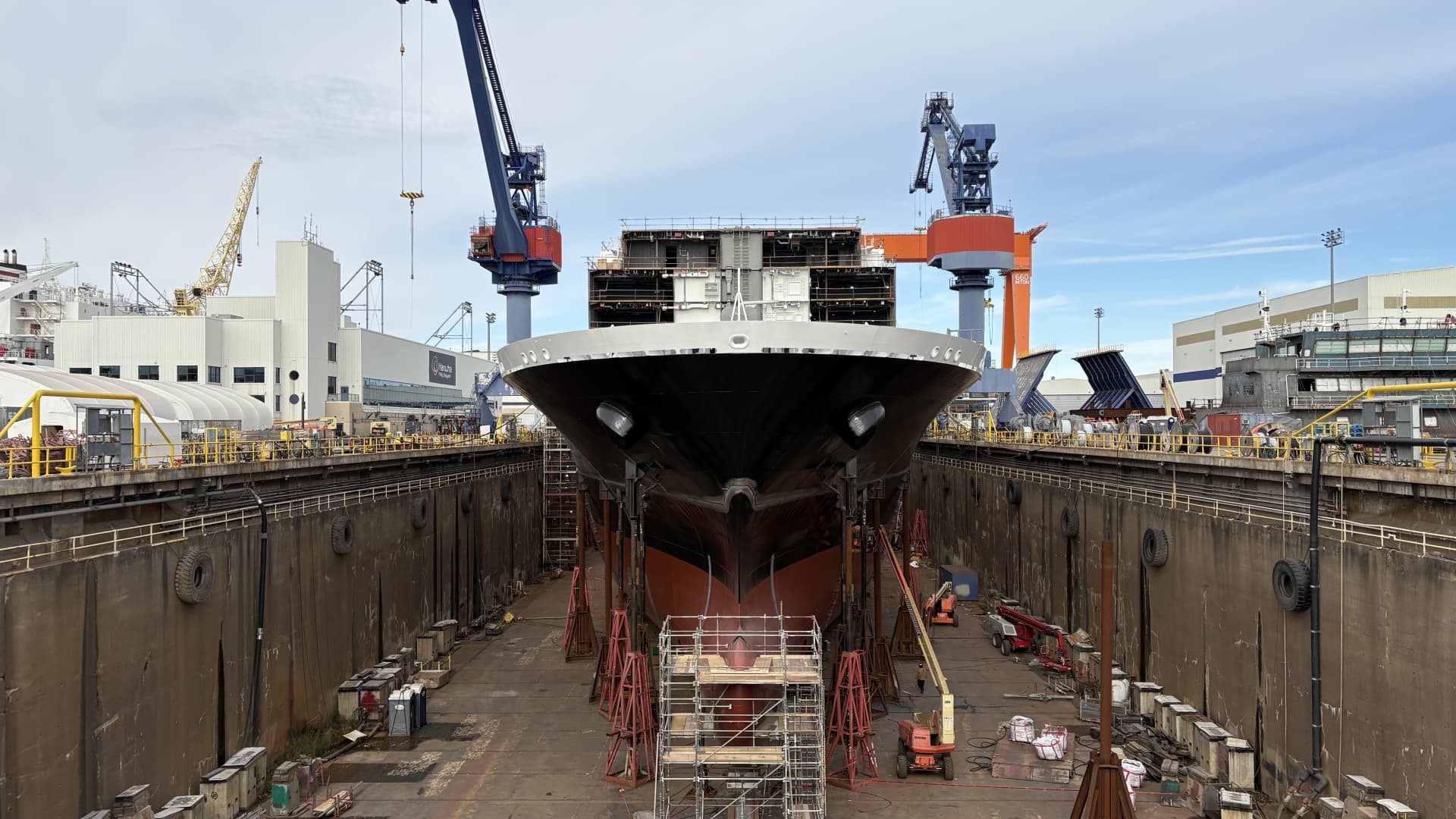
Core Insights - The U.S. shipbuilding industry is undergoing a revival initiative led by the Trump administration, focusing on enhancing domestic capabilities while relying on foreign expertise and investment [2][6][7] Shipbuilding Industry Overview - The American shipbuilding industry has experienced two significant booms in the past 110 years, during World War I and World War II, but currently faces challenges due to limited domestic capacity compared to China, which has 232 times the shipbuilding capacity of the U.S. [3][5] - The U.S. has only eight active shipyards, while China boasts over 300, dominating the global market with a 53% share [3][5] Foreign Collaboration and Investment - The Trump administration's "Make American Shipyards Great Again" initiative includes partnerships with foreign shipbuilders, particularly South Korea's Hanwha Group, which is the third-largest shipbuilder globally [7][8] - A $350 billion investment deal between South Korea and the U.S. includes $150 billion allocated for maritime investment, highlighting the importance of international collaboration [8] Specific Projects and Developments - Hanwha Philly Shipyard, acquired by Hanwha Group, is set to expand its vessel-making capacity significantly, with plans to increase production from 1-1.5 vessels per year to 20 vessels [9][12] - The shipyard has received its first orders for LNG carriers, marking a significant milestone in U.S. shipbuilding, with deliveries expected around 2028 [10] Workforce and Training Challenges - The U.S. shipbuilding industry faces workforce challenges, with a need for skilled instructors to train new employees. Hanwha plans to rotate U.S. workers to South Korea for training [11] - The current workforce at Hanwha Philly Shipyard is 1,700, with aspirations to grow to over 10,000 to meet production goals [12] Strategic Defense Considerations - The U.S. aims to enhance its naval capabilities, including the construction of nuclear-powered submarines at Hanwha Philly Shipyard, emphasizing the need for self-sufficiency in national security [17][18] - The U.S. Coast Guard's icebreaker fleet is outdated, with plans to acquire 11 new icebreakers through a $6.1 billion agreement with Finnish shipyards, addressing the need for Arctic defense capabilities [29][30] Market Dynamics - The U.S. currently has a minimal share in the LNG tanker market, with only one U.S.-flagged LNG tanker, while the country exports nearly 30% of its crude oil production without significant issues related to tanker availability [15][16] - The Jones Act mandates that vessels transporting goods between U.S. ports must be U.S.-built, which impacts the domestic shipbuilding market [14]
Will the Stock Market Rise in 2026? Investors Who Ignore This Historical Pattern Do So at Their Own Risk.
The Motley Fool· 2025-12-14 11:37
Market Overview - The S&P 500 has historically increased about 10% annually on average, with a year-to-date gain of 17% in 2025, indicating a potential for above-average returns for the third consecutive year [1][2] - Historical data suggests that the stock market tends to rise two out of three years, implying a high probability of another strong year in 2026 [5][7] Investment Strategy - Investors are encouraged to maintain a long-term investment strategy, as the average bear market lasts only 15 months and is infrequent, while market downturns of 10% to 20% are short-lived [7] - The S&P 500 is statistically likely to increase in value in 2026, and even if a market crash occurs, it is expected to be brief, leading to a new bull market [7][14] Company Focus: Sandisk - Sandisk has been the top performer in 2025 so far, with a year-to-date increase of over 500%, and is expected to outperform the S&P 500 again in 2026 [9][10] - The company reported a 10% revenue increase for fiscal 2025, with a significant surge of 23% year-over-year in the first quarter of 2026, and management anticipates over 40% growth for Q2 [12][13] - Sandisk's memory products are crucial for data centers, with demand from major hyperscalers driving revenue and profit margins, suggesting a favorable operating environment for the foreseeable future [13]

又一家万亿估值的公司诞生了
投中网· 2025-12-14 07:04
Core Viewpoint - The article discusses the rapid valuation increase of Databricks, highlighting the skepticism of its CEO, Ali Ghodsi, regarding the inflated valuations in the AI sector and the potential risks associated with it [3][4]. Group 1: Valuation and Growth - Databricks has seen its valuation double from $62 billion to $134 billion within a year, with annual sales expectations raised to $4 billion [4][10]. - The company is experiencing over 50% annual growth, and its recent funding round aims to raise $5 billion, reflecting strong investor interest [4][6]. - Databricks' valuation is set at 32 times its annual recurring revenue (ARR), which is considered reasonable compared to competitors like Snowflake and Palantir [10]. Group 2: Market Dynamics and Investment Trends - The global venture capital investment in Q3 2024 was approximately $66.5 billion, indicating that Databricks could capture nearly one-third of that capital if it accepted all offers [6][7]. - The private equity transaction volume in the data center sector has doubled from $49.9 billion to $107.7 billion over four years, showing strong investor interest in data-related assets [7][8]. - Major transactions, such as Blackstone's acquisition of AirTrunk for $16 billion, highlight the growing value of data infrastructure [8]. Group 3: Financial Performance and Challenges - Databricks has ended years of significant losses and is entering a profitable phase, with projected free cash flow of $10 million this year [9][13]. - Despite the positive outlook, the company has lowered its gross margin expectations from 77% to 74% due to rising operational costs associated with AI product usage [12]. - The reliance on OpenAI as a major customer raises concerns, as only 15% of Databricks' revenue comes from its top ten clients, indicating potential vulnerability [12][15].

哈佛老徐:大空头Burry预警,美股将陷入“2000年式熊市”,AI泡沫两年内破灭?
老徐抓AI趋势· 2025-12-14 01:06
Core Viewpoint - The article discusses the warnings from Michael Burry regarding the potential collapse of the AI boom within the next two years, emphasizing the importance of understanding his perspective rather than simply agreeing or disagreeing with him [2][4]. Group 1: Michael Burry's Profile - Michael Burry is characterized as an "outlier" with a medical background and unique personal experiences that shape his ability to see risks that others overlook [7]. - His approach involves thorough analysis, such as reviewing thousands of mortgage contracts before the 2008 financial crisis, showcasing his "superpower" in identifying hidden risks [7]. - Burry often stands against consensus, remaining calm when others are excited and analyzing structures when others are panicking, providing a unique perspective in financial history [7]. Group 2: Current AI Market Analysis - The current AI market is not in a bubble, as it is still in a phase of productivity breakthroughs and infrastructure development, with real demand and practical applications [8][10]. - However, the potential for a bubble could form rapidly within three to six months due to excessive growth expectations [10]. - The distinction is made that Burry's logic is not about the current state of AI being a bubble, but rather that future rapid growth could lead to a bubble [10]. Group 3: Utilizing Burry's Insights - Investors should view Burry's emotional signals as indicators of market consensus, where his heightened concerns may suggest a strong market sentiment [15]. - Understanding the structural risks and opportunities he identifies, such as his focus on companies like Tesla and Palantir, is crucial for investors [15]. - Burry's ability to identify risks often precedes market recognition by two to three years, highlighting the importance of "lead time" in investment strategies [15]. Group 4: Future Market Trends - The article predicts that the capital market will not wait for results to rise, suggesting a trajectory of explosion, overheating, bubble formation, tightening, and differentiation over the next two years [18]. - The emphasis is on the need for investors to adapt to market cycles rather than seeking to predict outcomes, focusing on risk-reward ratios [10][18]. - The future of AI is expected to see significant developments, with companies like Google and Tesla advancing their capabilities, indicating a potential for explosive growth in the coming years [16].

Jim Cramer Notes “Palantir Continued to Surge Higher as It Won Tons of Contracts”
Yahoo Finance· 2025-12-13 16:52
Group 1 - Palantir Technologies Inc. has been highlighted by Jim Cramer for its strong performance and numerous contracts from both the private sector and federal government, leading to a stock price increase of $6 to $188 [1] - The company develops data analytics and AI software platforms, including Gotham, Foundry, Apollo, and Palantir Artificial Intelligence Platform, which assist organizations in managing complex data [2] - Cramer expressed confidence in Palantir's stock, stating it is a high-quality name and believes it will continue to rise, despite acknowledging some political controversies surrounding the company [2] Group 2 - While Palantir is recognized for its potential, there are opinions suggesting that other AI stocks may offer greater upside potential with less downside risk [2]

Jim Cramer on Palantir: “I Believe There’ll Be Many More Pentagon Contracts Coming”
Yahoo Finance· 2025-12-13 16:52
Group 1 - Palantir Technologies Inc. is highlighted as a strong investment opportunity, particularly in light of the Fed rate cut, with a focus on its profitability and recent contracts with the US Navy [1] - The company has secured a significant contract to assist in building submarines more efficiently and at a lower cost, indicating potential for further Pentagon contracts in various defense sectors [1] - Palantir develops advanced data analytics and AI software platforms, including Gotham, Foundry, Apollo, and the Palantir Artificial Intelligence Platform, which are designed to help organizations manage complex data [2] Group 2 - While Palantir is recognized for its potential, there are other AI stocks that may offer greater upside potential and lower downside risk, suggesting a competitive landscape in the AI sector [3]