上海银行

Search documents
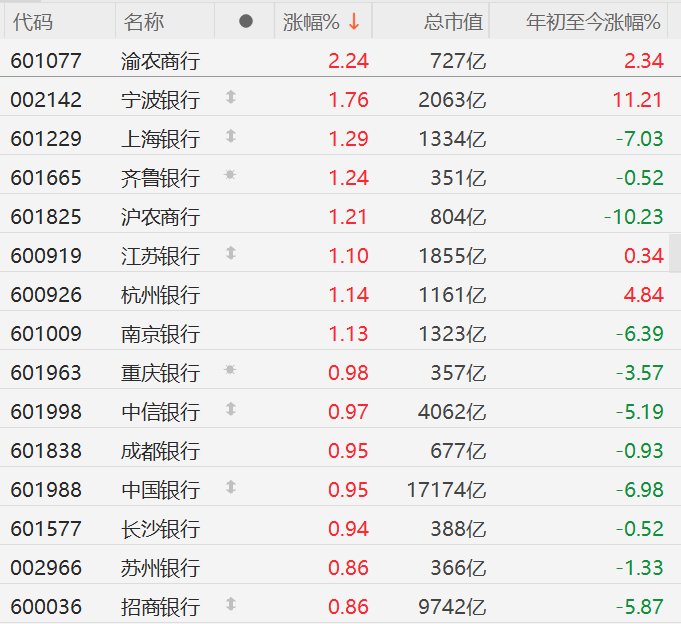
A股银行股集体上涨,渝农商行涨超2%
Ge Long Hui A P P· 2026-02-04 01:57
Group 1 - A-shares of bank stocks collectively rose, with notable increases in stocks such as Chongqing Rural Commercial Bank, which rose over 2%, and several others including Ningbo Bank, Shanghai Bank, and Qilu Bank, which rose over 1% [1] - Specific stock performance includes Chongqing Rural Commercial Bank increasing by 2.24% with a total market value of 72.7 billion, and Ningbo Bank rising by 1.76% with a market value of 206.3 billion [2] - The year-to-date performance shows significant variations, with Ningbo Bank up 11.21%, while Shanghai Bank down 7.03%, and Hu'nong Commercial Bank down 10.23% [2] Group 2 - The MACD golden cross signal has formed, indicating a positive trend for these bank stocks [2]




黄金白银继续暴跌 轮到银行股机会了?
Di Yi Cai Jing· 2026-02-04 01:02
Core Viewpoint - The A-share market experienced significant declines in various sectors, particularly in metals and banks, with a notable focus on bank stocks as a safe haven amid volatility in precious metals prices [1][3][4]. Group 1: Market Performance - On February 2, A-share non-ferrous metals led the decline with a drop of 7.62%, while steel, chemicals, coal, and oil and gas sectors also fell over 5% [1]. - The Shanghai Composite Index closed down 2.48%, with over 4,600 stocks declining and a trading volume of approximately 2.61 trillion yuan, a decrease of nearly 250 billion yuan from the previous trading day [3][4]. - The banking sector showed resilience, with certain banks like Citic Bank and Shanghai Bank posting gains of 2.64% and 1.62%, respectively, amidst the overall market downturn [4]. Group 2: Bank Sector Analysis - The banking sector has seen a significant correction, with the China Securities Bank Index dropping 6.76% as of January 30, with major banks like Pudong Development Bank and Agricultural Bank of China experiencing declines of 19.29% and 12.5%, respectively [4][5]. - Analysts believe that the peak of fund outflows from the banking sector has passed, with the sector's valuation becoming more attractive, as the median price-to-book (PB) ratio is around 0.57 and the median dividend yield has risen to over 4.5% [5][6]. - Recent reports indicate that passive fund outflows have been a major factor in the banking sector's recent adjustments, but the selling pressure is expected to diminish, allowing for potential recovery in bank stock prices [6][7]. Group 3: Institutional Insights - Institutions are starting to show interest in bank stocks, with reports indicating that active funds had reduced their holdings in bank stocks by 1.3 billion shares by the end of the fourth quarter [7]. - Several regional banks have announced stock buyback plans, which have been positively received by the market, reinforcing confidence in the banking sector's fundamentals [7].




银行花式让利 春节购车金融战升温
Bei Jing Shang Bao· 2026-02-03 15:49
Core Viewpoint - The automotive finance market is experiencing intense competition as banks implement various promotional strategies to attract consumers during the Spring Festival buying season, including interest-free first payments and low-interest loans [1][2]. Group 1: Marketing Strategies - Multiple banks, including Ping An Bank, SPD Bank, and Bank of Communications, are enhancing their automotive finance offerings with diverse plans to lower the purchasing threshold for consumers [1]. - SPD Bank offers a 7-year low-interest loan for Tesla vehicles, with an annualized rate as low as 0.49% after state subsidies, and a minimum monthly payment of 1788 yuan [2]. - Shanghai Bank provides a range of automotive finance discounts, with monthly rates as low as 0.15%, translating to an annualized rate of approximately 3.31% to 3.45% [3]. Group 2: Regulatory Actions - Many banks have initiated self-regulatory actions to prevent unfair competition in the automotive finance sector, with significant regional differences in commission standards [4][5]. - In Henan, banks have set a tiered commission structure, with maximum returns ranging from 3% for one-year products to 15% for five-year products [4]. - The Yunnan banking sector has adopted a strict "zero commission" principle to eliminate improper competition and protect consumers from inflated financing costs [5][6]. Group 3: Industry Analysis - Analysts suggest that the surge in automotive finance marketing is driven by the traditional peak buying season during the Spring Festival, with banks aiming to capture concentrated consumer demand [3][7]. - The differences in regional commission regulations reflect the varying maturity and competitive landscape of the automotive finance market across different areas [7][8]. - For sustainable development, the industry must establish a balanced financial ecosystem that promotes value creation and collaboration among banks, dealers, and consumers [8].
金融工程日报:沪指 V型反转,太空光伏、商业航天等热点题材全线反弹-20260203
Guoxin Securities· 2026-02-03 13:42
- The market saw a significant rebound with the Shanghai Composite Index showing a V-shaped recovery, and hot themes like space photovoltaics and commercial aerospace experiencing a full rebound[1] - On February 3, 2026, the market saw a broad-based rise, with the CSI 500 index performing well among scale indices, the STAR 100 index performing well among sector indices, and the CSI 500 Growth index performing well among style indices[2] - The mechanical, defense, building materials, basic chemicals, and steel industries performed well, while the banking, non-bank, coal, oil and petrochemicals, and electric utilities industries performed poorly[2] - Market sentiment on February 3, 2026, showed 82 stocks hitting the daily limit up and 23 stocks hitting the daily limit down, with a sealing rate of 78% and a continuous board rate of 36%[2] - As of February 2, 2026, the balance of margin financing and securities lending was 27,091 billion yuan, with a margin financing balance of 26,927 billion yuan and a securities lending balance of 164 billion yuan[2] - The ETF with the highest premium on February 2, 2026, was the G60 Innovation ETF by Shenwan Lingxin, with a premium of 1.83%, while the ETF with the highest discount was the Nonferrous Metals ETF by Huatai-PineBridge, with a discount of 3.89%[3] - The median annualized discount rates for the main contracts of the SSE 50, CSI 300, CSI 500, and CSI 1000 stock index futures over the past year were 0.63%, 3.79%, 11.15%, and 13.61%, respectively[3] - On February 3, 2026, the annualized discount rates for the main contracts of the SSE 50, CSI 300, CSI 500, and CSI 1000 stock index futures were 0.48%, 1.41%, 0.53%, and 2.94%, respectively[3] - The stocks with the most institutional attention over the past week were Ying Tang Zhikong, Ninebot-WD, Shanghai Bank, Gelisi, Tongli Shares, Taienkang, Wangsu Technology, and ST Jingji, with Ying Tang Zhikong being surveyed by 196 institutions[4] - The top ten stocks with net inflows from institutional seats on February 3, 2026, were Tongling Nonferrous Metals, Sanbian Technology, Robotec, Hunan Gold, Aerospace Development, Zhongchao Holdings, Autoway, Dikang Shares, Shuangjie Electric, and Hongqiang Shares[4] - The top ten stocks with net outflows from institutional seats on February 3, 2026, were Junda Shares, Wanfeng Shares, Jept, Southern Network Energy, Urban Development, Tongyu Communications, Zerun New Energy, Weiling Shares, Liujin Technology, and Intercontinental Oil and Gas[4]
春节购车金融战升温:银行花式让利,高返佣“潜规则”凉凉
Bei Jing Shang Bao· 2026-02-03 13:18
Core Viewpoint - The automotive finance market is experiencing intense competition as banks launch various promotional offers to attract consumers during the Spring Festival buying season, including interest-free loans and long-term low-interest financing options [1][3][4]. Group 1: Promotional Strategies - Multiple banks, including Ping An Bank, Shanghai Bank, and others, are intensifying their automotive finance offerings with measures such as interest-free first payments, interest subsidies, and extended low-interest loan periods to lower the barriers for consumers [1][3]. - For instance, Shanghai Bank offers a monthly interest rate of 0.20%-0.25%, translating to an annualized rate of approximately 4.40%-5.68%, with special promotional rates as low as 0.15% per month [4]. - Additionally, promotional activities include loyalty programs and point rewards for consumers who engage with specific automotive brands [3][4]. Group 2: Regulatory Actions - In response to the competitive landscape, various banks have initiated self-regulatory actions to prevent unfair competition in automotive finance, with notable differences in commission standards across regions [5][6]. - For example, banks in Henan have established a tiered commission structure, while banks in Yunnan have adopted a strict "zero commission" policy to eliminate improper competition [5][6]. - The regulatory measures aim to maintain market order and prevent practices that could lead to inflated consumer financing costs [6][9]. Group 3: Market Dynamics - Analysts suggest that the surge in automotive finance offerings is driven by the traditional peak buying season during the Spring Festival, with banks aiming to capture concentrated consumer demand [4][8]. - The differences in regional commission regulations reflect the varying maturity levels of automotive finance markets and competitive dynamics, indicating a tailored approach to regulation [8][9]. - The industry is encouraged to shift from price-based competition to a value-creating ecosystem that benefits all stakeholders, including banks, dealers, and consumers [10].

金融工程日报:沪指V型反转,太空光伏、商业航天等热点题材全线反弹-20260203
Guoxin Securities· 2026-02-03 12:55
- The CSI 500 Index performed well, with a rise of 3.11%[6] - The STAR 100 Index performed well, with a rise of 3.38%[6] - The CSI 500 Growth Index performed well, with a rise of 2.61%[6] - The mechanical, defense, building materials, basic chemicals, and steel industries performed well, with returns of 4.55%, 4.39%, 3.54%, 3.28%, and 3.25%, respectively[7] - The banking, non-bank, coal, petroleum and petrochemical, and electric power public utilities industries performed poorly, with returns of -0.81%, 0.06%, 0.24%, 0.44%, and 0.69%, respectively[7] - The TOPcon battery, BC battery, new energy equipment, rare earth, and photovoltaic concepts performed well, with returns of 8.01%, 7.11%, 6.36%, 6.09%, and 5.99%, respectively[10] - The central enterprise bank, yellow wine, bank selection, soybean, and swine fever vaccine concepts performed poorly, with returns of -1.63%, -0.73%, -0.66%, -0.47%, and -0.41%, respectively[10] - The number of stocks that hit the daily limit was 82, and the number of stocks that hit the daily limit was 23[13] - The closing return of stocks that hit the daily limit yesterday was 4.35%, and the closing return of stocks that hit the daily limit yesterday was -1.26%[14] - The sealing rate was 78%, an increase of 17% from the previous day, and the continuous board rate was 36%, an increase of 16% from the previous day[17] - The balance of margin financing and securities lending was 27,091 billion yuan, of which the balance of margin financing was 26,927 billion yuan, and the balance of securities lending was 164 billion yuan[19] - The balance of margin financing and securities lending accounted for 2.7% of the circulating market value, and the margin financing and securities lending transactions accounted for 9.3% of the market turnover[22] - The G60 Innovation ETF Shenwan Lingxin had the highest premium, with a premium of 1.83%, and the non-ferrous ETF Huatai PineBridge had the highest discount, with a discount of 3.89%[23] - The median annualized discount rates of the main contracts of the SSE 50, CSI 300, CSI 500, and CSI 1000 stock index futures over the past year were 0.63%, 3.79%, 11.15%, and 13.61%, respectively[28] - The annualized discount rate of the main contract of the SSE 50 stock index futures on the day was 0.48%, the annualized discount rate of the main contract of the CSI 300 stock index futures on the day was 1.41%, the annualized discount rate of the main contract of the CSI 500 stock index futures on the day was 0.53%, and the annualized discount rate of the main contract of the CSI 1000 stock index futures on the day was 2.94%[28] - The stocks with the highest net inflows from institutional seats were Tongling Nonferrous Metals, Sanbian Technology, Robotec, Hunan Gold, Aerospace Development, Zhongchao Holdings, Autoway, Dikang Holdings, Shuangjie Electric, and Hongqiang Holdings[37] - The stocks with the highest net outflows from institutional seats were Junda Holdings, Wanfeng Holdings, Jept, Southern Network Energy, Urban Construction Development, Tongyu Communications, Zerun New Energy, Weiling Holdings, Liujin Technology, and Intercontinental Oil and Gas[37] - The stocks with the highest net inflows from Northbound Trading were Robotec, Tongyu Communications, Dikang Holdings, Junda Holdings, Hunan Gold, Hailanxin, Far East Holdings, Zhongchao Holdings, Autoway, Southern Network Energy, and Urban Construction Development[38] - The stocks with the highest net outflows from Northbound Trading were Tongling Nonferrous Metals, Yuguang Gold and Lead, Zhejiang Wenlian, Jept, Aerospace Development, Intercontinental Oil and Gas, Juguang Technology, Taihao Technology, Litong Electronics, and others[38]
机构1月调研动向曝光!银行业调研热度上升
证券时报· 2026-02-03 10:52
Group 1 - In January 2026, over 600 A-share listed companies were surveyed by institutions, indicating a high level of interest in investment opportunities in the A-share market [1][3] - The sectors that attracted the most attention included electronics, machinery, pharmaceuticals, power equipment, and computers, with a notable increase in the banking sector's activity [1][8] - Jiemai Technology was the most frequently surveyed company, with over 10 surveys conducted in January, highlighting the interest from various types of institutions including public funds, private funds, and foreign capital [3][4] Group 2 - Ice Wheel Environment and Taihe New Materials also received significant attention, each with over 10 surveys, discussing their product developments and market strategies [4][5] - The banking sector saw a marked increase in survey activity, with institutions like Hu Nong Commercial Bank and Suzhou Bank outlining their credit strategies and growth plans for 2026 [7][9] - Hu Nong Commercial Bank emphasized a balanced approach to risk while setting aggressive credit targets, focusing on major projects and green transformation initiatives [9][10]


城商行板块2月3日跌0.59%,重庆银行领跌,主力资金净流入1.74亿元
Zheng Xing Xing Ye Ri Bao· 2026-02-03 09:03
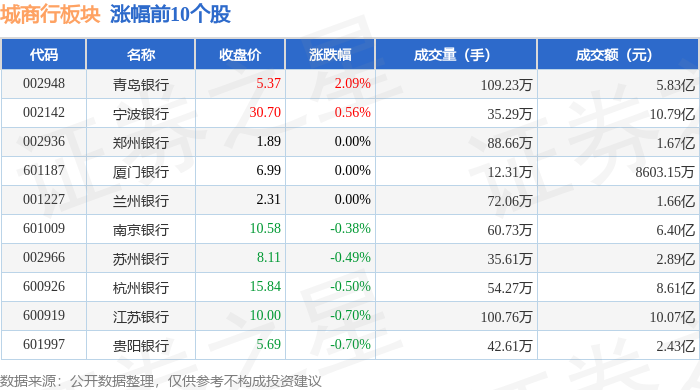
Market Overview - The city commercial bank sector experienced a decline of 0.59% on February 3, with Chongqing Bank leading the drop [1] - The Shanghai Composite Index closed at 4067.74, up by 1.29%, while the Shenzhen Component Index closed at 14127.1, up by 2.19% [1] Individual Bank Performance - Qingdao Bank closed at 5.37, with an increase of 2.09% and a trading volume of 1.09 million shares, totaling a transaction value of 583 million yuan [1] - Ningbo Bank closed at 30.70, up by 0.56%, with a trading volume of 352,900 shares and a transaction value of 1.079 billion yuan [1] - Chongqing Bank closed at 10.18, down by 1.83%, with a trading volume of 122,900 shares and a transaction value of 125 million yuan [2] - Chengdu Bank closed at 15.82, down by 1.62%, with a trading volume of 447,000 shares and a transaction value of 710 million yuan [2] Capital Flow Analysis - The city commercial bank sector saw a net inflow of 174 million yuan from institutional investors, while retail investors experienced a net outflow of 322 million yuan [2] - The main capital inflow and outflow for individual banks showed that Hangzhou Bank had a net inflow of 104.1 million yuan from institutional investors, while retail investors had a net outflow of 63.65 million yuan [3] - Chengdu Bank had a net inflow of 75.59 million yuan from institutional investors, with a net outflow of 66.56 million yuan from retail investors [3]
金融工程日报:沪指单边下行险守 4000 点,资源股全线下挫、白酒表现活跃-20260203
Guoxin Securities· 2026-02-03 06:20
证券研究报告 | 2026年02月02日 2026年02月03日 金融工程日报 沪指单边下行险守 4000 点,资源股全线下挫、白酒表现活跃 核心观点 金融工程日报 市场表现:20260202 市场全线下跌,规模指数中上证 50 指数表现较好,板 块指数中北证 50 指数表现较好,风格指数中沪深 300 价值指数表现较好。 食品饮料、银行、电新、家电、电力公用事业行业表现较好,有色金属、钢 铁、煤炭、石油石化、基础化工行业表现较差。特高压、白酒、光纤、培育 钻石、配网等概念表现较好,黄金精选、铅锌矿、黄金珠宝、存储器、磷化 工等概念表现较差。 市场资金流向:截至 20260130 两融余额为 27153 亿元,其中融资余额 26987 亿元,融券余额 166 亿元。两融余额占流通市值比重为 2.6%,两融 交易占市场成交额比重为 9.4%。 折溢价:20260130 当日 ETF 溢价较多的是 G60 创新 ETF 申万菱信,ETF 折价较多的是现金流 500ETF。近半年以来大宗交易日均成交金额达到 23 亿元,20260130 当日大宗交易成交金额为 16 亿元,近半年以来平均折价率 6.93%,当日折价 ...
海致科技:AI除幻第一股,叩开产业级智能体深水区大门
智通财经网· 2026-02-03 05:49
Core Insights - The article highlights Haizhi Technology's unique graph-model fusion technology, which allows AI agents to integrate into core business processes across various industries, taking on high-precision tasks such as analysis, decision-making, and execution [1][10] - Haizhi Technology is positioned as a key player in the AI industry, focusing on the deep-water zone of industrial-grade AI agents, creating dual barriers in technology and commercialization, and capitalizing on the explosive growth of the industry [1][15] Technology and Innovation - Haizhi Technology is the first company in China to effectively reduce the hallucination problem of large models through knowledge graphs, enhancing accuracy, reducing hallucination rates, and improving complex logical reasoning capabilities [1][2] - The company's graph-model fusion technology addresses the hallucination issue at its source, integrating knowledge graphs with large models to provide verifiable factual bases for AI outputs [2][5] - The core competitiveness of Haizhi Technology lies in its "trinity" approach: superior graph computing capabilities, graph-model fusion technology, and application expertise [5][6] Market Position and Growth - Haizhi Technology has established a significant market presence, holding a 50% market share in China's graph-based AI agent market, far exceeding its competitors [15] - The industrial-grade AI solutions market in China is projected to grow from approximately RMB 654 billion in 2025 to about RMB 2,861 billion by 2029, with a compound annual growth rate of 44.6% [15] - The company's revenue is expected to reach RMB 503.1 million in 2024, with a compound growth rate of 26.8% from 2022 to 2024, indicating a strong growth trajectory [15][19] Application and Client Engagement - Haizhi Technology's solutions have successfully addressed core pain points for clients, leading to significant risk reduction in financial services, such as a 20% increase in fraud detection for Shanghai Bank [10][11] - The company has served over 360 government and enterprise clients across various sectors, establishing a high customer retention rate and willingness to pay for its services [11][21] Future Outlook - The company is in the process of an IPO, with funds aimed at enhancing its graph-model fusion technology, optimizing its Atlas AI agent, and expanding into new markets [22] - Haizhi Technology's focus on a niche vertical technology path differentiates it from larger competitors, positioning it for long-term growth in the industrial-grade AI sector [22]