
易方达基金

Search documents
超60只新产品定档12月发行 公募基金年底发行大战如火如荼
Zhong Guo Zheng Quan Bao· 2025-12-03 22:13
Group 1 - The issuance of new funds remains strong in December, with over 60 products starting or about to start issuance, including 28 new funds on December 1 alone [1][2] - A total of 1,450 new funds have been issued this year, surpassing last year's total of 1,143 and reaching a three-year high, with a combined issuance of 10,359.09 million units [4] - Equity products are the main focus of new fund issuances, with 795 stock funds and 251 equity-mixed funds issued this year, accounting for over 70% of total new funds [4] Group 2 - Major fund companies are leading the issuance of new products, with several firms launching multiple new funds in December, such as Ping An Fund and Penghua Fund, each with four new products [3] - Innovative products have been introduced in the public fund industry, including credit bond ETFs and floating rate funds, enhancing the investment landscape [5] - The public fund industry has seen significant investor interest due to the strong performance of the A-share market and the clear earning effects of public funds, leading to a continuous increase in new fund issuances [6] Group 3 - Market expectations regarding policy and economic growth are influencing investment strategies, with suggestions for balanced asset allocation to manage volatility [6][7] - The upcoming Federal Reserve meeting and potential interest rate cuts are expected to impact the A-share market positively, particularly for growth-oriented investments [7] - The bond market is anticipated to maintain a narrow fluctuation range due to the interplay of new sales regulations and interest rate expectations [7]
不急于打满仓位 逾八成次新基金有序建仓
Zheng Quan Shi Bao· 2025-12-03 22:09
Group 1 - The core viewpoint of the articles indicates that over 80% of newly established active equity funds have shown signs of building positions, with cautious strategies due to market volatility and year-end style shifts [1][2][4] - As of December 3, 61 new active equity funds were established in the fourth quarter, with 57 being mixed equity funds, and 51 of these funds have experienced net value fluctuations [2][3] - The most notable building activity is observed in funds established in October, with some achieving over 10% returns, while others have faced slight losses due to November's market volatility [2][3] Group 2 - Fund managers are adopting a cautious approach to building positions, with many funds maintaining low levels of investment due to increased market volatility and rapid sector rotation [4][5] - The average decline in 34 core A-share indices has exceeded 3%, with some indices dropping over 11%, prompting fund managers to take a longer-term view on investments [4] - New floating fee rate funds have emerged, with an average fundraising scale of approximately 1.23 billion, and most of these funds have shown minimal net value fluctuations [5] Group 3 - The industry consensus is that AI applications will be a key focus area, with expectations for significant breakthroughs by 2026, particularly in sectors like smart driving and robotics [6][7] - Market analysts suggest that the upcoming central political bureau and economic work meetings may influence market recovery, with a focus on both new and traditional economic sectors [7] - The global AI computing market is expected to continue its strong growth, supported by increasing capital expenditures from leading cloud service providers [7]
公募基金年底发行大战如火如荼
Zhong Guo Zheng Quan Bao· 2025-12-03 20:28
Group 1 - The issuance of new funds remains strong in December, with over 60 products starting or about to start issuance, and a total of more than 1400 new funds issued this year, surpassing last year's total of 1143 and reaching a three-year high [1][2] - Equity products are the main focus of new fund issuances, with 26 stock funds and 16 mixed funds launched in December, including several managed by well-known fund managers [1][2] - The majority of new funds are being issued by large and medium-sized institutions, with several companies launching multiple new products simultaneously [2][3] Group 2 - The total issuance of new funds this year has reached 1450, with a combined share of 10,359.09 million units, marking a significant increase compared to last year [2][3] - Among the newly issued funds, 795 are stock funds and 251 are equity-mixed funds, accounting for over 70% of the total, with index products dominating the market [3] - The public fund industry is innovating continuously, introducing various new products such as credit bond ETFs and floating rate funds, enhancing the investment landscape for investors [3] Group 3 - The outlook for the market remains positive, with expectations of economic improvement and a downward trend in risk-free interest rates, although short-term disturbances may still exist [4] - Fund companies suggest a balanced allocation strategy to navigate market volatility, with recommendations to increase exposure to stable dividend assets and sectors with growth potential [4] - The bond market is expected to maintain a narrow fluctuation pattern in the short term, influenced by new sales regulations and interest rate expectations [4]
首批北交所主题基金再迎开放窗口期 多家基金公司正在筹备北证50ETF相关产品上报
Shang Hai Zheng Quan Bao· 2025-12-03 18:46
Group 1 - The first batch of North Exchange thematic funds is entering a new open window period, with the average cumulative return exceeding 100% over the past two years [1][2] - Eight North Exchange thematic funds established in November 2021 are now announcing their second open period for subscription, redemption, and conversion [2][3] - The average cumulative return of these eight funds is reported to be 104%, with one fund achieving a return of 174.67% [3] Group 2 - Public funds are increasing their investment in the North Exchange, with the amount held in North Exchange stocks rising from 54.18 billion to 103.07 billion from the end of last year to the third quarter of this year [4] - As of December 3, 2023, 15 North Index 50-related funds have been reported this year, indicating a growing interest in these products [5] - Multiple fund companies are preparing to submit North Index 50 ETF-related products, which are expected to enhance trading strategies and risk control mechanisms [6]
布局未来 年末基金经理更替“忙”
Shang Hai Zheng Quan Bao· 2025-12-03 18:46
Core Insights - The public fund industry is experiencing a peak in fund manager turnover as 2025 approaches, with over 130 changes since November, significantly higher than the same period last year [1][2] - The increase in turnover is attributed to year-end performance evaluations and strategic adjustments by fund companies to seize market opportunities and align with public fund reforms [1][2] Group 1: Fund Manager Changes - A total of 134 fund manager changes were recorded from November to December 3, surpassing last year's 92 changes, with a notable increase in departures, up over 110% year-on-year [2] - The performance evaluation at year-end poses replacement risks for underperforming fund managers, prompting some companies to proactively replace them in hopes of improving rankings [2] - The disparity in fund performance has widened, with equity funds showing a 226 percentage point difference between the best and worst performers over the past year [2] Group 2: New Appointments and Strategies - Despite the turnover, 73 new fund managers were hired since November, exceeding last year's 64, indicating a flow of "fresh blood" into the industry [3] - Some companies are adopting an "old brings new" approach, pairing new managers with experienced ones to ensure continuity in investment strategies [3] - Fund companies are optimistic about the upcoming market, with December seen as a key period for positioning ahead of a potential spring rally [3] Group 3: Regulatory and Structural Changes - The changes in fund management are part of a broader strategy to optimize talent and adapt to industry shifts, enhancing the investor experience [4] - The China Securities Regulatory Commission has outlined a plan to improve the quality of public funds, emphasizing performance-based assessments for fund managers, with at least 80% of evaluation metrics focused on investment returns [5] - Future assessments will prioritize long-term performance, with a significant weight on returns over three years or more, reflecting the industry's human resource-intensive nature [5]
科创ETF密集申报,A股科技赛道再迎增量资金
Di Yi Cai Jing Zi Xun· 2025-12-03 15:09
Group 1 - The A-share technology sector is experiencing an influx of capital as multiple semiconductor ETFs are being launched, indicating strong interest in AI, robotics, and semiconductor fields [2][3] - Since November 21, 49 new technology-focused ETFs have been reported, with the first batch of seven AI ETFs approved on the same date, reflecting a strategic positioning by public fund institutions [2][3] - The market response has exceeded expectations, with a potential influx of over 30 billion yuan if all ETFs reach their maximum fundraising limits [3] Group 2 - There is a noticeable market differentiation, with larger fund companies attracting more capital while smaller, homogeneous products struggle to gain traction, leading to a "good reputation but low sales" situation [4] - Investors prefer top-tier products with higher average daily trading volumes, which raises concerns about the liquidity and potential risks of smaller products [4] - The technology sector is currently in a critical phase of "expectation fulfillment" and "valuation digestion," necessitating a reassessment of market saturation as passive index products grow in size [5] Group 3 - Institutional investors' allocation to technology (TMT) has surpassed 40%, with semiconductor stocks becoming the largest holding sector, valued at over 250 billion yuan [6] - The valuation of technology stocks is under scrutiny, with significant disparities in price-to-earnings ratios across different sub-sectors, indicating potential overvaluation risks [6] - Unlike the 1990s tech bubble, current AI investments are supported by cash-rich, profitable large enterprises, with a strong commercial momentum and high data center utilization rates [6]


科创ETF密集申报,A股科技赛道再迎增量资金
第一财经· 2025-12-03 14:31
Core Viewpoint - The article highlights the influx of capital into the A-share technology sector, particularly focusing on the recent surge in the number of semiconductor and AI-related ETFs being launched, indicating a strategic positioning by public fund institutions in these high-demand areas [3][4]. Group 1: ETF Launch and Market Response - As of December 2, 49 new technology-focused ETFs have been reported since November 21, with a strong market response, exceeding expectations [3][5]. - The first batch of seven AI-themed ETFs was approved on November 21, with fundraising periods as short as three days, reflecting a rapid market entry strategy [3][6]. - If all initial ETFs reach their maximum fundraising limits, the sector could see over 30 billion yuan in new capital [6]. Group 2: Fundraising Dynamics and Market Differentiation - Different fund companies have set varying fundraising caps, with some like E Fund and Invesco setting limits at 8 billion units, while others like ICBC Credit Suisse have no cap [6]. - Smaller funds are facing challenges in fundraising, with a noticeable market differentiation where larger, well-positioned products attract more investor interest, while smaller, similar products struggle [7]. Group 3: Investment Trends and Market Sentiment - Institutional investors have increased their holdings in the technology sector, with TMT (Technology, Media, Telecommunications) positions exceeding 40% [10]. - The semiconductor industry has become the largest investment sector for public equity funds, with total holdings surpassing 250 billion yuan [10]. - Despite the enthusiasm for technology stocks, there are concerns about high valuations, particularly in software and semiconductors, where P/E ratios exceed 100, indicating potential overvaluation risks [11]. Group 4: AI Market Dynamics - The current AI investment landscape is supported by financially robust companies, contrasting with the 1990s tech bubble, as AI commercialization is progressing rapidly with strong cash flows [11]. - The demand for AI capabilities continues to outstrip supply, with data center utilization rates around 80%, suggesting a sustainable growth trajectory in the AI sector [11].

国产GPU第一股,周五上市!
Hua Er Jie Jian Wen· 2025-12-03 12:23
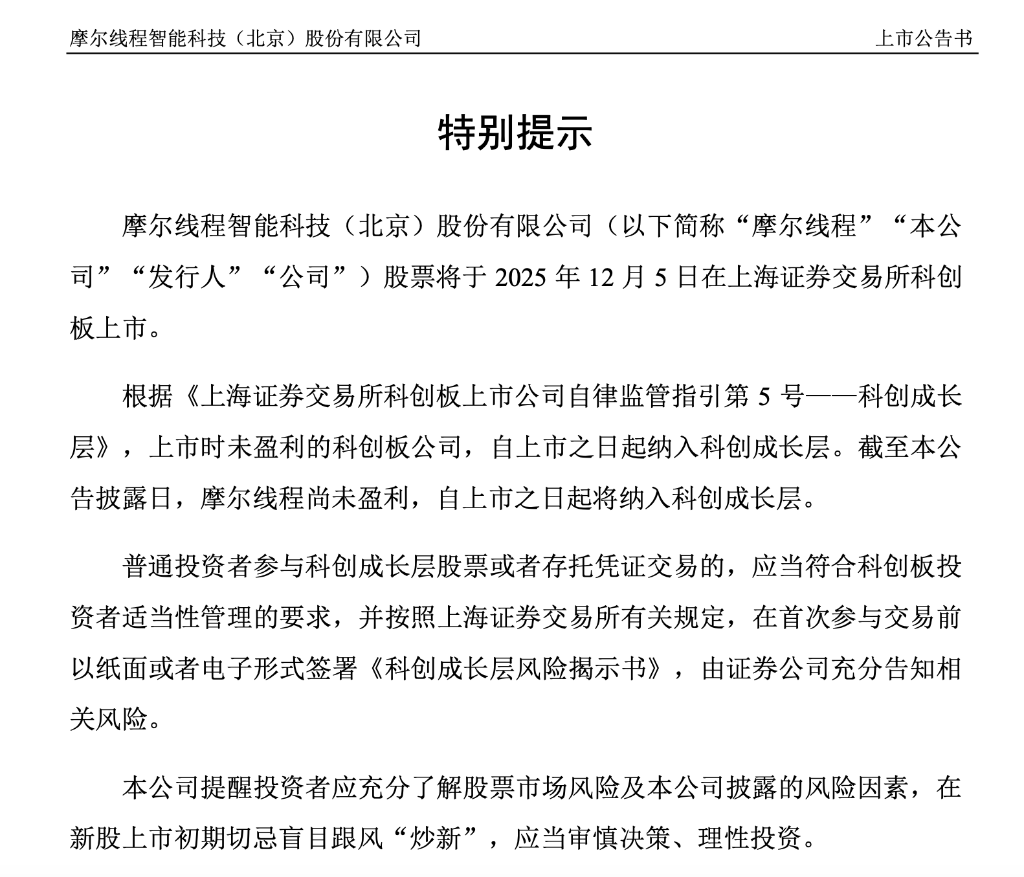
Core Viewpoint - Moer Technology, known as the "first domestic GPU stock," is set to list its shares on the Shanghai Stock Exchange's Sci-Tech Innovation Board on December 5, 2025, after receiving approval from the exchange [1][6]. Group 1: IPO Details - The company initiated its IPO subscription on November 24, 2025, with an issuance price of 114.28 yuan per share, marking the highest issuance price for new A-shares in 2025 [3][6]. - The IPO attracted unprecedented attention from institutional investors, with an offline subscription multiple reaching 1572 times and over 700 billion shares applied for [3][4]. - The online issuance saw 4,826,579 valid subscription accounts, totaling 46,216,647,000 shares, resulting in a preliminary winning rate of 0.02423369% [3][4]. Group 2: Institutional Interest - A total of 267 institutional investors participated in the offline subscription, with 7555 management allocation objects and a total subscription of 704.06 billion shares [4]. - Notable participants included 86 public funds, 124 private funds, 30 brokerages, and 13 insurance institutions, indicating strong institutional interest [4][5]. - Southern Fund submitted applications through 404 products, aiming to acquire 5.285 billion shares, while other major funds also showed significant interest [5]. Group 3: Record-Breaking IPO Process - The IPO process set multiple records, taking only 122 days from acceptance to registration, making it the fastest listing project on the Sci-Tech Innovation Board this year [6]. - The total fundraising amount of 8 billion yuan is the highest for any new stock on the Sci-Tech Innovation Board, with issuance costs also reaching a record 424 million yuan [6]. - The company's actual controller, Zhang Jianzhong, holds a 36.36% stake, valued at approximately 5.82 billion yuan based on the issuance market value [6].
ETF兵器谱、金融产品每周见:qdiiETF:折溢价探讨与产品投资策略分析-20251203
Shenwan Hongyuan Securities· 2025-12-03 12:05
Group 1: Overview of QDII ETF - QDII ETFs are primarily focused on Hong Kong stocks, experiencing rapid growth since 2021, with a significant increase in non-Hong Kong ETFs starting in 2023, reflecting a shift in investor interest towards overseas markets [3][12] - As of November 28, 2025, the cumulative scale of QDII ETFs reached 185.86 billion, indicating a growing trend in overseas investment opportunities [12] - The top 15 QDII ETFs by scale include products like Huaxia Hang Seng Technology ETF and Guotai Junan Nasdaq 100 ETF, with scales of 47.64 billion and 16.90 billion respectively [9][13] Group 2: Mechanism of Premium and Discount Formation - The premium formation mechanism for QDII ETFs relies on cash subscription and redemption, where the return to premium depends on the ability to arbitrage through "subscription + sale" [3][21] - High premiums often arise from disruptions in the arbitrage chain, particularly when subscription limits are imposed due to insufficient QDII quotas [27] - The expected arbitrage returns vary based on market conditions, with overlapping trading hours leading to different calculations of the indicative optimized price value (IOPV) [31][36] Group 3: Evaluation of QDII ETF Premiums - The premium rate is negatively correlated with the cost-effectiveness of QDII ETFs; for instance, when the premium rate exceeds 8%, holding the ETF for a month typically results in significant negative returns [3] - Daily subscription limits and market sentiment are significant factors influencing premium rates, with emotional factors providing long-term explanations for premium levels [3][27] - Some QDII ETFs exhibit additional premiums that cannot be easily explained by market sentiment, indicating potential inefficiencies in pricing [3][27] Group 4: Recent Developments in QDII ETFs - The number of QDII ETFs tracking new indices has been increasing, particularly those focusing on non-Hong Kong indices such as the Dow Jones Industrial Average and the S&P 500 Consumer Select Index [17] - Newly launched QDII ETFs often experience initial premiums, with the Huatai Baichuan South China Arabian ETF showing a first-day premium of 6.31% [17][18] - The overall market enthusiasm for QDII ETFs remains high, as evidenced by the sustained premium levels of newly listed products [17][18]
科创ETF密集申报,半导体、机器人等科技股再迎增量资金
Di Yi Cai Jing Zi Xun· 2025-12-03 11:18
Group 1 - The A-share technology sector is experiencing an influx of capital as multiple semiconductor ETFs are being launched, indicating strong interest in AI, robotics, and chip sectors [1] - Since November 21, 49 semiconductor-focused ETFs have been reported, with the first batch of 7 AI ETFs approved on the same date, highlighting a strategic positioning by public fund institutions [1][2] - The market response has exceeded expectations, with the first AI ETF raising nearly 1 billion yuan on its first day, and if all ETFs reach their fundraising caps, over 30 billion yuan could flow into the sector [2] Group 2 - There is a noticeable differentiation in fundraising limits among various fund companies, with some setting caps as high as 8 billion units while others, like Yongying Fund, set a limit of 1 billion units [2] - Smaller funds are facing challenges in fundraising, as investor preference shifts towards larger, more established products, leading to a concentration of capital in top-tier institutions [3] - The technology sector is currently in a critical phase of "expectation fulfillment" and "valuation digestion," with a need to reassess market saturation as passive index products grow [4] Group 3 - Institutional investors have increased their positions in the technology sector, with TMT sector holdings surpassing 40%, and semiconductor stocks becoming the largest weighted industry with a total market value exceeding 250 billion yuan [5] - There are concerns regarding the valuation of technology stocks, with significant disparities in price-to-earnings ratios across different sub-sectors, indicating potential overvaluation risks [5] - Morgan Fund suggests that the current AI investment landscape is supported by cash-rich, profitable large enterprises, contrasting with the 1990s bubble, and the ongoing commercialization of AI is expected to mitigate risks of overbuilding [6]
