双创人工智能ETF

Search documents
资金涌入,持续加仓!
Zhong Guo Zheng Quan Bao· 2025-12-16 14:08
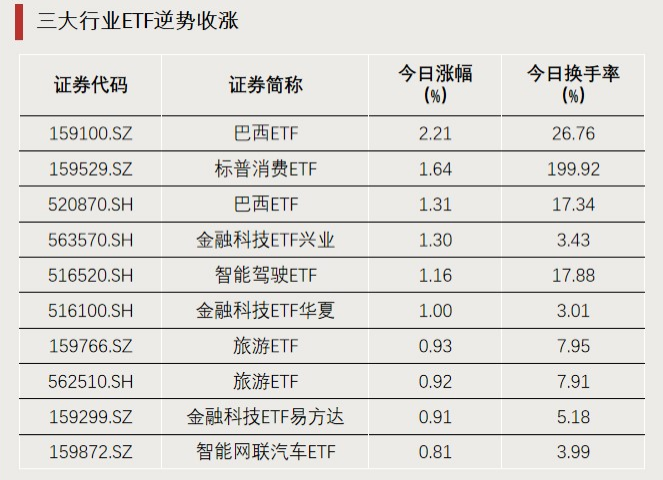
Market Overview - On December 16, A-shares and Hong Kong stocks experienced a pullback, with only about 50 out of over 1300 ETFs closing higher, and 6 of these ETFs rising by 1% or more. Financial technology, tourism, and automotive sector ETFs showed relative resilience [1] - In the cross-border ETF segment, two Brazilian ETFs and one S&P Consumer ETF led the market in terms of gains [1] ETF Performance - Notably, several ETFs that rose against the market trend saw significant increases in trading volume. The S&P Consumer ETF (159529) had a turnover rate of 199.92%, with a trading volume nearing 2 billion yuan, four times that of the previous day. The Smart Driving ETF (516520) also saw its trading volume increase to approximately seven times that of the previous day [2] - On December 16, financial technology, tourism, and automotive sector ETFs performed well, with multiple products ranking among the top gainers. The financial technology ETFs linked to the CSI Financial Technology Index saw over half of their constituent stocks close in the green, with notable gains from companies like Chuangshi Technology (300941) and Cuiwei Co. (603123) [4] Fund Flows - On December 15, despite the market pullback, ETFs experienced a net inflow of approximately 6.7 billion yuan, with broad-based ETFs attracting significant capital. Several ETFs linked to the CSI A500 Index ranked among the top for net inflows, with three A500 ETFs collectively receiving over 13.5 billion yuan in net inflows over the past five trading days [3][9] - The A500 ETF from Southern Fund (159352) led with a net inflow of 3.915 billion yuan on December 15, significantly outpacing other products [11] Sector-Specific Insights - The gold stock ETFs faced a sharp decline on December 16, with the largest drop exceeding 4%. Six out of the top ten ETFs with the largest declines were gold-related, reflecting a cautious market sentiment ahead of key economic data releases [7] - The CSI A500 Index has over 280 public funds linked to it, with more than 80 asset management firms involved, totaling over 240 billion yuan in assets. Over 80% of this is held in ETF products, with 40 ETFs exceeding 210 billion yuan in total assets [10] Upcoming Products - On December 19, Huatai-PB Fund will launch the Sci-Tech Entrepreneurship Artificial Intelligence ETF, adding to the growing list of innovative ETF products in the market [13]

盘前资讯|首批双创人工智能ETF陆续上市交易
Sou Hu Cai Jing· 2025-12-16 01:26
Group 1 - Huatai-PineBridge Fund announced the launch of the Sci-Tech Innovation and Entrepreneurship Artificial Intelligence ETF, set to be listed on December 19 [1] - Four products from the first batch of dual innovation AI ETFs have released their listing announcements, with Yongying Fund and Invesco Great Wall Fund launching their products on December 11 and December 12, respectively [1] - The China Securities Regulatory Commission (CSRC) emphasized the need to promote long-term funding mechanisms and the development of equity public funds during a recent meeting [1] Group 2 - The National Bureau of Statistics reported that the industrial added value for November increased by 4.8% year-on-year and 0.44% month-on-month [1] - The service industry production index grew by 4.2% year-on-year [1] - The total retail sales of consumer goods reached 43.898 billion yuan, reflecting a year-on-year growth of 1.3% [1]
基金“年终大考”倒计时!扛大梁的产品变了
Sou Hu Cai Jing· 2025-12-13 03:00
Core Insights - The public fund industry is entering the final countdown for its "year-end exam" as 2025 approaches, with scale remaining a critical factor for survival among smaller firms and a cornerstone for larger firms [1] - This year's year-end scale battle is characterized by a shift towards index funds as the main battleground, with bond funds serving as the stabilizing force [1] Fund Issuance Trends - In December, a total of 139 new funds are set to be launched, marking a significant increase from 107 in the same period last year, with equity funds, particularly index funds, leading the charge [2] - Among the new funds, 85 are equity funds, accounting for over 60%, with passive index funds making up the largest share at 40 and enhanced index funds at 19, together representing 70% of new equity fund issuances [2] - In November, index funds accounted for 50.34% of new fund issuances, raising a total of 32.305 billion yuan, which is 33.58% of the total fundraising for that month [2] Strategic Shifts in Fund Management - Unlike previous years where star fund managers created blockbuster products, more fund companies are now focusing on low-cost, efficient tool-based products to adapt to market demand changes [3] Performance of Leading Fund Companies - Leading fund management firms are notably active in the year-end scale battle, with companies like E Fund, Ping An Fund, and GF Fund launching multiple new products in December [4] - The rankings of fund companies have seen slight changes, with some firms improving their positions due to the growth of passive investment opportunities, particularly in ETFs [5] Focus on Technology Sector - The technology sector has emerged as the primary focus for new fund issuances, with 7 new AI-focused ETFs and 10 products targeting the semiconductor sector among the new passive index funds [7] - The first batch of 7 AI-focused ETFs is expected to attract over 30 billion yuan in new capital if fully subscribed, reflecting strong market interest in technology investments [7][8] Market Drivers - The surge in technology-focused ETF filings is driven by supportive policies, strong market performance, and heightened competition within the industry, creating a favorable environment for investment in hard technology and innovation [8]
基金“年终大考”倒计时!扛大梁的产品变了
券商中国· 2025-12-13 02:38
Core Viewpoint - The public fund industry is entering a critical phase as it approaches the end of 2025, with a focus on scale competition among fund companies, particularly emphasizing index funds as the main battlefield for major players [2][3]. Group 1: Fund Issuance Trends - In December, a total of 139 new funds are set to be launched, marking a significant increase from 107 in the same period last year, with equity funds, especially index funds, leading the charge [3]. - Among the new funds, 85 are equity funds, accounting for over 60%, with passive index funds making up 40 and enhanced index funds 19, representing 70% of new equity fund issuances [3]. - In November, index funds accounted for 50.34% of new fund issuances, raising a total of 32.305 billion yuan, which is 33.58% of the total fundraising [3]. Group 2: Competitive Landscape - Major fund management companies are significantly ramping up their efforts in the year-end scale competition, with notable issuances from firms like E Fund, Ping An Fund, and GF Fund [5]. - The rankings of fund companies have seen slight changes, with some companies improving their positions due to the growth of passive investment products, particularly ETFs [6]. - For instance, Southern Fund's Southern CSI 500 ETF saw a growth of 26.66 billion yuan in the third quarter, contributing to its improved ranking [6][7]. Group 3: Focus on Technology Sector - The technology sector has emerged as the primary focus for new fund issuances, with 7 new AI-focused ETFs and 10 products targeting the semiconductor and tech industries [8]. - The first batch of 7 AI ETFs is expected to attract over 30 billion yuan in new capital if fully subscribed, indicating strong market interest in technology investments [8][9]. - Factors such as supportive policies, market performance, and competitive dynamics are driving the surge in technology-focused ETF applications [9].

科技类ETF大战
Ren Min Ri Bao· 2025-12-08 10:38
Group 1 - The core viewpoint of the articles highlights a surge in the issuance of technology-focused ETFs, particularly those targeting the artificial intelligence (AI) sector, indicating a strong interest from public fund companies in this area [1][3][4] - Seven public fund companies have launched the first batch of "Double Innovation Artificial Intelligence ETFs," with one company ending its fundraising early due to reaching the 1 billion yuan limit [1][2][3] - The ETFs are designed to track the CSI Innovation and Entrepreneurship Artificial Intelligence Index, which includes 50 leading companies focused on AI technology development and its commercial applications across various sectors [3][4] Group 2 - A total of 19 new ETFs targeting the AI sector, including robotics and semiconductors, have been reported to the China Securities Regulatory Commission (CSRC) within a week, reflecting the growing trend in technology investments [2][3] - The influx of funds into these technology ETFs is expected to bring over 30 billion yuan in new capital to the AI and technology sectors if all funds reach their maximum fundraising targets [3] - Industry experts attribute the rapid growth in technology ETF offerings to supportive government policies, strong market performance, and a competitive landscape among fund companies [4][5] Group 3 - Investment managers express a strong belief in the long-term potential of AI, alongside other sectors such as semiconductors, biotechnology, and clean energy, viewing AI as a "golden track" for long-term investments [5][6] - Key investment opportunities within AI are identified as the computing power and algorithm sectors, with a particular focus on storage-related opportunities in the computing power segment [6] - Companies that can integrate AI into their business models to innovate products or services are also seen as valuable investment prospects [6]
科创ETF密集申报,A股科技赛道再迎增量资金
Di Yi Cai Jing Zi Xun· 2025-12-03 15:09
Group 1 - The A-share technology sector is experiencing an influx of capital as multiple semiconductor ETFs are being launched, indicating strong interest in AI, robotics, and semiconductor fields [2][3] - Since November 21, 49 new technology-focused ETFs have been reported, with the first batch of seven AI ETFs approved on the same date, reflecting a strategic positioning by public fund institutions [2][3] - The market response has exceeded expectations, with a potential influx of over 30 billion yuan if all ETFs reach their maximum fundraising limits [3] Group 2 - There is a noticeable market differentiation, with larger fund companies attracting more capital while smaller, homogeneous products struggle to gain traction, leading to a "good reputation but low sales" situation [4] - Investors prefer top-tier products with higher average daily trading volumes, which raises concerns about the liquidity and potential risks of smaller products [4] - The technology sector is currently in a critical phase of "expectation fulfillment" and "valuation digestion," necessitating a reassessment of market saturation as passive index products grow in size [5] Group 3 - Institutional investors' allocation to technology (TMT) has surpassed 40%, with semiconductor stocks becoming the largest holding sector, valued at over 250 billion yuan [6] - The valuation of technology stocks is under scrutiny, with significant disparities in price-to-earnings ratios across different sub-sectors, indicating potential overvaluation risks [6] - Unlike the 1990s tech bubble, current AI investments are supported by cash-rich, profitable large enterprises, with a strong commercial momentum and high data center utilization rates [6]

科创ETF密集申报,A股科技赛道再迎增量资金
第一财经· 2025-12-03 14:31
Core Viewpoint - The article highlights the influx of capital into the A-share technology sector, particularly focusing on the recent surge in the number of semiconductor and AI-related ETFs being launched, indicating a strategic positioning by public fund institutions in these high-demand areas [3][4]. Group 1: ETF Launch and Market Response - As of December 2, 49 new technology-focused ETFs have been reported since November 21, with a strong market response, exceeding expectations [3][5]. - The first batch of seven AI-themed ETFs was approved on November 21, with fundraising periods as short as three days, reflecting a rapid market entry strategy [3][6]. - If all initial ETFs reach their maximum fundraising limits, the sector could see over 30 billion yuan in new capital [6]. Group 2: Fundraising Dynamics and Market Differentiation - Different fund companies have set varying fundraising caps, with some like E Fund and Invesco setting limits at 8 billion units, while others like ICBC Credit Suisse have no cap [6]. - Smaller funds are facing challenges in fundraising, with a noticeable market differentiation where larger, well-positioned products attract more investor interest, while smaller, similar products struggle [7]. Group 3: Investment Trends and Market Sentiment - Institutional investors have increased their holdings in the technology sector, with TMT (Technology, Media, Telecommunications) positions exceeding 40% [10]. - The semiconductor industry has become the largest investment sector for public equity funds, with total holdings surpassing 250 billion yuan [10]. - Despite the enthusiasm for technology stocks, there are concerns about high valuations, particularly in software and semiconductors, where P/E ratios exceed 100, indicating potential overvaluation risks [11]. Group 4: AI Market Dynamics - The current AI investment landscape is supported by financially robust companies, contrasting with the 1990s tech bubble, as AI commercialization is progressing rapidly with strong cash flows [11]. - The demand for AI capabilities continues to outstrip supply, with data center utilization rates around 80%, suggesting a sustainable growth trajectory in the AI sector [11].

科创ETF密集申报 半导体、机器人等科技股再迎增量资金
Di Yi Cai Jing· 2025-12-03 12:10
Group 1 - The core viewpoint of the articles highlights a surge in new capital inflow into the A-share technology sector, particularly through the launch of multiple semiconductor and AI-focused ETFs, indicating strong institutional interest in these areas [1][2] - Since November 21, 49 new science and technology ETFs have been reported, focusing on popular fields such as semiconductors, robotics, and chips, with the first batch of AI ETFs approved and quickly reaching fundraising limits [1][2] - The market response has exceeded expectations, with a potential influx of over 30 billion yuan if all ETFs reach their maximum fundraising limits, although there is significant variation in fundraising caps set by different fund companies [2][5] Group 2 - There is a noticeable market differentiation, with larger funds attracting more attention and capital, while smaller, homogeneous products struggle to gain traction, leading to concerns about liquidity and potential risks of liquidation for smaller ETFs [2][3] - Institutional investors have increased their positions in technology sectors, with TMT (Technology, Media, and Telecommunications) holdings surpassing 40% of their portfolios, and semiconductor stocks becoming the largest sector by total market value [5] - Despite the enthusiasm for technology stocks, there are concerns about high valuations, particularly in sectors like software development and semiconductors, where P/E ratios exceed 100, while other sectors like batteries and consumer electronics remain below 50 [5] Group 3 - The current AI investment landscape is supported by large, cash-rich companies, contrasting with the 1990s tech bubble, as AI commercialization is progressing rapidly with high demand for computing power, maintaining data center utilization rates around 80% [6] - Morgan Fund suggests that while market enthusiasm may outpace reality, the financial strength of participating companies and the ongoing commercialization of AI technology mitigate the risks of overbuilding in the short term [6]

科创ETF密集申报,半导体、机器人等科技股再迎增量资金
Di Yi Cai Jing Zi Xun· 2025-12-03 11:18
Group 1 - The A-share technology sector is experiencing an influx of capital as multiple semiconductor ETFs are being launched, indicating strong interest in AI, robotics, and chip sectors [1] - Since November 21, 49 semiconductor-focused ETFs have been reported, with the first batch of 7 AI ETFs approved on the same date, highlighting a strategic positioning by public fund institutions [1][2] - The market response has exceeded expectations, with the first AI ETF raising nearly 1 billion yuan on its first day, and if all ETFs reach their fundraising caps, over 30 billion yuan could flow into the sector [2] Group 2 - There is a noticeable differentiation in fundraising limits among various fund companies, with some setting caps as high as 8 billion units while others, like Yongying Fund, set a limit of 1 billion units [2] - Smaller funds are facing challenges in fundraising, as investor preference shifts towards larger, more established products, leading to a concentration of capital in top-tier institutions [3] - The technology sector is currently in a critical phase of "expectation fulfillment" and "valuation digestion," with a need to reassess market saturation as passive index products grow [4] Group 3 - Institutional investors have increased their positions in the technology sector, with TMT sector holdings surpassing 40%, and semiconductor stocks becoming the largest weighted industry with a total market value exceeding 250 billion yuan [5] - There are concerns regarding the valuation of technology stocks, with significant disparities in price-to-earnings ratios across different sub-sectors, indicating potential overvaluation risks [5] - Morgan Fund suggests that the current AI investment landscape is supported by cash-rich, profitable large enterprises, contrasting with the 1990s bubble, and the ongoing commercialization of AI is expected to mitigate risks of overbuilding [6]
增量资金来了!首批双创人工智能ETF发行,人工智能相关ETF如何选择?
市值风云· 2025-12-03 10:08
Core Viewpoint - The first batch of seven AI ETFs focusing on innovation and entrepreneurship has been approved and will be launched on November 28, with a total fundraising cap exceeding 30 billion yuan, injecting new capital into the market [4][5]. Group 1: ETF Details - The ETFs track the "CSI Innovation and Entrepreneurship AI Index," which selects 50 companies involved in AI from the Sci-Tech Innovation Board and the Growth Enterprise Market to capture investment opportunities across the entire industry chain [6]. - The index includes companies related to AI foundational resources, technology, and applications, with significant representation from the communication (44.12%), electronics (32.22%), and computer (15.04%) sectors [7][10]. Group 2: Index Performance - As of November 27, the CSI Innovation and Entrepreneurship AI Index has increased by 85.1% year-to-date, significantly outperforming the CSI 300 Index (14.7%), the ChiNext Index (41.5%), and the Sci-Tech Innovation Index (39.8%) [13]. - Since its base date of December 31, 2019, the index has risen by 165.1%, showcasing its aggressive performance and high volatility compared to other indices [13]. Group 3: Key Stocks - The top 20 stocks in the index account for nearly 85% of its weight, focusing on leading companies in overseas computing chips, domestic computing, edge hardware, and AI applications [10][12]. - Key stocks include Zhongji Xuchuang (23.40% weight), Xinyi Sheng (16.99%), and Hanvon Technology (12.17%), which are critical for technology investments [11][16]. Group 4: Comparison with Other Indices - There are five notable AI-related indices, with the CSI Innovation and Entrepreneurship AI Index showing the best performance over the past year at 93.8% [22][23]. - The index's sector allocation is heavily concentrated in communication, computer, and electronics, with a total concentration of over 90% across the five indices [14][15]. Group 5: Investment Strategy - Investors are advised to choose ETFs based on their preferred segments of the AI industry, as the technology sector remains a strategic focus for future development [27].