
易方达基金

Search documents
科创ETF密集申报,半导体、机器人等科技股再迎增量资金
Di Yi Cai Jing Zi Xun· 2025-12-03 11:18
Group 1 - The A-share technology sector is experiencing an influx of capital as multiple semiconductor ETFs are being launched, indicating strong interest in AI, robotics, and chip sectors [1] - Since November 21, 49 semiconductor-focused ETFs have been reported, with the first batch of 7 AI ETFs approved on the same date, highlighting a strategic positioning by public fund institutions [1][2] - The market response has exceeded expectations, with the first AI ETF raising nearly 1 billion yuan on its first day, and if all ETFs reach their fundraising caps, over 30 billion yuan could flow into the sector [2] Group 2 - There is a noticeable differentiation in fundraising limits among various fund companies, with some setting caps as high as 8 billion units while others, like Yongying Fund, set a limit of 1 billion units [2] - Smaller funds are facing challenges in fundraising, as investor preference shifts towards larger, more established products, leading to a concentration of capital in top-tier institutions [3] - The technology sector is currently in a critical phase of "expectation fulfillment" and "valuation digestion," with a need to reassess market saturation as passive index products grow [4] Group 3 - Institutional investors have increased their positions in the technology sector, with TMT sector holdings surpassing 40%, and semiconductor stocks becoming the largest weighted industry with a total market value exceeding 250 billion yuan [5] - There are concerns regarding the valuation of technology stocks, with significant disparities in price-to-earnings ratios across different sub-sectors, indicating potential overvaluation risks [5] - Morgan Fund suggests that the current AI investment landscape is supported by cash-rich, profitable large enterprises, contrasting with the 1990s bubble, and the ongoing commercialization of AI is expected to mitigate risks of overbuilding [6]

巴西IBOVESPA指数ETF今日合计成交额1.26亿元,环比增加85.31%
Zheng Quan Shi Bao Wang· 2025-12-03 09:22
Core Insights - The total trading volume of Brazil's IBOVESPA Index ETFs reached 126 million yuan today, an increase of 58.1551 million yuan from the previous trading day, representing a growth rate of 85.31% [1] Trading Performance - The Huaxia Bradesco Brazil IBOVESPA ETF (QDII) (159100) had a trading volume of 82 million yuan today, up by 49.58 million yuan from the previous day, with a growth rate of 152.93% [1] - The E Fund Itaú Brazil IBOVESPA ETF (QDII) (520870) recorded a trading volume of 44.32 million yuan, an increase of 8.5751 million yuan from the previous day, with a growth rate of 23.98% [1] Market Movement - As of market close, ETFs tracking the Brazil IBOVESPA Index averaged an increase of 1.80%, with the Huaxia Bradesco Brazil IBOVESPA ETF (QDII) (159100) rising by 1.90% and the E Fund Itaú Brazil IBOVESPA ETF (QDII) (520870) increasing by 1.70% [1]
4只中证科创创业50指数ETF成交额环比增超50%
Zheng Quan Shi Bao Wang· 2025-12-03 09:22
Core Insights - The total trading volume of the CSI Innovation and Entrepreneurship 50 Index ETF reached 772 million yuan today, an increase of 203 million yuan from the previous trading day, representing a growth rate of 35.55% [1] Trading Performance - The Huabao Double Innovation Leader ETF (588330) had a trading volume of 81.24 million yuan today, up by 49.83 million yuan from the previous day, with a growth rate of 158.66% [1] - The E Fund CSI Innovation and Entrepreneurship 50 ETF (159781) recorded a trading volume of 193 million yuan, an increase of 43.72 million yuan, with a growth rate of 29.28% [1] - The Fortune CSI Innovation and Entrepreneurship 50 ETF (588380) saw a trading volume of 116 million yuan, up by 43.70 million yuan, with a growth rate of 60.18% [1] Market Performance - As of market close, the average decline for ETFs tracking the CSI Innovation and Entrepreneurship 50 Index was 0.62%, with the largest declines seen in the Huabao Double Innovation Leader ETF (588330) and the GF CSI Innovation and Entrepreneurship 50 Enhanced Strategy ETF (588320), which fell by 0.79% and 0.77% respectively [1]

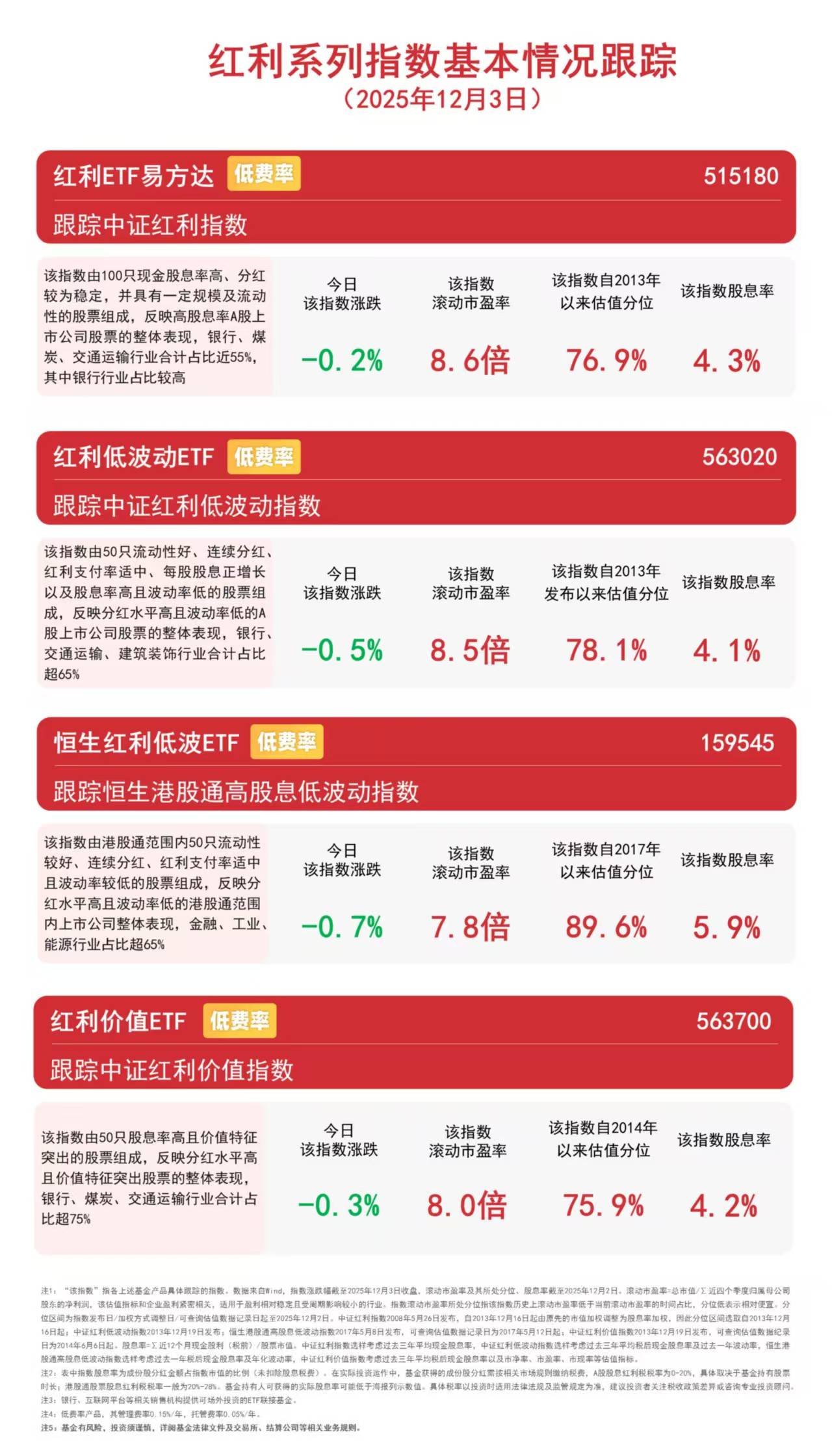
红利板块震荡调整,恒生红利低波ETF(159545)逆势获超1.5亿份净申购
Sou Hu Cai Jing· 2025-12-03 09:15
今日,A股午后集体回落,早盘强势的银行板块翻绿,带动红利板块下行;港股红利板块则全天低位震荡。指数层面,中证红利指数下跌0.2%,中证红利价 值指数下跌0.3%,中证红利低波动指数均下跌0.5%,恒生港股通高股息低波动指数下跌0.7%。资金逆势布局,恒生红利低波ETF(159545)全天净申购超 1.5亿份。 | 直特征 | 今日 | 该指数 | 该指数目2014年 | | --- | --- | --- | --- | | 水平高 | 该指数涨跌 | 滚动市盈率 | 以来估值分位 | | 表现, | | | | | 合计占 | -0. 3% | 8.0倍 | 75.9% | 据悉,易方达基金是目前唯一一家红利类ETF全部实行低费率的基金公司,旗下恒生红利低波ETF(159545)、红利ETF易方达(515180)、红利低波动 ETF(563020)、红利价值ETF(563700)、A500红利低波ETF(563510)等产品的管理费率均为0.15%/年,可助力投资者低成本布局高股息资产。 | 红利ETF易方达 低费率 | | | | | | --- | --- | --- | --- | --- | | 跟 ...

三载耕耘,硕果初现 九成个人养老金基金盈利助力养老财富积累
Cai Jing Wang· 2025-12-03 09:12
Core Viewpoint - Public funds are pioneers in personal pension initiatives and play a crucial role in the personal pension ecosystem, with the introduction of pension-targeted funds in 2018 and personal pension funds in 2022 [1] Product Matrix Expansion - As of now, a total of 1,246 personal pension products have been issued, including 466 savings products, 437 insurance products, 306 fund products, and 37 wealth management products [2] - The number of personal pension funds has expanded from 129 to 302 by the end of September 2025, with pension-targeted FOF products accounting for nearly 70% of the total [2] - By the end of the third quarter of 2025, the total scale of personal pension fund Y shares exceeded 15 billion yuan, growing over 65% since the beginning of the year [2] Performance and Growth - As of November 25, 2025, 120 out of the first 129 funds achieved positive returns, with a positive return rate of 93% and an average return of 9.14% [7] - The overall market performance of personal pension funds is strong, with an average return of 13.33% since inception, and over 90% of funds showing net value growth [7] - The largest pension FOF Y share fund, Xingquan Antai Active Pension, achieved a net value growth rate of 25.38%, surpassing its performance benchmark by 10.52 percentage points [7] Investor Engagement and Education - Companies emphasize the importance of educating investors about long-term pension planning and the need for personalized investment strategies based on individual circumstances [8] - Fund companies are focusing on enhancing investor experience and maintaining strategy stability while innovating product offerings to meet diverse investor needs [9]
天府证券ETF日报 2025.12.03-20251203
天府证券· 2025-12-03 09:05
1. Report Industry Investment Rating - No relevant content provided 2. Core View of the Report - On December 3, 2025, the A-share market declined, with the Shanghai Composite Index down 0.51% to 3878.00 points, the Shenzhen Component Index down 0.78% to 12955.25 points, and the ChiNext Index down 1.12% to 3036.79 points. The total trading volume of A-shares in the two markets was 1683.7 billion yuan. Industries with the highest gains were transportation (0.69%), non-ferrous metals (0.63%), and coal (0.57%), while those with the largest losses were media (-2.86%), computer (-2.26%), and real estate (-1.53%) [2][6] 3. Summary by Relevant Catalogs Market Overview - The Shanghai Composite Index, Shenzhen Component Index, and ChiNext Index all decreased, with trading volume reaching 1683.7 billion yuan. Transportation, non-ferrous metals, and coal led the gains, while media, computer, and real estate led the losses [2][6] Stock ETF - The top trading volume stock ETFs were mainly those tracking the CSI A500 Index, such as Huaxia CSI A500ETF (down 0.35%, premium rate -0.42%), Huatai-PineBridge CSI A500ETF (down 0.33%, premium rate -0.39%), and Guotai CSI A500ETF (down 0.52%, premium rate -0.53%) [3][7] Bond ETF - The top trading volume bond ETFs included Haifutong CSI Short-term Financing ETF (up 0.01%, premium rate 0.00%), Huaxia Shanghai Stock Exchange Benchmark Market-making Treasury Bond ETF (down 0.05%, premium rate 0.03%), and China Merchants CSI AAA Science and Technology Innovation Corporate Bond ETF (down 0.04%, premium rate -0.29%) [4][9] Gold ETF - Gold AU9999 fell 0.51% and Shanghai Gold fell 0.23%. The top trading volume gold ETFs were Huaan Gold ETF (down 0.18%, premium rate -0.36%), Boshi Gold ETF (down 0.24%, premium rate -0.36%), and E Fund Gold ETF (down 0.20%, premium rate -0.34%) [12] Commodity Futures ETF - Dacheng Non-ferrous Metals Futures ETF rose 0.38% (premium rate 0.51%), Huaxia Feed Soybean Meal Futures ETF had a 0.00% change (premium rate 0.65%), and China Construction Bank Yisheng Zhengzhou Commodity Exchange Energy and Chemical Futures ETF fell 0.73% (premium rate -1.09%) [15] Cross-border ETF - The previous trading day saw increases in the Dow Jones Industrial Average (0.39%), NASDAQ (0.59%), S&P 500 (0.25%), and Germany's DAX (0.51%). On December 3, the Hang Seng Index fell 1.28% and the Hang Seng China Enterprises Index fell 1.68%. The top trading volume cross-border ETFs included E Fund CSI Hong Kong Securities Investment Theme ETF (down 1.23%, premium rate -1.44%), Huatai-PineBridge Hang Seng Technology ETF (down 1.49%, premium rate -1.85%), and GF CSI Hong Kong Innovative Drug ETF (down 1.73%, premium rate -1.70%) [17] Money ETF - The top trading volume money ETFs were Yin Hua Rili ETF, Hua Bao Tian Yi ETF, and Money ETF [19]
万基时代下如何配置“好基”?这款APP为你轻松解决“选基”难题
Xin Lang Cai Jing· 2025-12-03 06:30
Group 1 - The core issue in the "ten thousand funds" era is the overwhelming number of fund products available, which complicates investment decisions for investors [2][17] - As of 2025, the number of public funds in China has surpassed 10,000, exceeding the number of A-share listed companies, leading to increased complexity in investment choices [1][16] - The market features a wide variety of fund types, including 46 different dividend ETFs, which are further categorized into various subtypes, increasing the decision-making challenge for investors [2][17] Group 2 - Professional investors are exploring adaptive fund allocation strategies, such as the "barbell strategy," which balances defensive dividend assets with growth assets to reduce portfolio volatility [3][18] - The future of dividend asset allocation is expected to enter a "dividend+" era, where performance differentiation among dividend assets will require careful selection based on specific industry and company conditions [3][18] - Growth asset allocation is becoming highly specialized, with themes like "Future Has Arrived" focusing on sectors such as AI, robotics, and future energy, providing clear growth direction for investors [3][18][4] Group 3 - The Sina Finance APP has emerged as a leading tool for investors, scoring 9.56 in a professional evaluation, and covering 98% of the market's fund products [6][20] - The APP integrates data from 163 fund companies, allowing investors to access comprehensive fund net value information without switching platforms [7][20] - Features like the "Xina AI Assistant" help investors understand complex data by summarizing lengthy reports and highlighting risk and opportunity points [7][21] Group 4 - The introduction of the "drawdown area" concept, or "pain index," provides a more comprehensive measure of investment experience compared to traditional metrics like maximum drawdown [11][22] - Research indicates that enhanced index funds outperform regular index funds across various metrics, including drawdown area and cumulative returns [11][22] - Combining different styles and market capitalizations of enhanced index products can further reduce portfolio volatility and improve investment experience [11][22] Group 5 - The Sina Finance APP offers a modular workspace with over 200 customizable features, allowing investors to tailor their investment environment [25] - The intelligent investment features, such as automatic adjustment of investment amounts based on market conditions, help investors make more rational decisions [25][21] - The APP also provides real-time news updates and deep research reports, enhancing the decision-making process for investors [25][26]
ETF两市成交额2068.04亿元
Xin Lang Cai Jing· 2025-12-03 06:14
Core Insights - The total trading volume of ETFs in the market reached 206.8 billion yuan, with various types contributing differently to this total [1] Summary by Category Trading Volume Breakdown - Stock ETFs accounted for 56.36 billion yuan of the total trading volume - Bond ETFs contributed 105.49 billion yuan - Money market ETFs had a trading volume of 9.42 billion yuan - Commodity ETFs recorded 3.65 billion yuan - QDII ETFs reached a trading volume of 20.05 billion yuan [1] Top Performing ETFs - The highest trading volumes among non-money market ETFs were: - Huaxia CSI A500 ETF (512050) with 4.35 billion yuan - A500 Fund (563360) with 3.17 billion yuan - E Fund CSI A500 ETF (159361) with 3.09 billion yuan [1]
越跌越买!加仓!12月2日红利ETF净流入超20亿元
Zhong Guo Ji Jin Bao· 2025-12-03 06:13
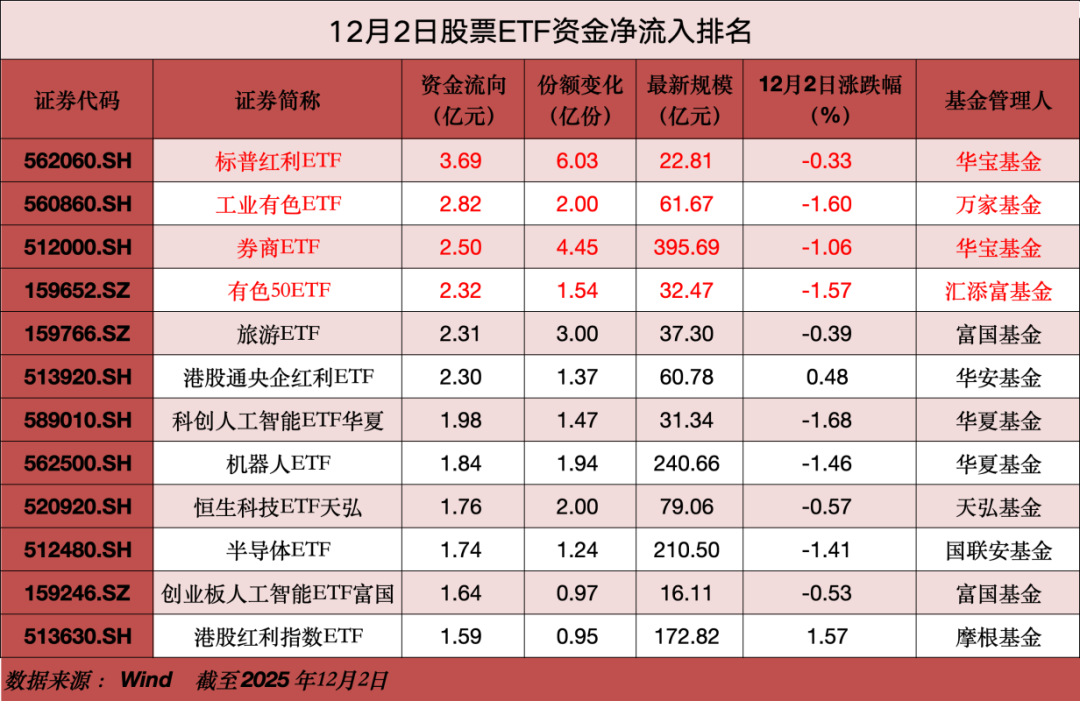
Market Overview - On December 2, A-shares experienced a collective decline, with the ChiNext Index down 0.69%, the Shenzhen Component Index down 0.68%, and the Shanghai Composite Index down 0.42% [1] - Despite market fluctuations, stock ETFs saw a relatively stable fund flow, with a net inflow of 1.619 billion yuan on the same day [1] ETF Fund Flows - Dividend ETFs, metal ETFs, and securities ETFs attracted significant inflows, while the CSI 300 ETF, defense industry ETF, and banking ETF experienced minor outflows [1] - The total scale of all stock ETFs in the market reached 4.55 trillion yuan as of December 2, with a net inflow of 1.619 billion yuan for the day [3] Dividend Sector Performance - The dividend sector showed notable inflows, totaling 2.02 billion yuan on December 2 [3] - Specific funds such as the E Fund's Hang Seng Dividend Low Volatility ETF saw a net inflow of 156 million yuan, reaching a record high of 6.406 billion yuan [3] - Other dividend ETFs, including those from Hua Bao, Hua An, and Morgan, also reported net inflows [3] Investment Insights - According to fund manager Huo Huaming from GF Fund, the increasing market volatility ahead of the Federal Reserve's December meeting and the growing number of growth-supporting policies in China are expected to support a rebound in Hong Kong stocks [3] - The Hang Seng Index is currently trading at approximately 12 times PE and 1.2 times PB, indicating relatively low valuations compared to major global markets [3] - Investors may consider shifting towards dividend stocks for defensive strategies amid uncertainties regarding the Federal Reserve's interest rate policies [3] ETF Inflows and Outflows - The top inflows on December 2 included the S&P Dividend ETF with 369 million yuan, Industrial Metal ETF with 282 million yuan, and Securities ETF with 250 million yuan [4] - Conversely, broad-based ETFs faced significant outflows, totaling 2.52 billion yuan, with the CSI 500 ETF and CSI 300 ETF leading the outflows at 570 million yuan and 342 million yuan, respectively [7][8]
越跌越买!加仓
Zhong Guo Ji Jin Bao· 2025-12-03 06:07
Group 1 - On December 2, the A-share market experienced a collective decline, with the ChiNext Index down 0.69%, the Shenzhen Component Index down 0.68%, and the Shanghai Composite Index down 0.42% [1] - Despite the market volatility, stock ETFs saw a relatively stable fund flow, with a net inflow of 16.19 billion yuan on the same day [1] - Dividend ETFs, non-ferrous metal ETFs, and securities ETFs attracted significant capital, while the CSI 300 ETF, defense industry ETF, and banking ETF experienced minor outflows [1] Group 2 - As of December 2, the total scale of 1,267 stock ETFs in the market reached 4.55 trillion yuan, with a net inflow of 16.19 billion yuan for the day [2] - The dividend sector saw a notable net inflow of 20.2 billion yuan, with the E Fund's Hang Seng Dividend Low Volatility ETF alone attracting 1.56 billion yuan, reaching a record high of 64.06 billion yuan [2] - Other dividend ETFs, including those from Hua Bao, Hua An, and Morgan, also reported net inflows [2] Group 3 - The non-ferrous metals, securities, pharmaceuticals, and Hang Seng Technology sectors also saw significant net inflows, amounting to 6.4 billion yuan, 5.7 billion yuan, 4 billion yuan, and 3.8 billion yuan respectively [3] - E Fund's ETFs reported a total scale of 807.68 billion yuan, with a net inflow of 5.1 billion yuan on the previous trading day, and a total increase of 207.03 billion yuan since 2025 [3] - Other notable inflows included the Hang Seng Technology ETF with 1.22 billion yuan, and various ETFs from Hua Xia, including the benchmark government bond ETF and the AI ETF, which saw inflows of 3.44 billion yuan and 1.98 billion yuan respectively [3] Group 4 - The broad-based ETFs experienced significant outflows, with a total net outflow of 25.2 billion yuan, primarily from the CSI 300 and CSI 500 index ETFs, each seeing outflows of 7 billion yuan [4] - Other sectors with notable outflows included defense industry, petrochemical, and banking, each exceeding 3 billion yuan in net outflows [4]