宁波银行

Search documents
美元存款利率 降了
Shang Hai Zheng Quan Bao· 2025-09-25 14:22
Core Viewpoint - The recent interest rate cuts by the Federal Reserve have led to a decrease in USD deposit rates by several foreign banks, with domestic banks following suit to lower foreign currency liability costs. Some banks are also launching short-term high-interest products to attract depositors during this period [1][2][3]. Group 1: USD Deposit Rate Adjustments - USD deposit rates have dropped to around 3%, with foreign banks like HSBC reducing rates for various terms, such as 1-year deposits to 3% and 6-month deposits to 3.5% [2]. - Domestic banks have also adjusted their rates, with previous rates for 1-year USD deposits reaching as high as 5.6%, now reduced to a maximum of 3% [2]. - The adjustment in rates is influenced by the Federal Reserve's recent 25 basis point rate cut and the strengthening of the RMB, prompting banks to reduce USD asset and liability scales [3]. Group 2: Divergent Rate Adjustment Responses - Some banks have not yet adjusted their rates but are expected to do so, with current rates at 2.8% for 1-year and 2-year deposits [3]. - The pace of rate adjustments varies among banks due to differences in liability structures and funding positions, with foreign banks typically responding more quickly to international market changes [3]. Group 3: High-Interest Marketing Strategies - A few banks are countering the trend by offering short-term high-interest USD deposits, such as Hong Kong's Hang Seng Bank advertising rates of 4.1% [4]. - Other banks, like Standard Chartered and HSBC, are also promoting competitive rates for new customers, with rates reaching up to 3.8% for certain deposit terms [4]. Group 4: Considerations for Depositors - Experts emphasize the need for depositors to carefully evaluate the risks associated with USD deposits, particularly in a declining interest rate environment [5][6]. - The potential for further rate cuts by the Federal Reserve may lead to additional downward pressure on USD deposit rates, with expectations of two more cuts this year [6]. - Depositors should consider both exchange rate risks and opportunity costs when choosing USD deposits, as fluctuations in the RMB could lead to currency losses [6].
星汉灿烂!2025Wind星选理财师年度评选榜单正式发布
Wind万得· 2025-09-25 11:03
Core Insights - The 2025 Wind Wealth Management Forum and the annual Star-selected Financial Advisor Awards were successfully held in Shanghai, emphasizing the industry's evolution towards professionalism, intelligence, and sustainability [1] - The Star-selected Financial Advisor competition has been upgraded, introducing an "Outstanding Investment Advisor" category, which attracted significant industry attention and participation [2] Group 1: Awards and Recognitions - The competition concluded with several outstanding talents recognized, including Mao Keying from Bank of Beijing, Li Chuan from Ping An Bank, and Shen Qiwei from Industrial Bank, who won the top three spots in the Outstanding Investment Advisor category [2] - The top three Outstanding Financial Advisors were Miao Ning from China Postal Savings Bank, Zhang Yuming from Industrial and Commercial Bank of China, and Li Shaozhang from China Construction Bank [2] - A total of 68 institutions and 135 financial advisors received prestigious awards from the organizers and co-organizers for their exceptional wealth management capabilities [2] Group 2: Industry Development - Wind aims to collaborate with industry partners to build a resilient, customer-centric, and sustainable wealth management ecosystem, facilitating a high-quality development phase for the industry [1] - The AI-powered Wind Investment Advisor Terminal is designed to support financial advisors and wealth managers by integrating various business scenarios, enhancing their operational efficiency and professional growth [39]


宁波银行:科技赋能 筑牢风控 积极推进外汇展业改革实践
Zhong Guo Jing Ji Wang· 2025-09-25 07:01
Core Insights - The State Administration of Foreign Exchange has introduced the "Bank Foreign Exchange Business Management Measures (Trial)" to provide a regulatory framework for the reconstruction of bank foreign exchange business processes [1] - Ningbo Bank has actively implemented a full-process management approach, balancing cross-border facilitation and risk prevention, and has created a foreign exchange service ecosystem tailored for small and medium-sized private enterprises [1] Group 1: Matrix Management and Risk Control - Ningbo Bank has innovatively established a three-tier matrix management system to strengthen the organizational foundation for foreign exchange business reform, ensuring efficient collaboration and information sharing across the bank [2] - A strict qualification mechanism for positions has been implemented, requiring compliance and risk management personnel to obtain professional certifications, thus ensuring business compliance and integrating foreign exchange operations into daily activities [2] Group 2: Full-Process Innovation - The bank has shifted its business model to a customer lifecycle management system, enhancing due diligence processes and implementing differentiated reviews based on customer risk levels [3] - A dual monitoring approach has been adopted, combining on-site visits and intelligent risk engines to enhance risk management's foresight and precision [3] Group 3: Technology Empowerment - The deep application of financial technology has significantly improved efficiency and accuracy in customer due diligence by automating data collection and reducing manual processes [4] - Artificial intelligence models have been introduced for customer classification, providing a scientific basis for differentiated services [4] Group 4: Business Environment Optimization - The reforms have led to a 75% increase in efficiency for cross-border transactions for first-class clients, significantly reducing institutional transaction costs [5] - Ningbo Bank has served over 1,200 import and export enterprises, involving amounts exceeding $18.6 billion, providing strong financial support for the real economy [6]

基金9月24日参与18家公司的调研活动
Zheng Quan Shi Bao Wang· 2025-09-25 03:12
Group 1 - On September 24, a total of 26 companies were investigated by institutions, with 18 companies being surveyed by funds, indicating a strong interest in these firms [1] - Among the companies surveyed, Mintai Aluminum (601677) received the most attention, with 12 funds participating in the investigation, followed by Antai Technology (000969) and Dongsheng Technology (300073), each with 9 funds [1] - The surveyed companies are distributed across various sectors, with the most represented industries being electric equipment, automotive, and non-ferrous metals, each having three companies listed [1] Group 2 - In terms of market performance, 7 out of the surveyed stocks increased in value over the past five days, with Jin Tai Yang (300606) leading with a rise of 12.67%, followed by New Coordinates (603040) at 10.47% and Honghua Digital Science (9.68%) [2] - Conversely, 11 stocks experienced declines, with Yun Aluminum (000807) dropping by 7.46%, followed by Jingjin Electric and Shuangjie Electric (300444) with declines of 6.91% and 3.66% respectively [2] - Notably, Dongsheng Technology saw a net inflow of funds amounting to 291 million yuan over the past five days, indicating strong institutional interest [2]




透视城商银行半年报:房地产贷款超8成投向个人住房,不良率绝大多数低于2%
Jin Rong Jie· 2025-09-25 01:54
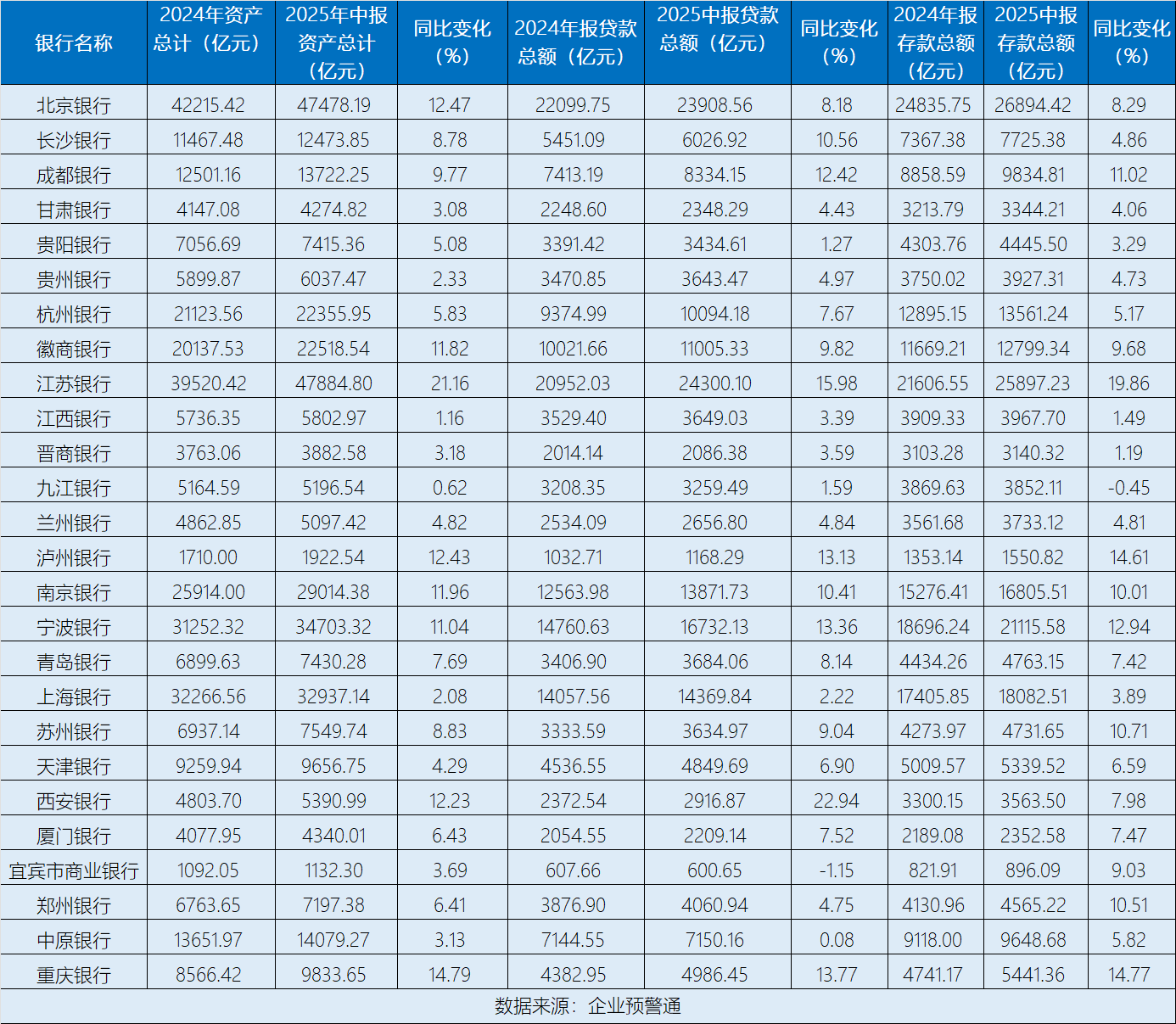
Core Insights - The total assets of 28 city commercial banks reached 38.99 trillion yuan in the first half of 2025, reflecting a year-on-year growth of 9.16% [1] - Jiangsu Bank and Beijing Bank lead in asset size, with 4.79 trillion yuan and 4.75 trillion yuan respectively, indicating strong market positions [2] - The overall loan growth for these banks was 8.66%, with notable increases from Ningbo Bank and Xi'an Bank, which saw growth rates of 13.36% and 22.94% respectively [4][5] Asset Scale - Jiangsu Bank and Beijing Bank are at the forefront with asset totals of 4.79 trillion yuan and 4.75 trillion yuan, respectively [2] - Other banks like Shanghai Bank and Ningbo Bank also show significant asset sizes above 2 trillion yuan, forming a strong first tier in the city commercial bank sector [2] - Year-on-year growth rates vary, with Jiangsu Bank at 21.16% and Chongqing Bank at 14.79%, while Jiujiang Bank showed minimal growth at 0.62% [2][3] Loan Performance - The total loan amount for the 28 banks increased to 19.41 trillion yuan, with a year-on-year growth of 8.66% [1][4] - Jiangsu Bank's loan total rose from 2.10 trillion yuan to 2.43 trillion yuan, marking a growth of 15.98% [3] - Xi'an Bank exhibited the highest loan growth rate at 22.94%, while Central Plains Bank's loan growth was negligible at 0.08% [4][5] Deposit Trends - Jiangsu Bank's deposits surged from 2.16 trillion yuan to 2.59 trillion yuan, reflecting a growth of 19.86% [5] - Other banks like Hangzhou Bank also reported deposit growth, increasing from 1.29 trillion yuan to 1.36 trillion yuan, a rise of 5.17% [5] - Jiujiang Bank experienced a slight decline in deposit growth, with a minimal increase of 0.45% [5] Real Estate Loan Distribution - The real estate loan proportion has generally decreased among city commercial banks, with Guiyang Bank leading at 15.36% [6][7] - Jiangsu Bank, on the other hand, has a low real estate loan ratio of 2.8%, indicating a conservative approach to real estate lending [6][7] - Ningbo Bank holds the highest total real estate loan amount at 1548.93 billion yuan, followed by Beijing Bank and Shanghai Bank [6][7] Personal Housing Loan Insights - Personal housing loans dominate the real estate loan portfolio, with banks like Weihai Bank and Central Plains Bank having high proportions of 36.26% and 17.8% respectively [8] - Most city commercial banks maintain low non-performing loan rates for personal housing loans, with the majority below 2% [8] - Yibin Commercial Bank reported a higher non-performing rate of 4.47% for personal housing loans [8]

证券代码:002849 证券简称:威星智能 公告编号:2025-044
Zhong Guo Zheng Quan Bao - Zhong Zheng Wang· 2025-09-24 22:55
Core Viewpoint - The company, Zhejiang Weixing Intelligent Instrument Co., Ltd., has approved the use of idle self-owned funds for entrusted wealth management, with a single investment limit not exceeding RMB 100 million, to enhance the efficiency of fund utilization and generate investment returns for the company and its shareholders [1][8]. Group 1: Wealth Management Plan - The company has recently purchased structured deposit products from Ningbo Bank, indicating a proactive approach to managing idle funds [1]. - The approved wealth management plan allows for a rolling use of funds within one year from the date of the shareholders' meeting [1]. Group 2: Risk Control Measures - The company adheres to relevant regulations and has established a robust approval and execution process for entrusted wealth management to ensure effective and compliant operations [3][4]. - A dedicated team within the finance department is responsible for managing the investment products and monitoring their status, with protocols in place for reporting any anomalies [4]. - The internal audit department will conduct regular audits and checks on the use and custody of funds related to entrusted wealth management [4]. Group 3: Impact on Operations - The implementation of entrusted wealth management will not affect the company's normal operations and is expected to improve the efficiency of idle funds, thereby providing additional returns for the company and its shareholders [8]. Group 4: Previous Wealth Management Activities - As of the announcement date, the company has successfully recovered the principal and returns from previously matured wealth management products, with a total of RMB 48 million in outstanding investments [8].

浙江威星智能仪表股份有限公司关于使用闲置自有资金进行委托理财的进展公告
Shang Hai Zheng Quan Bao· 2025-09-24 21:30
Core Viewpoint - Zhejiang Weixing Intelligent Instrument Co., Ltd. has approved the use of idle self-owned funds for entrusted wealth management, with a single limit not exceeding RMB 100 million, to enhance the efficiency of fund utilization and generate investment returns for the company and its shareholders [1][5]. Group 1: Wealth Management Plan - The company has recently purchased structured deposit products from Ningbo Bank, indicating a proactive approach to managing idle funds [2]. - The board of directors and the supervisory board have approved the wealth management plan, which allows for rolling use of the funds within one year from the date of shareholder approval [1]. Group 2: Risk Control Measures - The company adheres to relevant regulations and has established a robust approval and execution process for entrusted wealth management to ensure effective and compliant operations [3]. - A dedicated team within the finance department is responsible for managing the investment products and monitoring their safety, with protocols in place for reporting any anomalies [4]. - The internal audit department will conduct regular audits and checks on the use and custody of the entrusted funds, ensuring adherence to prudent investment principles [4]. Group 3: Impact on Operations - The implementation of entrusted wealth management will not affect the company's normal operations and is expected to improve the efficiency of idle funds, thereby providing additional returns for the company and its shareholders [5]. - As of the announcement date, the company has successfully recovered the principal and returns from previously matured wealth management products, with ongoing investments totaling RMB 48 million [5].
道明光学:关于控股股东部分股份解除质押的公告
Zheng Quan Ri Bao· 2025-09-24 10:12
Core Points - The announcement from Daoming Optical indicates that its controlling shareholder, Zhejiang Daoming Investment Co., Ltd., has completed the release of stock pledges at Ningbo Bank Co., Ltd., Jinhua Branch [2] - A total of 30 million shares were released from the pledge [2]

银行行业9月24日资金流向日报
Zheng Quan Shi Bao Wang· 2025-09-24 09:37
Market Overview - The Shanghai Composite Index rose by 0.83% on September 24, with 28 out of 41 sectors experiencing gains. The leading sectors were power equipment and electronics, with increases of 2.88% and 2.76% respectively. Conversely, the banking, coal, and telecommunications sectors saw declines of 0.36%, 0.29%, and 0.01% respectively, with the banking sector being the largest decliner [1]. Capital Flow Analysis - The net inflow of capital in the two markets was 19.725 billion yuan, with 14 sectors experiencing net inflows. The electronics sector led with a net inflow of 13.046 billion yuan and a daily increase of 2.76%. The computer sector followed with a net inflow of 5.021 billion yuan and a daily increase of 2.52% [1]. - In contrast, 17 sectors experienced net outflows, with the automotive sector leading at a net outflow of 2.064 billion yuan, followed by telecommunications with a net outflow of 1.670 billion yuan. Other sectors with significant outflows included public utilities, food and beverage, and banking [1]. Banking Sector Performance - The banking sector declined by 0.36% on the same day, with a net outflow of 795 million yuan. Out of 42 stocks in this sector, 20 rose while 21 fell. Notably, 19 stocks had net inflows, with the highest being China Merchants Bank, which saw a net inflow of 109 million yuan. Other banks with significant inflows included Ningbo Bank and Shanghai Pudong Development Bank, with net inflows of 55.414 million yuan and 32.761 million yuan respectively [2]. - The stocks with the largest net outflows included Agricultural Bank of China, China Bank, and China Construction Bank, with net outflows of 295 million yuan, 170 million yuan, and 140 million yuan respectively [2]. Individual Stock Performance in Banking - The following table summarizes the performance of selected banking stocks: - Agricultural Bank of China: -1.20% change, net outflow of 295.23 million yuan - China Bank: -0.38% change, net outflow of 170.08 million yuan - China Construction Bank: -1.13% change, net outflow of 139.90 million yuan - Industrial and Commercial Bank of China: +0.95% change, net outflow of 108.01 million yuan - Minsheng Bank: -0.24% change, net outflow of 67.54 million yuan [2][3].





城商行板块9月24日涨1.64%,齐鲁银行领涨,主力资金净流出6917.64万元
Zheng Xing Xing Ye Ri Bao· 2025-09-24 08:46
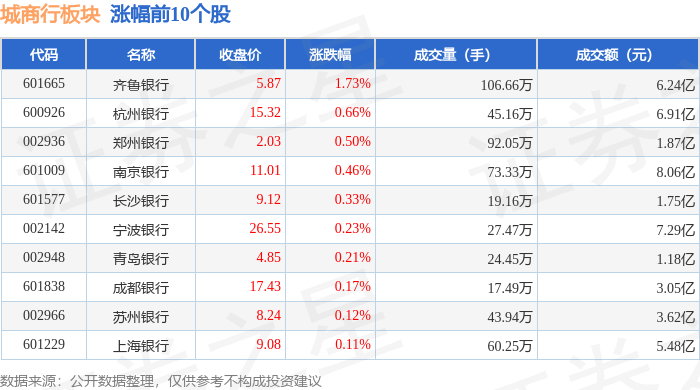
Market Performance - The city commercial bank sector increased by 1.64% on September 24, with Qilu Bank leading the gains [1] - The Shanghai Composite Index closed at 3853.64, up 0.83%, while the Shenzhen Component Index closed at 13356.14, up 1.8% [1] Individual Stock Performance - Qilu Bank closed at 5.87, with a rise of 1.73% and a trading volume of 1.0666 million shares, amounting to a transaction value of 624 million yuan [1] - Hangzhou Bank closed at 15.32, up 0.66%, with a trading volume of 451,600 shares and a transaction value of 691 million yuan [1] - Zhengzhou Bank closed at 2.03, up 0.50%, with a trading volume of 920,500 shares and a transaction value of 18.7 million yuan [1] - Nanjing Bank closed at 11.01, up 0.46%, with a trading volume of 1.7333 million shares and a transaction value of 806 million yuan [1] - Other banks such as Changsha Bank, Ningbo Bank, and Qingdao Bank also showed slight increases in their stock prices [1] Capital Flow Analysis - The city commercial bank sector experienced a net outflow of 69.1764 million yuan from institutional investors, while retail investors saw a net inflow of 55.8208 million yuan [2] - The overall capital flow indicates a mixed sentiment, with institutional investors withdrawing funds while retail investors continued to invest [2] Detailed Capital Flow for Selected Banks - Ningbo Bank had a net inflow of 74.388 million yuan from institutional investors, but a net outflow of 51.098 million yuan from speculative funds [3] - Shanghai Bank saw a net inflow of 17.1761 million yuan from institutional investors, while retail investors had a net outflow of 30.1701 million yuan [3] - Chengdu Bank experienced a net inflow of 16.3117 million yuan from institutional investors, with a net outflow from retail investors [3]