智谱

Search documents
智谱创始人唐杰:AI大模型“人类终极测试”能力正快速提升
Xin Lang Ke Ji· 2026-01-10 14:22
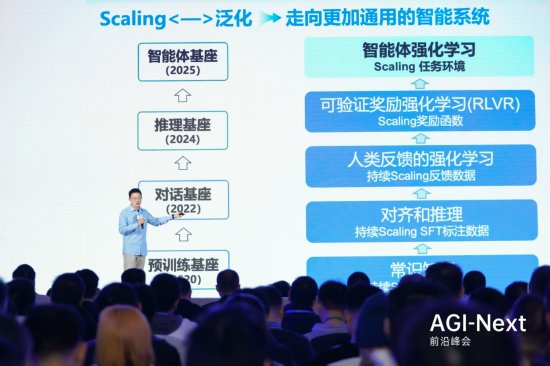
Group 1 - The core viewpoint of the article highlights the rapid improvement of AI large models in human-level testing (HLE) starting from 2025, as stated by Professor Tang Jie from Tsinghua University and founder of Zhipu AI [2] - In 2020, AI large models were only capable of solving basic problems such as MMU and QA. By 2021-2022, they began to develop mathematical reasoning abilities through post-training, addressing foundational reasoning gaps [2] - From 2023-2024, large models evolved from knowledge retention to complex reasoning, enabling them to tackle graduate-level problems and real programming tasks, reflecting a growth process similar to human development from elementary school to the workplace [2] Group 2 - By 2025, models are expected to significantly enhance their capabilities in human-level testing, which includes extremely niche questions that Google cannot retrieve, necessitating strong generalization abilities [2] - The industry has been focusing on improving AI's generalization capabilities through various methods, despite the current limitations in this area [2] - Around 2020, the industry leveraged the Transformer architecture to enhance long-term knowledge retention and direct knowledge retrieval, such as answering basic questions [3] - By 2022, the focus shifted to optimizing alignment and reasoning, enhancing complex reasoning abilities and intent understanding through instruction fine-tuning and reinforcement learning, utilizing extensive human feedback data to improve model accuracy [3] - By 2025, efforts will be made to create verifiable environments for machines to explore autonomously, gather feedback, and achieve self-improvement, addressing the issues of noise in traditional human feedback data and limited scenarios [3]

唐杰、杨植麟、林俊旸、姚顺雨罕见同台,「基模四杰」开聊中国AGI
36氪· 2026-01-10 14:14
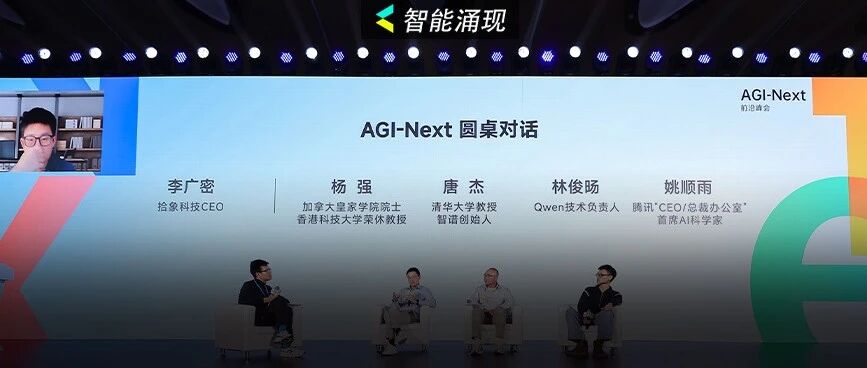
Core Insights - The article discusses the emergence of AI and its impact on various industries, highlighting the importance of foundational models in determining competitive advantages in the AI landscape [5][6][7]. Group 1: Key Players and Developments - The AGI-Next summit featured key figures from major Chinese AI companies, including Zhiyuan, Tencent, and Alibaba, emphasizing their roles in advancing foundational models [5]. - The discussion revealed a consensus that the capabilities of foundational models will dictate future competition, with a focus on becoming the next major entry point in the AI market [5][6]. Group 2: Paradigm Shifts in AI - The article notes a shift in AI exploration paradigms, with a focus on new metrics for measuring model intelligence, such as Token Efficiency and Intelligence Efficiency [7][8]. - The participants agreed that the next phase of AI development will prioritize autonomous learning, which is seen as a critical direction for future advancements [6][7]. Group 3: Market Segmentation - There is a clear distinction between ToC (consumer) and ToB (business) applications, with the former requiring tightly integrated models and products, while the latter focuses on enhancing productivity through strong models [8][10]. - The article highlights that in the ToB market, companies are willing to pay a premium for superior models, indicating a growing divide between strong and weak models [10][11]. Group 4: Future Trends and Challenges - The discussion points to the need for a new standard in measuring model intelligence as the AI landscape evolves, with a focus on balancing model capabilities and practical applications [7][8]. - The article emphasizes the importance of context and environment in improving AI interactions, suggesting that better contextual inputs can significantly enhance model performance [15][16]. Group 5: Cultural and Structural Factors - The article discusses the differences in research culture between China and the U.S., noting that Chinese researchers tend to favor safer, more established projects over innovative explorations [71][72]. - It also highlights the need for a more adventurous spirit in the Chinese AI landscape to foster innovation and breakthrough developments [70][78].
智谱创始人唐杰谈DeepSeek:很震撼,开启了“AI做事”新范式
Xin Lang Cai Jing· 2026-01-10 13:54
Core Viewpoint - The emergence of DeepSeek in early 2025 is expected to be a significant and surprising development in the AI field, prompting a reevaluation of the direction of AI advancements [2][5]. Group 1: AI Development Paradigms - The current paradigm of AI, focused on chat capabilities, may be nearing its limits, with future advancements likely to be more about engineering and technical challenges [2][5]. - A new paradigm is proposed where AI enables individuals to accomplish specific tasks, moving beyond mere conversational capabilities to practical applications [2][5]. Group 2: Company Innovations - The company, under the leadership of founder Tang Jie, has chosen to integrate AI capabilities in Coding, Agentic, and Reasoning, aiming for a balanced development rather than isolating these abilities [2][5]. - Following the release of GLM-4.5 on July 28, 2025, the company achieved leadership in 12 domestic benchmarks, with the recent GLM-4.7 showing significant improvements in Agent and Coding capabilities compared to its predecessors GLM-4.6 and GLM-4.5 [3][6].
姚顺雨对着唐杰杨植麟林俊旸贴大脸开讲!基模四杰中关村论英雄
量子位· 2026-01-10 13:17
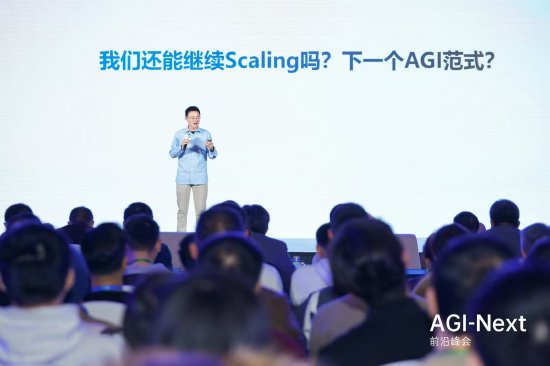
Core Viewpoint - The AGI-Next summit organized by Tsinghua University highlights the rapid advancements in AI, emphasizing the transition from conversational AI to task-oriented AI, indicating a significant shift in the AI landscape [4][34]. Group 1: Key Insights from Speakers - Tang Jie stated that with the emergence of DeepSeek, the era of chatbots is largely over, and the focus should now be on actionable AI [7]. - Yang Zhilin emphasized that creating models is fundamentally about establishing a worldview [7]. - Lin Junyang expressed skepticism about China's ability to overtake in the AI race, suggesting that a 20% improvement in capabilities would be optimistic [7]. - Yao Shunyu noted that most consumers do not require highly intelligent AI for everyday tasks [7]. Group 2: Development Trajectory of Large Models - The development of large models has progressed from solving simple tasks to handling complex reasoning and real-world programming challenges, with expectations for continued improvement by 2025 [18][21]. - The evolution of models reflects human cognitive development, moving from basic reading and arithmetic to complex reasoning and real-world applications [19]. - The introduction of HLE (Human-Level Evaluation) tests models on their generalization capabilities, with many questions being beyond the reach of traditional search engines [20]. Group 3: Challenges and Innovations in AI - Current challenges include enhancing models' generalization abilities and transitioning from scaling to true generalization [22][25]. - The path to improving generalization involves scaling, aligning models with human intentions, and enhancing reasoning capabilities through reinforcement learning [28][29]. - The introduction of RLVR (Reinforcement Learning with Verified Rewards) aims to allow models to explore autonomously and improve through verified feedback, addressing the limitations of human feedback [29]. Group 4: Future Directions and Expectations - The future of AI development will focus on multi-modal capabilities, memory structures, and self-reflective abilities, which are essential for achieving AGI [59][61][64]. - The integration of self-learning mechanisms is seen as crucial for models to adapt and improve continuously [69][73]. - The exploration of new paradigms beyond scaling is necessary to achieve breakthroughs in AI capabilities [89]. Group 5: Open Source and Global Positioning - The open-source movement in China has gained significant traction, with many models emerging as influential in the global landscape [53]. - The ongoing development of models like KimiK2 aims to establish new standards in AI, particularly in agent-based tasks [110]. - The emphasis on creating a diverse range of models reflects a commitment to advancing AI technology while addressing various application needs [125][134].


智谱首席科学家唐杰:将推进多模态感统技术,助力AI具身智能落地物理场景
Xin Lang Cai Jing· 2026-01-10 11:13
Core Insights - The future development direction and planning of AGI (Artificial General Intelligence) includes achieving bidirectional scaling, continuously exploring the upper limits of known domains while uncovering new paradigms [1] - In terms of practical applications, the focus is on advancing multimodal sensory technology to support AI's integration into the physical world and work scenarios, thereby realizing embodied intelligence [1] - The initiative aims to facilitate a breakthrough in AI for Science [1]
计算机行业周观点第48期:超级模型带来超级应用-20260110
Western Securities· 2026-01-10 11:04
Investment Rating - The industry is rated as "Overweight," indicating an expected increase in value exceeding 10% compared to the market benchmark index over the next 6-12 months [6]. Core Insights - OpenAI has launched ChatGPT Health, marking its entry into the healthcare sector, which aims to provide personalized health information and tools, potentially establishing a personal assistant for users [1]. - The AI sector is entering a new phase of capitalization, with companies like Zhiyu and Minimax recently going public, with Minimax's market value surpassing 100 billion HKD [2]. - DeepSeek is expected to release its next-generation flagship model, V4, in February, which reportedly surpasses current top models in programming capabilities and data understanding [2]. Summary by Sections Industry Developments - OpenAI's ChatGPT Health is developed in collaboration with over 260 doctors and aims to provide practical health information, addressing a significant market demand with over 230 million weekly inquiries on health topics [1]. - The partnership with b.well connects OpenAI users to a network of approximately 2.2 million healthcare providers, enhancing the integration of medical records [1]. Market Trends - The recent IPOs of Zhiyu and Minimax reflect a strong market response, with Zhiyu's market cap nearing 70 billion HKD and Minimax's exceeding 100 billion HKD after a 109% increase on its first trading day [2]. - Anticipation for DeepSeek's V4 model suggests a potential catalyst for the AI sector, with improvements in performance stability and programming capabilities [2]. Investment Opportunities - Recommended companies to watch include AI application firms such as Hehe Information, Dingjie Smart, and others, as well as domestic AI chip manufacturers like Cambricon and Haiguang Information [3].
智谱唐杰:2025年可能是多模态模型的适应年
Xin Lang Cai Jing· 2026-01-10 09:08
Core Viewpoint - The year 2025 may be a disappointing year for multimodal models, as many of them have not garnered significant attention and are still focused on enhancing text intelligence limits [1] Group 1: Multimodal Models - Many multimodal models are currently not receiving much attention and are primarily working on improving text intelligence [1] - The challenge for large models is to collect and unify multimodal information, which remains a shortcoming [1] Group 2: Human Sensory Integration - The concept of native multimodal models is compared to human sensory integration, which involves collecting visual, auditory, and tactile information [1] - The next functionality for models is to advance in the area of sensory integration, similar to how humans sometimes experience sensory coordination issues [1]
光伏退税退场,沪指站稳4100点丨一周热点回顾
Di Yi Cai Jing· 2026-01-10 07:51
其他热点还有:外卖平台迎来反垄断调查,一周之内三家AI企业港交所上市。 光伏产品增值税出口退税取消 继2024年底中国将光伏、电池出口退税率由13%下调至9%后,1月9日财政部、税务总局发布公告,决 定自2026年4月1日起,取消光伏等产品增值税出口退税;自2026年4月1日起至2026年12月31日,将电池 产品的增值税出口退税率由9%下调至6%;2027年1月1日起,取消电池产品增值税出口退税。 当前,光伏产业存在供需错配和无序低价竞争等问题。去年7月初,工业和信息化部召开光伏行业制造 业企业座谈会,提出依法依规、综合治理光伏行业低价无序竞争,引导企业提升产品品质,推动落后产 能有序退出,实现健康、可持续发展。 根据中国光伏行业协会数据,光伏主产业链31家企业2025年前三季度营业收入同比下降16.9%,合计亏 损310.39亿元。受全球光伏产业链价格整体下行影响,我国光伏产品出口额已连续两年同比下降。 【点评】经过多年出口退税支持,我国光伏和电池产业在国际上已经具备竞争优势,但也出现了无序低 价竞争以及其他一些国家反补贴调查等问题。业内人士认为,取消出口退税可看作"反内卷"的另一举 措,意在逼迫企业放弃 ...
预计2030年中国大语言模型市场规模或超千亿元
Huan Qiu Wang Zi Xun· 2026-01-10 04:10
Group 1 - MiniMax, an AI large model company, has officially listed on the Hong Kong Stock Exchange, closing at 345 HKD with a rise of over 109% [3] - Another domestic AI large model company, Zhipu, also debuted on the Hong Kong market the previous trading day [3] - The recent listings of domestic AI large model companies are seen as a sign that the industry is transitioning from the technology development phase to a stage where technology and commercialization are synchronously implemented, with business models becoming clearer [3] Group 2 - According to a report by Sullivan, the market size of China's large language model is projected to reach 5.3 billion CNY in 2024, and is estimated to grow to 101.1 billion CNY by 2030, with a compound annual growth rate of 63.5% from 2024 to 2030 [3]
离职程序员深夜忏悔用“绝望指数”算法害人:Uber Eats剥削外卖员让缺钱者狂接垃圾订单!如今竟被爆帖子是AI编的?网友:别再让AI背锅了
AI前线· 2026-01-10 04:10
Core Viewpoint - The article discusses the controversy surrounding a Reddit post by a self-proclaimed whistleblower from Uber Eats, which claimed systemic exploitation of delivery workers through algorithms. The post gained significant attention but was later revealed to be fabricated, raising questions about trust in information related to platform economies and algorithm governance [4][21]. Summary by Sections Incident Overview - A Reddit user, claiming to be an Uber Eats software engineer, posted allegations about the company's exploitation of delivery workers and consumers through its algorithms. The post described how the platform manipulates delivery speeds and charges fees to undermine driver unions [4][5]. Viral Spread and Public Reaction - The post received 86,000 upvotes and was widely shared, with millions of views across social media platforms. It resonated with public sentiment due to previous legal issues faced by delivery platforms like DoorDash, which had to pay $16.75 million for misappropriating driver tips [5][7]. Investigation and Debunking - Journalist Casey Newton investigated the claims and found inconsistencies in the whistleblower's communication and the authenticity of the provided evidence, including an employee ID and a lengthy internal document. Ultimately, it was confirmed that the whistleblower was not a real employee and the claims were likely fabricated using AI tools [12][19]. Implications for Trust and Information - The incident highlights the complexities of trust in the digital age, where misinformation can easily gain traction, especially in contexts where there are real concerns about labor exploitation. The article suggests that the debate over the authenticity of the claims reflects broader anxieties about algorithmic transparency and the integrity of information sources [21][27].