
Anthropic

Search documents
X @Elon Musk
Elon Musk· 2026-02-12 06:32
🤨DogeDesigner (@cb_doge):BREAKING: Anthropic's Claude AI has shown in testing that it's willing to blackmail and kill in order to avoid being shut down.Elon Musk was right about everything. 💀https://t.co/kjOpPAlvax ...
xAI 关键人物跑路,马斯克 AI 野心遭重创
投中网· 2026-02-12 06:31
Core Viewpoint - The article discusses the recent departures of key personnel from xAI, highlighting the potential impact on the company's future in the competitive AI landscape, particularly in the area of AI reasoning capabilities. Group 1: Key Departures - Tony Wu, a co-founder of xAI and responsible for AI reasoning, announced his departure, marking the second co-founder to leave within a year, raising concerns about the company's stability and future innovation [6][9]. - The loss of Wu is particularly critical as reasoning capabilities are seen as a bridge between current AI models and true general artificial intelligence [8]. Group 2: Management Style Concerns - The article suggests that the management style of Elon Musk, characterized by extreme pressure and a lack of creative freedom, may be a significant factor in the high turnover of talent at xAI [10]. - Musk's approach, which emphasizes rapid execution, may not align with the needs of AI research, which often requires time for reflection and experimentation [10]. Group 3: Industry Context - The talent exodus at xAI reflects a broader trend in the AI industry, where top talent is in high demand and can command salaries exceeding $500,000, along with substantial equity [12]. - Companies like OpenAI and Anthropic, which are led by researchers and offer a more conducive environment for innovation, are seen as more attractive to AI professionals compared to xAI's CEO-driven model [12][13].


日经指数盘中突破58000点,专家警告涨势与基本面严重脱节
Jin Shi Shu Ju· 2026-02-12 06:10
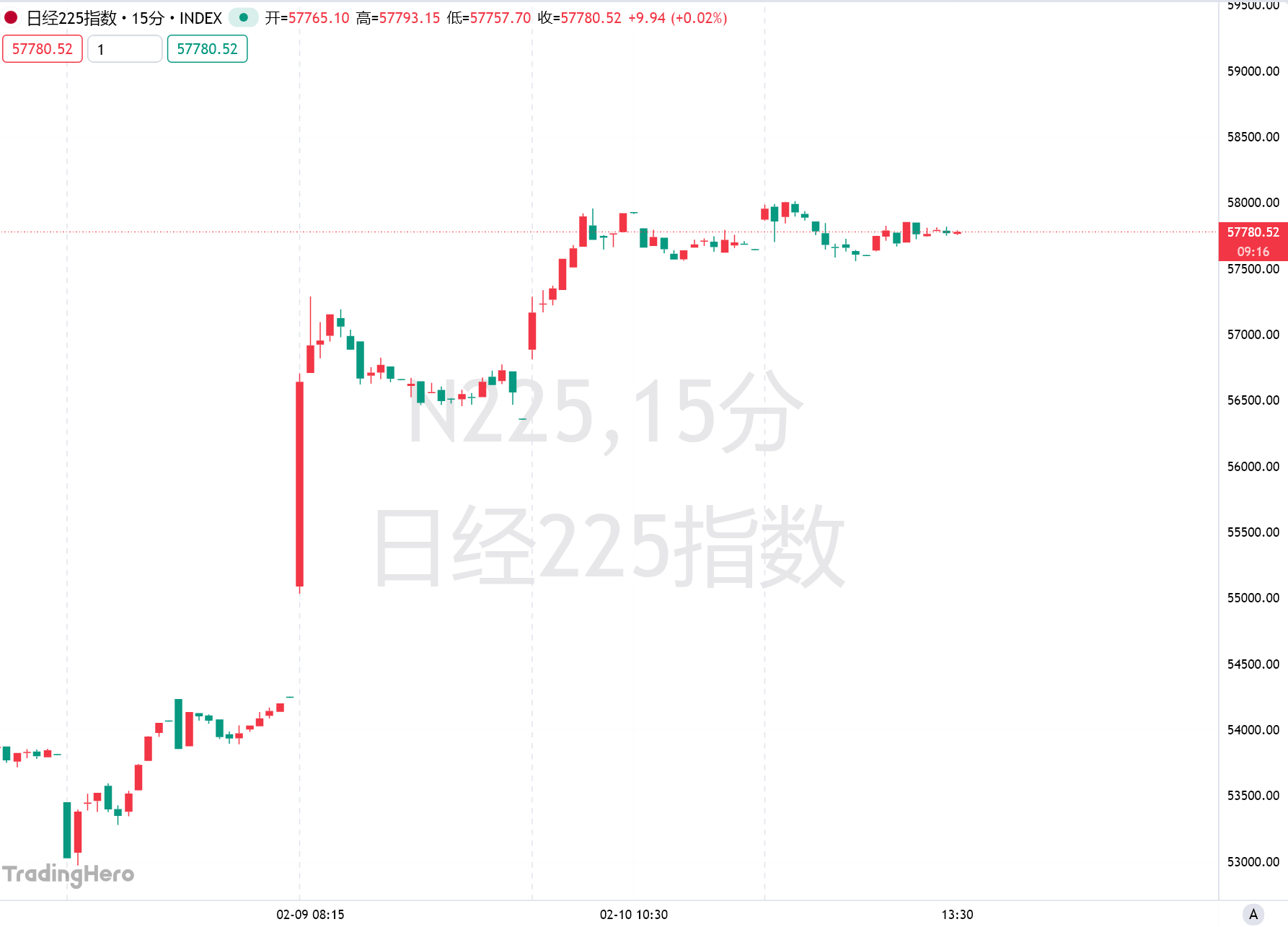
Market Performance - The Japanese stock market continues to rise, reaching a historical high, driven by renewed confidence in domestic politics and the government's economic agenda [1][3] - The Nikkei 225 index surpassed 58,000 points for the first time, with a year-to-date increase of 15% [1][3] Political Influence - The market rally is largely attributed to the political optimism following Prime Minister Sanae Takaichi's overwhelming victory in the House of Representatives elections [3] - Investors are anticipating larger fiscal spending, tax cuts, and a more aggressive economic agenda as a result of this political support [3] Economic Discrepancies - Analysts warn that the stock market's enthusiasm may be ahead of the clarity regarding policy funding sources, indicating a growing disconnect between stock prices and economic fundamentals [3][4] - Japan's economy contracted by 0.4% quarter-on-quarter for the three months ending in September, marking the first contraction in six quarters, with an annualized decline of 1.8% [4] Debt Concerns - Japan is noted to have the highest debt levels globally, with a projected debt-to-GDP ratio nearing 230% by 2025, raising concerns about the sustainability of increased fiscal spending [5] Market Drivers - The current market dynamics are driven by sentiment, liquidity, and narrative rather than fundamental economic strength [6] - The global AI investment wave has also positively impacted the Japanese stock market, although this connection makes it sensitive to fluctuations in global tech enthusiasm and exchange rate volatility [7][8] Currency Impact - The depreciation of the yen has historically benefited export-oriented manufacturing companies, but this effect may diminish as the yen's value is perceived to be excessively low [9][10] - The yen has depreciated approximately 3.67% against the dollar over the past six months [11] Government Intervention - Japan has indicated potential market intervention if the yen continues to depreciate, with concerns raised by the Finance Minister regarding unilateral yen depreciation [12] Future Outlook - Despite current vulnerabilities, structural reforms in corporate governance, capital efficiency, and shareholder returns are expected to provide sustainable growth momentum [15] - Some asset management firms believe that the overall fundamentals of Japanese companies still have support, contingent on the realization of reform expectations [15][16] - There is a warning that if the pace of improvements slows, there could be downside risks to the market [17]
xAI创始成员走了一半,马斯克回应
第一财经· 2026-02-12 06:08
Core Insights - The article discusses the significant restructuring of xAI following its merger with SpaceX, highlighting the departure of several key management members, including co-founder Tony Wu, which raises concerns about the company's future prospects [3][4]. Group 1: Company Restructuring - Elon Musk announced a major personnel restructuring at xAI, with half of the founding team having left the company, including notable figures like Tony Wu, Christian Szegedy, and Igor Babuschkin [3][4]. - Musk stated that the restructuring is necessary for improving organizational efficiency as the company has reached a certain scale, indicating that some individuals may be better suited for the early stages of the company rather than its later stages [4]. Group 2: Competitive Landscape - xAI is preparing for a significant IPO with an estimated valuation exceeding $1 trillion, but the recent departures have led to skepticism regarding its future [4]. - The company is facing intense competition from established players like OpenAI, Anthropic, and Google, with xAI's chatbot Grok.com only capturing about 3.4% of the generative AI chatbot traffic, compared to ChatGPT's 64.5% and Google's Gemini's 21.5% [5]. Group 3: Future Plans and Recruitment - xAI aims to compete in various fields, including large language models, image and video generation systems, and coding tools, with plans to recruit top AI researchers [4][5]. - The company boasts a training cluster equivalent to 1 million NVIDIA H100 GPUs, which is a significant advantage in attracting talent [5]. - Musk anticipates that the Grok Code programming model will reach a leading global standard within the next two to three months, suggesting that AI may soon be able to generate binary data directly without human coding efforts [5].

AI智能体领航,MCP筑基,开启银行智能化转型新范式
Refinitiv路孚特· 2026-02-12 06:03
Core Insights - The article discusses the evolution of AI in the banking sector, emphasizing the shift from basic applications to integrating AI into core business processes, particularly through the use of large language models (LLMs) and AI agents [2][4]. - The introduction of the Model Context Protocol (MCP) is highlighted as a key technological advancement that addresses the challenges of integrating AI with existing banking IT systems, enabling more effective and secure data access [3][9]. AI Agents Leading the Way - AI agents are evolving from simple interactive tools to sophisticated digital employees capable of autonomously executing complex business processes and addressing real-world challenges in banking [4]. - The core logic of AI agents involves a closed-loop mechanism of perception, reasoning, action, and reflection, allowing for self-executing tasks [5]. Challenges and Solutions - The article outlines several challenges in scaling AI agent applications, including the fragmented nature of existing banking IT systems and the need for standardized communication protocols to ensure secure and efficient integration [6][25]. - The MCP is presented as a solution to these challenges, providing a standardized communication layer that connects AI agents with various banking systems, thereby enhancing operational efficiency and compliance [9][15]. MCP Foundation - MCP serves as a foundational data link in the AI era, enabling real-time data collection and analysis, optimal action strategy generation, and self-optimizing capabilities for AI agents [8][12]. - The protocol is designed to facilitate secure and standardized interactions between AI agents and external data sources, significantly reducing integration complexity and costs [15]. Collaborative Architecture - The article proposes a layered collaborative architecture that leverages MCP to support autonomous execution and cross-system collaboration of AI agents in financial services [16][20]. - This architecture aims to enhance the efficiency and innovation of banking operations by enabling AI agents to execute complex workflows seamlessly [19]. Global Practices and Commercial Value - The implementation of MCP in financial institutions, such as Grasshopper Bank in the U.S., demonstrates its potential to enhance customer service through AI agents that can perform tasks like account inquiries and cash flow analysis [23]. - The London Stock Exchange Group (LSEG) is also highlighted for its commitment to integrating AI agents and MCP technology to provide high-quality financial data and services, thereby driving the digital transformation of the banking sector [24]. Future Outlook - The article anticipates significant growth in the AI agent market within the financial services sector, with projections indicating a compound annual growth rate exceeding 40% from 2025 to 2030 [26]. - It emphasizes the importance of balancing technological innovation with governance capabilities to ensure the successful integration of AI in banking, ultimately transforming service models towards proactive decision-making [28].

AI冲击“重灾区”,印度IT股崩了,印度的出口引擎要熄火了?
Hua Er Jie Jian Wen· 2026-02-12 05:52
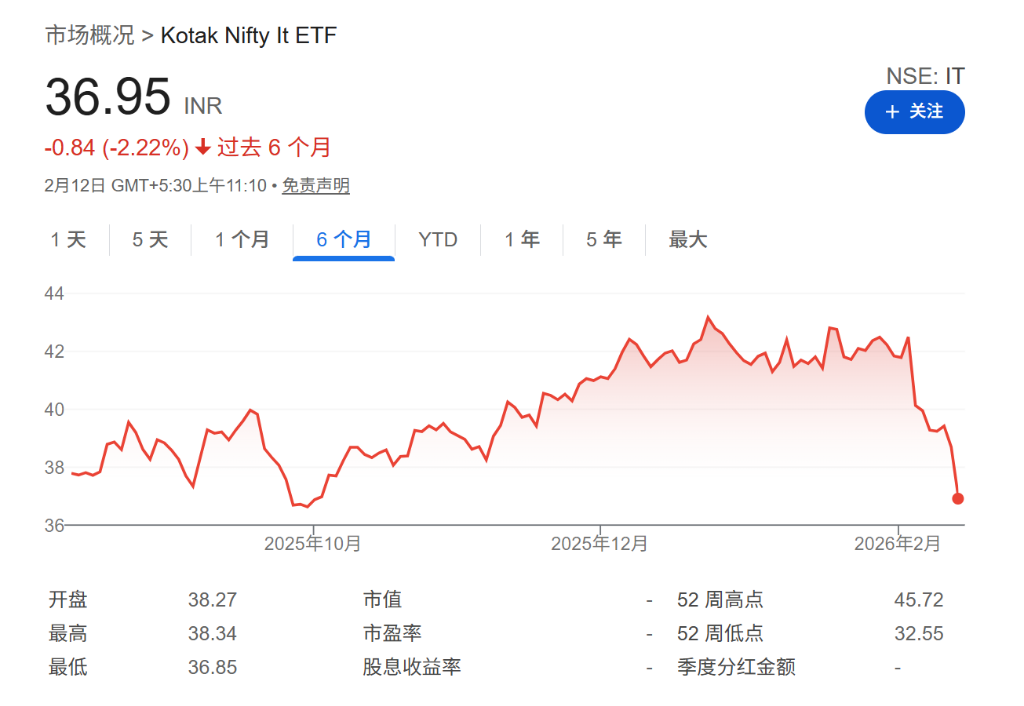
Core Insights - Indian software exporters are facing a market confidence crisis triggered by AI, leading to a significant drop in IT stocks, with the Nifty IT index falling over 4% to a four-month low [1] - The introduction of AI tools, particularly Anthropic's Claude Cowork, is causing fears of disruption in the core business areas of Indian IT services, which rely heavily on labor-intensive outsourcing [4][5] - Despite recent trade agreements with the US and EU that could support cross-border service exports, the impact of AI automation poses a substantial threat to the traditional business model of the Indian IT industry [6] Group 1: Market Reaction - The Nifty IT index experienced a weekly decline of 7%, marking the largest drop in over four months, with a total market value loss of $225 billion [1][4] - The global tech stock sell-off has seen the S&P 500 software and services index lose approximately $800 billion, reflecting a broader market concern [5][6] - Jefferies warns that the Indian IT industry may face further challenges, with AI potentially eroding application service revenues, which account for 40% to 70% of income for major firms [5] Group 2: Industry Challenges - The labor-intensive model that has supported the Indian IT sector since the 1990s is under threat from AI automation, which could reduce project timelines and billable hours [6][8] - Analysts express differing views on the severity of the situation, with some suggesting that the market reaction may be premature and not fully reflective of the underlying fundamentals [7] - Major Indian IT companies like TCS, Infosys, and Wipro are actively adapting their strategies to integrate AI, but the transition from a cost-based model to a value-driven approach presents significant challenges [8]
xAI创始成员走了一半,马斯克回应
Di Yi Cai Jing· 2026-02-12 05:27
Core Viewpoint - The restructuring of xAI is aimed at enhancing organizational efficiency as the company has reached a certain scale, with several key management departures raising concerns about its future prospects [1][2]. Group 1: Company Restructuring - xAI has undergone significant personnel restructuring following its merger with SpaceX, with half of the founding team remaining after multiple resignations, including co-founder Tony Wu [1][2]. - Elon Musk stated that the restructuring is necessary for the company to operate more efficiently at its current scale, indicating that some individuals are better suited for early-stage operations rather than later stages [1][2]. Group 2: Future Plans and Competition - xAI plans to compete in various fields, including large language models, image and video generation systems, and coding tools, as part of its ambition to become a comprehensive AI company [2]. - The company is actively recruiting top talent to enhance its capabilities, emphasizing the challenging work environment and its ambitious goals [2]. - xAI boasts a training cluster equivalent to 1 million NVIDIA H100 GPUs, which is a significant advantage in attracting researchers [2]. Group 3: Market Position - xAI's chatbot website, Grok.com, has seen steady traffic growth but ranks third globally in the generative AI chatbot market, capturing approximately 3.4% of the traffic, compared to ChatGPT's 64.5% and Google's Gemini at 21.5% [3].
20cm速递|AI变革深化,巨头持续加码,创业板人工智能ETF国泰(159388)涨超2.5%
Mei Ri Jing Ji Xin Wen· 2026-02-12 04:48
Group 1 - The core viewpoint highlights the continuous upgrades in large models, with Anthropic launching Claude Opus 4.6, which features an "AI agent team" capability and can handle a context window of millions of tokens, leading the industry in financial analysis tests [1] - OpenAI has released its strongest programming model, GPT-5.3-Codex, which has performed excellently in multiple benchmark tests [1] - North American tech giants such as Alphabet, Meta, Amazon, and Microsoft have reported strong earnings, with significant capital expenditure plans set to increase by 2026 [1] Group 2 - Domestic tech companies in China, including Tencent, Alibaba, ByteDance, and Baidu, are entering an AI competition ahead of the Spring Festival, investing resources to promote AI applications [1] - The Guotai Artificial Intelligence ETF (159388) tracks the entrepreneurial board AI index (970070), which has a daily price fluctuation limit of 20%, focusing on AI-related companies listed on the entrepreneurial board [1] - The index includes component stocks from sectors such as software development, information technology services, and smart hardware, aiming to reflect the overall performance of companies engaged in AI technology research and application [1]






X @Ivan on Tech 🍳📈💰
Ivan on Tech 🍳📈💰· 2026-02-12 04:33
Anthropic dropped Claude Opus 4.6, but their head of AI security just quit, saying the world is in peril. What's the real story behind the headlines? #AISafety #ClaudeOpus #IvanClips https://t.co/jDhXP5yuI9 ...
大模型行业点评:模型百花齐放,迭代日新月异
ZHESHANG SECURITIES· 2026-02-12 04:16
Investment Rating - The industry investment rating is "Positive" (maintained) [6] Core Insights - Domestic large models have been intensively released around the Spring Festival, initiating an AI arms race. Notable releases include DeepSeek's new model with a context processing capability of 1 million tokens, GLM-5 which ranks first globally in programming and agent testing, and ByteDance's Seedance 2.0 aimed at revolutionizing video creation [1][2] - The usability of agents is increasing, with large models transitioning from chat to collaboration. Claude Opus 4.5 can autonomously program for 5 hours, and AI coding agents are expected to double their task handling time every 4 months starting from 2024-2025, compared to a 7-month doubling period from 2019-2024 [2] - The demand for inference is expected to rise due to large-scale applications, with significant increases in token consumption for agent execution compared to dialogue scenarios. The cost of generating a 5-second 720P video is approximately 4 RMB, with Seedance costing about 2.3 RMB, indicating a substantial cost advantage over manual production [3] Summary by Sections Model Updates - MiniMax's M2.5 model is set to launch soon, currently in internal testing for the MiniMax Agent product. Other updates include GLM-5 from Zhizhu, which has achieved state-of-the-art capabilities in coding and agent functions, and DeepSeek's new model with a context window increased to 1 million tokens [7] Related Companies - Key companies mentioned include MiniMax, Zhizhu, Yunsai Zhilian, UCloud, Capital Online, Qingyun Technology, Wangsu Technology, and Nanxing Co. [4]
