凤凰传媒

Search documents
凤凰传媒(601928) - 凤凰传媒关于聘任高级管理人员的公告
2025-08-05 10:30
孙敏先生未接受过中国证监会及其他有关部门的处罚和证券交易所惩戒,符 合《公司法》的相关法律、法规和规定要求的任职条件。 证券代码:601928 股票简称:凤凰传媒 公告编号:2025-024 孙敏先生个人简历详见本公告附件。 江苏凤凰出版传媒股份有限公司 特此公告。 关于公司聘任高级管理人员的公告 本公司董事会及全体董事保证公告内容不存在任何虚假记载、误导性陈述或 者重大遗漏,并对其内容真实性、准确性、完整性承担法律责任。 江苏凤凰出版传媒股份有限公司(以下简称"公司")于 2025 年 8 月 5 日召 开了第六届董事会第二次会议,审议了《关于聘任公司高级管理人员的议案》。 根据公司《章程》有关规定,经公司总经理提名,公司第六届董事会提名委 员会 2025 年第二次会议审核,第六届董事会第二次会议审议通过,同意聘任孙 敏先生为公司副总经理,任期自本次董事会审议通过之日起至本届董事会届满时 止。 孙敏先生简历如下:男,1971 年 10 月出生,江苏无锡人。曾任江苏省出版 物审读中心副主任、江苏省新闻出版局(版权局)出版管理处副处长;2017 年 4 月起先后任江苏省新闻出版广电局(版权局)出版管理处处长、江 ...

凤凰传媒(601928) - 凤凰传媒关于为凤凰集团财务公司对控股子公司凤凰新云授信提供担保的公告
2025-08-05 10:30
证券代码:601928 证券简称:凤凰传媒 编号:2025-022 江苏凤凰出版传媒股份有限公司 关于为凤凰集团财务公司对控股子公司凤凰新云授信提供担保 的公告 本公司及董事会全体成员保证本公告内不存在任何虚假记载、误导性陈述或 者重大遗漏,并对其内容的真实性、准确性和完整性承担个别与连带责任。 重要内容提示: (一)基本情况 2024年7月,江苏凤凰出版传媒股份有限公司(以下简称"凤凰传媒"或"公 司")控股子公司江苏凤凰新云网络科技有限公司(以下简称"凤凰新云")由于 经营需要拟向江苏凤凰出版传媒集团财务有限公司(以下简称"凤凰集团财务公 司")申请人民币5,000万元授信,期限为1年,公司根据出资比例为该授信提供 不超过4,800万元担保,担保事项经2024年7月10日召开的第五届董事会第十八次 会议审议通过。 上述授信将于近期到期,凤凰新云拟继续向凤凰集团财务公司申请5000万元 授信,期限为1年。凤凰传媒拟按照持股比例为该借款提供担保,签订《最高额 保证合同》,担保金额不超过4800万元。 (二)决策程序 公司于2025年8月5日召开第六届董事会第二次会议,审议通过了《关于为凤 1 ● 担保人:江苏 ...
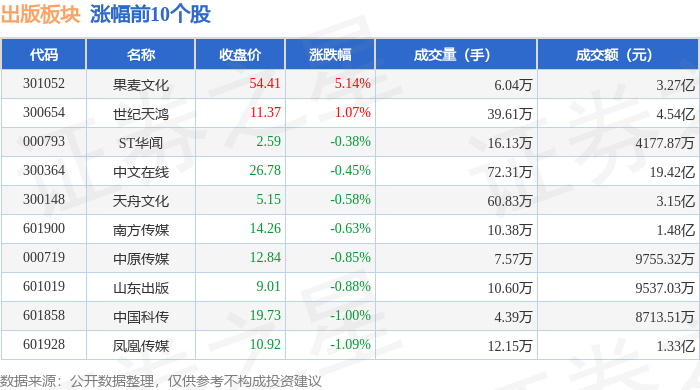
出版板块7月31日跌1.28%,粤 传 媒领跌,主力资金净流出1.99亿元
Zheng Xing Xing Ye Ri Bao· 2025-07-31 08:32
证券之星消息,7月31日出版板块较上一交易日下跌1.28%,粤 传 媒领跌。当日上证指数报收于 3573.21,下跌1.18%。深证成指报收于11009.77,下跌1.73%。出版板块个股涨跌见下表: | 代码 | 名称 | 主力净流入(元) | 主力净占比 游资净流入 (元) | | 游资净占比 散户净流入 (元) | | 散户净占比 | | --- | --- | --- | --- | --- | --- | --- | --- | | 300654 | 世纪天鸿 | 2539.13万 | 5.59% | 649.17万 | 1.43% | -3188.30万 | -7.02% | | 301052 果麦文化 | | 1919.62万 | 5.87% | -914.18万 | -2.79% | -1005.44万 | -3.07% | | 601928 凤凰传媒 | | 1530.55万 | 11.52% | -214.95万 | -1.62% | -1315.59万 | -9.90% | | 601098 | 中南传媒 | 860.37万 | 6.74% | 784.98万 | 6.15% | -16 ...




凤凰传媒(601928)7月30日主力资金净流出1703.72万元
Sou Hu Cai Jing· 2025-07-30 12:38
资金流向方面,今日主力资金净流出1703.72万元,占比成交额8.61%。其中,超大单净流出1143.12万 元、占成交额5.77%,大单净流出560.60万元、占成交额2.83%,中单净流出流出46.96万元、占成交额 0.24%,小单净流入1750.68万元、占成交额8.84%。 凤凰传媒最新一期业绩显示,截至2025一季报,公司营业总收入32.26亿元、同比减少3.52%,归属净利 润5.07亿元,同比增长42.30%,扣非净利润4.80亿元,同比增长38.73%,流动比率1.488、速动比率 1.310、资产负债率35.00%。 天眼查商业履历信息显示,江苏凤凰出版传媒股份有限公司,成立于1985年,位于南京市,是一家以从 事新闻和出版业为主的企业。企业注册资本254490万人民币,实缴资本162374.158万人民币。公司法定 代表人为章朝阳。 金融界消息 截至2025年7月30日收盘,凤凰传媒(601928)报收于11.04元,上涨0.27%,换手率0.7%, 成交量17.81万手,成交金额1.98亿元。 通过天眼查大数据分析,江苏凤凰出版传媒股份有限公司共对外投资了103家企业,参与招投标项目 ...
中文传媒: 中文传媒关于上海证券交易所对公司2024年年度报告的信息披露监管问询函的回复公告
Zheng Quan Zhi Xing· 2025-07-25 16:37
Core Viewpoint - The company, Zhongwen Media, reported a significant decline in revenue and net profit for the year 2024, prompting regulatory inquiries regarding its financial disclosures and business operations [1][2]. Business Overview - The main business segments of Zhongwen Media include general books, educational materials, new business formats, integrated marketing, and material trading. The company achieved a revenue of 9.304 billion yuan, a year-on-year decrease of 14.56%. The net profit attributable to shareholders was 744 million yuan, down from 686 million yuan, indicating a decline in profitability [2]. Revenue Breakdown - Revenue from general books and educational materials saw substantial declines, with year-on-year decreases of 26.97% and 27.55%, respectively. The sales models employed include both unconditional and conditional sales returns [2]. Regulatory Inquiry - The company received an inquiry from the Shanghai Stock Exchange regarding its 2024 annual report, which necessitated a detailed response addressing various aspects of its financial disclosures and business relationships [1][3]. Client and Supplier Relationships - The company provided detailed disclosures about its major clients and suppliers over the past three years, including sales content, settlement policies, and outstanding amounts. Notably, there were no significant overlaps in client-supplier relationships that could raise concerns about commercial rationality [3][6]. Sales and Settlement Policies - The company outlined its sales channels and models, particularly for general books and educational materials, detailing the conditions for sales returns, pricing mechanisms, and revenue recognition methods in compliance with accounting standards [3][6]. Performance Analysis - A quantitative analysis was requested to explain the significant decline in performance, considering industry policies, competitive conditions, and cost structures. The company is expected to provide insights into quarterly performance fluctuations based on cost and expense changes [3][4]. Integrated Marketing and New Business Formats - The integrated marketing segment and new business formats, including game-related services, are also part of the company's revenue streams. The company has established various settlement policies with clients in these segments, reflecting a diverse approach to revenue generation [4][7]. Supplier Relationships in Material Trading - The company disclosed its supplier relationships in the material trading segment, detailing procurement policies and outstanding amounts, which are crucial for understanding its operational dynamics [6][7]. Financial Health Indicators - The company has reported various financial health indicators, including accounts receivable and provisions for bad debts, which are essential for assessing its financial stability and risk management practices [5][6].

江苏数字文化产业按下“加速键”
Jiang Nan Shi Bao· 2025-07-24 22:46
Core Viewpoint - Jiangsu Province has launched a three-year action plan (2025-2027) for the high-quality development of its digital cultural industry, aiming to establish a robust framework and achieve significant growth in the sector by 2027 [1][3]. Group 1: Development Framework - The action plan proposes a "4916" development system, focusing on four major industry directions: audio-visual, information media, publishing, and cultural entertainment, and aims to create nine digital cultural industry chains [2][3]. - By 2024, the total revenue of the digital audio-visual industry is projected to reach 315.8 billion yuan, with 1,139 enterprises; the digital information media industry is expected to generate 203.3 billion yuan with 815 enterprises; the digital publishing industry is forecasted to achieve 32.2 billion yuan with 204 enterprises; and the digital entertainment industry is anticipated to reach 41.6 billion yuan with 112 enterprises [2]. Group 2: Quantitative Goals - By 2027, the plan aims for over 3,000 digital cultural enterprises, with total revenue reaching 800 billion yuan, accounting for over 40% of the total revenue of large-scale cultural enterprises [1][3]. - The action plan sets a target of 120 digital cultural enterprises with revenues exceeding 1 billion yuan and 10 enterprises surpassing 10 billion yuan [3]. Group 3: Enterprise and Infrastructure Development - The plan emphasizes the importance of strong enterprises for industry growth, with 2,270 large-scale digital cultural enterprises projected to generate 592.9 billion yuan in revenue by 2024 [4]. - It outlines initiatives for nurturing key enterprises and enhancing digital transformation, including the establishment of a key cultural enterprise cultivation database and the implementation of the "Smart Xinhua" initiative [4][5]. Group 4: Technological Innovation - The action plan highlights the need for technological innovation as a core driver for the digital cultural industry, focusing on key areas such as generative artificial intelligence, big data, and the metaverse [6]. - Jiangsu's innovation indicators rank high nationally, with a research and development investment intensity of approximately 3.33% [6]. Group 5: Data Utilization - The plan stresses the efficient development and utilization of cultural data, including the establishment of a digital museum and the promotion of public data resource systems [7]. - It aims to create a clear legal framework for data rights to facilitate data circulation and trading [7]. Group 6: Service and Support Mechanisms - The action plan includes measures to enhance financial services tailored to digital cultural enterprises, improve government service efficiency, and strengthen intellectual property protection [10]. - It also emphasizes the importance of talent development in fields such as big data and artificial intelligence, encouraging collaboration between enterprises and educational institutions [10]. Group 7: Implementation and Monitoring - To ensure effective implementation, the plan calls for a coordinated approach among various departments and the establishment of a statistical monitoring system for the digital cultural industry [11]. - Local governments are encouraged to focus on their regional advantages and develop specific action plans to support the digital cultural industry [11].
中欧国企红利混合A:2025年第二季度利润160.32万元 净值增长率4.59%
Sou Hu Cai Jing· 2025-07-20 07:32
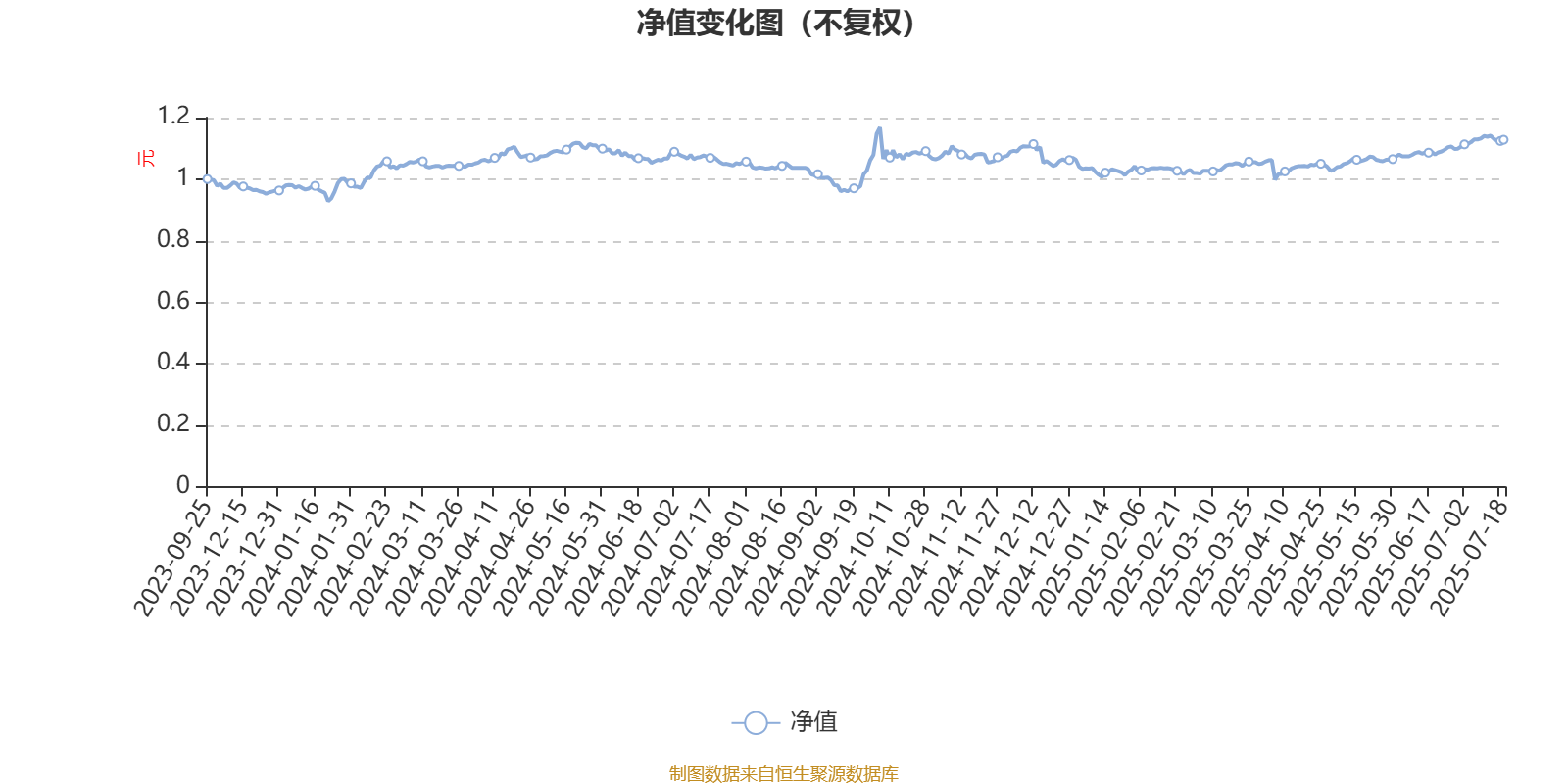
Core Viewpoint - The AI Fund, China Enterprise Dividend Mixed A (019015), reported a profit of 1.6032 million yuan for Q2 2025, with a net value growth rate of 4.59% during the period, and a total fund size of 33.8038 million yuan as of the end of Q2 2025 [3][16]. Fund Performance - As of July 18, the unit net value was 1.128 yuan, with a one-year cumulative net value growth rate of 9.58%, ranking 446 out of 584 comparable funds [3][4]. - The fund's performance over the last three months showed a growth rate of 8.11%, ranking 436 out of 615, and over the last six months, it had a growth rate of 9.65%, ranking 338 out of 615 [4]. Investment Strategy - The fund manager indicated that with the implementation of U.S. President Trump's tariff policies, global trade tensions are rising. They believe that state-owned enterprise stocks with self-controllable and domestic demand attributes will have better defensive characteristics [3]. - The report suggests that the concept of "dividend" investment, particularly high-dividend stocks, is expected to expand to broadly defined dividend stocks with potential high dividend capabilities. These companies typically have high operational barriers, stable ROE, and abundant operating cash flow, indicating a potential for sustained dividends while still being undervalued historically [3]. Fund Holdings - As of June 27, the fund's top ten holdings included Yanzhou Coal Mining Company, Shandong Publishing Group, Zoomlion Heavy Industry Science and Technology Co., New Media Group, Bohai Ferry, Phoenix Media, Nanjing Steel Group, Nanjing High Accurate Drive Equipment Manufacturing Group, China Shenhua Energy Company, and China Construction Bank [19]. Risk Metrics - The fund has a Sharpe ratio of 0.6765 since inception, indicating a reasonable risk-adjusted return [9]. - The maximum drawdown since inception is 14.12%, with the largest quarterly drawdown occurring in Q3 2024 at 11.88% [12]. Fund Positioning - The average stock position since inception has been 91.66%, compared to the peer average of 83.17%. The fund reached a peak stock position of 93.42% at the end of Q1 2024 and a low of 89.12% at the end of 2024 [15].




ESG信披观察 | A股“谷子经济”概念股ESG评级仅两家获A,文化出海成特色议题
Mei Ri Jing Ji Xin Wen· 2025-07-17 08:55
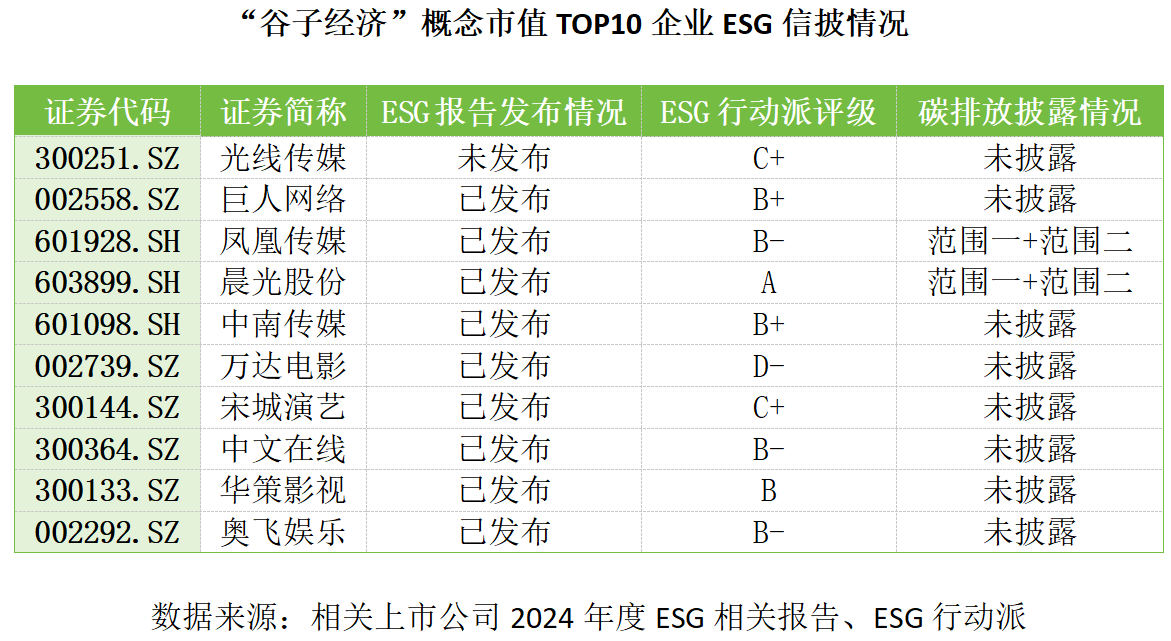
Group 1 - Pop Mart (HK 09992) expects a revenue increase of at least 200% and a profit increase of at least 350% in the first half of the year compared to the same period last year, with revenue reaching at least 13.7 billion yuan [1] - The "Guzi Economy" concept stocks have gained attention, with 38 companies in the A-share market, of which 22 have released ESG reports for 2024, resulting in a disclosure rate of 58% [2][4] - Only 2 companies within the "Guzi Economy" concept stocks have an ESG rating of A, indicating a low percentage of 5.26% for A-rated companies in this sector [2][4] Group 2 - The "Guzi Economy" concept stocks primarily focus on social dimensions rather than environmental issues, leading to a lack of attention to sustainability governance [2][5] - The top 10 companies by market value in the "Guzi Economy" have only 2 that disclosed their direct and indirect greenhouse gas emissions, with none reporting on scope three emissions [2][4] - The industry faces challenges with IP infringement, highlighting the need for a robust copyright protection system [6][7] Group 3 - Cultural export has become a distinctive topic, with companies integrating ESG into their global strategies to enhance compliance and brand reputation [8] - Companies like Youzu Network have successfully expanded their cultural reach globally, partnering with over 1,000 partners and reaching nearly 1 billion users [8] - Recommendations include establishing sustainable development standards for the "Guzi Economy" to better guide companies in their sustainable practices [9]





【干货分享】中国图书零售行行业市场运行态势及发展趋势预测报告(智研咨询)
Sou Hu Cai Jing· 2025-07-17 02:17
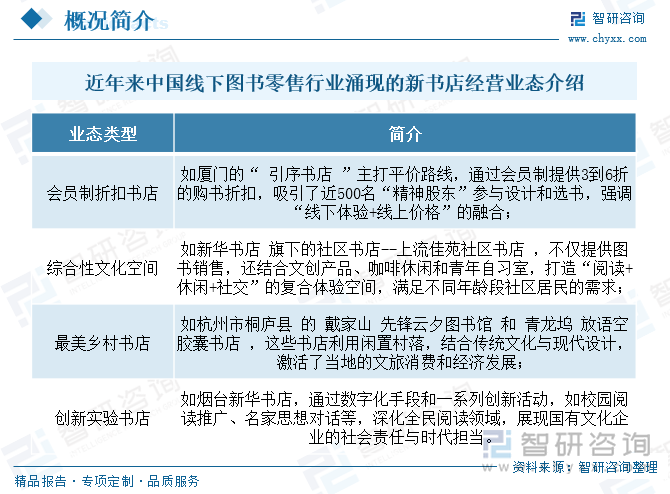
Industry Overview - The book retail industry refers to the process of selling books directly to end consumers, utilizing careful selection, pricing, promotion, and distribution to meet consumer demand while achieving commercial benefits for publishers and distributors [3] - Since 2020, China's book retail market has experienced fluctuations, with the market size declining from 98.7 billion yuan in 2021 to 87.1 billion yuan in 2022 [6] - In 2023, the market began to recover, with the retail market size slightly increasing to 91.2 billion yuan, representing a growth rate of 4.7% [6] Market Trends - By 2024, the integration of online and offline book sales channels has been established, driven by the rise of short video e-commerce and innovations in physical bookstores, leading to a significant market growth [6] - The industry code volume has reached 112.9 billion yuan in 2024, with a year-on-year growth rate of 23.8% [6] - The market is undergoing transformation, reflected in changes in consumer habits, marketing models, channel diversification, policy support, and technological advancements [8] Sales Channel Structure - In 2024, the market share of different sales channels is as follows: platform e-commerce accounts for 40.92%, short video e-commerce for 30.48%, vertical and other e-commerce for 14.71%, and offline physical stores for 13.99% [8] - The significant increase in the market share of short video e-commerce and offline physical stores compared to the previous year indicates a dynamic growth in the book retail sector [8] Key Players - Notable listed companies in the industry include CITIC Publishing (300788), China South Publishing (601098), Xinhua Wenhui (601811), and others [2] - Other relevant enterprises include Zhejiang Xinhua Bookstore Group, Beijing Ren Tian Bookstore Group, and various local bookstores [2]



研判2025!中国图书零售行业产业链图谱、市场规模、竞争格局及未来前景分析:短视频电商加速崛起,图书零售市场实现高速增长[图]
Chan Ye Xin Xi Wang· 2025-07-11 01:13
Core Insights - The Chinese book retail market has experienced fluctuations since 2020, with a decline in market size from 987 billion yuan in 2021 to 871 billion yuan in 2022, followed by a slight recovery to 912 billion yuan in 2023, representing a growth rate of 4.7% [1][5] - In 2024, the market is expected to achieve rapid growth, with the industry scale reaching 1,129 billion yuan, a year-on-year growth rate of 23.8%, driven by the rise of short video e-commerce and innovations in physical bookstores [1][5] Industry Overview - Book retail refers to the process of selling books directly to end consumers, involving careful selection, pricing, promotion, and distribution to meet consumer demand while achieving commercial benefits for publishers and distributors [2] - The industry has seen a stable growth in the number of physical bookstores, with a rise of distinctive and diverse new bookstores, contributing to a preliminary establishment of an integrated online and offline sales channel [2] Market Dynamics - The book retail market is undergoing transformation, reflected in changes in consumer habits, marketing models, channel diversification, policy support, and technological advancements [7] - In 2024, the market structure shows that platform e-commerce accounts for 40.92% of the market, short video e-commerce for 30.48%, while vertical and other e-commerce and offline physical stores account for 14.71% and 13.99%, respectively [7] Book Categories - The largest category in the book retail market is children's books, accounting for 28.16% of the market in 2024, followed by educational materials at 25.33%, supported by a large user base of students [9] Competitive Landscape - The market competition is characterized by diversification and the integration of online and offline sales. Major online platforms like Dangdang and JD Books dominate the market, while physical bookstores like Xinhua Bookstore and independent bookstores enhance their competitiveness through cultural experiences and events [11] - Companies such as CITIC Publishing, Zhongnan Media, and Xinhua Wenhui are key players in the market, each with distinct business focuses ranging from educational materials to digital publishing [13] Development Trends - The integration of online and offline channels is accelerating, with a predicted stable online channel share of 65%-70% and offline bookstores achieving 30%-35% in the next five years [17] - Digitalization and personalized services are emerging trends, with the digital education market expected to exceed 5 billion yuan by 2025, accounting for 15% of the overall market [18][19] - Government policies are continuously supporting the industry's transformation and high-quality development, with initiatives like a 5 billion yuan fund for physical bookstore upgrades [20]