
金龙汽车

Search documents
金龙汽车涨2.00%,成交额1.10亿元,主力资金净流出312.89万元
Xin Lang Cai Jing· 2025-12-19 03:52
Core Viewpoint - Jinlong Automobile's stock price has shown a significant increase this year, with a year-to-date rise of 16.77%, despite a slight decline in the last five trading days [1]. Group 1: Stock Performance - As of December 19, Jinlong Automobile's stock price reached 16.29 CNY per share, with a trading volume of 1.10 billion CNY and a turnover rate of 0.95%, resulting in a total market capitalization of 11.681 billion CNY [1]. - The stock has experienced a 1.21% decline over the last five trading days, but has increased by 15.61% over the past 20 days and 40.80% over the past 60 days [1]. Group 2: Financial Performance - For the period from January to September 2025, Jinlong Automobile reported a revenue of 16.329 billion CNY, reflecting a year-on-year growth of 13.40%. The net profit attributable to shareholders was 247 million CNY, marking a substantial increase of 223.71% [2]. Group 3: Shareholder Information - As of September 30, 2025, the number of shareholders for Jinlong Automobile was 61,200, a decrease of 5.02% from the previous period. The average number of circulating shares per shareholder increased by 5.28% to 11,706 shares [2]. - The company has distributed a total of 862 million CNY in dividends since its A-share listing, with 104 million CNY distributed over the last three years [3].

商用车板块12月18日跌0.11%,金龙汽车领跌,主力资金净流入1.44亿元
Zheng Xing Xing Ye Ri Bao· 2025-12-18 09:02
从资金流向上来看,当日商用车板块主力资金净流入1.44亿元,游资资金净流出1.2亿元,散户资金净流 出2349.74万元。商用车板块个股资金流向见下表: 以上内容为证券之星据公开信息整理,由AI算法生成(网信算备310104345710301240019号),不构成投资建议。 证券之星消息,12月18日商用车板块较上一交易日下跌0.11%,金龙汽车领跌。当日上证指数报收于 3876.37,上涨0.16%。深证成指报收于13053.98,下跌1.29%。商用车板块个股涨跌见下表: ...


绿控传动创业板IPO已受理 专注于新能源商用车电驱动系统
智通财经网· 2025-12-16 23:36
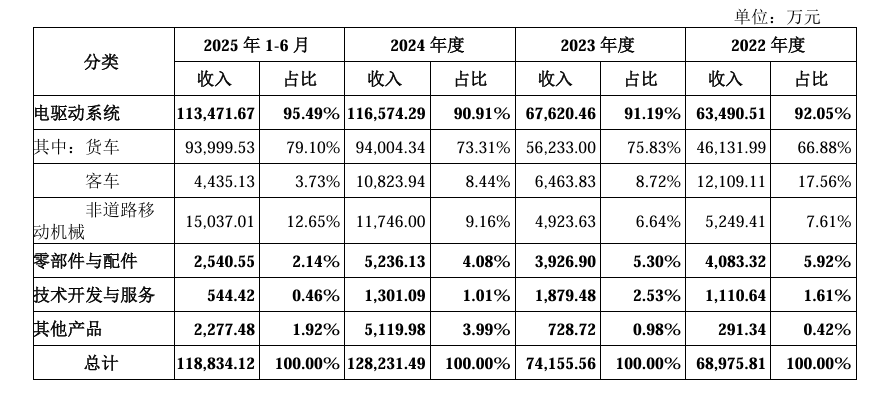
Core Viewpoint - Suzhou Green Control Transmission Technology Co., Ltd. (Green Control Transmission) has received acceptance for its IPO on the Shenzhen Stock Exchange's ChiNext board, aiming to raise 1.58 billion yuan [1] Company Overview - Green Control Transmission is a leading player in the domestic electric drive systems for new energy commercial vehicles, providing electric drive systems, components, and related technical development and services [1] - The company's main products are electric drive systems for pure electric, hybrid, and fuel cell commercial vehicles, as well as non-road mobile machinery [1] Market Position - The company has established itself as a mainstream powertrain system supplier for leading manufacturers in the new energy commercial vehicle sector, with major clients including XCMG Group, SANY Group, Dongfeng Motor, and others [1] - In the new energy heavy truck sector, the company holds a significant market position, with a leading market share in electric motor matching for new energy heavy trucks from 2022 to 2024 [1] Financial Performance - Revenue from electric drive systems accounted for over 90% of the company's total income, indicating its primary revenue source [2] - The company reported revenues of approximately 712 million yuan, 770 million yuan, 1.328 billion yuan, and 1.219 billion yuan for the years 2022, 2023, 2024, and the first half of 2025, respectively [3] - Net profits for the same periods were -99.43 million yuan, -12.33 million yuan, 48.04 million yuan, and 68.30 million yuan [4] Revenue Breakdown - For the first half of 2025, the revenue breakdown by product category is as follows: - Electric drive systems: 113.47 million yuan (95.49%) - Trucks: 93.99 million yuan (79.10%) - Buses: 4.44 million yuan (3.73%) - Non-road mobile machinery: 15.04 million yuan (12.65%) - Components and accessories: 2.54 million yuan (2.14%) - Technical development and services: 544.42 thousand yuan (0.46%) - Other products: 2.28 million yuan (1.92%) [3] Investment Plans - The net proceeds from the IPO are planned to be invested in projects including the annual production of 100,000 sets of new energy medium and heavy commercial vehicle electric drive systems and the establishment of a research and development center, with total investments of 1.38 billion yuan and 200 million yuan, respectively [3]

A股公司今年以来斥资逾9440亿元购买理财产品
Zheng Quan Ri Bao· 2025-12-16 16:09
Core Viewpoint - The phenomenon of listed companies using idle funds to purchase financial products has sparked market discussions, emphasizing the need for careful planning based on the company's development stage and actual funding needs [1] Group 1: Financial Product Purchases - A total of 1,147 A-share listed companies purchased 15,000 financial products this year, with a total subscription amount of 944.099 billion yuan, a year-on-year decrease of 18.76% [1] - Among the various financial products, structured deposits were the most favored, with a subscription amount of 563.834 billion yuan, accounting for 59.72% of the total [1] - Bank financial products followed with a total subscription of 108.124 billion yuan, while deposit products and brokerage financial products had subscription amounts of 76.969 billion yuan and 65.807 billion yuan, respectively [1] Group 2: Factors Influencing Purchase Trends - The overall amount of financial products purchased by listed companies has decreased due to three main factors: lower market interest rates reducing the attractiveness of financial product yields, a policy shift encouraging companies to enhance returns to investors through cash dividends and share buybacks, and a favorable capital market encouraging companies to invest in primary and secondary markets [2] - Despite the decline in enthusiasm for purchasing financial products, the subscription amount for brokerage financial products remained stable, with their proportion of total subscriptions rising from 5.76% last year to 6.97% this year [2] Group 3: Company-Specific Purchases - Seven listed companies have subscribed to financial products exceeding 10 billion yuan this year, with the highest being Jiuzhoutong at 29.164 billion yuan, followed by Hisense Home Appliances at 22.933 billion yuan, and ZTE Corporation and Dongpeng Beverage at 18.512 billion yuan and 14.094 billion yuan, respectively [3] - The funding sources for purchasing financial products mainly include self-owned funds and self-raised funds, with 335.301 billion yuan from self-owned funds (35.52%) and 608.798 billion yuan from self-raised funds (64.48%) [3] Group 4: Investment Principles - Companies should prudently determine the scale and duration of their investments in financial products, adhering to the principle of safety and prioritizing the protection of principal and shareholder interests [4]
商用车板块12月16日跌1.42%,金龙汽车领跌,主力资金净流出2.56亿元
Zheng Xing Xing Ye Ri Bao· 2025-12-16 09:09
Core Viewpoint - The commercial vehicle sector experienced a decline of 1.42% on December 16, with Jinlong Automobile leading the drop. The Shanghai Composite Index closed at 3824.81, down 1.11%, while the Shenzhen Component Index closed at 12914.67, down 1.51% [1]. Group 1: Market Performance - The commercial vehicle sector saw a net outflow of 256 million yuan from major funds, while retail investors contributed a net inflow of 132 million yuan [2][3]. - Key stocks in the commercial vehicle sector showed varied performance, with Foton Motor increasing by 1.46% to close at 2.78 yuan, while Jinlong Automobile fell by 6.45% to 16.10 yuan [1][2]. Group 2: Individual Stock Analysis - Foton Motor had a trading volume of 1.2982 million shares and a transaction value of 359 million yuan [1]. - Dongfeng Motor closed at 7.13 yuan, with a trading volume of 229,100 shares and a transaction value of 163 million yuan [1]. - Jinlong Automobile led the decline with a trading volume of 421,600 shares and a transaction value of 699 million yuan [2].

如何看2025年11月消费数据
2025-12-16 03:26
Summary of Key Points from Conference Call Records Industry Overview Retail Industry - In November 2025, the total retail sales of consumer goods grew at a rate of approximately 1%, indicating a slowdown in growth momentum. Restaurant revenue increased by 3.2% year-on-year but showed a month-on-month decline, reflecting weakened overall consumption market dynamics [1][3] - Online retail sales of physical goods accounted for 26% of total retail sales, but the growth rate has declined compared to previous periods. Offline retail, particularly convenience stores and supermarkets, remains relatively robust, while department stores and specialty shops show lower growth rates, indicating an imbalance in the development of online and offline retail formats [1][3] - Essential consumer goods like grain and oil maintain steady growth, while discretionary items such as cosmetics and gold jewelry perform well due to promotions and rising gold prices. However, home appliances are experiencing a year-on-year decline due to policy impacts and demand exhaustion, highlighting consumption differences across categories [1][3] Automotive Industry - The total retail sales of automobiles in November 2025 amounted to 445.4 billion yuan, down 8.3% year-on-year. Despite this, passenger car sales and export volumes continue to grow, with a penetration rate of new energy vehicles remaining high, indicating structural changes in the automotive market and potential for export growth [1][7] - The expected continuation of trade-in subsidies may release pent-up demand, with companies like Geely and Great Wall Motors being highlighted as potential investment opportunities. BYD is noted for its strong overseas market prospects, while XPeng Motors is recommended for its leading smart driving technology [1][7] Duty-Free Industry - The duty-free industry showed steady growth in the first ten months of 2025, with the fourth quarter benefiting from high-value items like gold jewelry and mobile phones. It is expected that Hainan's offshore duty-free sales will maintain positive growth at least until the third quarter of next year, reflecting the growth potential of duty-free consumption [1][6] - Companies to watch include China Duty Free Group, ShouLai JinJiang, Huazhu, and Atour, along with restaurant chains like Haidilao and Baosheng China, which are noted for their strong management capabilities and new brand incubation strategies [1][6] Food and Beverage Industry - The food and beverage sector experienced relatively flat demand in November 2025, with retail sales of tobacco and alcohol declining by 3.4% year-on-year. The overall demand is in a slow recovery phase, influenced by seasonal factors and the timing of the upcoming Spring Festival [1][11] Home Appliance Industry - The home appliance sector faced significant sales declines due to the impact of national subsidy policies, with retail sales down 19.4% year-on-year. However, there is an expectation that these policies may continue into next year, suggesting a focus on resilient demand in white goods and two-wheeler markets, as well as overseas market opportunities [1][2][14] Alcohol Industry - The liquor industry is currently in a phase of active destocking, with high-end brands like Moutai experiencing price corrections that support demand. The upcoming Spring Festival is expected to see marginal improvements in sales, with recommendations to gradually allocate investments in the liquor sector, particularly in high-end brands [1][12] Textile and Apparel Industry - In November 2025, online sales of clothing and textiles grew by 3.5% year-on-year, although there was a month-on-month decline. The overall performance is expected to improve in the fourth quarter, aiding inventory reduction and setting the stage for a favorable market in the following year [1][9] Investment Recommendations - Focus on companies with strong growth potential in the beauty and personal care sector, such as MaoGaoPing and Shangmei, and in the gold jewelry sector, prioritize firms with strong product design and foundational support [1][4] - In the automotive sector, consider companies like Geely and Great Wall Motors, as well as BYD for overseas expansion opportunities [1][7] - For the duty-free sector, keep an eye on leading companies like China Duty Free Group and ShouLai JinJiang, as well as promising restaurant chains [1][6]
汽车整车板块高开
Xin Lang Cai Jing· 2025-12-16 01:30
Core Viewpoint - The automotive sector opened high, with notable gains in various companies, indicating positive market sentiment in the industry [1] Group 1: Company Performance - Beiqi Blue Valley opened at the涨停价 (limit up price), reflecting strong investor interest [1] - Jinlong Automobile, Changan Automobile, Seres, Qianli Technology, and GAC Group also experienced upward movement, suggesting a broader rally in the automotive sector [1]




L3级自动驾驶来了!仅2款车型拿到首批入场券,这行业要变天?
Zheng Quan Shi Bao· 2025-12-16 00:11
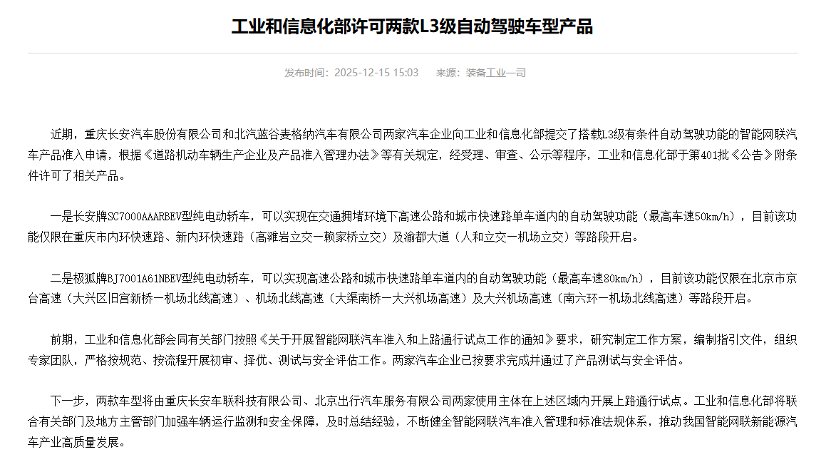
Core Insights - The first batch of L3-level conditional autonomous driving vehicles has been granted approval in China, marking a significant step towards commercial application in the intelligent connected vehicle industry [1][4] Group 1: Regulatory Developments - The Ministry of Industry and Information Technology announced the approval of two L3-level conditional autonomous driving models: Changan SC7000AAARBEV and Arcfox BJ7001A61NBEV [1] - According to national standards, L3-level autonomous driving allows the vehicle system to fully take over driving tasks under specific conditions, while the driver must remain alert and ready to take control [3] Group 2: Industry Implications - Analysts suggest that this approval signifies a transition from "testing demonstration" to "commercial application" for China's intelligent connected vehicle industry [4] - The two approved models will undergo road trials in designated areas, with the Ministry of Industry and Information Technology collaborating with local authorities to enhance vehicle operation monitoring and safety [4] Group 3: Market Trends - The "Automotive Industry Stabilization Growth Work Plan (2025-2026)" was released, providing clear guidance for industry development over the next two years, including conditional approval for L3-level autonomous vehicle production [5][6] - The formal implementation of L3-level autonomous driving regulations is expected to be a key catalyst for industry development by 2026, with consumer interest in advanced driver assistance systems increasing [6] Group 4: Financial Performance of Related Companies - A total of 13 intelligent driving stocks have seen net buying exceeding 100 million yuan since Q4 2025, with Hikvision, JAC Motors, Lens Technology, and Desay SV leading in net buying amounts [7] - Companies like Hikvision and Desay SV are focusing on smart driving sensor solutions and intelligent cockpit systems, respectively, indicating a strong growth trajectory in the intelligent driving sector [10] - Predictions for 2025 show that 19 intelligent driving stocks are expected to have a net profit growth rate exceeding 30%, with notable increases from companies like Foton Motor (1633.76%) and SAIC Motor (584.34%) [12]

长安/江铃/大通份额超20%争冠,“二龙”排名上升,11月轻客销4万辆增14%!
第一商用车网· 2025-12-15 02:38
Core Viewpoint - The light commercial vehicle (LCV) market in China has shown a significant growth trend, achieving an 8-month consecutive increase in sales, with November 2025 sales reaching 40,500 units, a year-on-year growth of 14% [2][6][20]. Group 1: Market Performance - In November 2025, the overall bus market sold 53,200 units, with a month-on-month increase of 7% and a year-on-year increase of 16% [1]. - The light bus market accounted for 76.14% of total bus sales in November, a slight decrease from the previous month [1]. - Cumulatively, from January to November 2025, the light bus market sold 403,700 units, marking an 11% year-on-year increase, which is the highest in five years [4][15]. Group 2: Sales Trends - The light bus market has experienced a fluctuating trend over the past five years in November, with 2025's sales being the highest in this period, surpassing the lowest sales in November 2022 by 14,200 units [4]. - The cumulative sales from January to November 2025 exceeded 400,000 units, with an increase of over 41,400 units compared to the same period last year [4][15]. Group 3: Company Performance - In November 2025, the top ten companies in the light bus market had a combined market share of 97.90%, with Changan, Jiangling, and Maxus leading the market, each exceeding 20% market share [13]. - Changan and Maxus saw significant year-on-year sales increases of 44% and 79%, respectively, while Jiangling grew by 10% [10][16]. - Among the top ten companies, five experienced sales growth while five saw declines, with the most significant drop being 48% for one company [10]. Group 4: Market Share Dynamics - From January to November 2025, Changan, Jiangling, and Maxus captured 28.92%, 22.15%, and 21.13% of the light bus market share, respectively [17]. - Compared to the previous year, Changan, Jiangling, and Maxus increased their market shares by 4.76, 0.81, and 3.35 percentage points, respectively [18].


客车行业基本面更新
2025-12-15 01:55
Summary of the Bus Industry Conference Call Industry Overview - The bus industry is experiencing explosive growth in the overseas market for new energy buses, significantly boosting sales and profitability for leading domestic companies like Yutong [1][2] - The electrification process for public buses is advancing faster than for seated buses, with China's electrification rate for public buses nearing 100%, while Europe ranges from 30% to 50% [1][3] - Global electrification rates for seated buses remain low, indicating significant growth potential in the coming years, especially as policies shift towards electrifying seated buses [1][7] Key Insights and Arguments - Yutong has achieved remarkable growth through exports, particularly to Europe, with a projected export volume of 4,000 units in 2025, including 2,000 units to Europe [5] - The average selling price (ASP) for new energy buses in Europe can reach 2 million to 2.5 million yuan, significantly higher than traditional fuel buses, leading to higher profit margins [9] - Various countries, including Colombia, Brazil, and Peru, are implementing supportive policies for new energy buses, which is driving penetration rates in regions like South America, the Middle East, and Southeast Asia [6] Profitability and Market Dynamics - The overall sales growth in the bus industry has been modest, with Yutong's sales growth at 6.1% in the first ten months of 2025, and export volumes showing a year-on-year increase of about 10% to 13% [10] - Despite the lack of significant sales growth, profit margins are increasing rapidly, particularly in the Middle East, due to the lower profitability of traditional fuel buses [10] - The future growth of the bus industry is heavily reliant on exports, especially to non-EU regions, which are expected to contribute significantly to performance [11] Future Growth Potential - The seated bus sector is anticipated to see substantial growth as electrification rates increase, particularly in China and the EU, which will gradually shift focus towards seated buses after achieving high electrification in public transport [7][11] - The industry is expected to experience a second wave of growth driven by the acceleration of seated bus electrification [11] Risks and Considerations - The bus industry faces significant order volatility due to reliance on local government contracts, which can lead to fluctuations in sales and performance [12] - Large orders, such as the recent 900-unit order from Chile for Zhongtong, can lead to rapid sales growth but also create uncertainty for future orders [12] - Short-term sales data may not accurately reflect the long-term growth potential of the industry, as seen with Yutong's stock performance despite short-term sales declines [13]

