易方达基金

Search documents
216只ETF获融资净买入 博时中证可转债及可交换债券ETF居首
Zheng Quan Shi Bao Wang· 2025-12-01 02:18
Core Viewpoint - As of November 28, the total margin balance for ETFs in the Shanghai and Shenzhen markets is 118.316 billion yuan, showing a decrease of 0.221 billion yuan from the previous trading day [1] Summary by Category ETF Financing and Margin Balance - The ETF financing balance stands at 110.65 billion yuan, down by 0.325 billion yuan compared to the previous trading day [1] - The ETF margin short balance is 7.666 billion yuan, which has increased by 0.104 billion yuan from the previous trading day [1] Net Buy and Performance of ETFs - On November 28, 216 ETFs experienced net financing purchases, with the highest net purchase amounting to 92.1675 million yuan for the Bosera CSI Convertible Bonds and Exchangeable Bonds ETF [1] - Other ETFs with significant net financing purchases include the E Fund ChiNext ETF, HFT CSI Short-term Bond ETF, Huaan ChiNext 50 ETF, Guotai CSI All-Share Communication Equipment ETF, and others [1]
“小阳春”!11月基金发行近千亿元
券商中国· 2025-12-01 02:01
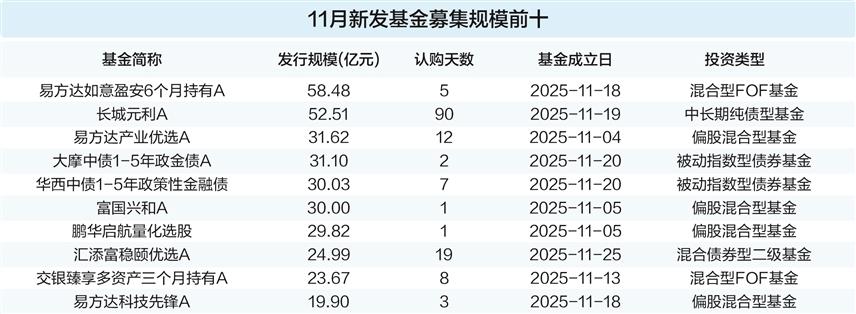
Core Viewpoint - The public fund issuance market experienced a "small spring" in November, with a total new fund scale reaching 96.616 billion yuan, indicating strong investor enthusiasm for subscriptions [1][5]. Fund Issuance Overview - A total of 136 new funds were established in November, showcasing a positive trend in both volume and price, driven by increased year-end capital allocation needs [1][7]. - The top fund by issuance scale was E Fund's E Fund Ruiyi Ying'an 6-Month Holding A, with 5.848 billion yuan, followed by Great Wall Fund's Great Wall Yuanli A at 5.251 billion yuan [1][3]. Fund Types and Performance - Equity funds (stock and mixed types) remained the main force in the market, with stock fund issuance reaching 30.669 billion yuan, accounting for 32.43% of the total scale [5]. - Mixed funds followed with an issuance scale of 23.999 billion yuan, making the total for equity funds 54.669 billion yuan, which constituted 57.81% of the total issuance [5]. Popular Fund Products - Notable high-raising products included mixed equity funds like Fu Guo Xing He A (3 billion yuan) and Peng Hua Qi Hang Quantitative Stock Selection (2.982 billion yuan) [5]. - Passive index funds also gained traction, covering various sectors, with notable products like Wan Jia Zhong Zheng 800 Dividend Low Volatility Index A raising 1.723 billion yuan [5]. International Market Interest - Funds targeting overseas emerging markets, particularly two ETFs focused on Brazil, attracted significant interest, raising a total of 3 billion yuan, exceeding their initial fundraising cap by over seven times [6]. Stability and Growth in Fund Types - Bond funds raised 21.666 billion yuan, accounting for 22.91% of the issuance market, serving as an important stabilizer [6]. - Fund of Funds (FOF) also performed well, with an issuance scale of 16.975 billion yuan, reflecting investor preference for professional fund selection and risk diversification [6]. Market Sentiment and Future Outlook - Analysts noted that the concentration of fund establishment dates in November allowed new products to meet year-end capital allocation needs, indicating that public funds continue to attract incremental capital into the market [7][8]. - The issuance volume approaching 100 billion yuan is seen as a positive signal for market confidence and structural optimization for the upcoming year [7][8].


两市ETF两融余额较上一日减少2.21亿元
Zheng Quan Shi Bao Wang· 2025-12-01 02:01
Group 1 - The total ETF margin balance in the two markets is 118.316 billion yuan, a decrease of 0.19% compared to the previous trading day [1] - The financing balance of ETFs is 110.650 billion yuan, down 0.29% from the previous day [1] - The margin balance in the Shenzhen market is 35.480 billion yuan, while in the Shanghai market it is 82.836 billion yuan [1] Group 2 - Among the ETFs, 132 have a financing balance exceeding 100 million yuan, with the highest being Huaan Gold ETF at 7.853 billion yuan [2] - The top three ETFs with the largest financing balance increases are Kechuang 200, Zhongzheng Shanghai State-owned Enterprises ETF, and Haifutong Shanghai Investment Grade Convertible Bond ETF, with increases of 67.44%, 58.42%, and 56.70% respectively [2] - The ETFs with the largest financing balance decreases include Chuangye Board ETF, Huatai-PB Zhongzheng Hong Kong and Shanghai Cloud Computing Industry ETF, and E Fund Zhongzheng AAA Technology Innovation Company Bond ETF, with decreases of 88.27%, 66.10%, and 63.41% respectively [2] Group 3 - The net financing inflow is highest for Bosera Convertible Bond ETF, E Fund Chuangye Board ETF, and Haifutong Zhongzheng Short-term Bond ETF, with inflows of 92.1675 million yuan, 60.8073 million yuan, and 52.5457 million yuan respectively [5] - The ETFs with the largest net financing outflows include Guotai Zhongzheng All-Index Securities Company ETF, Gold Stock ETF, and Huaxia Zhongzheng Robot ETF, with outflows of 49.5898 million yuan, 44.5180 million yuan, and 42.1333 million yuan respectively [4] Group 4 - The latest margin balance for short selling is highest for Southern Zhongzheng 1000 ETF, Southern Zhongzheng 500 ETF, and Huaxia Zhongzheng 1000 ETF, with balances of 2.410 billion yuan, 2.331 billion yuan, and 473 million yuan respectively [6] - The ETFs with the largest increases in short selling balances are Southern Zhongzheng 500 ETF, Southern Zhongzheng 1000 ETF, and Bosera Convertible Bond ETF, with increases of 92.4538 million yuan, 38.0371 million yuan, and 16.1608 million yuan respectively [7] - The ETFs with the largest decreases in short selling balances include Huatai-PB Hu-Shen 300 ETF, Huabao Zhongzheng Bank ETF, and Invesco Great Wall Zhongzheng Dividend Low Volatility 100 ETF, with decreases of 33.6238 million yuan, 10.9527 million yuan, and 8.0082 million yuan respectively [7]
“硬科技”ETF迎来发售热潮 增量资金涌入前沿科技赛道
Zhong Guo Zheng Quan Bao· 2025-12-01 00:43
Core Viewpoint - The recent surge in the issuance of "hard technology" themed ETFs indicates strong investor interest and potential for growth in sectors like semiconductors and artificial intelligence, driven by policy support and industry trends [1][4]. Fund Issuance - On November 28, the GF Securities' Shanghai Stock Exchange Sci-Tech Innovation Board Chip Design ETF was launched, leading the issuance of six similar funds [2]. - Seven AI-themed ETFs were also launched on the same day, with initial fundraising caps set at 80 billion yuan for some and 50 billion yuan for others [2]. - The Yongying CSI Sci-Tech Innovation Entrepreneurship AI ETF announced an early closure of its fundraising period due to high demand, reaching over 9 billion yuan on its first day [3]. Capital Inflow - An additional 40 new funds are set to be issued next week, with many targeting the technology sector and the Sci-Tech Innovation Board, indicating a significant influx of capital into these areas [4]. - The concentration of "hard technology" products is expected to attract more incremental funds, facilitating precise investments in the semiconductor industry and directing market resources towards "hard technology" sectors [4]. Market Trends - Despite short-term market fluctuations, the long-term growth logic for "hard technology" remains solid, supported by policy and industry trends [1][5]. - Analysts suggest that the current market is at a critical juncture, with fluctuations expected but the core drivers of the current market cycle still intact [5]. - The technology sector is experiencing a "back-and-forth" trend, but macroeconomic factors are becoming more favorable, particularly with rising expectations for overseas interest rate cuts [5][6].
医药板块,后续怎么走?
Zheng Quan Shi Bao Wang· 2025-11-30 23:35
Core Insights - The pharmaceutical sector has experienced a slowdown in momentum after a strong rally earlier in the year, with the number of "doubling funds" significantly decreasing [1][2] - As of November 28, only two pharmaceutical-themed funds maintained over 100% returns, indicating a retreat from previous high performance [2] - The industry is currently in a transitional phase characterized by increased market speculation, despite a solid long-term growth outlook supported by policy reinforcement and improved cash flow [1][3] Fund Performance - As of November 28, the only two funds with over 100% returns are Zhongyin Hong Kong Stock Connect Pharmaceutical A (up 107.69%) and Chuangjin Hexin Global Pharmaceutical Biotechnology A (up 100.32%) [2] - The average return of pharmaceutical-themed funds has retreated approximately 10% from their peak in September [2] - Major pharmaceutical ETFs have seen a decline in scale over the past three months, reflecting a shift from aggressive buying to a more cautious stance [2] Policy Environment - The policy landscape is expected to remain favorable for the pharmaceutical industry, with significant measures announced to support high-quality development [3][4] - Key policies include a comprehensive support framework for innovative drugs, scientific regulation, and standardized development of traditional Chinese medicine [3] - The upcoming negotiations for the national basic medical insurance directory are anticipated to enhance funding sources for the healthcare industry [3][4] Valuation and Market Dynamics - The pharmaceutical sector has been ranked low in relative performance over the past four years, indicating a potential for upward valuation adjustments [5][6] - The market is transitioning from short-term trading strategies to a focus on valuation recovery, with signs of performance improvement following the third-quarter earnings reports [5][6] - Positive catalysts are expected in the fourth quarter, including accelerated business development and improved cash flow for leading companies [6]
医药板块,后续怎么走?
券商中国· 2025-11-30 23:25
Core Viewpoint - The pharmaceutical sector has experienced a slowdown in its upward momentum after a strong rally earlier in the year, with the number of "doubling funds" significantly decreasing [1][2]. Group 1: Market Performance - As of November 28, only two pharmaceutical-themed funds, Zhongyin Hong Kong Stock Connect Pharmaceutical A and Chuangjin Hexin Global Pharmaceutical Biotechnology A, maintained doubling returns, with gains of 107.69% and 100.32% respectively, indicating a notable contraction compared to previous performance [3]. - In the third quarter, multiple pharmaceutical funds saw significant net value increases, but by the end of November, the average return for pharmaceutical-themed funds had retreated approximately 10% from their September peak [3]. - Major pharmaceutical ETFs, including the CSI 300 Pharmaceutical and Health Index and the CSI All Share Pharmaceutical and Health Index, have also seen a decline in scale over the past three months, reflecting a shift in investor sentiment from aggressive buying to cautious observation [3]. Group 2: Policy Environment - The policy landscape is viewed as a stabilizing factor for the pharmaceutical sector, with institutions focusing on policy and industry dynamics to gauge future trends [4]. - The National Healthcare Security Administration and the National Health Commission have issued measures to support the high-quality development of innovative drugs, providing comprehensive support across research, access, clinical application, and payment mechanisms [5]. - Regulatory improvements, such as the implementation of ICH guidelines and encouragement of real-world studies for drug safety assessments, are expected to enhance the efficiency and scientific rigor of drug approvals [5]. Group 3: Valuation and Investment Outlook - The pharmaceutical industry has ranked relatively low in terms of valuation over the past four years, suggesting significant potential for upward movement as valuations have been sufficiently digested [6]. - Following a period of correction, the relative value of the pharmaceutical sector is becoming more apparent, with a shift in investment logic from short-term trading to valuation recovery [6]. - Positive signs of recovery are emerging in the pharmaceutical sector's fundamentals, with improved performance reported in the third quarter and expectations for accelerated business development in the fourth quarter [6]. - The Federal Reserve's interest rate cuts are anticipated to facilitate a recovery in pharmaceutical financing, alongside improvements in the domestic capital market, which will likely enhance new drug research and development spending [7].

“硬科技”ETF迎来发售热潮
Zhong Guo Zheng Quan Bao· 2025-11-30 20:21
Group 1 - The recent surge in the issuance of "hard technology" themed ETFs indicates strong market interest, with multiple funds launching on November 28, including the GF Securities Shanghai Stock Exchange Sci-Tech Innovation Board Chip Design ETF and seven AI-themed ETFs [1][2] - The first batch of AI-themed ETFs has set fundraising caps, with E Fund, Invesco Great Wall, and Morgan Asset Management each having a cap of 8 billion, while Huatai-PB has a cap of 5 billion, and Penghua has a cap of 2 billion [2] - The early closure of the Yongying CSI Sci-Tech Innovation Entrepreneurship AI ETF's fundraising period, due to overwhelming demand, highlights the strong market appetite, with subscriptions exceeding 900 million on the first day [2][3] Group 2 - The upcoming issuance of 40 new funds, with many targeting the technology sector and the Sci-Tech Innovation Board, is expected to bring additional capital into the market [1][3] - Industry experts believe that the concentrated issuance of "hard technology" products will attract more incremental funds to related sectors, providing investors with tools to strategically invest in the semiconductor industry [3] - Despite short-term market fluctuations, the long-term growth logic of "hard technology" remains solid, supported by policy and industry trends [1][4] Group 3 - The current market is experiencing a critical phase, with fluctuations between 3,800 and 4,000 points, driven by multiple factors including policy expectations and external environments [3][4] - The global technology stock indices have shown volatile movements, but the macroeconomic environment is becoming more favorable for technology stocks as expectations for overseas interest rate cuts rise [4] - The technology sector has undergone a month-long adjustment, with expectations of a potential bottoming out in mid to late November, prompting a gradual increase in focus on broad technology ETFs [4]
宽基ETF交投活跃 核心资产迎增量资金
Zhong Guo Zheng Quan Bao· 2025-11-30 20:21
Group 1 - The technology sector, led by computing power, continues to show strong momentum, with multiple AI-themed ETFs rising over 8% [1][2] - The communication and AI sectors remain robust, with leading stocks like Zhongji Xuchuang and Dongshan Precision seeing gains of over 10% [1][2] - Core assets are attracting incremental capital, with significant net inflows into ETFs tracking the SSE 50 index, totaling over 2.5 billion yuan [3] Group 2 - Several communication and AI-themed ETFs experienced substantial gains, with some biotechnology ETFs also rising over 10% [2] - The recent market discussions around AI bubble concerns have intensified, but long-term trends in AI technology and industry expansion remain intact [4][5] - The launch of the first batch of AI-themed ETFs is expected to inject fresh capital into quality enterprises in the AI and hard technology sectors [4] Group 3 - The A-share market saw a rebound after a decline, with broad-based ETFs becoming the focus of trading activity [3] - The Hong Kong-themed ETFs have also seen significant trading activity, with net inflows into ETFs tracking the Hang Seng Technology index nearing 2 billion yuan [3] - The recent outflow of funds from "Double Innovation" themed ETFs indicates a shift in investor sentiment [4]
基金进入业绩冲刺阶段 绩优“迷你基”纷纷限购
Zheng Quan Shi Bao· 2025-11-30 18:09
Core Viewpoint - The recent trend of mini funds implementing purchase limits reflects a cautious approach by fund companies regarding strategy capacity and the protection of fund performance and investors [1][6]. Group 1: Mini Fund Purchase Limits - Several small-sized but high-performing funds, referred to as "mini funds," have recently announced purchase limits as the public fund market enters a competitive year-end phase [2][4]. - Notable fund companies such as E Fund, GF Fund, and Southern Fund have restricted large subscriptions for their top-performing products, with some funds like the Chuangjin Hexin Global Pharmaceutical QDII reducing daily subscription limits from 20,000 to 10,000 within a few trading days [2][5]. - The Southern Core Technology fund, with a year-to-date return of 45%, also initiated purchase limits, highlighting the trend among high-performing yet small-scale funds [2][4]. Group 2: Performance and Strategy Capacity - The year-end purchase limits are closely tied to the unique assessment timing, as many high-performing products rely on specific investment strategies sensitive to scale [4][6]. - Smaller funds can maintain flexibility in investment strategies, allowing for rapid adjustments during market style shifts, which is more challenging for larger funds [4][6]. - For instance, the E Fund Global Allocation has shown significant shifts in its holdings across different markets, demonstrating the agility that smaller funds possess [4]. Group 3: Protecting Existing Investors - The decision to limit purchases is also aimed at protecting the interests of existing investors, as large inflows can dilute fund performance [5][6]. - Fund managers emphasize that exceeding a fund's strategy capacity can lead to increased transaction costs and reduced liquidity, ultimately harming performance [6][7]. - Maintaining a smaller fund size allows managers to concentrate investments in specific sectors or stocks, enhancing performance, but larger sizes complicate this strategy [6][7]. Group 4: Industry Trends - The public fund industry is transitioning from a focus on growth to prioritizing high-quality development, emphasizing investor interests over sheer scale [7]. - By controlling fund sizes, high-performing funds aim to build brand reputation and product value, sacrificing short-term growth for long-term stability [7].
资金配置需求激增 11月基金发行近千亿元
Zheng Quan Shi Bao· 2025-11-30 17:29
Group 1 - The core viewpoint of the article highlights a significant increase in the public fund issuance market in November, with a total scale of 966.16 billion yuan, indicating strong investor enthusiasm for subscriptions [2] - A total of 136 new funds were established in November, reflecting a positive trend in both volume and price, driven by increased year-end capital allocation needs [2] - Equity funds (stock and mixed types) remain the main force in the market, with an issuance scale of 306.69 billion yuan, accounting for 32.43% of the total scale, showcasing investor confidence in the equity market [2][3] Group 2 - The top new fund by issuance scale was the E Fund Ruiyi Ying'an 6-Month Holding A, with 58.48 billion yuan, followed closely by Changcheng Yuanli A at 52.51 billion yuan [2][4] - The issuance scale of mixed funds was 239.99 billion yuan, representing 25.38% of the total, while the combined total for equity funds reached 546.69 billion yuan, making up 57.81% of the total issuance [2] - Bond funds also played a significant role, with an issuance scale of 216.66 billion yuan, accounting for 22.91%, and FOFs (funds of funds) reached 169.75 billion yuan, representing 17.95% of the total [3] Group 3 - Notable interest was observed in funds targeting overseas emerging markets, with two ETFs focused on the Brazilian market raising a combined 3 billion yuan, significantly exceeding their initial fundraising limits [3] - The strong performance of bond funds and FOFs indicates a continued demand for stable returns and professional fund selection among investors [3][4] - The concentration of fund establishment dates in November allowed new products to meet year-end capital allocation needs effectively, contributing to a substantial influx of new capital into the market [4]