邮储银行

Search documents
杨西琳,出任邮储银行党委委员
中国基金报· 2025-12-10 12:20
【导读】杨西琳以邮储银行党委委员身份公开亮相,曾任金融同业部总经理 中国基金报记者 马嘉昕 邮储银行副行长、董事会秘书杜春野表示,公司金融是该行推进均衡战略的重要一环,是为邮储银行投资者进一步提升价值创造的重要抓 手。 从财报来看,邮储银行的对公业务发展也颇为强劲。截至2025年三季度末,邮储银行总资产规模约为18.61万亿元,较上年末增长 8.90%。其中,客户贷款总额约为9.62万亿元,较上年末增长8.33%;个人贷款总额约为4.86万亿元,较上年末增长1.90%。 12月10日,记者从相关渠道获悉,杨西琳以邮储银行党委委员身份公开亮相。这意味着,邮储银行的高管团队进一步"扩容"。 据悉,在2025年邮储数字金融大会暨手机银行11.0发布会现场,邮储银行副行长牛新庄在介绍出席来宾时对杨西琳的职务表述为该行党委 委员。 从过往履历来看,杨西琳在邮储银行体系内深耕多年,此前曾担任邮储银行金融同业部总经理,长期主导金融同业业务,具备扎实的区域 管理经验。 2025年1月,据"中国银协"微信公众号披露,杨西琳曾以新当选的第四届票委会主任单位邮储银行金融同业部总经理的身份发言。 公开资料显示,2010年3月,杨西琳 ...


消费贷 不卷利率卷服务
Bei Jing Shang Bao· 2025-12-10 12:00
Core Insights - The consumer loan market in China has reached a balance of 21.29 trillion yuan by the end of Q3 2025, reflecting a year-on-year growth of 4.2% [3][4] - The era of aggressive expansion in consumer loans is over, with a shift towards compliance and quality improvement in the industry [1][7] - Banks and licensed consumer finance institutions are now focusing on sustainable growth within regulatory frameworks, emphasizing the need for a balanced approach to risk and expansion [8] Market Expansion - Consumer loans have been viewed as a buffer for banks amid slowing mortgage growth, with a notable increase in loan balances driven by government policies and financial institutions adjusting their business structures [3][4] - The total consumer loan balance for 41 A-share listed banks reached approximately 6.80 trillion yuan in the first half of 2025, marking a 5.37% increase from the previous year [4] - Major banks like China Construction Bank and Postal Savings Bank have significant consumer loan balances, indicating a competitive landscape among financial institutions [4] Customer Segmentation and Rate Differentiation - The consumer loan market is characterized by a "dislocated competition" where banks and licensed consumer finance institutions target different customer segments and pricing strategies [5][6] - Banks typically offer lower interest rates (3%-5%) due to their low-cost funding advantages, focusing on high-quality borrowers [5][6] - Licensed consumer finance institutions cater to underserved markets, often charging higher rates (4%-24%) to cover risk costs while providing flexible loan options [5][6] Regulatory Environment - The adjustment of consumer loan interest rates has been a long-term trend, with a recent regulatory push to maintain rates around 3% to prevent financial arbitrage [7] - New regulations effective from October 1, 2025, set a cap on comprehensive financing costs at 24%, aiming to guide consumer loan rates into a compliant downward trajectory [7] Sustainable Development Challenges - The industry faces three core challenges for sustainable development: asset quality management, deepening customer value, and fulfilling social responsibilities [8] - Financial institutions are encouraged to leverage technology for better consumer demand analysis and to reduce costs, thereby enhancing the precision of credit approvals [8] - Banks should focus on building ecosystem capabilities and improving organizational agility, while consumer finance institutions need to strengthen their technological capabilities and explore new growth models [8]

探寻利率方向(4):从M2看2026年债市流动性
GF SECURITIES· 2025-12-10 11:48
Investment Rating - The report assigns a "Buy" rating for the banking sector, indicating an expectation that stock prices will outperform the market by more than 10% over the next 12 months [40]. Core Insights - The growth of M2 is primarily driven by government and corporate leverage, with government leverage's contribution increasing from 23.9% in 2015 to 45.5% in 2025, while corporate leverage is expected to contribute 63.6% to M2 growth in 2025 [5][14]. - The report highlights a divergence between the social financing (社融) and M2 growth rates, indicating a liquidity accumulation in the financial system when the demand for financing from the real economy is insufficient, which can lead to a decline in bond yields [5][19]. - The expected social financing-M2 differential for 2026 is projected to be 0.56%, with a quarter-on-quarter increase of 33 basis points [32]. Summary by Sections M2 and Liquidity Analysis - M2 includes cash, personal deposits, corporate deposits, non-bank deposits, and deposits from non-deposit financial institutions. The main contributors to M2 growth are government and corporate leverage [5][13]. - The report discusses the relationship between the social financing-M2 differential and bond market performance, noting a shift in correlation since the second half of 2022 [5][19]. Social Financing Projections - For 2026, the report forecasts a total of 16.3 trillion yuan in new loans under the social financing framework, with a growth rate of 8.11% [32][34]. - The report anticipates that the net issuance of government bonds will reach 14.8 trillion yuan in 2026, with a focus on maintaining a proactive fiscal policy [34]. M2 Growth Forecast - The M2 growth rate for 2026 is projected at 7.55%, influenced by factors such as net fiscal deposits, the strengthening of the equity market, and cross-border capital flows [32][36].




银行今十条:有企业侵犯“国开行”“开行”字号;多地优化住房公积金政策;吉林农商银行获批经营保险代理业务...
Jin Rong Jie· 2025-12-10 11:47
Group 1 - Multiple central banks are holding interest rate meetings in December, with the Australian central bank expected to maintain rates, the Federal Reserve likely to implement a third rate cut, and the Swiss central bank anticipated to keep rates unchanged [1] - Cities like Changsha and Shenzhen are optimizing housing provident fund policies to stimulate housing demand, with Shenzhen including home purchase tax in the provident fund withdrawal scope [2] Group 2 - The six major state-owned banks are expected to distribute over 200 billion yuan in mid-term cash dividends, maintaining a payout ratio of 30% of net profit [4] - Postal Savings Bank's Yang Xilin made a public appearance as a member of the bank's party committee, highlighting her long tenure within the bank [5] - China Construction Bank's registered capital has been approved to increase to 261.6 billion yuan following a stock issuance [6] - Beijing Bank plans to grant a 40 billion yuan credit line to Zhejiang Merchants Bank, which has been approved by its board [7] - Hangzhou Bank intends to fully redeem 100 billion yuan of its preferred shares, with the redemption price set at 104 yuan per share [8] - Harbin Bank has been approved to acquire three village banks in Chongqing, taking over all assets, liabilities, and operations [10] - Jilin Rural Commercial Bank has received approval to operate insurance agency business, having been established through a merger of multiple entities [11]
中行、建行相继公告!资本补充工作迎来关键进展
Xin Lang Cai Jing· 2025-12-10 10:55
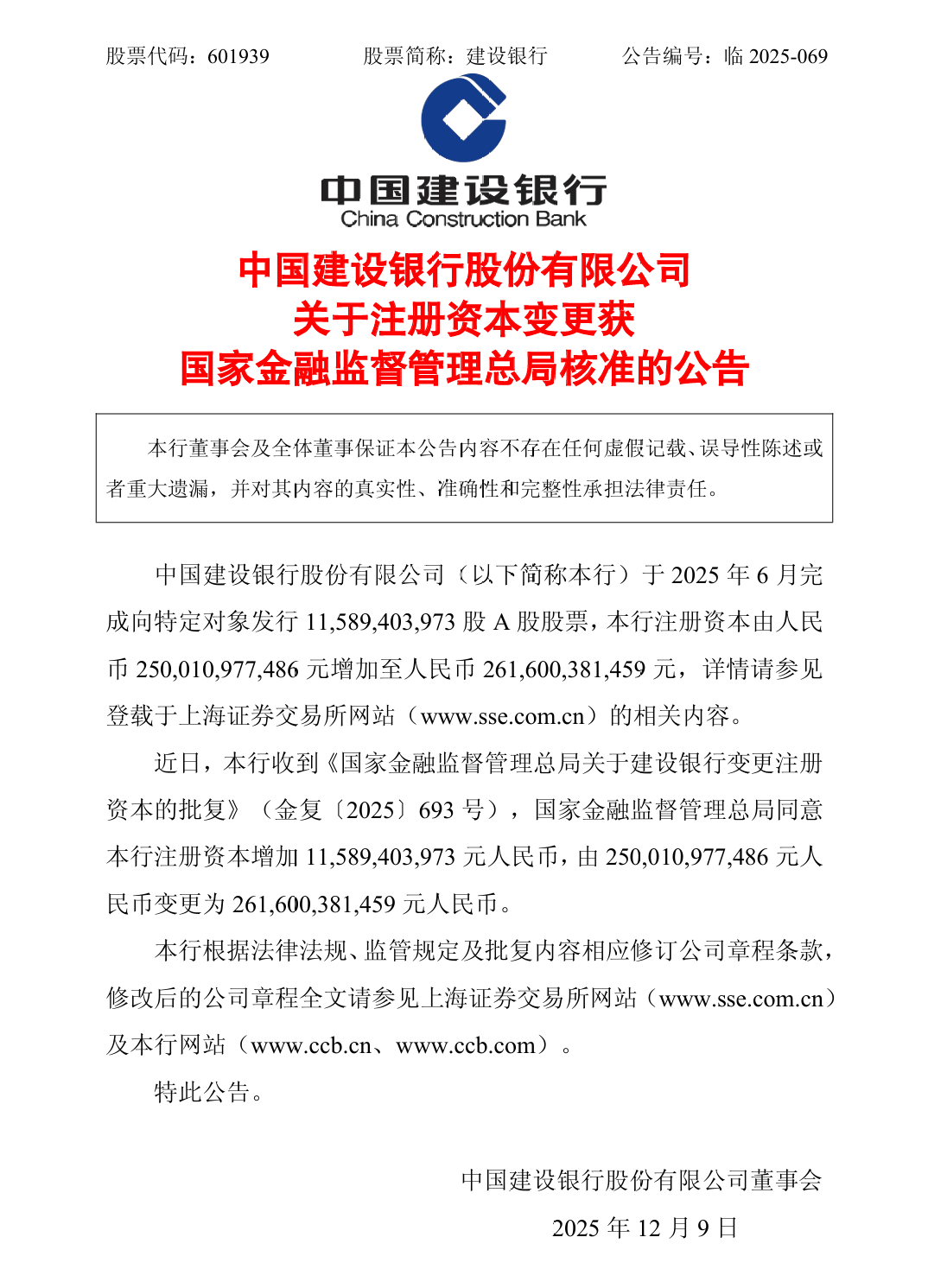
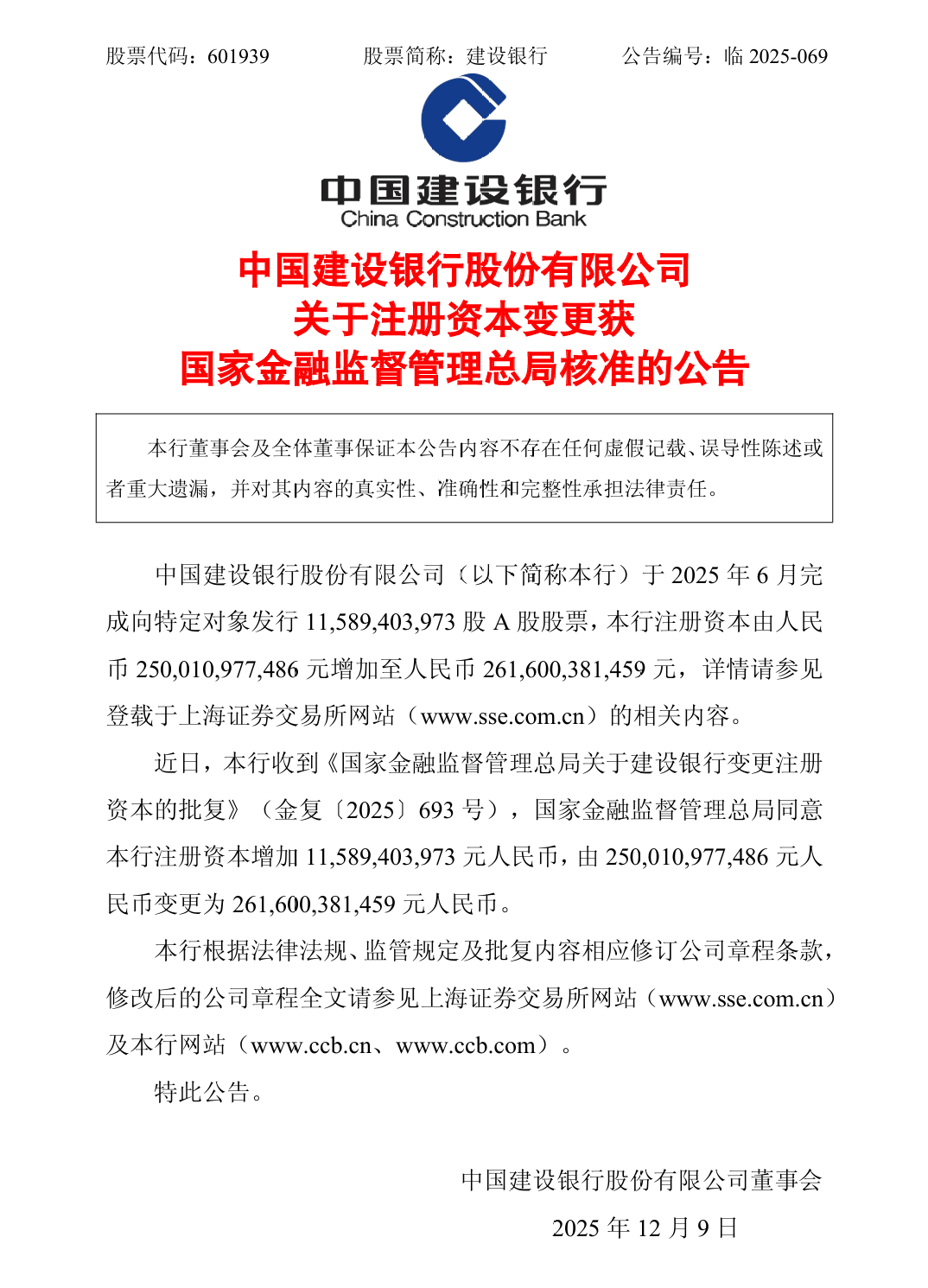
Core Viewpoint - The recent announcements from major state-owned banks regarding capital replenishment reflect a broader trend of capital enhancement among these institutions, with China Construction Bank (CCB) completing a significant issuance of A-shares to increase its registered capital [1][7]. Group 1: Capital Increase Details - China Construction Bank announced on December 9 that it completed the issuance of approximately 11.589 billion A-shares, raising its registered capital from RMB 2500.11 billion to RMB 2616.00 billion [1][4][7]. - The issuance was approved by the National Financial Regulatory Administration, allowing CCB to increase its registered capital by RMB 115.89 billion [4][7]. Group 2: Context of Capital Replenishment - The capital increase is part of a collective effort by major state-owned banks to enhance their capital bases, as highlighted in the government's work report which proposed issuing special government bonds worth RMB 500 billion to support these banks [7][15]. - In March, four major banks, including CCB, announced plans to issue A-shares to raise a total of RMB 4.1 trillion, with CCB aiming to raise up to RMB 1650 billion [7][15]. Group 3: Implications for Capital Adequacy - The capital increase is expected to directly improve the core Tier 1 capital adequacy ratio of CCB and other banks, which is crucial for risk management and supporting the real economy [7][16]. - While the increase in share capital may dilute earnings per share in the short term, it is anticipated to enhance the banks' competitive edge and long-term return expectations for investors [8][16].

中行、建行相继公告!
Jin Rong Shi Bao· 2025-12-10 10:41
近日,国有大行资本补充工作陆续迎来关键进展。 12月9日,建设银行(601939)发布公告称,该行于2025年6月完成向特定对象发行约115.89亿股A股股票,该行注册资本由人民币2500.11亿元增加至人 民币2616.00亿元。 公告显示,近日该行收到国家金融监督管理总局行政批复,同意该行注册资本增加115.89亿元人民币,由2500.11亿元增加至人民币2616.00亿元。 股票代码:601939 公告编号:临 2025-069 山国 长 前 : China Construction Bank 中国建设银行股份有限公司 关于注册资本变更获 国家金融监督管理总局核准的公告 本行董事会及全体董事保证本公告内容不存在任何虚假记载、误导性陈述或 者重大遗漏,并对其内容的真实性、准确性和完整性承担法律责任。 中国建设银行股份有限公司(以下简称本行)于2025年6月完 成向特定对象发行 11.589.403.973 股 A 股股票,本行注册资本由人民 币 250.010.977.486 元增加至人民币 261.600.381.459 元,详情请参见 登载于上海证券交易所网站(www.sse.com.cn)的相关内容 ...
银行行业2026年年度策略报告-20251210
Ping An Securities· 2025-12-10 10:38
Group 1 - The banking industry in 2026 will face a mixed external environment with strong macroeconomic resilience but insufficient effective demand, leading to continued moderate monetary policy and challenges in asset allocation due to a low interest rate environment [4][10] - The "14th Five-Year Plan" emphasizes the construction of a financial powerhouse, urging banks to leverage their resource endowments and deepen their strategic initiatives over the next five years [4][10][22] - The overall financial performance of listed banks is expected to improve in 2026, driven by the recovery of net interest income and non-interest income, with a projected net profit growth of 2.4% year-on-year [4][27] Group 2 - The net interest margin is expected to narrow by 6 basis points in 2026, with net interest income growth projected to rise to 4% compared to 0.3% in 2025 [4][27] - Non-interest income is anticipated to continue improving due to the recovery of wealth management opportunities and the fading impact of fee reductions from previous years [4][27] - The overall asset quality of the banking sector is expected to remain stable, with a focus on monitoring risks in the retail sector [4][27] Group 3 - The investment strategy emphasizes high dividend yields as a protective measure, with the banking sector's average dividend yield at 3.94%, providing a significant premium over ten-year government bonds [4][27] - Specific banks such as Chengdu Bank, Jiangsu Bank, and Shanghai Bank are highlighted for their strong regional advantages and potential for continued dividend growth [4][27][34] - The report suggests that the active capital market will provide a potential boost to quality retail banks, enhancing their recovery prospects [4][27]





白金信用卡权益大缩水:贵宾厅限次、酒店减量银行吐槽没赚头,“羊毛党”薅了个寂寞
Mei Ri Jing Ji Xin Wen· 2025-12-10 10:12
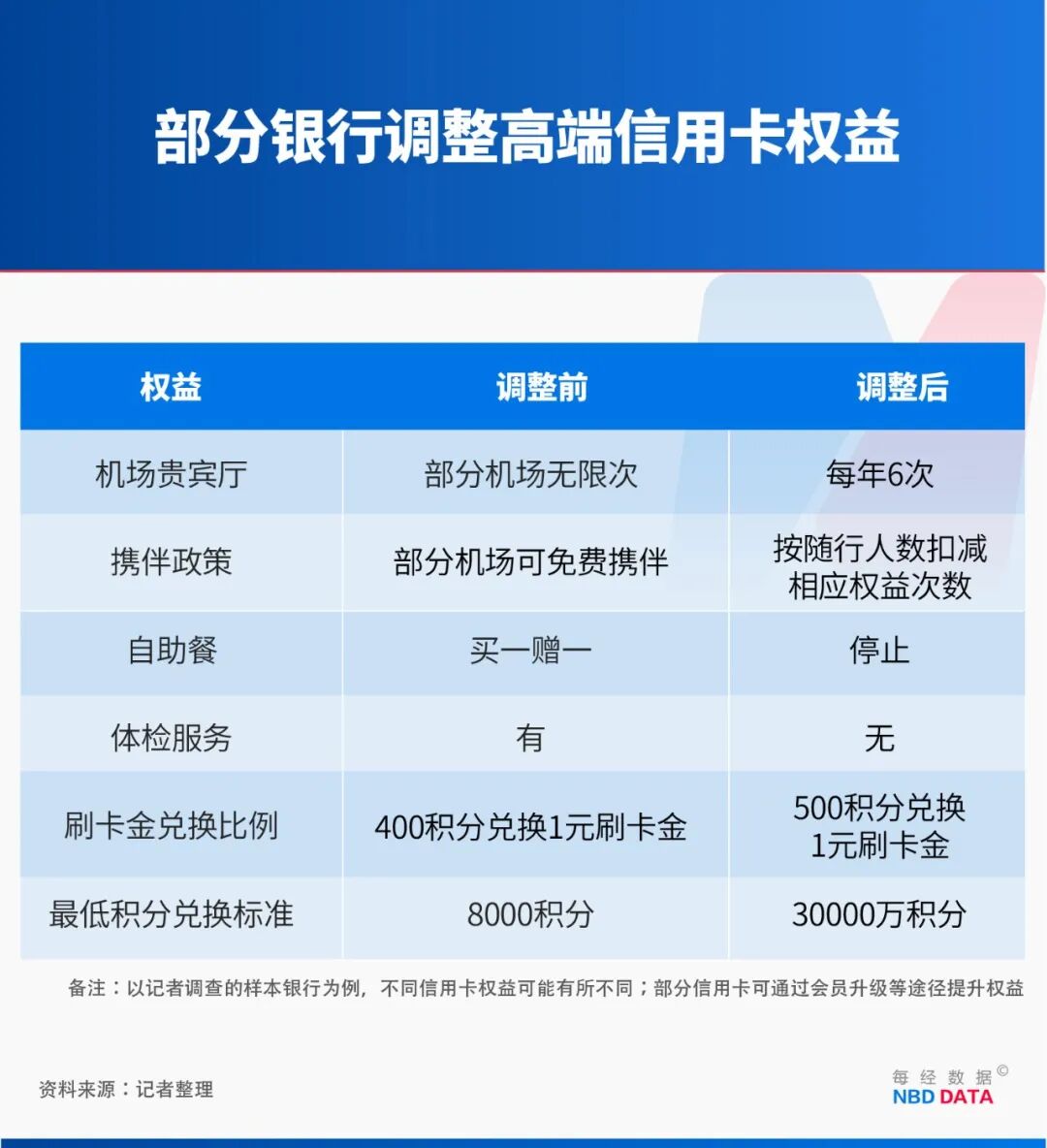
Core Viewpoint - The high-end credit card benefits are being significantly reduced by multiple banks, leading to a shift in the value proposition of these cards as banks struggle with profitability in this segment [2][5][7]. Group 1: Changes in High-End Card Benefits - Many banks are announcing reductions in high-end card benefits for the upcoming year, including limiting access to airport lounges and increasing the thresholds for redeeming points [2][5]. - Specific changes include limiting airport lounge access from unlimited visits to a maximum of six per year and increasing the points required for cash redemption from 400 to 500 points per dollar [6][5]. - The overall trend indicates a significant contraction in benefits, with services like health check-ups being completely removed [5][6]. Group 2: Profitability Challenges - High-end credit cards are not profitable for banks due to high costs associated with benefits and low commission rates from merchants, which average around 0.3% [7][9]. - The cost of providing services such as airport transfers can range from 200 to 300 yuan, while the revenue generated from card usage is minimal if customers do not carry a balance [8][7]. - The presence of "arbitrageurs" exploiting card benefits further erodes profitability, prompting banks to tighten rules and reduce benefits [10][7]. Group 3: Strategic Focus on High-End Cards - Despite the lack of profitability, banks continue to invest in high-end credit cards as a strategy to attract and retain high-value customers, linking these cards to broader wealth management services [11][14]. - High-end cards serve as a "hook" to deepen relationships with customers, enhancing loyalty and engagement across various banking services [15][14]. - The focus is shifting from acquiring new customers to maintaining existing high-quality clients, with banks aiming to create distinctive offerings in niche markets [19][18].

资本充足水平大幅下滑,长安银行增资26.11亿股获批
Xin Lang Cai Jing· 2025-12-10 10:11
Group 1 - The core point of the article is that Chang'an Bank is facing a decline in its capital adequacy ratio and has received approval for a capital increase to address this issue [2][11] - The bank plans to raise no more than 2.611 billion shares, with all funds raised designated for supplementing core Tier 1 capital [3][12] - As of the third quarter, Chang'an Bank's core Tier 1 capital adequacy ratio is 8.23%, down 0.92 percentage points from the end of the previous year, which is below the industry average [4][13] Group 2 - Chang'an Bank was established on July 29, 2009, and has undergone multiple capital increases, raising its registered capital from 3 billion to 7.577 billion yuan [3][12] - The bank's major shareholders include Shaanxi Yanchang Group (19.04%), Shaanxi Coal and Chemical Industry Group (18.71%), and Shaanxi Nonferrous Metals Group (11.22%) [3][12] - The bank's capital adequacy ratios as of the third quarter are 8.23% for core Tier 1, 9.62% for Tier 1, and 11.66% for total capital, all showing a downward trend compared to the previous year [4][13] Group 3 - The decline in capital adequacy is attributed to rapid loan growth and a slight increase in non-performing loans, which have put pressure on capital consumption [5][14] - Loan growth rates for the years 2022, 2023, and 2024 are 15.51%, 14.09%, and 9.58% respectively, with non-performing loans growing at a faster rate than normal loans [5][14] - The non-performing loan ratios for the same years are 1.82%, 1.81%, and 1.85%, indicating a rising trend in asset quality issues [5][14] Group 4 - The bank's provision coverage ratio has also decreased, with figures of 182.30%, 191.15%, and 173.44% for the years 2022 to 2024 [6][14] - To mitigate the impact of non-performing loans on capital, Chang'an Bank plans to recover and dispose of 5.528 billion yuan in non-performing assets in 2024 [6][15] - The bank's revenue for 2024 is projected to be 9.461 billion yuan, a decrease of 3.26%, with net profit expected to be 2.315 billion yuan, down 5.29% [7][16] Group 5 - Despite the challenges, Chang'an Bank's operating income for the third quarter has shown an increase of 18.08% year-on-year, reaching 7.643 billion yuan, with net profit up 6.11% to 1.882 billion yuan [8][17] - The bank's net interest income for 2024 is expected to be 9.017 billion yuan, a decrease of 2.48%, while fee and commission income has been negative since 2019, with a projected loss of 601 million yuan in 2024 [7][17]

白金信用卡权益大缩水:贵宾厅限次、酒店减量⋯⋯银行吐槽没赚头,“羊毛党”薅了个寂寞
3 6 Ke· 2025-12-10 09:50
Core Viewpoint - The high-end credit card benefits are being significantly reduced by multiple banks, leading to a decline in the perceived value of these cards, as banks struggle with profitability in this segment [1][5][7]. Group 1: Benefit Reductions - Many banks are cutting back on high-cost benefits such as unlimited airport lounge access, reducing it to a maximum of six visits per year [5][6]. - The redemption thresholds for rewards points are being raised, with some banks changing the conversion rate from 400 points to 500 points for one unit of cash back [5][6]. - Additional benefits like complimentary dining and health check services are being eliminated entirely [5][6]. Group 2: Profitability Challenges - High-end credit cards are not profitable for banks due to high costs associated with benefits and low interchange fees, which average around 0.3% in China [7][8]. - The typical high-end cardholder often uses the card solely for payments without generating interest income for the bank, further complicating profitability [7][8]. - The presence of "arbitrageurs" exploiting card benefits has led to increased costs for banks, prompting them to tighten rules around benefit usage [9]. Group 3: Strategic Shifts - Banks are shifting focus from expanding customer bases to managing existing high-value clients, emphasizing a strategy of resource allocation towards wealth management and private banking [10][13]. - High-end credit cards are viewed as tools for identifying valuable customers and enhancing overall profitability through cross-selling opportunities in other financial services [10][13]. - The credit card industry is transitioning into a phase of maintaining existing customers rather than aggressively acquiring new ones, as the market becomes saturated [19][20].