欣旺达

Search documents
新能源产业重塑:中国500强比亚迪首超上汽,宁德时代排名下滑
Bei Ke Cai Jing· 2025-09-16 04:22
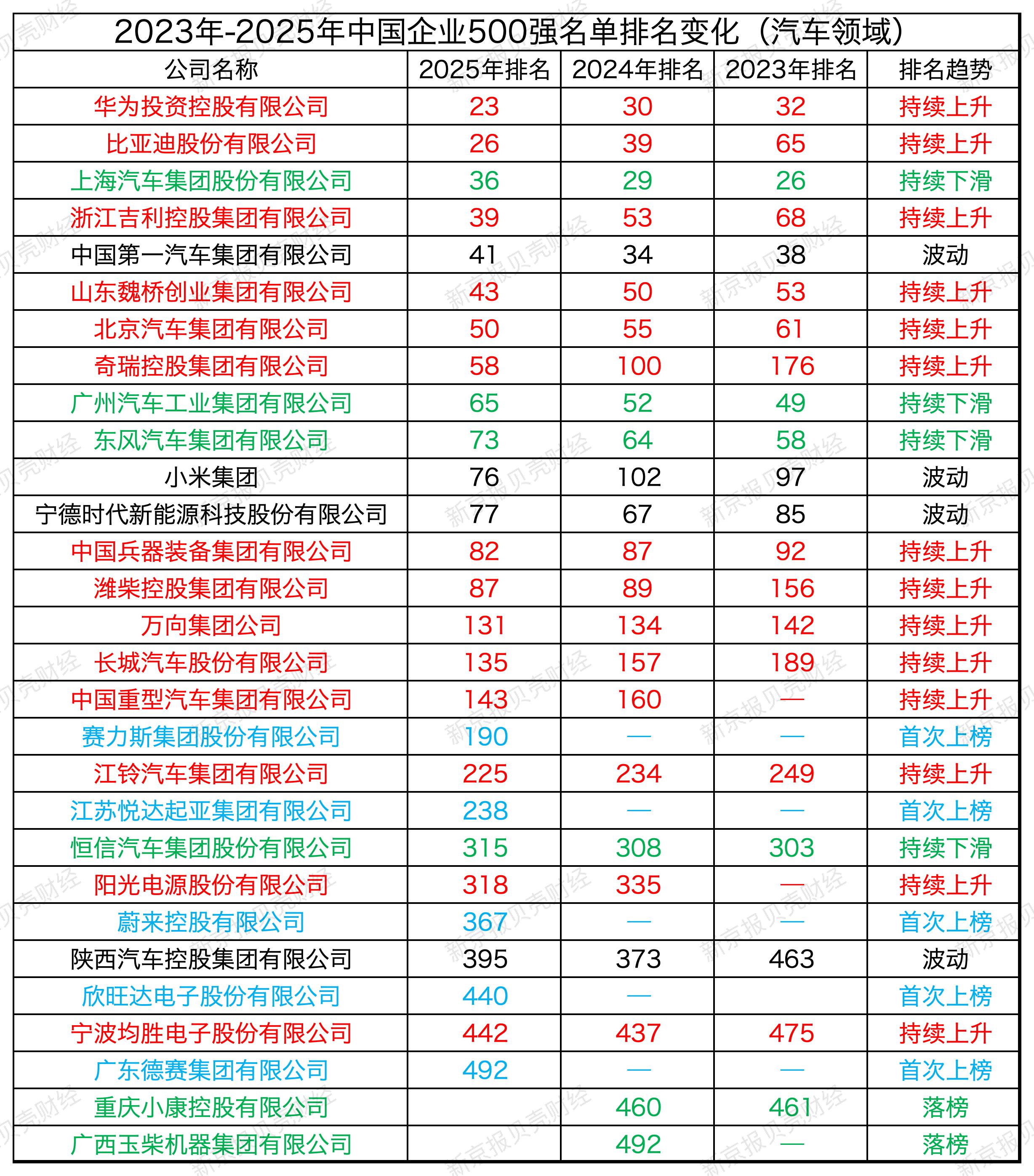
Core Insights - BYD has emerged as the top automotive company in China, ranking 26th overall in the "2025 China Top 500 Enterprises List" with a revenue of 777.1 billion yuan, surpassing SAIC for the first time [1][6] - The rankings reflect a significant shift towards new energy and intelligent transformation within the automotive industry, with traditional automakers experiencing declines [1][9] - Chery Holdings made a remarkable leap from 176th in 2023 to 58th in 2025, showcasing the impact of technological advancements and overseas market expansion [1][11][12] Automotive Industry Rankings - BYD's revenue growth allowed it to rise from 65th in 2023 to 26th in 2025, overtaking FAW and SAIC [6] - SAIC's ranking has consistently declined, dropping from 26th in 2023 to 36th in 2025, indicating a loss of competitive edge [7] - FAW also fell from 34th in 2024 to 41st in 2025, while Geely rose from 68th in 2023 to 39th in 2025, replacing FAW in the top three [8] New Energy Vehicle Sector - The rise of new energy vehicles (NEVs) is reshaping the automotive landscape, with companies like Seres and NIO making their debut on the list [9][14] - Seres ranked 190th and NIO ranked 367th, both representing the new wave of intelligent automotive companies [14] - The shift in value from traditional components to batteries and intelligent systems is evident, with over 60% of value in NEVs coming from these areas [9][10] Chery's Performance - Chery's significant rise is attributed to its accelerated transition to new energy and successful overseas market penetration, with NEV sales increasing from 17% in 2023 to 35% in 2024 [12] - Chery became the top exporter in 2024, with 1.145 million units exported, a 21.4% increase year-on-year [13] Industry Trends - The automotive supply chain is undergoing rapid restructuring, with battery manufacturers like CATL experiencing a decline in ranking, now at 77th overall [19] - New entrants in the battery sector, such as Xinwangda Electronics, made their first appearance on the list at 440th, reflecting the fast expansion of the power battery market [20] - The overall trend indicates a reduction in traditional automakers on the list, while core component manufacturers in electric driving and intelligent systems are rising [22][23] Market Dynamics - The Chinese automotive market is entering a phase of deep integration, with several brands exiting the market, leading to increased concentration [24] - Despite the growth of large enterprises, there is a call for improvement in international competitiveness and the establishment of world-class companies [24]



二线动力电池厂对比(财务数据)
数说新能源· 2025-09-16 03:35
Core Viewpoint - The article analyzes the financial performance of three companies in the lithium battery industry: EVE Energy, Guoxuan High-Tech, and Sunwoda, highlighting their revenue similarities but significant differences in net profit due to variations in profitability, cost control, business structure, and asset efficiency [1]. Group 1: Revenue and Profit Comparison - EVE Energy reported a revenue of 486.15 billion CNY, a slight decrease of 0.35%, with a net profit of 40.76 billion CNY, down 0.63% [1]. - Guoxuan High-Tech achieved a revenue of 353.92 billion CNY, an increase of 11.98%, but its net profit fell by 28.56% to 12.07 billion CNY [1]. - Sunwoda had the highest revenue at 560.21 billion CNY, up 17.05%, but its net profit decreased by 36.43% to 14.68 billion CNY [1]. Group 2: Gross Margin and Product Structure - EVE Energy excels in high-margin businesses, focusing on large cylindrical batteries and energy storage cells, with a gross margin of 28.87% for energy storage systems, up 7.55 percentage points year-on-year [2]. - Guoxuan High-Tech's business structure is dominated by power batteries (73% of revenue), with energy storage growing but starting from a low base, resulting in a gross margin of only 23.87% [3]. - Sunwoda's consumer battery segment, which constitutes 54% of its revenue, suffers from low margins (10%-15%) due to intense competition, while its power battery segment has not yet realized profitability [4]. Group 3: R&D and Management Efficiency - EVE Energy invests approximately 35 billion CNY in R&D, accounting for 7.2% of its revenue, with a high average salary for R&D staff, leading to efficient conversion of research outcomes into high-margin products [5]. - Guoxuan High-Tech faces increased management costs due to overseas expansion, with a 25% rise in management expenses and a financial cost rate of 3.5%, impacting profitability [5]. - Sunwoda's R&D spending exceeds 40 billion CNY (7.1% of revenue), but its dispersed business model dilutes R&D effectiveness, resulting in a lack of competitive advantage [5]. Group 4: Scale Effect and Per Capita Efficiency - EVE Energy achieves a per capita profit of 140,000 CNY, significantly higher than Guoxuan High-Tech's 46,000 CNY and Sunwoda's 27,000 CNY, due to efficient production and lower costs [6]. - EVE Energy's effective production capacity is 100 GWh with a utilization rate of 70%, while Guoxuan High-Tech has 60 GWh (55% utilization) and Sunwoda 50 GWh (50% utilization), highlighting the impact of scale on fixed cost distribution [6]. - The differences in net profit among the companies are primarily driven by high-margin business focus, cost control, and asset efficiency [6].




创业板新能源ETF(159261)红盘向上,奔驰EQS固态测试车跑出1205公里续航
Xin Lang Cai Jing· 2025-09-16 02:48
Group 1 - The core viewpoint highlights the mixed performance of the ChiNext New Energy Index, with notable gains from companies like Zhenyu Technology and Feirongda, while Jinli Permanent Magnet led the declines [1] - The ChiNext New Energy ETF has shown a slight increase of 0.14%, with the latest price at 1.45 yuan, indicating a stable market interest in new energy stocks [1] - The recent milestone of the Mercedes EQS solid-state test vehicle achieving a range of 1205 kilometers signifies significant advancements in the global new energy vehicle industry, with China's Ministry of Industry and Information Technology approaching a project review deadline [1] Group 2 - As of August 29, 2025, the top ten weighted stocks in the ChiNext New Energy Index account for 64.15% of the index, with companies like CATL and Sungrow leading the list [2] - The ChiNext New Energy ETF closely tracks the performance of the ChiNext New Energy Index, reflecting the operational characteristics of listed companies in the new energy sector on the Shenzhen Stock Exchange [2]




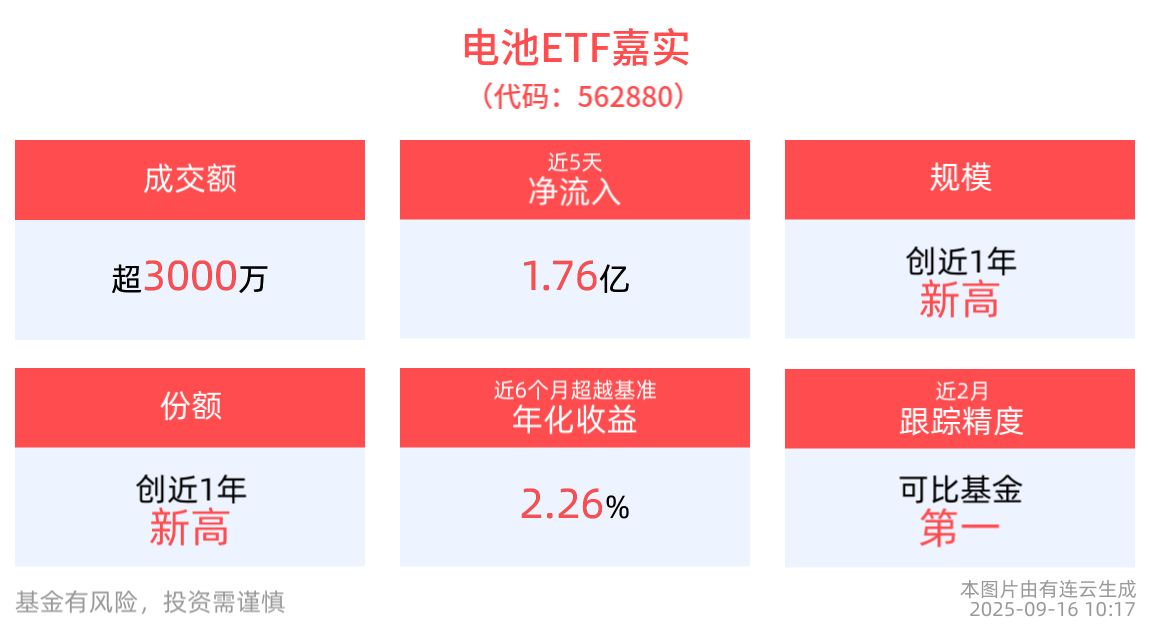
近5日累计“吸金”1.76亿元,电池ETF嘉实(562880)规模、份额均创成立以来新高!
Xin Lang Cai Jing· 2025-09-16 02:39
Group 1 - The battery ETF, 嘉实, has seen a turnover of 3.08% with a transaction volume of 37.53 million yuan, and an average daily transaction of 141 million yuan over the past week as of September 15 [2] - The latest scale of the battery ETF, 嘉实, reached 1.216 billion yuan, marking a new high since its establishment, with a total of 1.599 billion shares, also a record high [2] - The net inflow of funds into the battery ETF, 嘉实, was 30.22 million yuan, with a total of 176 million yuan net inflow over the last five trading days [2] - The net value of the battery ETF, 嘉实, has increased by 89.58% over the past year, with the highest monthly return since inception being 31.11% and an average monthly return of 8.13% [2] Group 2 - Solid-state batteries can achieve an energy density of 500 Wh/kg, significantly enhancing range and addressing safety issues associated with traditional lithium batteries [2] - Major domestic manufacturers, including BYD and CATL, have announced mass production timelines, indicating a shift from technology validation to large-scale application [2] - According to GGII and the China Business Industry Research Institute, the shipment volume of solid-state batteries in China is expected to reach an inflection point by 2027, with a compound annual growth rate of 44% from 2024 to 2028 [2] Group 3 - CITIC Securities is optimistic about the allocation value of core battery assets in China, anticipating that battery prices will stabilize in Q2 2025 due to improved supply and demand [3] - The performance of the battery sector is expected to exceed expectations, driven by the electrification of commercial vehicles, AI data centers, and overseas markets [3] - The top ten weighted stocks in the China Battery Theme Index account for 53.03%, with significant players including 阳光电源, 宁德时代, and 三花智控 [3][5] Group 4 - Investors without stock accounts can access battery industry investment opportunities through the battery ETF 嘉实 linked fund (016567) [6]
宁德时代钠新电池通过新国标认证 A股盈利居前钠离子电池概念股一览
Xin Lang Cai Jing· 2025-09-15 23:56
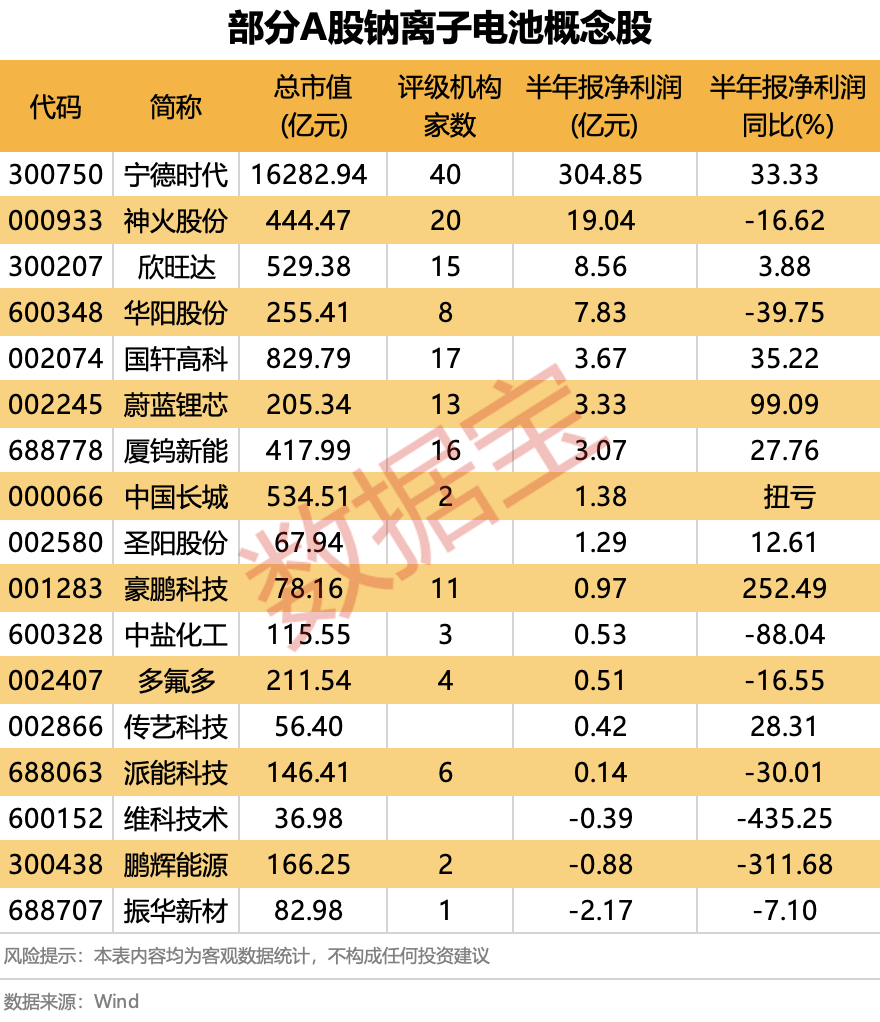
Group 1 - The core point of the article is that CATL has successfully certified its sodium-ion battery under new national standards, making it the first in the world to achieve this certification [1] - The sodium-ion battery is currently being developed and implemented for passenger vehicles, with progress reported as smooth [1] - The certification allows the sodium-ion battery to enter both domestic and international markets for energy storage and low-speed electric vehicles, addressing previous limitations due to the lack of national standards [1] Group 2 - There are 17 stocks in the A-share market related to sodium-ion battery concepts, primarily consisting of small and mid-cap stocks [1] - Among these, CATL has a total market capitalization of 1.63 trillion yuan, while only three other companies exceed 50 billion yuan in market capitalization: Guoxuan High-Tech, Great Wall Motors, and Xinwangda [1] - In the first half of the year, nine sodium-ion battery concept stocks reported profits exceeding 100 million yuan, with CATL leading at 30.485 billion yuan, followed by Shenhuo Co., Xinwangda, and Huayang Co. [1]
全球首款,新国标认证!300750,曝出大利好
Zheng Quan Shi Bao· 2025-09-15 23:55
Core Insights - CATL's sodium-ion battery has received certification under new national standards, marking it as the first sodium-ion battery globally to achieve this certification [1] - The sodium-ion battery has a lower energy density compared to lithium-ion batteries but offers advantages in low-temperature performance, carbon footprint, and safety [1] - The battery's energy density is 175Wh/kg, with a cycle life exceeding 3000 cycles and a discharge efficiency of over 85% at -20°C [1] - The certification allows the sodium-ion battery to enter domestic and international energy storage and low-speed electric vehicle markets, addressing previous application limitations due to the lack of standards [1] - The Chinese sodium-ion battery market is projected to see significant growth, with shipments expected to exceed 1.5GWh in 2024 and 7GWh in 2025, reaching over 200GWh by 2030 [2] Company Developments - CATL is actively developing its sodium-ion battery for passenger vehicles, with progress reported as smooth [1] - Other companies in the sodium-ion battery sector include Guoxuan High-Tech, which has established a research center with Fudan University focusing on sodium-ion battery technology [3] - Xinwanda has launched ultra-low temperature sodium-ion batteries that meet the needs of various electric vehicle applications [3] Financial Performance - In the first half of 2025, CATL reported a net profit of 30.485 billion yuan, reflecting a 33.33% year-on-year increase [6] - Shenhuo Co. achieved revenue of 20.428 billion yuan, a 12.12% increase, but its net profit decreased by 16.62% due to falling coal sales [4] - Other notable companies include Haopeng Technology, which saw a net profit increase of 252.49%, and Guoxuan High-Tech, with a net profit growth exceeding 30% [4]
全球首款!宁德时代钠新电池通过新国标认证!概念股名单曝光
Zheng Quan Shi Bao Wang· 2025-09-15 23:44
宁德时代钠新电池通过新国标认证。 9月15日晚间,宁德时代(300750)在投资者互动平台表示,钠离子电池能量密度比锂离子电池略低,但低温性能、碳足迹、安 全性能均更有优势,相关优势有助推动电池产业有效降低对锂资源的依赖。 公司于4月发布钠新电池,钠新乘用车动力电池拥有优异的低温能量保持率与安全表现,9月初公司钠新电池已通过新国标认 证,成为全球首款通过新国标认证的钠离子电池。目前,公司钠新乘用车动力电池正在与客户推进开发、落地中,进展顺 利。 据悉,宁德时代钠新电池能量密度达175Wh/kg,循环寿命超3000次,低温-20℃放电效率保持85%以上。太平洋证券指出,该 电池通过认证后可合规进入国内外储能及低速电动车市场,解决钠电池此前因无国标导致的应用受限问题,加速钠离子电池 产业化落地。 近年来,钠离子电池受到政策方面的大力支持。2025年2月,工信部、发展改革委等八部门联合印发《新型储能制造业高质量 发展行动方案》,其中明确"推动大规模钠电池储能系统集成及应用技术攻关,服务新型电力系统建设"。 豪鹏科技2025年上半年实现营收27.63亿元,同比增长19.29%;归母净利润0.97亿元,同比增长252. ...
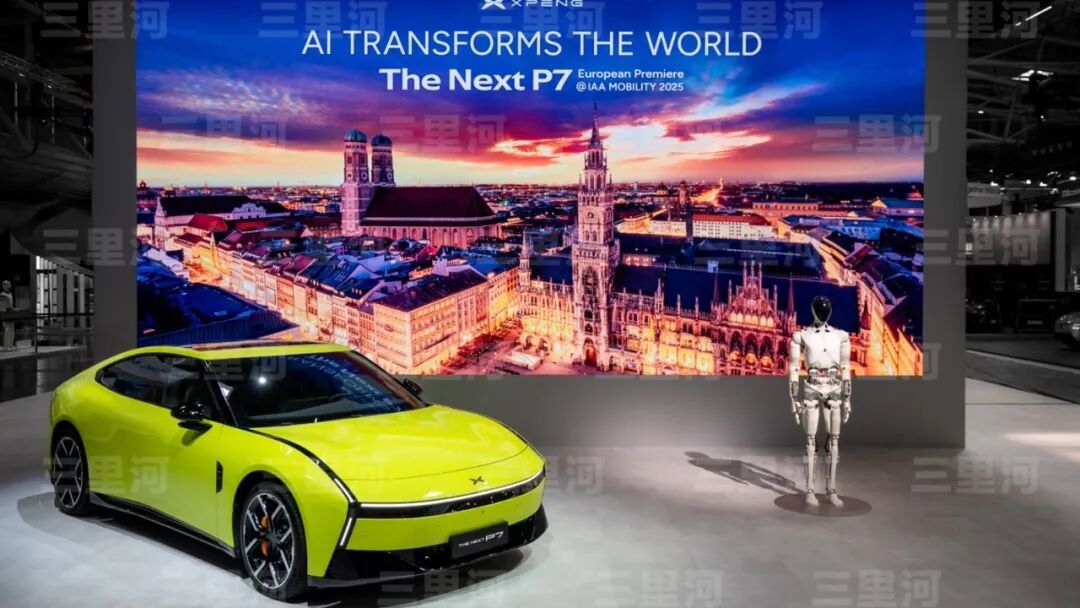
加速出海、深耕本地,中国车企在欧洲打开新局
Zhong Guo Xin Wen Wang· 2025-09-15 14:59
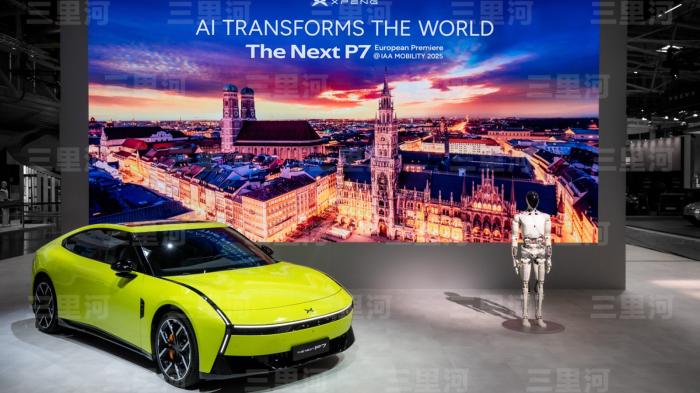
Core Insights - Chinese electric vehicles are making significant inroads into the European market, particularly highlighted at the Munich Auto Show, where they showcased advanced models and technologies [1][3][4] Group 1: Market Presence - At the Munich Auto Show, China had the largest number of exhibitors among foreign participants, accounting for nearly one-third of the total, indicating a strong presence in the European automotive market [3] - Major Chinese automakers like Xpeng, GAC, and BYD are launching new models specifically designed for the European market, showcasing their commitment to local adaptation [1][4] Group 2: Strategic Shifts - Chinese automakers are shifting from a "domestic production + vehicle export" strategy to a more localized approach, emphasizing "in Europe, for Europe" to better integrate into the European market [4] - The focus is now on technological innovation rather than just competitive pricing, with Chinese companies emerging as technology leaders and standard-setters in the electric vehicle sector [5] Group 3: Investment Trends - According to a report by the Rhodium Group, in 2024, Chinese investments in the overseas electric vehicle sector are projected to reach $16 billion, surpassing domestic investments for the first time [6] - The battery sector is a significant focus, accounting for 74% of the total overseas investment in the Chinese electric vehicle industry, with companies like CATL leading the charge [6] Group 4: Export Growth - From January to August this year, China exported 4.292 million vehicles, a year-on-year increase of 13.7%, with electric vehicle exports reaching 1.532 million, up 87.3% [6] - The overseas expansion is expected to yield higher returns and strategic value for Chinese companies, marking a shift in the global automotive landscape [6][7]
龙蟠科技与宁德时代签署采购协议 合同总销售额超60亿元
Zheng Quan Shi Bao Wang· 2025-09-15 14:21
Group 1 - The core viewpoint of the news is that Longpan Technology has signed a procurement cooperation agreement with CATL for lithium iron phosphate cathode materials, with a total sales amount exceeding 6 billion yuan [1] - The agreement is expected to result in the sale of 157,500 tons of lithium iron phosphate cathode materials from Q2 2026 to 2031, helping the company establish long-term stable relationships with downstream partners and seize overseas market opportunities [1] - The agreement is described as a non-binding intention agreement, with demand forecasts subject to adjustments based on CATL's overseas project progress [1] Group 2 - The market demand for cathode materials is rapidly growing, with a projected 68% year-on-year increase in lithium battery shipments in China for the first half of 2025, reaching 776 GWh [2] - Longpan Technology plans to raise up to 2 billion yuan through a private placement to fund projects for high-performance phosphate cathode materials, enhancing its production capacity and market responsiveness [2] - The company aims to build production lines for fourth-generation high-energy-density lithium iron phosphate cathode materials, while also accommodating various high-performance phosphate cathode materials [2] Group 3 - In the first half of the year, Longpan Technology reported revenue of 3.622 billion yuan, a year-on-year increase of 1.49%, but incurred a net loss of 85 million yuan, a reduction of 61.70% compared to the previous year [3] - The company attributed the losses to a significant decline in lithium iron phosphate prices and inventory impairment losses, but managed to narrow the loss through cost reduction and efficiency improvement strategies [3] - The overall lithium battery industry is still at the bottom of the cycle, impacting the performance of leading companies [3]

中德车企慕尼黑对弈
Zhong Guo Xin Wen Wang· 2025-09-15 13:28
Core Insights - Chinese electric vehicles (EVs) are making significant inroads into the European market, particularly highlighted at the Munich Auto Show where they became the focal point [1][2][4] Group 1: Market Presence - At the Munich Auto Show, Chinese brands like Xpeng, GAC, and BYD showcased new models and announced production plans in Europe, indicating a strong commitment to the market [2][4] - China had the largest number of exhibitors after Germany, accounting for nearly one-third of foreign participants, showcasing a systematic approach to entering the European market [4] Group 2: Strategic Shifts - Chinese automakers are shifting from a "domestic production + vehicle export" model to a localized strategy, emphasizing "in Europe, for Europe" to better integrate into the European market [6][7] - This shift mirrors the earlier strategies of German automakers in China, indicating a role reversal in the global automotive landscape [7] Group 3: Technological Advancements - Chinese companies are transitioning from competing on price to focusing on technology, with significant innovations in battery and smart driving technologies [8][9] - Many foreign exhibits at the Munich Auto Show utilized Chinese technology, highlighting China's emerging role as a technology exporter and standard setter in the automotive industry [10] Group 4: Investment Trends - A report from Rhodium Group indicates that in 2024, China's overseas investment in the EV sector is projected to reach $16 billion, surpassing domestic investments for the first time [12] - The growth in overseas investment is reflected in the establishment of factories globally by Chinese automakers, such as Chery in Spain and Great Wall in Brazil [13] - Battery manufacturers are leading the charge in overseas investments, accounting for 74% of the total, driven by companies like CATL and others expanding their global footprint [13] Group 5: Challenges and Future Outlook - Despite the progress, challenges remain in local adaptation, compliance management, and operational efficiency as Chinese companies navigate deeper into international markets [14] - The structural transformation driven by technology, capital, and branding is redefining the competitive landscape of the global automotive industry [14]