易方达基金

Search documents
聚焦绿色创新发展 上交所召开绿色及ESG债券座谈调研会
Shang Hai Zheng Quan Bao· 2025-11-27 11:53
Core Viewpoint - The Shanghai Stock Exchange (SSE) is actively promoting the development of green and ESG bonds to enhance the bond market's service for green development and the transformation of the real economy [1][2]. Group 1: Market Development and Achievements - As of October 2025, the cumulative issuance of green bonds (including ABS) on the SSE has approached 900 billion yuan, with low-carbon transition bonds exceeding 80 billion yuan since their introduction in 2022 [2]. - The market structure of green and low-carbon transition bonds is characterized by a diversified maturity profile, primarily mid-term, with issuers spanning key industries such as industrial, public utilities, and finance, including large state-owned enterprises, local state-owned enterprises, and private companies [2]. - The funds raised are directed towards the green transformation of the real economy, aligning closely with the national "dual carbon" strategy and green development goals [2]. Group 2: Financing Mechanisms and Innovations - The SSE has facilitated smoother low-carbon financing for enterprises through innovative market mechanisms, with companies like COSCO Shipping issuing 1 billion yuan in 15-year low-carbon transition bonds at a rate of 2.18% [3]. - Green bonds allow for the replacement of self-funded expenditures on green projects incurred in the previous 12 months, providing greater autonomy in choosing issuance timing and reducing financing costs [3]. - The SSE has lowered the threshold for green bonds to be included in benchmark market-making securities, enhancing liquidity and pricing efficiency in the secondary market [4]. Group 3: Future Directions and Recommendations - Participants at the symposium emphasized the importance of enhancing the flexibility of fund usage and management, as well as optimizing incentive policies to expand the depth and breadth of the green bond market [5]. - Investment institutions called for a richer supply of green bonds to broaden investment choices, with expectations for more enterprises to issue green bonds on the SSE [6]. - Experts suggested introducing more diversified institutions in the investment sector and expanding bond innovations in areas such as biodiversity, climate adaptation, and carbon benefits to promote the development of the green finance system [6][7].
近9000亿元,上交所最新发声
Zheng Quan Shi Bao· 2025-11-27 11:03
Core Viewpoint - The Shanghai Stock Exchange (SSE) is actively promoting the development of the green and ESG bond market to support the green transformation of real enterprises and enhance the effectiveness of financing for the real economy [1][3]. Group 1: Market Development and Achievements - As of October 2025, the cumulative issuance scale of green bonds (including ABS) on the SSE has approached 900 billion yuan, with low-carbon transition bonds exceeding 80 billion yuan since their launch in 2022 [1]. - The market structure of SSE's green and low-carbon transition bonds features a diversified maturity profile, primarily mid-term, with issuers spanning key industries such as industrial, public utilities, and finance, including large state-owned enterprises, local state-owned enterprises, and private companies [1][3]. Group 2: Financing Mechanisms and Benefits - The SSE's green bonds provide a convenient financing mechanism that aligns well with companies' financing needs, as demonstrated by China Merchants Energy's successful issuance of a 1 billion yuan, 15-year low-carbon transition bond at a 2.18% interest rate [3]. - The ability to replace self-funded expenditures on green projects with raised funds enhances the flexibility of fund usage and reduces financing costs [3]. Group 3: Secondary Market Innovations - The SSE is continuously innovating mechanisms to support green bond issuance, including lowering the threshold for green bonds to be included as benchmark market-making securities, which improves liquidity and pricing efficiency in the secondary market [4]. - The introduction of a science and technology innovation bond ETF has effectively reduced financing costs and could further stimulate market activity if similar products are launched in the green bond market [4]. Group 4: Future Directions and Recommendations - Participants at the symposium emphasized the importance of enhancing the flexibility of fund management and optimizing incentive policies to expand the depth and breadth of the green bond market [6]. - Investment institutions called for a richer supply of green bonds to broaden investment choices, with expectations for more enterprises to issue green bonds on the SSE [7]. - The SSE plans to continue advancing the green and ESG bond market under the guidance of the China Securities Regulatory Commission, aiming to provide stronger financing support for the green transformation of real enterprises and better serve national strategic goals and high-quality economic development [6][7].

近9000亿元!上交所最新发声
证券时报· 2025-11-27 10:18
Core Viewpoint - The Shanghai Stock Exchange (SSE) is actively promoting the development of the green and ESG bond market to support the green transformation of real enterprises and enhance the effectiveness of financing for the real economy [1][3]. Group 1: Market Development and Achievements - As of October 2025, the cumulative issuance scale of green bonds (including ABS) on the SSE has approached 900 billion yuan, with low-carbon transition bonds exceeding 80 billion yuan since their launch in 2022 [1]. - The market structure of SSE's green and low-carbon transition bonds is characterized by a diversified maturity profile, primarily mid-term, with issuers spanning key industries such as industrial, public utilities, and finance [1][4]. Group 2: Financing Mechanisms and Benefits - The financing mechanisms for green bonds and low-carbon transition bonds on the SSE are considered convenient, effectively meeting companies' financing needs in related fields [3]. - The SSE allows funds raised from green bonds to replace self-funded expenditures on green projects incurred in the previous 12 months, providing greater autonomy in choosing issuance timing and reducing financing costs [3]. Group 3: Secondary Market Innovations - The SSE has lowered the threshold for green bonds to be included as benchmark market-making securities, enhancing liquidity and pricing efficiency in the secondary market [4]. - The introduction of a science and technology innovation bond ETF has effectively reduced financing costs and could further stimulate market activity if similar products are launched in the green bond market [4]. Group 4: Future Directions and Recommendations - Participants at the symposium emphasized the importance of enhancing the flexibility of fund usage and management, as well as optimizing incentive policies to expand the depth and breadth of the green bond market [6]. - There is a call for a richer supply of green bonds to broaden investment choices, with expectations for more enterprises to issue green bonds on the SSE [6]. Group 5: Standards and Training - The understanding and application of green bond standards are becoming focal points, with suggestions for increased industry training and communication to enhance market participants' capabilities [7]. - Future innovations in bonds are encouraged to include areas such as biodiversity, climate adaptation, and carbon benefits to promote the development of the green finance system [7].


上证50指数ETF今日合计成交额24.93亿元,环比增加41.55%
Zheng Quan Shi Bao Wang· 2025-11-27 10:02
Core Insights - The trading volume of the SSE 50 Index ETFs reached 2.493 billion yuan today, an increase of 732 million yuan from the previous trading day, representing a growth rate of 41.55% [1] Trading Volume Summary - The Huaxia SSE 50 ETF (510050) had a trading volume of 2.032 billion yuan today, up by 576 million yuan, with a growth rate of 39.60% compared to the previous day [1] - The E Fund SSE 50 ETF (510100) recorded a trading volume of 422 million yuan, increasing by 167 million yuan, with a growth rate of 65.36% [1] - The E Fund SSE 50 Enhanced Strategy ETF (563090) had a trading volume of 7.024 million yuan, up by 3.179 million yuan, with a growth rate of 82.68% [1] - The Bosera SSE 50 ETF (510710) and Tianhong SSE 50 ETF (530000) saw significant increases in trading volume, with growth rates of 244.18% and 105.24% respectively [1] Market Performance Summary - As of the market close, the SSE 50 Index (000016) rose by 0.02%, while the average performance of related ETFs declined by 0.06% [2] - The Tianhong SSE 50 ETF (530000) and the SSE 50 ETF Dongcai (530050) were among the top performers, increasing by 0.22% and 0.09% respectively [2] - The Huazhong SSE 50 ETF (510190) and the Shenwan Lingxin SSE 50 Open-Ended Index Fund (510600) experienced the largest declines, falling by 0.23% and 0.18% respectively [2]
沪市绿色债券累计发行规模接近9000亿元 上交所:扎实推进绿色及ESG债券市场建设
Zheng Quan Shi Bao Wang· 2025-11-27 09:34
与会证券公司代表提到,上交所市场近年发行多单"绿色+X"复合贴标债券,能够实现政策效应聚合与 首单标杆引领,在提升对发行人吸引力同时,也将生态保护、城乡融合、科技创新等多重目标纳入融资 框架,提升了绿色债券服务实体经济质效。 为扎实做好绿色金融"大文章",进一步提升债券市场服务绿色发展与实体经济转型质效,上交所近日举 办了绿色债券和ESG债券创新发展座谈调研会,企业代表、证券公司代表、投资机构代表、绿色评级机 构代表及专家学者共同探讨绿色债券市场发展取得的成效及未来发展方向。证券时报记者获悉,上交所 将扎实推进绿色及ESG债券市场建设,为实体企业绿色转型提供更有力融资支持。 近年来,上交所积极落实国家绿色发展战略,持续推进绿色金融相关的产品和机制创新,积极发展绿色 及ESG债券市场。截至2025年10月末,上交所绿色债券(含ABS)累计发行规模已接近9000亿元;低碳转 型债自2022年推出以来,累计发行规模超过800亿元。 从市场结构来看,上交所绿色及低碳转型债券呈现以中期为主、短期与长期为辅的多元化期限特征;发 行主体覆盖工业、公用事业和金融等重点行业,汇聚了大型央企、地方国企和民营企业等多元化市场主 体 ...
投顾深度赋能多样化养老金融服务
Xin Hua Cai Jing· 2025-11-27 08:58
Core Insights - The importance of a diversified and sustainable pension financial service system is increasingly recognized as a key support to address the challenges of an aging population in China [1][2][4] Group 1: Aging Population and Pension Challenges - By the end of 2024, the population aged 60 and above in China is expected to exceed 310 million, accounting for 22% of the total population [1] - The rapid urbanization and diversification of employment methods pose severe challenges to the pension insurance system [1][2] Group 2: Pension Fund Management and Investment - The U.S. retirement market's total assets reached $45.8 trillion as of June 30, 2025, highlighting the critical role of pension assets in supporting long-term market stability [3] - Current pension asset management in China lacks differentiation based on employees' age and risk tolerance, leading to inefficiencies in long-term asset appreciation [3][4] Group 3: Financial Institutions and Pension Services - Banks play a crucial role in wealth allocation, with over 44,000 existing bank wealth management products and a total scale exceeding 32 trillion yuan, indicating a solid market foundation for developing pension finance [3][4] - Financial institutions are encouraged to innovate marketing service models and enhance customer engagement to better serve the pension finance sector [4][5] Group 4: Regulatory and Structural Improvements - Effective regulation and market interaction are essential to create a healthy ecosystem for long-term pension investments, including encouraging the development of quality long-term investment products [2][4] - The necessity for mandatory pension plans is emphasized, as relying solely on employees to consider future pension matters is insufficient [4][5]
市场午后震荡,资金流向红利资产,恒生红利低波ETF(159545)盘中净申购近1亿份
Mei Ri Jing Ji Xin Wen· 2025-11-27 07:08
Group 1 - The core viewpoint of the article highlights the resilience of high-dividend sectors in the current market environment, particularly in response to weak economic data and a strong US dollar, which have led to decreased market risk appetite [1] - The Hang Seng High Dividend Low Volatility Index has seen a 0.1% increase, with the Hang Seng Dividend Low Volatility ETF (159545) experiencing a net subscription of nearly 100 million units during the day, accumulating over 500 million yuan in the first three trading days of the week [1] - According to China Merchants Securities, high-dividend strategies are favored by investors during periods of economic uncertainty, and potential economic stimulus policies may further benefit certain high-dividend cyclical industries due to expected profit recovery [1] Group 2 - The Hang Seng Dividend Low Volatility ETF (159545) tracks an index composed of 50 liquid stocks within the Hong Kong Stock Connect that have a history of continuous dividends, moderate payout ratios, and low volatility, with energy, finance, and public utilities sectors accounting for over 55% of the index [1] - The current dividend yield of the index is approximately 5.8%, making it an attractive option for investors seeking income [1] - Various dividend ETFs, including the Hang Seng Dividend Low Volatility ETF (159545) and others under E Fund, implement a management fee rate of 0.15% per year, which aids investors in low-cost allocation to high-dividend assets [1]
福元医药股价涨5.01%,易方达基金旗下1只基金位居十大流通股东,持有256.38万股浮盈赚取315.35万元
Xin Lang Cai Jing· 2025-11-27 06:25
Group 1 - The core viewpoint of the news is that Fuyuan Pharmaceutical's stock has increased by 5.01%, reaching a price of 25.76 yuan per share, with a trading volume of 432 million yuan and a turnover rate of 3.65%, resulting in a total market capitalization of 12.365 billion yuan [1] - Fuyuan Pharmaceutical, established on February 3, 1999, is located in Tongzhou District, Beijing, and was listed on June 30, 2022. The company's main business involves the research, production, and sales of pharmaceutical preparations and medical devices, with pharmaceutical preparations accounting for 94.09% of revenue and medical devices 6.00% [1] Group 2 - Among the top ten circulating shareholders of Fuyuan Pharmaceutical, a fund under E Fund ranks as a significant shareholder. The E Fund Healthcare Industry Mixed A (110023) entered the top ten circulating shareholders in the third quarter, holding 2.5638 million shares, which represents 0.53% of the circulating shares. The estimated floating profit today is approximately 3.1535 million yuan [2] - The E Fund Healthcare Industry Mixed A (110023) was established on January 28, 2011, with a latest scale of 3.802 billion yuan. Year-to-date returns are 39.49%, ranking 1421 out of 8130 in its category; the one-year return is 35.06%, ranking 1969 out of 8054; and since inception, the return is 324.9% [2] - The fund manager of E Fund Healthcare Industry Mixed A is Yang Zhenshao, who has been in the position for 9 years and 102 days. The total asset scale under management is 9.816 billion yuan, with the best fund return during the tenure being 215.53% and the worst being -12.11% [2]

航天智装股价涨5.36%,易方达基金旗下1只基金位居十大流通股东,持有1141.52万股浮盈赚取1461.14万元
Xin Lang Cai Jing· 2025-11-27 06:13
Group 1 - The core viewpoint of the news is that Aerospace Intelligent Equipment Co., Ltd. has seen a stock price increase of 5.36%, reaching 25.16 yuan per share, with a trading volume of 1.191 billion yuan and a turnover rate of 7.01%, resulting in a total market capitalization of 18.059 billion yuan [1] - The company, established on September 4, 2007, and listed on May 15, 2015, is located in Haidian District, Beijing, and specializes in railway vehicle operation safety detection and maintenance systems, intelligent testing and simulation systems, and automation equipment for the nuclear industry and special environments [1] - The revenue composition of the company's main business includes 51.56% from nuclear industry and special environment intelligent equipment systems, 30.33% from intelligent testing and simulation systems and micro-system control components, and 22.84% from railway vehicle operation safety detection and maintenance systems [1] Group 2 - From the perspective of the top ten circulating shareholders, E Fund's ETF, the E Fund National Robot Industry ETF (159530), has entered the top ten shareholders in the third quarter, holding 11.4152 million shares, which accounts for 1.61% of the circulating shares, with an estimated floating profit of approximately 14.6114 million yuan [2] - The E Fund National Robot Industry ETF (159530) was established on January 10, 2024, with a latest scale of 13.315 billion yuan, and has achieved a return of 21.63% this year, ranking 2207 out of 4206 in its category; over the past year, it has returned 26.92%, ranking 1668 out of 4006 [2] - The fund managers, Li Shujian and Li Xu, have cumulative management tenures of 2 years and 3 days, and 3 years and 3 days respectively, with total fund asset scales of 19.931 billion yuan and 26.841 billion yuan, achieving best returns of 93.67% and 120.92% during their tenures [2]

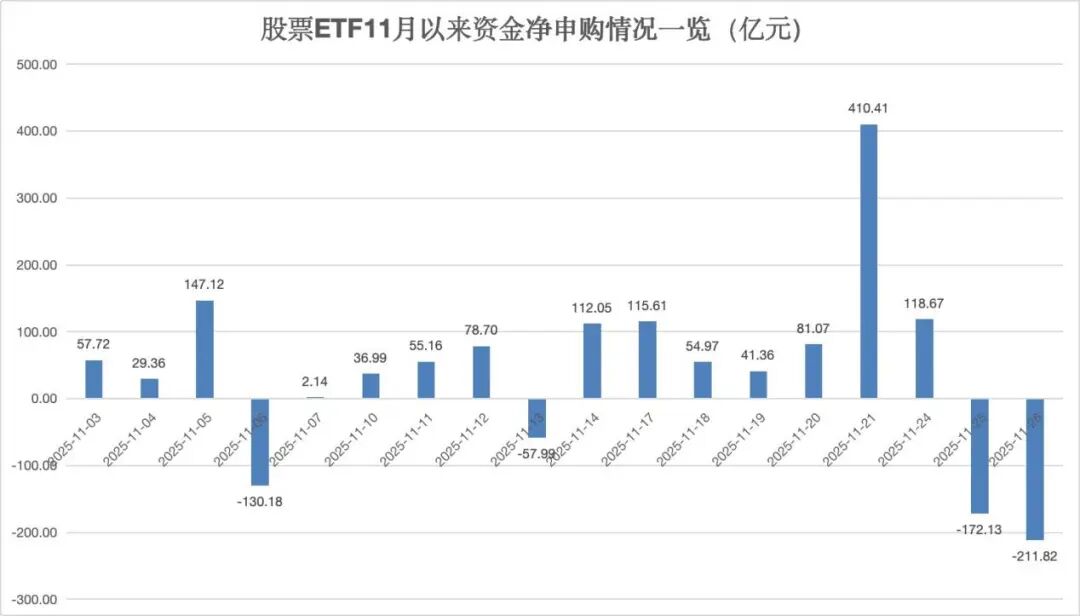
落袋为安!超200亿,“跑了”!
Zhong Guo Ji Jin Bao· 2025-11-27 05:49
Core Insights - The stock ETF market experienced a significant net outflow of over 20 billion yuan on November 26, marking the largest single-day outflow since February 12 of the same year [2][3] - Despite a market rebound, investors opted to secure profits, leading to a reduction in total shares of stock ETFs by 11.558 billion, with a total market size of 4.33 trillion yuan [3] Fund Flow Analysis - The total net outflow from stock ETFs reached 21.182 billion yuan, contributing to a cumulative outflow exceeding 38 billion yuan over the past two days [3] - Defensive products such as bond ETFs, free cash flow ETFs, and dividend ETFs attracted more capital, while broad-based ETFs tracking indices like the ChiNext, CSI 300, and CSI 500 faced significant outflows [2][5] ETF Performance - Among various ETF categories, strategy-style ETFs and commodity ETFs saw net inflows of 1.014 billion yuan and 409 million yuan, respectively, while broad-based ETFs experienced a net outflow of 15.111 billion yuan [5] - Major fund companies like E Fund and Huaxia Fund reported continued inflows into their ETFs, with E Fund's ETFs reaching a total size of 805.69 billion yuan, including a net inflow of 2.6 billion yuan into the Hang Seng Dividend Low Volatility ETF [5][6] Specific ETF Highlights - The top-performing bond ETFs included Huaxia's benchmark government bond ETF and the technology innovation bond ETFs from Taikang and Fuguo, each with net inflows exceeding 600 million yuan [7][8] - The gold ETF from Huaan also saw a notable net inflow of 327 million yuan, ranking fifth among all ETFs for net inflows on that day [8] Outflow Trends - The broad-based ETFs, particularly those tracking the ChiNext, CSI 300, CSI 500, and the STAR 50 indices, experienced the most significant outflows, with the ChiNext ETF alone seeing a net outflow of 2.645 billion yuan [10]