
河钢股份

Search documents
规模超1800亿,2025年10月这些基金的GP被LP选中
母基金研究中心· 2025-11-16 08:52
Group 1 - The core viewpoint of the article highlights significant fundraising activities in October 2025, with a total of 9 fundraising events amounting to over 180 billion RMB [1] - Brookfield has successfully raised a total of 20 billion USD for its clean energy fund, surpassing its initial target and becoming the largest private fund focused on clean energy transition globally [2][3] - The Hong Kong University of Science and Technology and Gobi Partners have established a strategic fund aimed at nurturing early-stage startups incubated by the university, focusing on commercialization of cutting-edge research [4][6] Group 2 - CICC Hebei Steel Development Equity Investment Fund has been established with a total scale of 32 billion RMB, focusing on private equity investments [5][7] - The Fujian Cultural and Tourism Digital Innovation Fund has officially launched with a total scale of 30 billion RMB, aimed at supporting innovation in the cultural and tourism sectors [5][8] - Prologis has completed fundraising for its first new materials and new energy-themed fund, with a total scale of 5 billion RMB [5][9][10] Group 3 - Kangqiao Capital's R-Bridge Healthcare Fund II has raised 500 million USD, focusing on investments in the healthcare sector [5][11] - Shanghai Xinjucyuan Fund has signed agreements with several high-tech enterprises, with a total scale of 4.5 billion RMB, targeting advanced manufacturing and other cutting-edge fields [5][12][13] - The China-Portuguese Economic and Trade Development Fund has been established with a total scale of 1 billion RMB, focusing on enhancing economic cooperation between China and Portuguese-speaking countries [5][14][15] Group 4 - Jiangsu Yangzhou Aerospace Industry Special Mother Fund's third sub-fund has been successfully registered with a total scale of 5 billion RMB, leveraging public selection for management [5][16] - The fourth Davos Global Mother Fund Summit is scheduled for January 2026, aiming to facilitate dialogue among global fund industry leaders [5][18][20] - The 2025 Global Best Investment Institutions ranking has commenced, highlighting the importance of recognizing top investment entities [5][23]


钢材:铁水下降空间仍存,成材强于原料
Yin He Qi Huo· 2025-11-15 15:25
1. Report Industry Investment Rating There is no information provided in the document regarding the report industry investment rating. 2. Core Viewpoints of the Report - The total output of five major steel products declined this week, with a greater reduction in rebar production than in plate production. The overall steel inventory continued to decrease, but hot-rolled coils showed a slight accumulation. The supply-demand structure constrained the performance of steel prices. It is expected that hot metal production will continue to decrease, squeezing raw materials and causing the center of steel prices to move downward. However, due to the launch of the 2025 Central Safety Production Assessment and Inspection, the supply of coking coal is unlikely to increase significantly, providing cost support for steel. Therefore, in the short term, steel prices will remain range-bound, and a breakthrough requires more factors. Hot-rolled coils are expected to perform better than rebar, and the spread between hot-rolled coils and rebar is expected to remain in an expansion cycle [7]. - In terms of trading strategies, it is recommended to maintain a range-bound trading approach for single positions, continue to hold long positions on the spread between hot-rolled coils and rebar for arbitrage, and adopt a wait-and-see approach for options [9]. 3. Summary by Relevant Catalogs Chapter 1: Steel Market Summary and Outlook Summary - **Supply**: This week, the weekly output of small-sample rebar was 200 million tons (-8.54), and that of small-sample hot-rolled coils was 313.66 million tons (-4.50). The daily average hot metal output of 247 blast furnaces was 236.88 million tons (+2.66), and the capacity utilization rate of 49 independent electric arc furnace steel mills was 32.9% (+0.4). Although the profit of electric arc furnaces improved slightly with the decline in scrap steel prices, it remained in a loss, leading to a slight increase in production. The profit of long-process steel also remained in a loss but improved slightly, and hot metal production increased this week [4]. - **Demand**: The apparent demand for small-sample rebar was 216.37 million tons (-2.15), and that for small-sample hot-rolled coils was 313.59 million tons (-0.71). Steel demand continued to decline recently, with difficulties in project payment collection for downstream construction sites and a decrease in the number of projects on hand in the fourth quarter, indicating significant demand pressure. From January to October, the growth rate of China's fixed asset investment declined month-on-month, with insufficient incremental investment in domestic projects. In October, the decline in housing sales, land acquisition, new construction, and completion areas widened, with the decline in new construction and completion falling to around -30%, indicating weak data and insufficient willingness among residents to purchase houses, and the real estate market continued to decline. In October, the official manufacturing PMI was 49%, and the S&P Global manufacturing PMI was 50.6%, showing a decline in the manufacturing PMI, with significant weakening in new orders and export data. In October, China's automobile production increased by 12.1% year-on-year, and exports increased by 41.6% year-on-year, maintaining strong positive growth in both domestic and foreign demand. In November, the production schedule of the three major white goods decreased by 21.2% year-on-year, showing a further decline. In the United States, the Markit manufacturing PMI in October was 52.5, up from the previous value of 52, indicating a continued recovery in the manufacturing industry. The number of initial jobless claims last week was 218,000, unchanged from the previous value. The initial value of the eurozone manufacturing PMI in October rose to 50, up from the previous value of 49.8, indicating an increase in the manufacturing PMI. The final values of the manufacturing PMIs in Germany and France, the two largest economies, were 49.6 and 48.8 respectively, remaining in the contraction zone and failing to break out of the predicament [4]. - **Inventory**: In terms of rebar inventory, the mill inventory decreased by 64,200 tons, and the social inventory decreased by 99,500 tons, resulting in a total inventory decrease of 163,700 tons. For hot-rolled coils, the mill inventory increased by 900 tons, and the social inventory decreased by 200 tons, resulting in a total inventory increase of 700 tons. The mill inventory of the five major steel products decreased by 126,100 tons, and the social inventory decreased by 136,100 tons, resulting in a total inventory decrease of 262,200 tons [4]. - **Outlook**: It is expected that hot metal production will continue to decrease, squeezing raw materials and causing the center of steel prices to move downward. However, due to the launch of the 2025 Central Safety Production Assessment and Inspection, the supply of coking coal is unlikely to increase significantly, providing cost support for steel. Therefore, in the short term, steel prices will remain range-bound, and a breakthrough requires more factors. Hot-rolled coils are expected to perform better than rebar, and the spread between hot-rolled coils and rebar is expected to remain in an expansion cycle. Future attention should be paid to coal mine safety inspections, overseas tariffs, and domestic macro and industrial policies [7]. Chapter 2: Price and Profit Review Summary - **Spot Prices**: On Friday, the aggregated price of rebar in Shanghai was 3,190 yuan (unchanged), and that in Beijing was 3,180 yuan (unchanged). The price of hot-rolled coils in Shanghai was 3,260 yuan (unchanged), and that of Hebei Steel's hot-rolled coils in Tianjin was 3,190 yuan (unchanged) [13]. - **Profit**: The flat - rate electricity profit of electric arc furnaces in East China was -240.38 yuan (+34), and the off - peak electricity profit was -75 yuan (+34) [28]. Chapter 3: Important Domestic and Foreign Macroeconomic Data Summary - **Domestic Macroeconomy**: In the first ten months, China's cumulative increase in social financing scale was 30.9 trillion yuan, an increase of 3.83 trillion yuan compared with the same period last year. At the end of October, the year - on - year growth rate of social financing stock was 8.5%, and the year - on - year growth rate of M2 was 8.2%, both down 0.2 percentage points month - on - month. In October, the newly added social financing was 81.49 billion yuan, a significant decline both year - on - year and month - on - month. The newly added RMB loans were 22 billion yuan. Residential loans decreased by 36.04 billion yuan, and corporate loans were 35 trillion yuan. Currently in the off - season of investment, credit demand is weakening, residential demand is cooling, the real estate market is further cooling, and the contribution of fiscal policy to social financing is weakening. However, it may improve at the end of this year and next year due to the impact of policy - based financial instruments. From January to October 2025, the cumulative year - on - year growth rate of China's fixed asset investment was -1.70%, a further rapid decline. Among them, the cumulative year - on - year growth rate of real estate development investment was -14.7%, that of manufacturing investment was +2.7%, and that of infrastructure investment was +1.51%. The cumulative year - on - year growth rate of infrastructure investment (excluding electricity) was -0.1%. The growth rates of the three types of investment continued to contract significantly month - on - month. The real estate market lacks fiscal support and remains a drag on domestic demand. The issuance of government bonds has slowed down compared with the same period last year, affecting infrastructure investment to some extent. The repayment situation of downstream projects is poor, corporate loans are low, and the investment growth rate of the manufacturing industry continues to contract due to insufficient industrial prosperity [30][35]. - **Foreign Macroeconomy**: In the United States, the Markit manufacturing PMI in October was 52.5, up from the previous value of 52, indicating a continued recovery in the manufacturing industry. The number of initial jobless claims last week was 218,000, unchanged from the previous value. The initial value of the eurozone manufacturing PMI in October rose to 50, up from the previous value of 49.8, indicating an increase in the manufacturing PMI. The final values of the manufacturing PMIs in Germany and France, the two largest economies, were 49.6 and 48.8 respectively, remaining in the contraction zone and failing to break out of the predicament [4]. Chapter 4: Steel Supply, Demand, and Inventory Situation Summary - **Supply**: The daily average hot metal output of 247 blast furnaces was 236.88 million tons (+2.66), and the capacity utilization rate of 49 independent electric arc furnace steel mills was 32.9% (+0.4). The weekly output of small - sample rebar was 208.54 million tons, a decrease of 8.54 million tons month - on - month. The weekly output of small - sample hot - rolled coils was 313.66 million tons, a decrease of 4.50 million tons month - on - month [53][58]. - **Demand**: The apparent demand for small - sample rebar was 216.37 million tons (a 7.6% decrease compared with the same period in the lunar calendar), a decrease of 2.15 million tons month - on - month. The apparent demand for small - sample hot - rolled coils was 313.59 million tons (a 1.67% decrease compared with the same period in the lunar calendar), a decrease of 0.71 million tons month - on - month. The demand for building materials and the production schedule of white goods declined, while the production and export of automobiles maintained strong growth [61]. - **Inventory**: The total inventory of rebar decreased, while the total inventory of hot - rolled coils increased slightly. The overall inventory of the five major steel products decreased [4].
利率修复信用债大致平稳,二永债收益率小幅回落
Xinda Securities· 2025-11-15 15:23
Report Industry Investment Rating No relevant content provided. Core Viewpoints of the Report - Interest rates are recovering, credit bond yields are generally stable, and credit spreads of high - grade bonds over 3Y are widening. The yields of credit bonds are generally stable, while the yields of government - developed bonds of 3Y, 5Y, 7Y, and 10Y are declining. Credit spreads of high - grade bonds over 3Y are mostly widening [2][5]. - Most urban investment bond spreads have slightly increased. The credit spreads of external rating AAA and AA+ platforms have generally increased by 2BP and 1BP respectively compared to last week, while the AA platform has generally remained flat [2][9]. - The spreads of industrial bonds have increased overall, and the increase in the spreads of mixed - ownership real - estate bonds is significant. The spreads of central and state - owned enterprise real - estate bonds, mixed - ownership real - estate bonds, and private real - estate bonds have all increased, with the mixed - ownership real - estate bonds having the largest increase [2][20]. - The yields of Tier 2 and perpetual bonds have slightly declined, and high - grade varieties are relatively advantageous. The yields of Tier 2 and perpetual bonds of all maturities have slightly decreased, with 3Y perpetual bonds performing strongly and high - grade varieties being more favorable [2][27]. - The excess spreads of 3Y industrial perpetual bonds have declined, and the excess spreads of urban investment perpetual bonds continue to diverge. The excess spreads of industrial AAA 3Y perpetual bonds have decreased, while the excess spreads of urban investment AAA 3Y and 5Y perpetual bonds show different trends [2][31]. Summary by Relevant Catalogs 1. Interest rates are recovering, credit bond yields are generally stable, and credit spreads of high - grade bonds over 3Y are widening - Yield changes: 1Y government - developed bond yields are flat compared to last week, while 3Y, 5Y, 7Y, and 10Y yields have decreased by 3BP, 2BP, 2BP, and 1BP respectively. For credit bonds, 1Y yields are flat, 3Y AAA - grade yields increase by 1BP, others decrease by 1BP; 5Y AAA - grade yields are flat, AA+ decreases by 1BP, AA decreases by 3BP, AA - decreases by 8BP; 7Y AAA - grade yields increase by 1BP, others decrease by 1BP; 10Y AAA - grade yields increase by 2BP, others are flat [2][5]. - Credit spread changes: 1Y credit spreads are flat; 3Y AAA - grade credit spreads increase by 4BP, others increase by 2BP; 5Y AA+ and above grade spreads increase by 1 - 2BP, AA grade decreases by 1BP, AA - grade decreases by 6BP; 7 - 10Y credit spreads increase by 1 - 3BP [2][5]. - Rating spread changes: 1Y spreads are flat; 3Y AAA/AA+ spreads decrease by 2BP, others are flat; 5Y AA/AA - grade spreads decrease by 5BP, others decrease by 1 - 2BP; 7Y and 10Y AAA/AA+ rating spreads decrease by 2BP, others are flat [5]. - Maturity spread changes: For AAA grade, 5Y/3Y decreases by 1BP, others increase by 1BP; for AA+ grade, 3Y/1Y decreases by 1BP, 10Y/7Y increases by 1BP, others are flat; for AA grade, 5Y/3Y and 3Y/1Y decrease by 1 - 2BP, others increase by 1 - 2BP [5]. 2. Most urban investment bond spreads have slightly increased - By external rating: The credit spreads of external rating AAA and AA+ platforms have generally increased by 2BP and 1BP respectively compared to last week, while the AA platform has generally remained flat. Among them, most AAA - grade platform spreads increase by 1 - 2BP, with Henan and Yunnan remaining flat; most AA+ - grade platforms are flat or increase by 1BP, with Guizhou, Yunnan, and Tianjin decreasing by 1 - 3BP, Gansu and Inner Mongolia increasing by 2BP; most AA - grade platforms are flat or increase by 1BP, with Shaanxi, Tianjin, Jilin, and Shandong decreasing by 1 - 3BP, Guizhou increasing by 4BP [2][9]. - By administrative level: The credit spreads of provincial and municipal platforms have generally increased by 2BP and 1BP respectively compared to last week, while the county - level platform spreads have remained flat. Most provincial platform spreads increase by 1 - 2BP, with Xinjiang, Anhui, and Zhejiang increasing by 3 - 4BP, Jiangsu increasing by 7BP, Yunnan and Shaanxi remaining flat; most municipal platforms increase by 1BP, with Yunnan decreasing by 1BP, Qinghai remaining flat, Zhejiang increasing by 2BP; most county - level platforms are flat or increase by 1BP, with Shaanxi, Jilin, and Jiangxi decreasing by 1 - 2BP, Guizhou increasing by 3BP [2][17]. 3. The spreads of industrial bonds have increased overall, and the increase in the spreads of mixed - ownership real - estate bonds is significant - Real - estate bonds: The spreads of central and state - owned enterprise real - estate bonds have increased by 1BP, the spreads of mixed - ownership real - estate bonds have increased by 123BP, and the spreads of private real - estate bonds have increased by 14BP. The spreads of Longfor have increased by 20BP, CIFI by 40BP, Midea Real Estate remained flat, and Vanke by 438BP [2][20]. - Other industrial bonds: The spreads of coal bonds of all grades have increased by 0 - 2BP; the spreads of AAA - grade steel bonds have increased by 1BP, AA+ by 5BP; the spreads of AAA - grade chemical bonds have increased by 2BP, AA+ remained flat. The spreads of Shaanxi Coal Industry have increased by 1BP, while the spreads of HBIS and Jinkong Coal Industry have decreased by 1BP [2][20]. 4. The yields of Tier 2 and perpetual bonds have slightly declined, and high - grade varieties are relatively advantageous - 1Y: The yields of all grades of Tier 2 and perpetual bonds have decreased by 0 - 1BP, and the spreads have compressed similarly [2][27]. - 3Y: The yields of all grades of Tier 2 capital bonds have decreased by 2 - 3BP, and the spreads have increased by 0 - 1BP; the yields of all grades of perpetual bonds have decreased by 3 - 4BP, and the spreads have compressed by 0 - 1BP [2][27]. - 5Y: The yield of AAA - grade Tier 2 capital bonds has decreased by 3BP, and the spread is flat; the yields of other grades of Tier 2 and perpetual bonds have decreased by 2BP, and the spreads have increased by 1BP [2][27]. 5. The excess spreads of 3Y industrial perpetual bonds have declined, and the excess spreads of urban investment perpetual bonds continue to diverge - Industrial perpetual bonds: The excess spreads of industrial AAA 3Y perpetual bonds have decreased by 1.38BP to 14.79BP compared to last week, at the 38.88% percentile since 2015; the excess spreads of industrial 5Y perpetual bonds are flat at 12.39BP compared to last week, at the 27.07% percentile since 2015 [2][31]. - Urban investment perpetual bonds: The excess spreads of urban investment AAA 3Y perpetual bonds have decreased by 2.04BP to 5.35BP, at the 5.14% percentile; the excess spreads of urban investment AAA 5Y perpetual bonds have increased by 1.83BP to 10.97BP, at the 17.02% percentile [2][31]. 6. Credit Spread Database Compilation Instructions - Calculation basis: The overall market credit spreads, commercial bank Tier 2 and perpetual bond spreads, and urban investment/industrial perpetual bond credit spreads are calculated based on ChinaBond Medium - and Short - Term Notes and ChinaBond Perpetual Bonds data, with historical percentiles since the beginning of 2015; the urban investment and industrial bond - related credit spreads are compiled and统计 by the R & D Center of Cinda Securities, with historical percentiles since the beginning of 2015 [36]. - Calculation methods: Industrial and urban investment individual bond credit spreads = individual bond ChinaBond valuation (exercise) - same - maturity government - developed bond yield to maturity (calculated by linear interpolation method), and then the credit spreads of industries or regional urban investments are obtained by arithmetic averaging; bank Tier 2 capital bond/perpetual bond excess spreads = bank Tier 2 capital bond/perpetual bond credit spreads - same - grade and same - maturity bank ordinary bond credit spreads; industrial/urban investment - type perpetual bond excess spreads = industrial/urban investment - type perpetual bond credit spreads - same - grade and same - maturity medium - term note credit spreads [38]. - Sample selection: Both industrial and urban investment bonds select medium - term notes and public corporate bonds as samples, and exclude guaranteed bonds and perpetual bonds. If the remaining maturity of an individual bond is less than 0.5 years or more than 5 years, it is excluded from the statistical sample. Industrial and urban investment bonds use external entity ratings, while commercial banks use ChinaBond implicit debt ratings [38].
河钢股份:北铁指数各品位指数产品正在逐步构建 公司将对此保持积极关注
Zheng Quan Ri Bao Zhi Sheng· 2025-11-14 14:08
(编辑 姚尧) 证券日报网讯 河钢股份11月14日在互动平台回答投资者提问时表示,前不久,北铁指数推出,该指数 以人民币计价,聚焦中国主要港口铁矿石现货成交价。北铁指数各品位指数产品正在逐步构建,公司将 对此保持积极关注。 ...

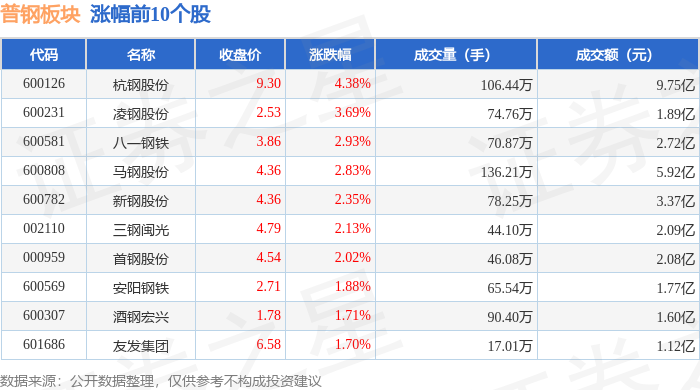
普钢板块11月13日涨1.33%,杭钢股份领涨,主力资金净流出5541.52万元
Zheng Xing Xing Ye Ri Bao· 2025-11-13 08:44
Group 1 - The core viewpoint of the news is that the steel sector experienced a rise, with the overall index showing positive performance on November 13, 2023, where the steel sector increased by 1.33% and the Shanghai Composite Index rose by 0.73% [1] - Hangzhou Iron & Steel Co., Ltd. led the gains in the steel sector with a closing price of 9.30, reflecting a 4.38% increase [1] - The trading volume for Hangzhou Iron & Steel was 1.0644 million hands, with a transaction value of 975 million yuan [1] Group 2 - The net capital flow in the steel sector showed a net outflow of 55.4152 million yuan from main funds and a net outflow of 123 million yuan from speculative funds, while retail investors saw a net inflow of 179 million yuan [2] - Specific stocks like Hualing Steel reported a net inflow of 55.1534 million yuan from main funds, while Hangzhou Iron & Steel had a net outflow of 41.6871 million yuan from speculative funds [2] - The overall sentiment in the market indicates a mixed response, with some stocks experiencing significant retail inflows despite the outflows from main and speculative funds [2]


河钢股份(000709) - 华泰联合证券有限责任公司关于河钢股份有限公司重大诉讼事项进展的受托管理事务临时报告
2025-11-12 09:16
| 债券代码: | 148301.SZ | 债券简称: | 23HBIS01 | | --- | --- | --- | --- | | 债券代码: | 148862.SZ | 债券简称: | 24 河钢 Y3 | | 债券代码: | 148922.SZ | 债券简称: 24 河钢 Y4 | | 华泰联合证券有限责任公司关于 河钢股份有限公司重大诉讼事项进展的 受托管理事务临时报告 债券受托管理人 泰联合证券有限责任公司 UATAI UNITED SECURITIES CO.,LTD 1 华泰联合证券作为"河钢股份有限公司2023年面向专业投资者公开发行公司 债券 (第一期)"、"河钢股份有限公司2024年面向专业投资者公开发行可续期公 司债券(第三期)"和"河钢股份有限公司2024年面向专业投资者公开发行可续 期公司债券(第四期)"的受托管理人,根据《公司债券发行与交易管理办法》 《公司债券受托管理人执业行为准则》等相关规则,与发行人《河钢股份有限公 司关于重大诉讼事项终审判决的公告》,现就公司债券重大事项报告如下: 一、重大事项 根据发行人2025年11月6日披露的《河钢股份有限公司关于重大诉讼事项终 审 ...
河钢股份(000709) - 中信建投证券股份有限公司关于河钢股份有限公司重大诉讼事项进展的临时受托管理事务报告
2025-11-12 09:16
重大诉讼事项进展的 临时受托管理事务报告 债券简称:24HBIS01 债券代码:148581.SZ 债券受托管理人 2025 年 11 月 关于 河钢股份有限公司 根据发行人2025年11月6日披露的《河钢股份有限公司关于重大诉讼事项终 审判决的公告》,发行人发生的重大事项如下: (一)本次重大诉讼事项的基本情况 亚联(香港)国际投资有限公司(以下简称"亚联公司")于2020年9月向 发行人及相关公司提起了诉讼,河北省石家庄市中级人民法院于2021年9月对该 案作出了裁定,驳回了原告亚联公司的起诉。后亚联公司不服裁定提起上诉,经 河北省高级人民法院审理后,裁定撤销河北省石家庄市中级人民法院对本案的裁 定,并指令河北省石家庄市中级人民法院审理本案。2024年7月,石家庄市中级 人民法院判决驳回原告亚联公司的诉讼请求,亚联公司不服石家庄中院判决,再 次向河北省高级人民法院提起上诉。详见发行人于2020年10月9日、2020年11月 7日、2021年9月28日、2021年11月2日、2021年12月30日、2024年7月13日披露于 《中国证券报》《上海证券报》《证券时报》和巨潮资讯网(http://www.cni ...
河钢股份(000709) - 中信证券股份有限公司关于河钢股份有限公司重大诉讼事项进展的临时受托管理事务报告
2025-11-12 09:16
债券简称:25 河钢 KY1 债券代码:524435.SZ 关于河钢股份有限公司重大诉讼事项进展 的临时受托管理事务报告 债券受托管理人 中信证券股份有限公司 2025 年 11 月 重要声明 本报告依据《公司债券发行与交易管理办法》《公司债券受托管理人执业行 为准则》、河钢股份有限公司(以下简称"发行人"或"公司")就存续公司债 券与受托管理人签署的《河钢股份有限公司2025年面向专业投资者公开发行公司 债券之债券受托管理协议》(以下简称"《受托管理协议》")、《河钢股份有 限公司2025年面向专业投资者公开发行公司债券之持有人会议规则》(以下简称 "债券持有人会议规则")及其它相关信息披露文件以及发行人出具的相关说明 文件和提供的相关资料等,由受托管理人中信证券股份有限公司(以下简称"中 信证券"或"受托管理人")编制。中信证券编制本报告的内容及信息均来源发 行人提供的资料或说明。 本报告不构成对投资者进行或不进行某项行为的推荐意见,投资者应对相关 事宜做出独立判断,而不应将本报告中的任何内容据以作为中信证券所作的承诺 或声明。 1 中信证券作为"河钢股份有限公司2025年面向专业投资者公开发行科技创新 ...
河钢股份(000709) - 光大证券股份有限公司关于河钢股份有限公司重大诉讼事项进展的临时受托管理事务报告
2025-11-12 09:16
(住所:上海市静安区新闸路 1508 号) 债券简称:23HBIS02 债券代码:148477.SZ 债券简称:24 河钢 Y1 债券代码:148794.SZ 债券简称:24 河钢 Y2 债券代码:148795.SZ 债券简称:25 河钢 Y1 债券代码:524154.SZ 债券简称:25 河钢 Y2 债券代码:524208.SZ 光大证券股份有限公司关于 河钢股份有限公司重大诉讼事项进展的 临时受托管理事务报告 债券受托管理人 2025 年 11 月 契约锁 声明 本报告依据《公司债券发行与交易管理办法》、其它相关信息披露文件以及 河钢股份有限公司(以下简称"发行人"、"公司")出具的相关说明文件和提供的 相关资料等,由债券受托管理人光大证券股份有限公司(以下简称"光大证券") 编制。光大证券编制本报告的内容及信息均来源于河钢股份有限公司提供的资料 或说明。 本报告不构成对投资者进行或不进行某项行为的推荐意见,投资者应对相关 事宜做出独立判断,而不应将本报告中的任何内容据以作为光大证券所作的承诺 或声明。 1 契约锁 一、发行人概况 二、受托债券基本情况 (一)"23HBIS02"债券概况 (7)债券还本付 ...
河钢股份有限公司 六届五次董事会决议公告
Zhong Guo Zheng Quan Bao - Zhong Zheng Wang· 2025-11-11 04:50
Meeting Information - The sixth meeting of the board of directors of Hebei Iron and Steel Co., Ltd. was held on November 10, 2025, via communication methods, with all 9 directors participating in the voting [2] - The meeting was legally compliant with the Company Law and the Articles of Association [2] Resolutions Passed - The board approved the proposal to elect Han Jian and Wang Baowei as candidates for the sixth board of directors, with unanimous support (9 votes for, 0 against, 0 abstentions) [2] - The board also approved the proposal to hold the second extraordinary general meeting of shareholders on November 26, 2025, with the same unanimous voting results [2] Upcoming Shareholder Meeting - The second extraordinary general meeting of shareholders is scheduled for November 26, 2025, at 14:30, with both on-site and online voting options available [9][10] - The record date for shareholders to attend the meeting is November 18, 2025 [11] Candidate Profiles - Han Jian, born in February 1970, holds a master's degree in engineering and has held various senior positions within the company, currently serving as the general manager and vice chairman [5] - Wang Baowei, born in July 1975, is a senior economist with a background in financial management and currently serves as the chief accountant of Hebei Iron and Steel Co., Ltd. [6] Voting Procedures - Shareholders can vote through the Shenzhen Stock Exchange trading system and the internet voting system on November 26, 2025, during specified time slots [26] - The voting will follow a cumulative voting method, allowing shareholders to allocate their votes among the candidates [15]