Keurig Dr Pepper Inc.

Search documents
Is Keurig Dr Pepper Stock Underperforming the Nasdaq?
Yahoo Finance· 2025-09-09 07:16
Company Overview - Keurig Dr Pepper Inc. (KDP) is a non-alcoholic beverage company based in Burlington, Massachusetts, with a market cap of $38.9 billion [1] - The company operates through three segments: U.S. Refreshment Beverages, U.S. Coffee, and International [1] Market Position - KDP is classified as a large-cap stock, reflecting its substantial size and influence in the non-alcoholic beverages industry [2] - The company is known for its diverse product offerings, including carbonated soft drinks, ready-to-drink teas and juices, and specialty coffees [2] Stock Performance - KDP's stock reached a two-year high of $38.28 on September 24, 2024, but is currently trading 27.8% below that peak [3] - Over the past three months, KDP stock has dropped 15.7%, underperforming the Nasdaq Composite's 11.6% increase during the same period [3] - Year-to-date, KDP's stock has declined nearly 14%, and it has fallen 25% over the past 52 weeks, while the Nasdaq has surged 12.9% in 2025 and 30.6% over the past year [4] Recent Developments - On August 25, KDP's stock plummeted 11.5%, followed by a 6.9% drop in the next trading session, coinciding with the announcement of its acquisition of JDE Peet for approximately €15.7 billion (or $18.4 billion), which included a 33% premium on the target's share prices [5] - Following the acquisition, KDP plans to split into two separate companies, one focusing on soft drinks and the other on coffee, which management views as strategically beneficial [6] - Investor sentiment has been negatively impacted due to the premium paid for the acquisition, and KDP has underperformed compared to its peer, Monster Beverage Corporation, which has seen gains of 19.9% year-to-date and 29.5% over the past 52 weeks [6]

超1300亿,“星巴克祖师爷”被卖了
3 6 Ke· 2025-09-08 00:17
Core Insights - The global coffee market is undergoing significant changes, highlighted by the acquisition of Peet's Coffee by Keurig Dr Pepper (KDP) for €15.7 billion (approximately ¥130 billion) [1][12] - JAB Holdings, a key player in the coffee industry, is behind both KDP and JDE Peet's, indicating a strategic consolidation of coffee assets to enhance global market presence [3][13] - The premium coffee segment, represented by brands like Peet's, faces challenges in balancing high-end positioning with market adaptability, particularly as competition from lower-priced brands intensifies [4][14] Company Overview - Peet's Coffee, founded in 1966 by Alfred Peet, is recognized for revolutionizing the American coffee scene with high-quality beans and deep roasting techniques [5][8] - The brand has historical ties to Starbucks, with several of its founders having trained under Peet, which contributes to its reputation as the "father of Starbucks" [5][7] - After being privatized by JAB in 2012, Peet's expanded internationally, including a successful entry into the Chinese market in 2017 [8][10] Financial Performance - JDE Peet's reported a 7.9% increase in global sales to €8.837 billion (approximately ¥736 billion) for FY 2024, with Peet's Coffee being a significant growth driver [10][11] - Adjusted EBITDA for JDE Peet's reached €1.587 billion, reflecting an 11.3% increase year-over-year [11] - Despite strong performance, Peet's Coffee has seen a slowdown in store openings in China, from 98 in 2023 to a projected 51 in 2024 [10] Market Dynamics - The coffee market is experiencing a shift towards price competition, with brands like Luckin Coffee and Kudi attracting consumers through aggressive pricing strategies [14][16] - Consumer preferences are evolving, with a growing demand for personalized and innovative coffee products, challenging traditional brands to adapt [16][20] - The failure to penetrate lower-tier markets has hindered Peet's growth, while competitors like Luckin have successfully expanded their presence in these areas [17][20] Strategic Responses - Peet's Coffee is launching a sub-brand, Ora Coffee, aimed at price-sensitive consumers, with prices ranging from ¥15 to ¥25, to better compete in the changing market landscape [19][20] - The strategic acquisition by KDP is seen as a move to enhance its global coffee capabilities and address its previous limitations in the coffee sector [12][13]


Deficit Decline, Rising Reports, and Interesting Investments
ETF Trends· 2025-09-06 12:25
Economic Indicators - The Congressional Budget Office (CBO) estimates that Trump's global tariff hikes could reduce deficits by $3.3 trillion and cut federal interest payments by $0.7 trillion over the next decade [5] - The employment rate for individuals aged 16 to 24 decreased to 53.1% in July 2025, down from 54.5% in July 2024, despite an increase in the youth labor force from 21.7 million in April 2025 to 23.7 million in July 2025 [5] Market Performance - Jefferies raised its year-end target for the S&P 500 to 6,600, up from a previous target of 5,600, citing strong second-quarter corporate earnings [5] Company Developments - Zoom reported a 4.7% year-over-year revenue growth and a 10.5% year-over-year growth in non-GAAP income from operations for its second quarter of fiscal year 2026 [5] - The U.S. government is set to acquire a 9.9% stake in Intel through a deal converting government grants into equity, providing Intel with $10 billion to expand chip factories in the U.S. [5] - Databricks is targeting a $100 billion valuation as it approaches a $1 billion Series K funding round, reflecting a 61% increase from its December 2024 valuation of $62 billion [5] - Starbucks announced a reduction in production from seven days a week to five, following a cap on raises for North America salaried employees to a fixed 2% [5] - Keurig Dr Pepper plans to acquire European JDE Peet's for $18 billion, which owns a variety of coffee and tea brands [5] Social Concerns - A Pew Research Center survey indicates that 70% of Americans view the spread of false information online as a major threat, ranking it higher than terrorism and the global economy [5] Media Performance - Fox achieved its best preseason NFL game viewership in four years, with 5.11 million viewers for the Bears-Bills game on August 17, although the highest remains the Pro Football Hall of Fame Game in 2021 with 7.4 million viewers [5]
Where Coca-Cola Is Winning: A Deep Dive Into Segment Performance
ZACKS· 2025-09-05 16:36
Core Insights - The Coca-Cola Company is achieving success by balancing global scale with local execution, reporting 5% year-over-year organic revenue growth in Q2 2025 despite a 1% volume decline, indicating strong pricing power and portfolio strength [1][8] - Coca-Cola has gained global value share for 17 consecutive quarters, driven by strong performance in brands like Coca-Cola Zero Sugar and Fanta [1] Regional Performance - Coca-Cola is performing well in Europe, Africa, and parts of Asia, with volume growth in Europe attributed to the Share a Coke campaign and strong sales of Coke Zero Sugar and Sprite [2] - In Africa, growth is seen in Egypt, Morocco, and Nigeria through refined pack-price strategies and bold marketing [2] - The company is also gaining share in volatile markets like Eurasia and the Middle East by focusing on local sourcing and affordability [2] Innovation and Strategy - Coca-Cola's ability to scale innovation is a competitive advantage, with recent product launches like Sprite + Tea and portfolio expansion in dairy through fairlife [3] - The company is leveraging digital platforms and AI-driven pack-price optimization to enhance execution, while refillable and mini-can strategies support both affordability and premiumization [3] - These initiatives reinforce Coca-Cola's "all-weather strategy," allowing for quick market pivots and sustainable growth amid economic uncertainty [3] Competitive Landscape - In the competitive beverage market, PepsiCo and Keurig Dr Pepper are leveraging their strengths and strategic expansions to capture growth [4] - PepsiCo is focusing on productivity and innovation, with its Frito-Lay business stabilizing the category and beverages gaining ground [5] - Keurig is experiencing significant growth in U.S. Refreshment Beverages, with net sales rising nearly 11% in Q2, driven by core strengths and emerging categories [6] Financial Performance - Coca-Cola's shares have increased by 9.6% year-to-date, outperforming the industry's growth of 3.6% [7] - The company has a forward price-to-earnings ratio of 21.72X, higher than the industry's 17.58X [9] - The Zacks Consensus Estimate for Coca-Cola's earnings implies year-over-year growth of 3.1% for 2025 and 8.3% for 2026, with estimates remaining unchanged in the past week [10]

咖啡迎“变”:市场格局重塑 并购重组增多
Zhong Guo Jing Ying Bao· 2025-09-05 11:44
Group 1: Mergers and Acquisitions - Keurig Dr Pepper (KDP) announced the acquisition of JDE Peet's for €15.7 billion (approximately $18.2 billion) to create a global coffee company [1] - Coca-Cola is considering selling its coffee brand Costa, having initiated preliminary talks with potential buyers [1][4] - The coffee market is experiencing a wave of mergers, with 60% of consumer goods executives expecting to sell assets in the next three years [5][6] Group 2: Market Dynamics - The Chinese coffee market is shifting, with local brands rising and first-tier cities becoming saturated, while lower-tier cities are emerging as growth areas [2] - JDE Peet's reported a strong organic sales growth of 23.8% in China, contributing to a global sales increase of 7.9% [4] - Starbucks is exploring the sale of a portion of its Chinese business, with over 20 institutions expressing interest [1][6] Group 3: Competitive Landscape - The competitive environment for Costa is challenging, leading to its potential sale by Coca-Cola due to poor performance and lack of synergy with its core business [5] - Local brands like Luckin Coffee are expanding internationally, increasing pressure on established brands like Peet's [4][6] - Starbucks is adapting its strategy in China, focusing on maintaining a significant equity stake to ensure quality control and brand integrity [8]


5 Soft Drink Stocks Battling for Relevance Amid Consumer Taste Shift
ZACKS· 2025-09-03 15:51
Industry Overview - The Zacks Beverages – Soft Drinks industry is facing challenges due to rising costs, tariff uncertainty, and supply-chain disruptions, which are negatively impacting margins and profitability [1][5][9] - The industry is currently ranked 184 out of over 250 Zacks industries, placing it in the bottom 25% and indicating dull near-term prospects [9][10][11] - The industry has underperformed compared to the Consumer Staples sector and the S&P 500 Index, with a collective loss of 8.6% over the past year [12] Consumer Trends - There is a growing demand for healthier beverages with natural ingredients, reduced sugar, and functional benefits, leading companies to pivot away from sugary sodas [2][6] - Plant-based beverages and functional drinks that promote hydration, energy, and mood support are gaining traction among health-conscious consumers [6] Digital Transformation and Innovation - The industry is leveraging digital transformation to enhance consumer engagement and capture evolving demand through investments in e-commerce and subscription models [3][7][8] - Companies are optimizing fulfillment strategies and expanding digital offerings to boost customer loyalty and secure recurring revenues [7][8] Company Performance - PepsiCo is expected to benefit from its strong global beverage and convenience food businesses, with a focus on cost-management and revenue-management initiatives amid inflationary pressures [19][20] - Zevia, focused on zero-sugar, naturally sweetened drinks, has seen a stock increase of 166.7% in the past year, with strong growth estimates for sales and earnings [23][24] - Coca-Cola is positioned for long-term growth through strategic transformation and digital investments, with a focus on the rapidly growing RTD category [27][28] - Monster Beverage continues to perform well in the energy drinks category, with a stock increase of 28.2% in the past year and positive growth estimates [30][31] - Keurig Dr Pepper is benefiting from momentum in the Refreshment Beverages segment, with growth estimates for sales and earnings, despite a stock decline of 22.4% in the past year [34][35]



PepsiCo's P/E Valuation Crosses Industry: A Buy Opportunity Knocking?
ZACKS· 2025-09-02 16:56
Core Insights - PepsiCo Inc. has experienced a strong stock rally, with its price-to-earnings (P/E) multiple exceeding the industry average, reflecting increased investor confidence driven by robust revenue growth and recovery signs in North America [1][8] Valuation Metrics - PepsiCo's forward 12-month P/E multiple is 17.93X, slightly above the industry average of 17.75X, while its price-to-sales (P/S) ratio of 2.14X remains below the industry's 4.36X [2] - Compared to competitors, PepsiCo's P/E ratio is lower than Coca-Cola's 21.96X and Monster Beverage's 30.23X, but higher than Keurig Dr Pepper's 13.63X [3][4] Stock Performance - Over the past three months, PepsiCo's shares have increased by 12.8%, contrasting with a 3% decline in the broader industry and declines in competitors like Coca-Cola and Monster Beverage [5][8] - The current share price of $148.65 is 17.3% below its 52-week high of $179.73 and 16.5% above its 52-week low of $127.60, indicating bullish sentiment as it trades above its 50 and 200-day moving averages [9][10] Operational Strength - PepsiCo's recent stock momentum is supported by operational improvements, including organic revenue growth driven by international expansion and strong snack volumes [12][17] - The company is focusing on innovation and cost optimization through its "One North America" initiative, which aims to enhance profitability and competitiveness [15][22] Growth Outlook - The Zacks Consensus Estimate indicates a 1.3% year-over-year sales growth for 2025, with a projected decline of 1.8% in EPS, while 2026 estimates suggest 3.2% sales growth and 5.2% EPS growth [19] - Analysts have revised earnings estimates upward, reflecting growing confidence in PepsiCo's growth potential [18] Investment Consideration - PepsiCo's strategic initiatives and operational strengths position it well for sustained growth, making it an attractive option for long-term investors seeking stability with growth potential [22][23]
PepsiCo Eyes Efficiency Gains: Can It Protect Margins Amid Inflation?
ZACKS· 2025-09-02 16:16
Core Insights - PepsiCo, Inc. reported a strong second-quarter 2025 with an EPS of $2.12, exceeding estimates, and revenues increased by 1% year-over-year to $22.73 billion, indicating solid performance despite modest top-line growth [1][8] - The company is focusing on productivity and efficiency gains to protect margins against inflation, with significant investments in technology, AI, and data to streamline operations across its various business units [1][2] Efficiency Initiatives - PepsiCo is implementing three major efficiency strategies: ongoing productivity initiatives expected to yield 70% more cost savings in the second half of 2025 compared to the first half, integration of its nearly $30 billion North American businesses to create synergies, and the establishment of global capability centers under "One PepsiCo" to reduce duplicative processes [2][3] - The company is balancing cost management with the need to maintain capacity for growth, ensuring that any closed production lines can be quickly reactivated as demand increases [3] Competitive Landscape - Competitors Coca-Cola and Keurig Dr Pepper are also focusing on productivity and efficiency to defend margins in an inflationary environment, with Coca-Cola reporting strong gross and operating margin expansion through marketing transformation and expense discipline [4][5] - Keurig Dr Pepper is leveraging efficiency gains to offset rising input costs, with operational improvements stabilizing profitability despite a contraction in gross margins [6] Stock Performance and Valuation - PepsiCo's shares have declined approximately 2.2% year-to-date, contrasting with the industry's growth of 4.5% [7] - The company trades at a forward price-to-earnings ratio of 17.93, slightly above the industry average of 17.75 [9] Earnings Estimates - The Zacks Consensus Estimate for PepsiCo's 2025 earnings indicates a year-over-year decline of 1.8%, while the 2026 earnings estimate suggests a growth of 5.2%, with recent upward revisions in EPS estimates for both years [10]
Kraft Heinz to split into two companies
CNBC· 2025-09-02 10:38
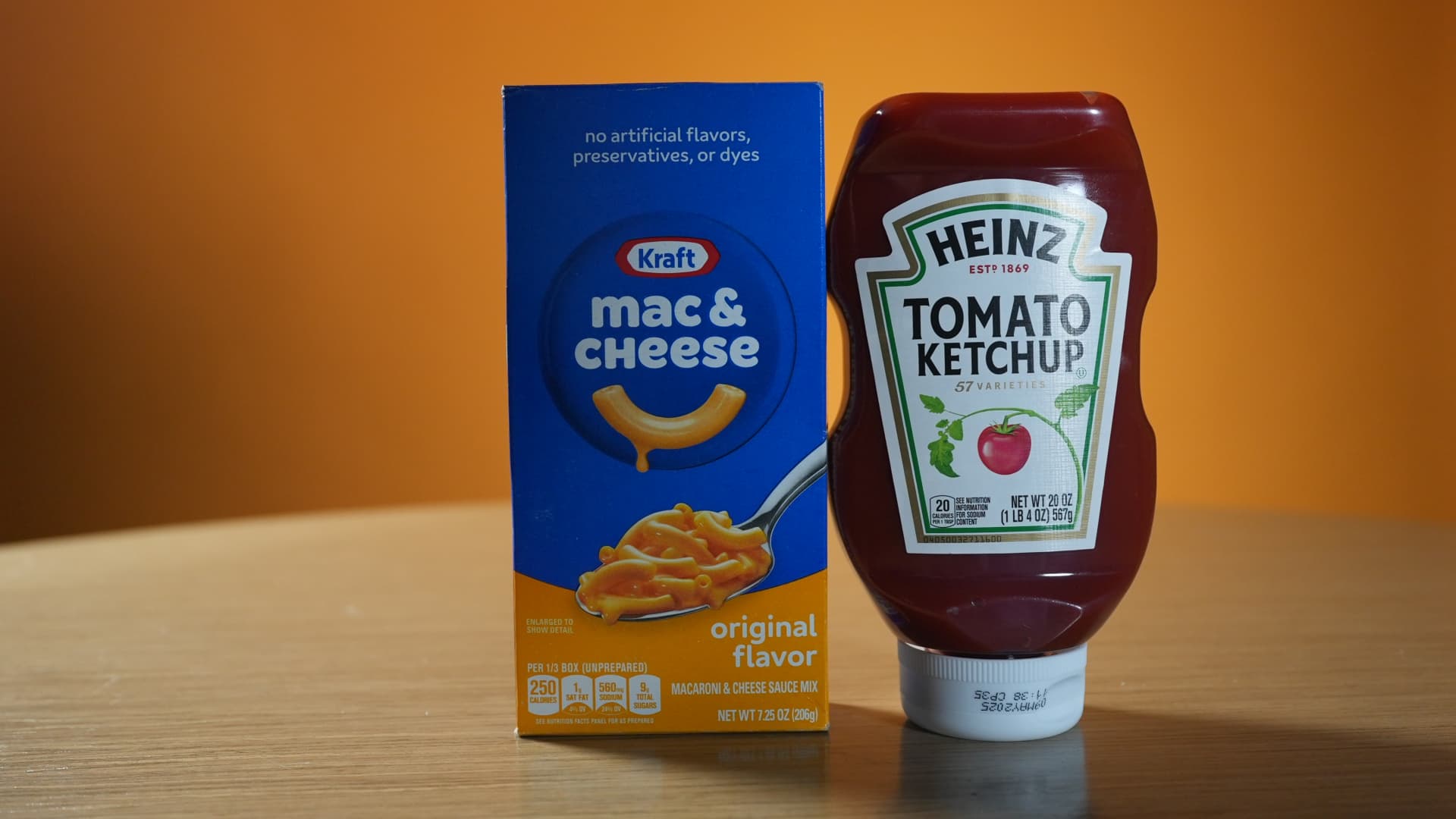
Company Overview - Kraft Heinz will split into two companies, reversing much of the $46 billion merger from a decade ago that created one of the largest food companies globally [1] - The split aims to enhance capital allocation, prioritize initiatives, and drive scale in promising areas, according to Miguel Patricio, executive chair of the board [4] New Company Structure - The first new company will focus on shelf-stable meals, including brands like Heinz, Philadelphia, and Kraft mac and cheese, projected to have $15.4 billion in net sales for 2024, with approximately 75% of sales from sauces, spreads, and seasonings [2] - The second new company will consist of a "scaled portfolio of North America staples," including Oscar Mayer, Kraft singles, and Lunchables, with an estimated $10.4 billion in net sales for 2024 [3] Historical Context - The merger that created Kraft Heinz in 2015 was initiated by Berkshire Hathaway and 3G Capital, initially well-received by investors, but faced challenges as U.S. sales declined [4] - The company faced significant issues, including a subpoena from the SEC regarding accounting policies, a 36% dividend cut, and a $15.4 billion write-down on major brands [5] - Following these challenges, Kraft Heinz underwent leadership changes, additional write-downs, and divestitures of certain business units, including its cheese unit and nuts division [6] Industry Trends - The split aligns with a broader trend in the food industry, where companies are pursuing breakups to divest from slower-growth categories and enhance investor appeal [7] - Other companies, such as Keurig Dr Pepper and Kellogg, have also pursued similar strategies to separate their business units for better performance [7]

零售周报|9月服务消费新政;美团开线下超市;安踏、蜜雪冰城业绩亮眼
Sou Hu Cai Jing· 2025-09-02 01:33
Group 1 - The Ministry of Commerce will introduce several policy measures to expand service consumption in September, focusing on enhancing service supply capabilities and stimulating new service consumption [1] - The Ministry has already implemented various policies this year, including initiatives for elderly tourism, home services, health consumption, and green consumption [1] - The upcoming policies will utilize fiscal and financial tools to optimize service supply and drive actual results in service consumption [1] Group 2 - Li Ning has launched an immersive theater experience called "China Li Ning World" in Shanghai, featuring five themed theaters that blend drama, interaction, and product experience [4] - The experience showcases multiple co-branded series and introduces a new logo in a 3D format [4] Group 3 - The Nordic fragrance brand Yougift will open its first store in Nanjing on August 31, offering a range of products inspired by Nordic culture and nature [6] Group 4 - Anta Group has announced a joint venture with South Korea's Musinsa to establish "Musinsa China," with Anta holding 40% and Musinsa 60% of the shares [7][8] - Musinsa China will focus on developing its own brand "Musinsa STANDARD" and multi-brand stores in the Chinese market [8] Group 5 - Meituan has opened its first self-operated discount supermarket "Happy Monkey" in Hangzhou, marking its entry into the offline retail sector [11] - The company plans to open approximately 10 stores in major cities by 2025, with a long-term goal of reaching 1,000 stores nationwide [11][12] Group 6 - Hema's budget community supermarket Hema NB has been rebranded as "Super Box Calculation NB" to enhance its brand while maintaining its community budget positioning [15] Group 7 - Anta Group reported a 14.3% increase in revenue to 38.54 billion yuan for the first half of 2025, with operating profit rising 17% to 10.131 billion yuan [16] - FILA's revenue reached a record high, growing 8.6% to 14.18 billion yuan, driven by its "ONE FILA" strategy [16] Group 8 - Biyinlefen's revenue increased by 8.6% to 2.103 billion yuan in the first half of 2025, while net profit declined by 13.56% [17] Group 9 - Xiaocaiyuan plans to expand its store count to 1,000 by next year, with a goal of over 3,000 stores in the next decade [18] Group 10 - Mixue Ice City reported a 39.3% increase in revenue to 14.8748 billion yuan for the first half of 2025, with a profit of 2.718 billion yuan, up 44.1% [19][20] Group 11 - Gu Ming's revenue for the first half of 2025 reached 5.6629 billion yuan, a 41.2% increase, with net profit significantly rising [21][22] Group 12 - Tims Coffee reported a 4.9% decline in revenue to 349 million yuan for the second quarter, but food revenue reached a historical high of 35.2% [23] Group 13 - Nayuki's revenue decreased by 14.4% to 2.178 billion yuan in the first half of 2025, while adjusted net losses decreased by 73.1% [24][25] Group 14 - Aeon reported a 3.0% decrease in revenue to 3.931 billion HKD for the first half of 2025, with net losses widening to 226 million HKD [26] Group 15 - Anta and Bosideng have responded to reports of their interest in acquiring Canada Goose, clarifying that they are not potential buyers [27][29] Group 16 - Keurig Dr Pepper has agreed to acquire JDE Peet's for 57 billion euros, with the transaction expected to complete in the first half of 2026 [32] Group 17 - Coca-Cola is evaluating the sale of Costa Coffee, with initial discussions with private equity firms indicating a potential sale price of 2 billion pounds [33]