AWS

Search documents
X @Chainlink
Chainlink· 2025-11-08 13:07
150+ teams. One Road to SmartCon.21X. Aave Horizon. Aerodrome. Airlinez. AllUnity. ANZ. Apex Group. ApeX Exchange. ARC. AWS. Balcony. Bean. Banco Inter. Banco Central do Brasil. BNB Chain. bitsCrunch. BitGo. Bluprynt. Brickken. Bridgetower. BX Digital. Cap. Capricorn. Causeway. CipherOwl. Coinbase. Concero. Chainalysis. Chintai. CovenantFi. Cryptex. Curvance. Denaria. Dexe Drake Exchange. Dinari. Dolomite. Ebisu. Eliza Labs. Enclabs. EntravelX. Enzyme. Ethereum. Euler Labs. Euroclear. FairsquareLab. Falcon. ...
AI服务器换代潮加速,汇丰看好PCB/CCL新一轮涨价周期!
Hua Er Jie Jian Wen· 2025-11-07 06:05
Core Insights - The report from HSBC highlights a significant technological and specification upgrade in the printed circuit board (PCB) and copper-clad laminate (CCL) sectors driven by the rapid evolution of AI servers [1][2] - The introduction of NVIDIA's next-generation Rubin platform is identified as a key catalyst for this upgrade cycle, which is expected to increase both the shipment volume and average selling prices of related products [1][2] Group 1: Drivers of Growth - The growth in the PCB/CCL industry is primarily driven by two engines: NVIDIA's new platform and the ASIC chips from major cloud service providers (CSPs) [2] - NVIDIA's Rubin platform, expected to start mass production in the second half of 2026, will trigger a value leap in PCB/CCL through new structures and increased usage of PCBs [2] - The ASIC market is rapidly becoming a critical catalyst, with major CSPs projected to spend over $420 billion on capital expenditures by 2025, a 61% increase year-on-year [2] Group 2: Pricing Environment - The pricing environment for CCL is becoming increasingly favorable due to tight supply conditions and rising raw material costs [4] - The CCL cost index has risen by 40% over the past six months, driven by a 27% increase in copper prices and a 72% increase in glass fiber prices [4] - Manufacturers are expected to pass on these cost increases to downstream PCB customers, particularly in the high-end market [4] Group 3: Key Players and Market Position - Shengyi Technology is positioned to maintain its leading role in supplying M9-level CCL for NVIDIA's Rubin platform, benefiting from a surge in AI data center orders [4] - Shenzhen South Circuit is becoming a core supplier for major clients like Huawei and Google in the high-value AI PCB sector [4] - Dazhong Laser's M9-level CCL materials are expected to drive demand for high-end drilling equipment, reflecting the increasing complexity of PCB manufacturing [5]





材料革命_行业合作伙伴如何助力英伟达下一代人工智能性能突破-Material Revolution_ How Industry Partners Power Nvidia's Next-Generation AI Performance Breakthrough
2025-11-07 01:28
Summary of Key Points from the Conference Call Industry Overview - The focus of the TPCA Show 2025 in Taipei shifted from manufacturing equipment to materials essential for next-generation electronics, particularly in the context of AI computing growth [5][15][18] - PCB materials, especially copper foils, glass fabrics, and copper-clad laminates (CCLs), are now critical resources in the semiconductor and advanced packaging supply chain [5][15] Core Insights - Industry experts describe the current situation as a "battle before the battlefield," where upstream material bottlenecks are influencing the competition for AI hardware [6][15] - AI servers are redefining material requirements, necessitating substrates that can handle increased thermal stress and high-frequency signaling [7][8] - Traditional materials like FR-4 laminates are becoming inadequate as signaling speeds exceed 224 Gbps, leading to a shift towards low-Dk, low-Df resin systems and advanced copper foils [8][9] Material Shortages and Challenges - Fine-weave glass fabrics and ultra-thin copper foils are in critical shortage, with suppliers fully booked into 2026 [10][11] - The prices of high-end copper foil and T-glass have surged, creating challenges for CCL manufacturers in securing stable long-term supply [12][13] - CCL producers face dual challenges of improving resin performance while managing upstream constraints [13] Strategic Shifts in the Industry - The AI boom is transforming global supply chains, making materials a new geopolitical and economic leverage point [15][16] - Companies that control critical materials will dominate the AI infrastructure market, marking a shift from design-driven differentiation to material-driven leadership [16][18] - Long-term sourcing and co-development alliances are becoming essential strategies for CCL manufacturers to stabilize costs and secure supply [17] Market Dynamics - Demand for GB200/GB300 foils and AI ASIC substrates is surging, with material shortages spreading upstream [17] - The competition is no longer solely about chip design but also about securing high-quality materials and stable supply chains [18][20] - The semiconductor industry is entering a phase of vertical integration that begins in the materials lab, emphasizing the importance of material ownership for future AI developments [20] Conclusion - The TPCA Show 2025 highlights the critical role of materials in the AI era, where advancements in computing depend on the availability and performance of high-quality substrates [18][20] - The future of computing is increasingly tied to the materials that enable technological advancements, making them strategic assets for companies in the semiconductor space [18][20]
ASML中国区总裁沈波:AI浪潮下的“光刻逻辑”
2 1 Shi Ji Jing Ji Bao Dao· 2025-11-06 23:25
Core Insights - ASML has reported strong financial results for the first three quarters of 2025, with net sales of €7.5 billion, net lithography system sales of €5.6 billion, and a net profit of €2.1 billion, reflecting a gross margin of 51.6% [2] - The company anticipates a 15% growth in net sales for 2025 and expects sales in 2026 to be at least at the same level as 2025, with long-term revenue projections for 2030 ranging between €44 billion and €60 billion [2] - AI is identified as a key driver for growth in the global semiconductor industry, with increasing demand for advanced logic chips and DRAM chips benefiting ASML's broader customer base [2][5] Financial Performance - ASML's net sales for Q3 2025 reached €7.5 billion, with a significant portion coming from lithography systems [2] - The company achieved a net profit of €2.1 billion, indicating robust financial health despite the cyclical adjustments in the semiconductor industry [2] Market Outlook - The semiconductor industry is currently in an adjustment phase, gradually moving towards an upward cycle, with ASML maintaining an optimistic outlook on the overall industry prospects [2][11] - AI is expected to play a transformative role in the semiconductor market, with predictions that it will contribute approximately $10 trillion to global GDP by 2030 [6] AI's Impact on Semiconductor Demand - AI is seen as a major force driving the next wave of semiconductor market growth, with the potential to significantly influence chip demand once applications become widespread [5][8] - Current AI developments are still in the investment and construction phase, and the true demand for chip production capacity has yet to be fully realized [3][7] China Market Dynamics - ASML's sales in China have been high due to previously accumulated unfulfilled orders, but the company expects a normalization of business in the Chinese market in the coming years [3][11] - The Chinese market accounted for over 30% of ASML's global sales in recent years, but this is expected to revert to historical levels of 15%-20% as part of the normal cyclical adjustments [12][13] Technological Challenges and Innovations - The AI era presents challenges in terms of computational power and energy consumption, with demand for AI capabilities growing exponentially [9][10] - ASML is pursuing a dual-track strategy to address these challenges, focusing on both 2D scaling and advancing 3D integration technologies to enhance chip performance and efficiency [10]

Genpact(G) - 2025 Q3 - Earnings Call Transcript
2025-11-06 23:00
Financial Data and Key Metrics Changes - Revenue for Q3 2025 increased by 7% year-over-year, reaching $1.291 billion, exceeding guidance by $21 million [4][16] - Gross margin improved to 36.4%, and adjusted operating income margin rose to 17.7%, reflecting healthy margin expansion [4][19] - Adjusted diluted EPS grew 14% year-over-year to $0.97, surpassing the high end of guidance by $0.07 [4][19] Business Line Data and Key Metrics Changes - Advanced technology solutions revenue surged 20% year-over-year to $311 million, now accounting for 24% of total revenue [17] - Core business services revenue grew 3% year-over-year to $980 million, driven by digital operations and technology services [17] - Data tech and AI revenue increased by 9.3% year-over-year to $622 million, while digital operations revenue rose by 4.3% to $669 million [17] Market Data and Key Metrics Changes - Revenue growth was strongest in high-tech and manufacturing at 14%, followed by financial services at 3%, and consumer and healthcare at 1% [18] - Non-FTE revenue accounted for 47% of total revenue, benefiting from advanced technology solutions [18] Company Strategy and Development Direction - The company is focused on establishing itself as a global leader in advanced technology solutions through its Genpact Next framework [5][24] - Investments in partnerships and AI talent are accelerating growth, with partner-related revenue increasing by 56% year-over-year [13] - The company aims to sharpen its go-to-market focus in decision support services to enhance execution and market share [9] Management's Comments on Operating Environment and Future Outlook - Management expressed confidence in the strong demand signals across various client segments and the overall environment [26][28] - The company raised its full-year revenue guidance to a range of 6.1%-6.4% and adjusted diluted EPS to between $3.60 and $3.61, reflecting double-digit growth [15][23] - Management highlighted the importance of building trust with clients as they transition to agentic operations, emphasizing the need for process intelligence alongside AI [40] Other Important Information - The company returned $119 million to shareholders through share repurchases and dividends, representing 59% of free cash flow year-to-date [20] - The company is committed to returning at least 50% of cash flow to investors while maintaining flexibility for strategic investments [23] Q&A Session Summary Question: Can you comment on the bookings performance in Q3? - Management noted strong demand signals across new and existing clients, with five large deals closed in the quarter [26][27] Question: What are the primary reasons clients are not ready to launch agentic operations? - Clients often face issues with data readiness and process standardization, which are critical for implementing advanced technology solutions [31][32] Question: How is the competitive landscape evolving? - The company differentiates itself through last-mile expertise and a strong culture of client centricity and innovation [34][35] Question: Why is a significant portion of agentic work coming from new clients? - New clients are increasingly adopting agentic solutions, while existing clients are also absorbing these solutions, indicating a growing total addressable market [36][37] Question: How are contracts structured for agentic AI solutions? - The company is shifting towards non-FTE models and subscription-based structures for its software solutions [41][42]

X @Avi Chawla
Avi Chawla· 2025-11-06 20:53
AI Agent Infrastructure - The industry is focused on building a real-time context layer for AI Agents across numerous data sources [2] - Airweave offers an open-source context retrieval layer as a solution [2] Technical Challenges & Solutions - Companies face the challenge of querying data spread across multiple sources like Gmail and Drive [2] - A common but potentially insufficient solution is embedding everything in a vector database and using RAG (Retrieval-Augmented Generation) [2]


Tech trade's at a significant inflection point, says GQG Partners' Brian Kersmanc
CNBC Television· 2025-11-04 21:22
Joining me now is GQG partners Brian Kershman. And Brian, it's really great to have you on here to to lay it all out for us. What what is the nature of this inflection point that uh that you there have perceived and uh and how long have we been at risk.How does it play out from here. >> Yeah, thank you very much first of all for for having us and being able to share our views here. Um so in terms of tech I think our biggest issue at this point in time is for all the spending and all the hype that has happen ...

海外再现算力大单交易!恒生科技ETF(513130)近15个交易日共获34.95亿元资金加仓
Sou Hu Cai Jing· 2025-11-04 03:20
Core Viewpoint - The article highlights the increasing investment in AI by major tech companies and the favorable liquidity environment, suggesting that Hong Kong tech assets may benefit from these trends [1]. Group 1: AI Investment and Market Trends - AWS has signed a $38 billion agreement to provide computing power to OpenAI, utilizing hundreds of thousands of NVIDIA GPUs, with all target capacity to be delivered by the end of 2026 [1]. - Recent dovish signals from Federal Reserve officials have strengthened market expectations for interest rate cuts, with a potential 50 basis point cut if future economic data aligns with expectations [1]. Group 2: Hong Kong Tech Sector Performance - The Hang Seng Tech ETF (513130) has seen significant inflows, with 12 out of 15 trading days since October 13, 2025, resulting in a total of 3.495 billion yuan in net inflows, and its latest share count reaching a record high of 52.778 billion [1]. - The Hang Seng Tech Index, which the ETF closely tracks, includes 30 leading Hong Kong tech companies across various sectors, making it a representative index for foreign investors [1]. Group 3: Valuation and Investment Opportunities - The current valuation of the Hang Seng Tech Index is at a price-to-earnings ratio of 22.85, which is in the lower range of the past five years [1]. - The trading volume of the Hang Seng Tech Index accounts for 26.66% of the total Hang Seng Index, also reflecting a lower position compared to the past five years [1]. - The Hang Seng Tech ETF (513130) and its associated funds are positioned as quality tools for investors looking to gain exposure to the Hong Kong tech sector [1]. Group 4: Fund Performance - The Hang Seng Tech ETF (513130) has shown varying performance since its inception, with returns of -30.24%, -21.43%, -8.89%, 21.13%, and 16.37% for the years 2021 to the first half of 2025, respectively [2].
Every increase in tech capital spend will bring a return on capital, says Needham's Laura Martin
CNBC Television· 2025-11-03 19:47
Where are the best places for your money right now. Joining us, Laura Mart Martin, managing director, senior internet analyst at Needm and Company. Laura, I tried to You're the media wiz, so I tried to get like the TV show reference in there.Was it directionally correct. I mean, or does it it seems like everybody is kind of semidating everybody. >> I would make a more practical point here.Amazon is the only cloud company that does not tell us they are capacity constrained because they doubled their power ov ...

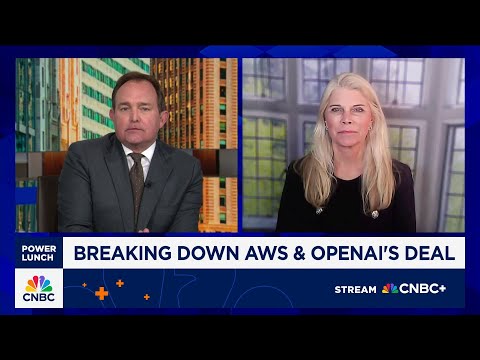
OpenAI is looking to control entire vertical stack of AI, says Plexo Capital's Lo Toney
CNBC Television· 2025-11-03 19:00
Let's discuss all of it with Lo Tony. He's founding managing partner at Plexo Cap Capital. He's also a CNBC contributor.Lo, it's so great to have you here. I mean, Matt went through everything that OpenAI is doing. Obviously, now they are partnering up here with AWS for compute as Microsoft's right of first refusal expired, but it doesn't seem like Microsoft is going to be too poor off right now.They've obviously been making some of your own deals. Can you sort of size up where we are in this space right no ...