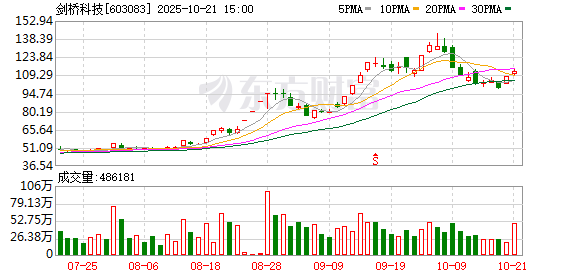
三花智控

Search documents
家用电器行业10月22日资金流向日报
Zheng Quan Shi Bao Wang· 2025-10-22 10:04
Core Points - The Shanghai Composite Index fell by 0.07% on October 22, with nine industries rising, led by the oil and petrochemical sector, which increased by 1.58% [1] - The total net outflow of capital from the two markets was 44.231 billion yuan, with only four industries experiencing net inflows [1] Industry Summary Oil and Petrochemical - The oil and petrochemical industry saw a net inflow of 558 million yuan and a price increase of 1.58% [1] Home Appliances - The home appliance industry rose by 0.82%, with a net capital inflow of 479 million yuan [2] - Out of 94 stocks in this sector, 50 stocks increased, and 3 stocks hit the daily limit [2] - The top three stocks with the highest net inflow were: - Haier Group: 446 million yuan [2] - Sanhua Intelligent Controls: 203 million yuan [2] - Stone Technology: 57 million yuan [2] Electronics - The electronics industry had the largest net outflow of capital, totaling 8.021 billion yuan [1] Power Equipment - The power equipment sector experienced a net outflow of 6.284 billion yuan [1] Non-Banking Financials and Nonferrous Metals - Both non-banking financials and nonferrous metals also saw significant net outflows, contributing to the overall market decline [1]




家电零部件板块10月22日涨1.56%,海立股份领涨,主力资金净流入5.09亿元
Zheng Xing Xing Ye Ri Bao· 2025-10-22 08:19
Core Insights - The home appliance components sector saw a rise of 1.56% on October 22, with Haili Co., Ltd. leading the gains [1] - The Shanghai Composite Index closed at 3913.76, down 0.07%, while the Shenzhen Component Index closed at 12996.61, down 0.62% [1] Market Performance - Haili Co., Ltd. (600619) closed at 23.65, up 10.00% with a trading volume of 472,500 shares and a transaction value of 1.102 billion yuan [1] - Other notable performers included: - Zhenbang Intelligent (003028) at 32.19, up 3.37% [1] - Sanhua Intelligent Control (002050) at 48.10, up 2.49% [1] - The sector experienced a net inflow of 509 million yuan from main funds, while retail investors saw a net outflow of 246 million yuan [2][3] Fund Flow Analysis - Haili Co., Ltd. had a net inflow of 397 million yuan from main funds, but a net outflow of 209 million yuan from retail investors [3] - Sanhua Intelligent Control experienced a net inflow of 137 million yuan from main funds, with a slight net outflow from retail investors [3] - The overall trend showed that while main funds were entering the market, retail investors were withdrawing [2][3]



永杰新材:公司液冷板材料在冷却技术领域有成熟应用并已稳定量产
Zheng Quan Shi Bao Wang· 2025-10-22 07:51
Core Viewpoint - Yongjie New Materials (603271) has confirmed its mature application of liquid cooling plate materials in solid-state battery cooling technology, indicating a stable mass production and integration into major domestic manufacturers' supply chains [1] Group 1: Company Developments - Yongjie New Materials has established a partnership in solid-state battery cooling technology, showcasing its liquid cooling plate materials [1] - The company's products are compatible with solid-state battery applications and have achieved stable mass production [1] Group 2: Market Position - Yongjie New Materials' liquid cooling plate materials have been integrated into the supply chains of major domestic manufacturers such as Sanhua Intelligent Controls (002050) and Kexin New Energy (300731) [1]
A股收评:三大指数集体收跌 两市成交额萎缩至1.67万亿
2 1 Shi Ji Jing Ji Bao Dao· 2025-10-22 07:20
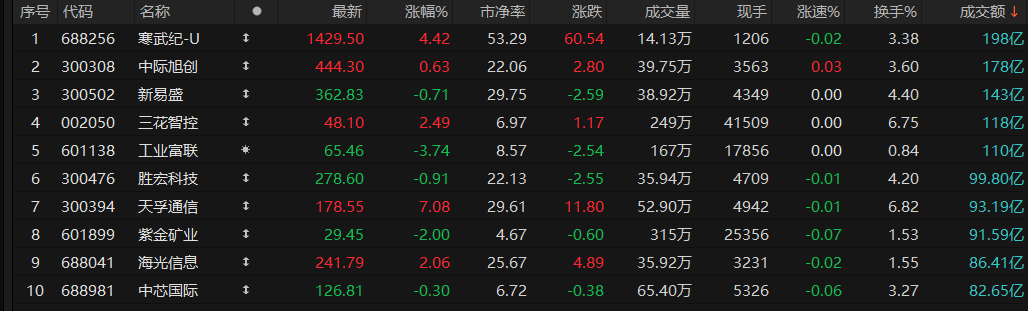
Market Performance - The market experienced a weak fluctuation throughout the day, with all three major indices showing a decline by the end of trading: Shanghai Composite Index down 0.07%, Shenzhen Component Index down 0.62%, and ChiNext Index down 0.79% [1] Sector Performance - The deep earth economy concept stocks showed strength, with ShenKai Co., Petrochemical Machinery, and CITIC Heavy Industries achieving three consecutive trading limit ups [2] - Hubei state-owned assets concept stocks continued to perform well, with Wuhan Holdings and others advancing to two consecutive trading limit ups [3] - Oil and gas stocks surged in the afternoon, with Beiken Energy hitting the trading limit up [4] - The banking sector performed strongly against the trend, with Agricultural Bank of China reaching a historical high [5] - In contrast, battery stocks collectively weakened, with Tianji Co. and Tianci Materials experiencing significant declines [6] Trading Volume - The total trading volume in the Shanghai and Shenzhen markets was 1.67 trillion yuan, indicating a further contraction in trading volume, down 224.8 billion yuan compared to the previous trading day [7] Individual Stock Performance - In terms of individual stocks, Cambrian Technologies-U had the highest trading volume at 19.8 billion yuan, followed by Zhongji Xuchuang, Xinyi Sheng, Sanhua Intelligent Control, and Industrial Fulian with significant trading volumes [8]



A股午评:创业板指跌近1%,黄金概念股集体下挫
2 1 Shi Ji Jing Ji Bao Dao· 2025-10-22 03:53
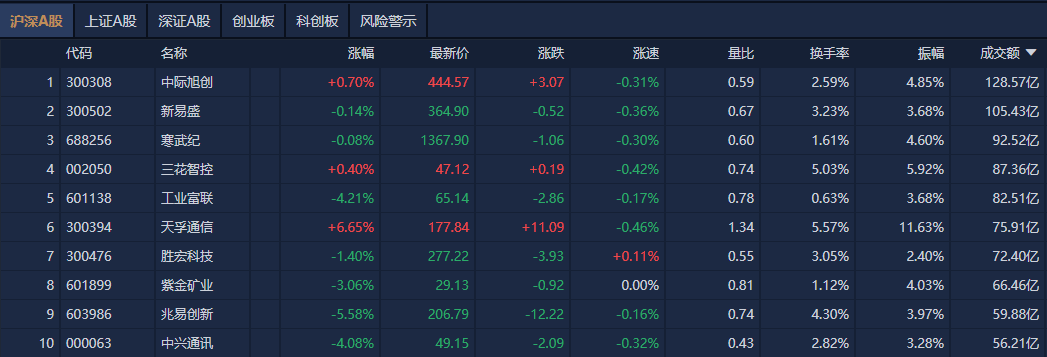
Market Overview - The market experienced fluctuations, with the Shenzhen Component Index and ChiNext Index briefly turning positive before declining again. As of the morning close, the Shanghai Composite Index fell by 0.44%, the Shenzhen Component Index decreased by 0.81%, and the ChiNext Index dropped by 0.89% [1] Sector Performance - The deep earth economy concept continued to perform strongly, with companies like ShenKai Co. and Petrochemical Machinery achieving three consecutive trading limit increases [1] - The Hubei state-owned assets concept maintained its strength, with stocks such as Wuhan Holdings and Hubei Broadcasting advancing to two consecutive trading limit increases [1] - The controllable nuclear fusion concept saw renewed strength, with AnTai Technology and Atlantic both hitting the trading limit [1] Declining Sectors - The gold sector experienced a collective pullback, with Hunan Silver hitting the trading limit down [2] - The natural gas sector weakened, with Guo Xin Energy also hitting the trading limit down [2] Trading Volume - The total trading volume of the Shanghai and Shenzhen stock markets was 1.1 trillion yuan, a decrease of 53.5 billion yuan compared to the previous trading day [3] Individual Stock Performance - Zhongji Xuchuang had the highest trading volume, exceeding 12.8 billion yuan, followed by XinYisheng, Hanwujing, and Sanhua Intelligent Control with significant trading volumes [4]

宇树科技官宣发布H2仿生人形机器人,汽车零件ETF(159306)机器人含量高,涨超1.0%
Xin Lang Cai Jing· 2025-10-22 02:50
Group 1 - Yushu Technology officially announced the release of the H2 bionic humanoid robot, which stands 180 cm tall and weighs 70 kg, showcasing capabilities in dance and martial arts performance [1] - As of October 22, 2025, the CSI Automotive Parts Theme Index (931230) increased by 0.94%, with component stocks such as Dayang Electric (002249) rising by 10.02% and Lingyun Co., Ltd. (600480) by 7.81% [1] - The Automotive Parts ETF (159306) also rose by 0.94%, marking a three-day consecutive increase, with a latest price of 1.4 yuan [1] Group 2 - As of September 30, 2025, the top ten weighted stocks in the CSI Automotive Parts Theme Index accounted for 43.35% of the index, including companies like Huichuan Technology (300124) and Fuyao Glass (600660) [2] - The Automotive Parts ETF has several off-market connections, including Ping An CSI Automotive Parts Theme ETF Connect A (022731) and C (022732) [2]

50亿采购订单被证伪,「三花智控」再现重大利好
Robot猎场备忘录· 2025-10-22 00:03
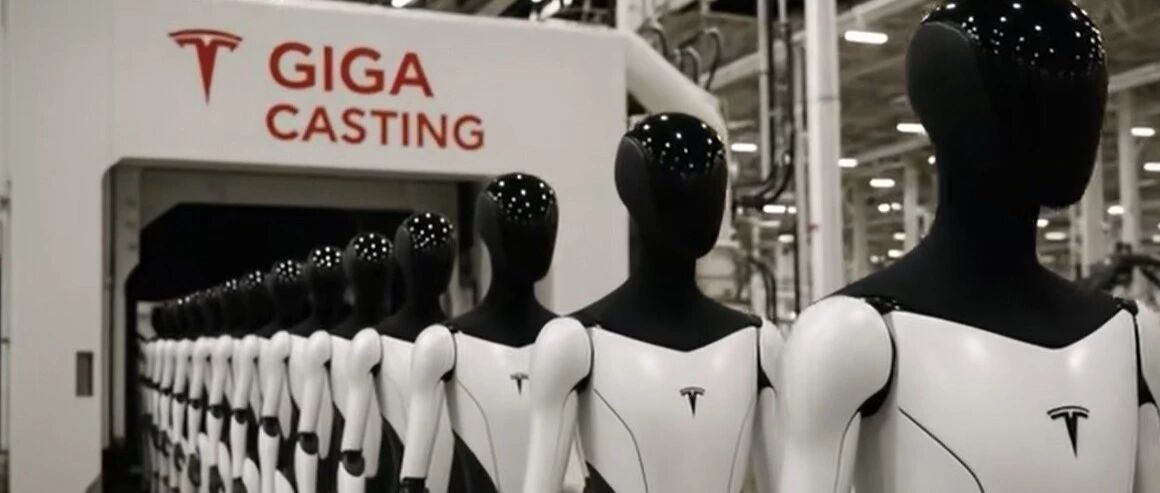
Core Insights - The article discusses the recent developments surrounding the company Sanhua Intelligent Control, particularly its role as a Tier 1 supplier for Tesla's Optimus project, and how it has positively influenced the robotics sector despite the retraction of a significant procurement order [2][5]. Group 1: Company Developments - Sanhua Intelligent Control was reported to have received a $685 million (approximately 5 billion yuan) order from Tesla for Optimus linear actuators, which led to a surge in its stock price and positively impacted the robotics sector [2][4]. - Following the initial excitement, Sanhua issued a statement denying the validity of the procurement order, which caused a brief market correction but did not significantly affect its stock performance [5][8]. - On October 17, Sanhua announced an increase in its share buyback price limit from 35.75 yuan to 60.00 yuan per share, extending the buyback period until February 28, 2026, indicating confidence in its stock value [8]. Group 2: Market Reactions - Despite the denial of the procurement order, Sanhua's stock exhibited resilience, showing an upward trend and leading the robotics sector in performance during the subsequent market downturn [8][9]. - On October 20, Sanhua continued to lead the robotics sector, with a reported expenditure of 20.01 million yuan to repurchase 430,000 shares, further demonstrating its commitment to shareholder value [9]. Group 3: Industry Outlook - The article highlights that the robotics sector is poised for potential growth in the fourth quarter, driven by multiple upcoming events related to Tesla's Optimus project, including factory audits and performance reviews [10]. - A comprehensive list of nearly 70 companies involved in the Tesla Optimus supply chain has been compiled, indicating a robust ecosystem supporting the robotics industry [10].
偏好新经济领域 险资加速掘金港股
Bei Jing Shang Bao· 2025-10-21 15:35
Core Viewpoint - The Hong Kong IPO market has seen significant activity this year, with insurance capital becoming a notable force as cornerstone investors in new listings, reflecting a shift in investment strategy towards stable returns in the context of favorable market conditions [1][2]. Group 1: Insurance Capital Participation - Insurance institutions have participated as cornerstone investors in 7 Hong Kong IPOs this year, with a total subscription amount of approximately 34.4 billion HKD, which is more than three times the total of less than 10 billion HKD from the previous year [1]. - The participation of insurance capital in Hong Kong IPOs is driven by the need for stable investment returns, the relatively low valuations in the market, and supportive regulatory policies encouraging long-term investments [1][2]. Group 2: Active Insurance Institutions - Among the most active insurance institutions in the Hong Kong IPO market are Taikang Life and China Pacific Insurance, with Taikang Life participating in 6 IPOs, while China Pacific Insurance and its subsidiaries have appeared twice as cornerstone investors [3]. - Other participants include Zhongyou Insurance and Dajia Life, each participating in one IPO as cornerstone investors [3]. Group 3: Investment Preferences - Insurance capital shows a preference for sectors such as technology, consumer goods, and new energy, including industries like automotive, home appliances, semiconductors, and energy storage [3]. - This investment strategy aligns with the growth potential of new economy sectors and the national industrial development direction, indicating a focus on high-growth and quality assets [3].

险资加速掘金港股IPO 选股逻辑看重什么?
Bei Jing Shang Bao· 2025-10-21 12:34
Core Insights - The Hong Kong IPO market has seen significant activity this year, with insurance funds becoming a notable force as cornerstone investors in new listings [2][3] - Insurance funds have collectively invested over 34.4 billion HKD in seven IPOs, a substantial increase compared to less than 10 billion HKD in the previous year [2][3] Group 1: Investment Trends - Insurance funds are actively participating in Hong Kong IPOs due to the need for stable investment returns and the availability of new economy enterprises in the market [3] - The overall valuation of the Hong Kong market is relatively low after adjustments, particularly in technology and consumer sectors, which are seen as having long-term investment value [3] - Regulatory policies are encouraging long-term investments from insurance funds, creating a favorable environment for overseas investments [3] Group 2: Active Participants - Among the insurance institutions, TaiKang Life and China Pacific Insurance have been the most active in cornerstone investments in Hong Kong IPOs, with TaiKang Life participating in six IPOs [4] - Other participants include Zhongyou Insurance and Dajia Life, each involved in one IPO [4] Group 3: Sector Preferences - Insurance funds show a preference for sectors such as technology, consumer goods, and renewable energy, including industries like automotive, home appliances, and semiconductor [5] - These sectors align with national industrial development directions and are characterized by high growth potential [5]