
易方达基金

Search documents
两市ETF两融余额减少28.21亿元丨ETF融资融券日报
2 1 Shi Ji Jing Ji Bao Dao· 2025-11-21 03:15
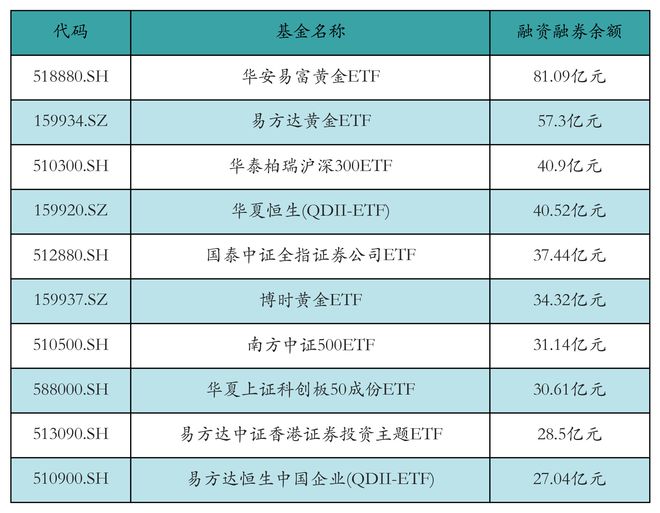
Market Overview - As of November 20, the total ETF margin balance in the two markets is 120.919 billion, a decrease of 2.821 billion from the previous trading day [1] - The financing balance is 113.28 billion, down by 2.566 billion, while the margin short balance is 7.639 billion, decreasing by 0.255 billion [1] - In the Shanghai market, the ETF margin balance is 84.407 billion, down by 2.443 billion, with a financing balance of 77.726 billion, decreasing by 2.172 billion [1] - The Shenzhen market's ETF margin balance is 36.512 billion, down by 0.379 billion, with a financing balance of 35.553 billion, decreasing by 0.394 billion [1] ETF Margin Balance - The top three ETFs by margin balance on November 20 are: - Huaan Yifu Gold ETF (8.109 billion) - E Fund Gold ETF (5.73 billion) - Huatai-PB CSI 300 ETF (4.09 billion) [2] - The detailed top 10 ETFs by margin balance are provided in the table [2] ETF Financing Amount - The top three ETFs by financing amount on November 20 are: - Huatai-PB Southbound Hang Seng Technology Index (1.467 billion) - E Fund CSI Hong Kong Investment Theme ETF (1.241 billion) - Bosera CSI Convertible Bonds and Exchangeable Bonds ETF (0.951 billion) [3] - The detailed top 10 ETFs by financing amount are provided in the table [4] ETF Net Financing Amount - The top three ETFs by net financing amount on November 20 are: - Huaxia Shanghai Stock Exchange Sci-Tech Innovation Board 50 ETF (88.5893 million) - Huatai-PB Southbound Hang Seng Technology Index (58.9784 million) - Southern CSI 500 ETF (58.7087 million) [5] - The detailed top 10 ETFs by net financing amount are provided in the table [6] ETF Margin Short Selling Amount - The top three ETFs by margin short selling amount on November 20 are: - Southern CSI 500 ETF (37.8834 million) - Huatai-PB CSI 300 ETF (37.877 million) - Huaxia CSI A500 ETF (25.0182 million) [7] - The detailed top 10 ETFs by margin short selling amount are provided in the table [8]

建筑材料、银行等防御类ETF逆市领涨丨ETF基金日报
2 1 Shi Ji Jing Ji Bao Dao· 2025-11-21 03:09
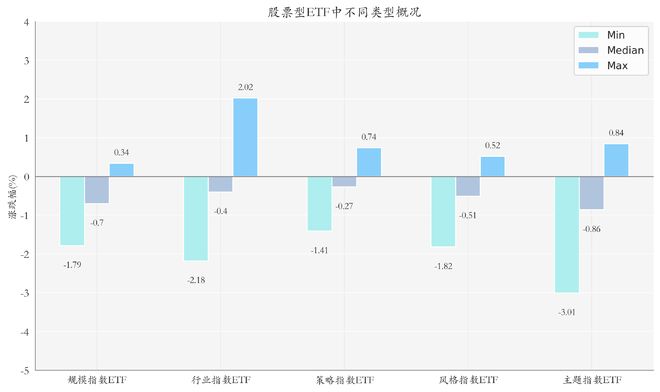
Market Overview - The Shanghai Composite Index fell by 0.4% to close at 3931.05 points, with a high of 3967.97 points during the day [1] - The Shenzhen Component Index decreased by 0.76% to 12980.82 points, reaching a peak of 13226.04 points [1] - The ChiNext Index dropped by 1.12% to 3042.34 points, with a maximum of 3137.07 points [1] ETF Market Performance - The median return of stock ETFs was -0.67% [2] - The highest performing scale index ETF was the China Southern Shenzhen 100 ETF with a return of 0.34% [2] - The top industry index ETF was the China Tai Zhongzheng All Index Building Materials ETF, yielding 2.02% [2] - The highest return among strategy index ETFs was the China Tai Baichuan Zhongzheng Dividend Low Volatility ETF at 0.74% [2] - The best performing thematic index ETF was the Yinhua Zhongzheng Mainland Real Estate Theme ETF, with a return of 0.84% [2] ETF Performance Rankings - The top three ETFs by return were: - Guotai Zhongzheng All Index Building Materials ETF (2.02%) [4] - Fuguo Zhongzheng All Index Building Materials ETF (1.56%) [4] - Huabao Zhongzheng 800 Real Estate ETF (1.52%) [4] - The worst performing ETFs included: - Penghua SSE Sci-Tech Innovation Board New Energy ETF (-3.01%) [4] - Yifangda SSE Sci-Tech Innovation Board New Energy ETF (-2.91%) [4] - Fuguo SSE Sci-Tech Innovation Board New Energy ETF (-2.78%) [4] ETF Fund Flows - The top three ETFs by fund inflow were: - Southern Zhongzheng 500 ETF (7.6 billion) [6] - Huaxia SSE Sci-Tech Innovation Board 50 Component ETF (7.59 billion) [6] - Southern Zhongzheng 1000 ETF (4.18 billion) [6] - The largest outflows were from: - Huabao Zhongzheng Bank ETF (4.33 billion) [6] - Huatai Baichuan SSE 300 ETF (4.07 billion) [6] - Huabao Zhongzheng Financial Technology Theme ETF (3.25 billion) [6] ETF Margin Trading Overview - The highest margin buy amounts were: - Huaxia SSE Sci-Tech Innovation Board 50 Component ETF (5.56 billion) [8] - Guotai Zhongzheng All Index Securities Company ETF (4.8 billion) [8] - Yifangda ChiNext ETF (4.78 billion) [8] - The largest margin sell amounts were: - Southern Zhongzheng 500 ETF (37.88 million) [8] - Huatai Baichuan SSE 300 ETF (37.87 million) [8] - Huaxia Zhongzheng A500 ETF (25.01 million) [8] Institutional Insights - Huafu Securities suggests that the building materials capacity cycle may reach an inflection point due to accelerated expectations of "anti-involution" [9] - The combination of declining interest rates and monetary support for housing may stabilize the real estate market, potentially boosting post-cycle demand [9] - Debon Securities highlights that undervalued financial stocks, such as insurance and banks, possess defensive allocation value amid a weak market [10]
晶科能源股价跌5.11%,易方达基金旗下1只基金位居十大流通股东,持有1.47亿股浮亏损失4423.21万元
Xin Lang Cai Jing· 2025-11-21 03:06
Group 1 - JinkoSolar's stock price decreased by 5.11% to 5.57 CNY per share, with a trading volume of 352 million CNY and a turnover rate of 0.62%, resulting in a total market capitalization of 55.729 billion CNY [1] - JinkoSolar, established on December 13, 2006, and listed on January 26, 2022, is based in Shanghai and specializes in the research, production, and sales of solar photovoltaic modules, cells, and wafers, providing high-quality solar products globally [1] - The company's main business revenue is entirely derived from product sales, accounting for 100% of its income [1] Group 2 - E Fund's ETF, the E Fund SSE STAR 50 ETF (588080), is among JinkoSolar's top ten circulating shareholders, having reduced its holdings by 18.2429 million shares in the third quarter, now holding 147 million shares, which is 1.47% of the circulating shares [2] - The E Fund SSE STAR 50 ETF has a current scale of 76.761 billion CNY, with a year-to-date return of 34.69%, ranking 1058 out of 4208 in its category [2] - The fund manager Lin Weibin has a tenure of 12 years and 264 days, with a total fund asset scale of 122.692 billion CNY, achieving a best return of 84.68% during his tenure [2]

晶澳科技股价跌5.45%,易方达基金旗下1只基金位居十大流通股东,持有2443.83万股浮亏损失1759.56万元
Xin Lang Cai Jing· 2025-11-21 02:46
Group 1 - The core point of the news is that JinkoSolar Technology Co., Ltd. has experienced a significant decline in stock price, dropping 5.45% to 12.50 CNY per share, with a total market capitalization of 41.371 billion CNY and a cumulative drop of 8.7% over four consecutive days [1] - JinkoSolar's main business includes the research, production, and sales of silicon wafers, solar cells, and solar modules, as well as the development, construction, and operation of solar photovoltaic power plants. The revenue composition is as follows: photovoltaic modules 91.10%, others 5.85%, and photovoltaic power station operation 3.05% [1] Group 2 - From the perspective of JinkoSolar's top ten circulating shareholders, E Fund's Hu Shen 300 ETF reduced its holdings by 796,400 shares in the third quarter, now holding 24.4383 million shares, which accounts for 0.74% of circulating shares. The estimated floating loss today is approximately 17.5956 million CNY, with a total floating loss of 30.7923 million CNY during the four-day decline [2] - E Fund's Hu Shen 300 ETF was established on March 6, 2013, with a current scale of 305.165 billion CNY. Year-to-date returns are 18.95%, ranking 2641 out of 4208 in its category, while the one-year return is 17.57%, ranking 2380 out of 3972. Since inception, the return is 134.53% [2]

嘉元科技股价跌5.31%,易方达基金旗下1只基金重仓,持有5.97万股浮亏损失11.35万元
Xin Lang Cai Jing· 2025-11-21 02:14
Group 1 - The core viewpoint of the news is that 嘉元科技 (Jia Yuan Technology) has experienced a significant decline in stock price, dropping 5.31% to 33.90 yuan per share, with a total market capitalization of 14.45 billion yuan, and a cumulative decline of 9.34% over three consecutive days [1] - 嘉元科技 specializes in the research, production, and sales of high-performance electrolytic copper foil, with its main business revenue composition being 83.77% from lithium battery copper foil, 12.64% from other income, and 3.58% from standard copper foil [1] - 易方达上证科创板200ETF (E Fund SSE Sci-Tech Innovation Board 200 ETF) holds 嘉元科技 as its fourth largest position, with 59,700 shares, accounting for 1.22% of the fund's net value, resulting in a floating loss of approximately 113,500 yuan today and a total floating loss of 220,500 yuan during the three-day decline [2] Group 2 - The 易方达上证科创板200ETF was established on June 5, 2025, with a current scale of 183 million yuan and a cumulative return of 28.36% since inception [2] - The fund manager, 李博扬 (Li Boyang), has been in position for 1 year and 223 days, managing total assets of 5.759 billion yuan, with the best fund return during his tenure being 100.81% and the worst being -1.34% [2]

276只ETF获融资净买入 华夏上证科创板50ETF居首
Zheng Quan Shi Bao Wang· 2025-11-21 02:04
Core Viewpoint - As of November 20, the total margin balance for ETFs in the Shanghai and Shenzhen markets is 120.919 billion yuan, showing a decrease of 2.821 billion yuan from the previous trading day [1] Summary by Category ETF Margin Balance - The ETF financing balance is 113.28 billion yuan, down by 2.566 billion yuan from the previous trading day [1] - The ETF margin short balance is 7.639 billion yuan, decreasing by 255 million yuan compared to the previous trading day [1] Net Inflows - On November 20, 276 ETFs experienced net financing inflows, with the Huaxia Shanghai Stock Exchange Sci-Tech Innovation Board 50 ETF leading with a net inflow of 88.5893 million yuan [1] - Other ETFs with significant net inflows include the Huatai-PB Hang Seng Technology ETF, Southern CSI 500 ETF, Huaxia Hang Seng Internet Technology ETF, Huaxia Hang Seng Technology ETF, and the E Fund ChiNext ETF [1]
又要见证历史!超5万亿市场传来大消息!
天天基金网· 2025-11-21 01:07
Core Viewpoint - The recent regulatory changes in the ETF market aim to enhance product identification and investor experience, addressing the issue of name homogeneity among ETFs [3][5][10]. Summary by Sections Regulatory Changes - The Shanghai and Shenzhen Stock Exchanges have introduced new guidelines for the naming of existing ETFs, requiring that names include the fund manager's abbreviation and follow specific structural formats [3][6][7]. - The deadline for fund managers to complete the renaming process is set for March 31, 2026 [6][7]. Market Impact - The new naming conventions are expected to improve the recognition and attractiveness of ETF products, allowing investors to make quicker and more informed decisions [3][9][12]. - The ETF market has surpassed 5 trillion yuan, and the renaming initiative is seen as a significant step towards strengthening the index investment ecosystem [12]. Industry Response - Several fund companies, including E Fund, Huatai-PB, and GF Fund, have already begun the process of renaming their ETFs to align with the new guidelines, enhancing clarity and ease of identification for investors [11][12]. - Industry experts believe that the inclusion of fund manager names in ETF titles will favor well-known brands, potentially disadvantaging smaller firms in a competitive market [12].

AI入场“挑战”基金经理
Zheng Quan Ri Bao· 2025-11-20 23:18
Core Viewpoint - The public fund industry is facing a transformative wave driven by AI, which is seen as a necessary evolution rather than a mere trend, with AI becoming a critical factor for long-term industry development [1][2]. Group 1: Internal Demand Driving AI Adoption - The push for AI adoption in public funds is driven by the urgent need to address deep-seated industry pain points, with firms like Tianhong Fund emphasizing that AI is not just a trend but a means to break through existing challenges [2]. - The asset management industry has a significant demand for advanced AI technologies due to its reliance on data analysis and information processing, as highlighted by various fund companies [2]. - Traditional business models are in urgent need of digital transformation, and AI is seen as a key to enhancing competitiveness by efficiently processing vast amounts of information and automating processes [2][3]. Group 2: AI's Role in Enhancing Research Capabilities - AI is increasingly integrated into core business lines such as research, marketing, and customer service, leading to an upgrade in fund research capabilities [4]. - In active management, AI serves as a powerful assistant, helping to identify opportunities from vast data and providing quantifiable advantages in predictive modeling [4][6]. - AI can also challenge traditional thinking among fund managers, prompting them to consider risks and opportunities that may be overlooked by human intuition [6]. Group 3: Data Security and Model Reliability Concerns - As AI becomes more embedded in the industry, data security and model reliability have emerged as critical concerns, with analysts noting risks such as data leakage and compliance issues [7]. - Fund companies are actively working to establish robust data security measures, with Tianhong Fund implementing a multi-layered control system to ensure the reliability of AI conclusions [7]. - The need for accurate and secure data is paramount, as financial data is highly sensitive and involves customer privacy, necessitating careful management of data integration across institutions [7]. Group 4: Future Outlook for AI in the Industry - The future application of AI in the public fund industry is expected to evolve, focusing on relieving professionals from repetitive tasks and allowing them to concentrate on value creation [8]. - The industry is still in the exploratory phase of AI application, with potential advancements in building specialized models and enhancing collaboration across institutions [8]. - Companies like Yifangda Fund are setting examples in AI talent development, emphasizing the integration of technology, business understanding, and compliance awareness to drive financial AI innovation [8].
是助手更是诤友 AI入场“挑战”基金经理
Zheng Quan Ri Bao· 2025-11-20 16:16
Core Insights - The public fund industry is facing a significant transformation driven by the adoption of AI technologies, which are seen as essential for long-term development rather than a mere trend [1][2] - AI is increasingly viewed as both a challenger to traditional fund management practices and a means to enhance research capabilities within the industry [1][4] Group 1: Internal Demand for AI - The push for AI adoption in public funds is primarily driven by the urgent need to address deep-seated industry challenges, such as efficiency improvement and risk control [2][3] - AI technologies are crucial for processing vast amounts of data and automating workflows, which are essential for enhancing competitiveness in asset management [2][3] - Institutions like Tianhong Fund have recognized that traditional models lead to diminishing returns as scale increases, and AI enables "intelligent scaling" to convert scale advantages into service capabilities [2][3] Group 2: AI's Role in Investment Research - AI is enhancing the investment research capabilities of fund companies by serving as both an assistant and a challenger to traditional thinking [4][5] - In active management, AI tools like Tianhong's TIRD platform and deep learning models from other firms are proving effective in identifying investment opportunities from large datasets [4][5] - AI can sometimes provide contrary signals to fund managers, which can help mitigate risks and protect performance, showcasing the value of human-machine collaboration [5][6] Group 3: Data Security and Model Reliability - As AI becomes more integrated into core business functions, data security and model reliability have emerged as critical concerns for the industry [6][7] - Challenges include data leakage, compliance risks, and the need for accurate and secure data management practices [6][7] - Firms are actively developing comprehensive security frameworks to ensure the reliability of AI-driven conclusions while maintaining data privacy [7] Group 4: Future Outlook for AI in Public Funds - The future application of AI in the public fund industry is expected to evolve, focusing on reducing repetitive tasks and enhancing value creation through better decision-making [7][8] - The industry is still in the exploratory phase of AI application, with potential advancements in specialized models and cross-institutional data collaboration [7][8] - Companies like E Fund are leading in AI talent development, emphasizing the integration of technology, business understanding, and compliance awareness to drive innovation [7][8]
全市场FOF产品规模较年初增长超70%
Zheng Quan Ri Bao· 2025-11-20 16:09
Core Insights - The establishment of E Fund's Ruiyi Ying'an 6-month holding mixed fund (FOF) has raised 5.848 billion yuan, marking it as the largest FOF product in terms of fundraising in Q4 2023 [1] - The FOF market has seen a significant surge in issuance this year, with 79 new FOF products launched, totaling 65.728 billion units, surpassing the combined issuance of 2023 and 2024 [1] - The total scale of FOF products in the market has reached 221.992 billion yuan, reflecting a 70.13% increase since the beginning of the year, primarily driven by newly launched funds [1] Fund Issuance Trends - A total of 18 FOF products have exceeded 1 billion units in issuance this year, with the top product, Dongfanghong Yingfeng, reaching 6.573 billion units [2] - The issuance of FOF products has accelerated in Q4, with 27 products launched and a total issuance of 25.893 billion units, significantly higher than the previous quarters [1][2] - The majority of FOF products currently being issued are mixed-type, with only one being a bond-type FOF [3] Market Dynamics - The strong performance of FOF products, with an overall net value growth rate exceeding 12% this year, has attracted considerable investor interest [2] - The diversification of underlying asset allocation in FOF products has better aligned with the varying risk preferences of investors [2] - There are currently 12 FOF products in the issuance process, and 37 new FOF products are awaiting approval from 28 fund management companies [3]