Anthropic

Search documents
Everything you need to know about ChatGPT 5.3 Codex
Matthew Berman· 2026-02-06 14:00
Open AAI and Anthropic are going head-to-head within minutes of each other. Opus 4.6% was dropped and now GPT 5.3% Codeex. They are both going so hard into a Gentic coding.That is where the industry is headed. That is where all of these frontier labs are investing their time. Long horizon task, agents, sub aents, agent teams.One of the biggest complaints about codec has been how slow it is. A lot of people say it is the best coding model out there, but it is so brutally slow as compared to Opus and other co ...


AI Model Advancements Do Not Alter the Quantum Threat Model — They Reinforce the Need for SEALSQ Type of Post-Quantum Secure Infrastructure
Globenewswire· 2026-02-06 13:45
Core Viewpoint - Recent advancements in classical AI, such as Anthropic's Claude Opus 4.6, do not materially alter the quantum computing threat landscape or the requirements for quantum-secure cryptographic architectures [1][5]. Quantum Computing vs. Classical AI - Quantum computing operates on principles like superposition and entanglement, requiring scalable qubit architectures and fault-tolerant error correction, which are not addressed by classical AI advancements [3][4]. - Large language models, including Claude Opus 4.6, cannot execute quantum algorithms or undermine post-quantum cryptographic methods [4][5]. Security Architecture Implications - The quantum threat model remains unchanged, with the need for post-quantum cryptography and secure hardware components still essential for long-term digital trust [6][8]. - The deployment of advanced AI systems increases the urgency for quantum-secure infrastructure, as it expands the digital attack surface and accelerates vulnerability discovery [8][9]. Market Reactions and Industry Dynamics - Market reactions to AI announcements reflect disruptions in enterprise software rather than foundational security technology changes [7]. - The anticipated impacts of AI are primarily in automation and content generation, which do not apply to secure silicon and cryptographic hardware governed by physical constraints [7]. SEALSQ's Position and Offerings - SEALSQ is focused on developing post-quantum technology solutions, integrating semiconductors and PKI to address security challenges posed by quantum computing [10][11]. - The company is pioneering post-quantum semiconductors designed to protect sensitive data across various applications, ensuring resilience against quantum threats [12].
Bitcoin's rough week, Amazon's plunge, Super Bowl ads and more in Morning Squawk
CNBC· 2026-02-06 13:29
分组1 - Stellantis expects a $26 billion hit from a business overhaul, leading to a more than 25% drop in its U.S.-listed shares [1] - The company's stock has already decreased over 12% at the start of 2026 [1] 分组2 - Bob's Discount Furniture had its IPO priced at $17 per share, valuing the company at $2.22 billion [8] - The IPO comes at a time when traditional IPOs raised $33.6 billion in 2025, marking the best year since 2021 [8] 分组3 - Peloton shares fell more than 25% due to weak quarterly earnings and demand [9] - Estée Lauder's stock dropped over 19% after announcing a $100 million hit to full-year profitability due to tariffs [9]


Anthropic步步紧逼OpenAI,大型SaaS却先崩盘
第一财经· 2026-02-06 12:59
Core Viewpoint - The competition between major AI model companies, particularly OpenAI and Anthropic, is intensifying as both firms release updates to their foundational models, focusing on enhancing task execution capabilities and AI agent functionalities, which has led to a sell-off in the software sector [2][5]. Group 1: Model Updates and Competition - OpenAI and Anthropic launched updates to their models, GPT-5.3-Codex and Claude Opus 4.6, respectively, with a focus on AI agents and engineering capabilities [2][5]. - GPT-5.3-Codex is touted as having the "best programming performance," with a significant reduction in token consumption during task execution compared to its predecessor [5]. - Claude Opus 4.6 has improved programming skills and excels in financial analysis and document creation, showcasing a shift towards broader task capabilities [5]. Group 2: Market Reactions and Stock Performance - Following the announcements, the U.S. stock market experienced a downturn, with major tech stocks like Microsoft, Amazon, and Nvidia seeing declines of 4.95%, 4.42%, and 1.33% respectively [2]. - The S&P North American Technology Software Index (IGV) dropped approximately 25.8% since January, reflecting growing concerns about the software sector's valuation amidst AI advancements [7]. Group 3: Industry Perspectives and Future Outlook - Industry leaders express differing views on the impact of AI on existing software tools, with some suggesting a new workflow driven by AI, while others believe AI will enhance rather than replace current systems [8]. - Major tech companies are significantly increasing their capital expenditures, with Amazon planning $200 billion and Alphabet $185 billion for 2026, indicating a strong commitment to AI despite market volatility [9]. - The ongoing competition highlights the need for software companies to demonstrate stable net retention rates and pricing power in the face of AI disruptions [9].

资讯日报:美国劳动力数据疲软;白银、加密货币跳水-20260206
Guoxin Securities Hongkong· 2026-02-06 12:45
Market Overview - The Hang Seng Index closed at 26,885, down 0.14% for the day and up 4.90% year-to-date[3] - The S&P 500 index fell by 1.23% to close at 6,883, with a year-to-date decline of 0.69%[3] - The Nasdaq dropped 1.59% to 22,905, marking a year-to-date decrease of 3.02%[3] Sector Performance - The restaurant sector saw significant gains, with Yum China rising over 11% after reporting a Q4 operating profit of $187 million, a 25% year-on-year increase[9] - Automotive stocks showed positive movement, with Xiaomi and NIO both increasing by over 2%[9] - The metals sector faced downward pressure, with Lykins Resources down 6.57% and Minmetals Resources down 6.51%[9] Economic Indicators - U.S. job openings fell to their lowest level since 2020, with a significant increase in layoffs announced by companies, marking the highest level for January since 2009[12] - Initial jobless claims in the U.S. exceeded all economists' forecasts in a Bloomberg survey[12] Cryptocurrency and Precious Metals - Silver prices plummeted nearly 20% due to heavy selling pressure in the precious metals market[12] - Bitcoin dropped below $63,000, erasing all gains since Trump's election victory, influenced by leveraged bets being unwound[12] Technology Sector - Major tech stocks like Microsoft and Amazon experienced declines, with Microsoft down 4.95% and Amazon down 4.42%[12] - AMD's stock fell 17.31% after providing a revenue forecast that, while above market expectations, was below some analysts' high-growth predictions[9]
堪比“ChatGPT”时刻!SemiAnalysis深度解读:Claude Code将是AI “智能体”的转折点
Hua Er Jie Jian Wen· 2026-02-06 12:19
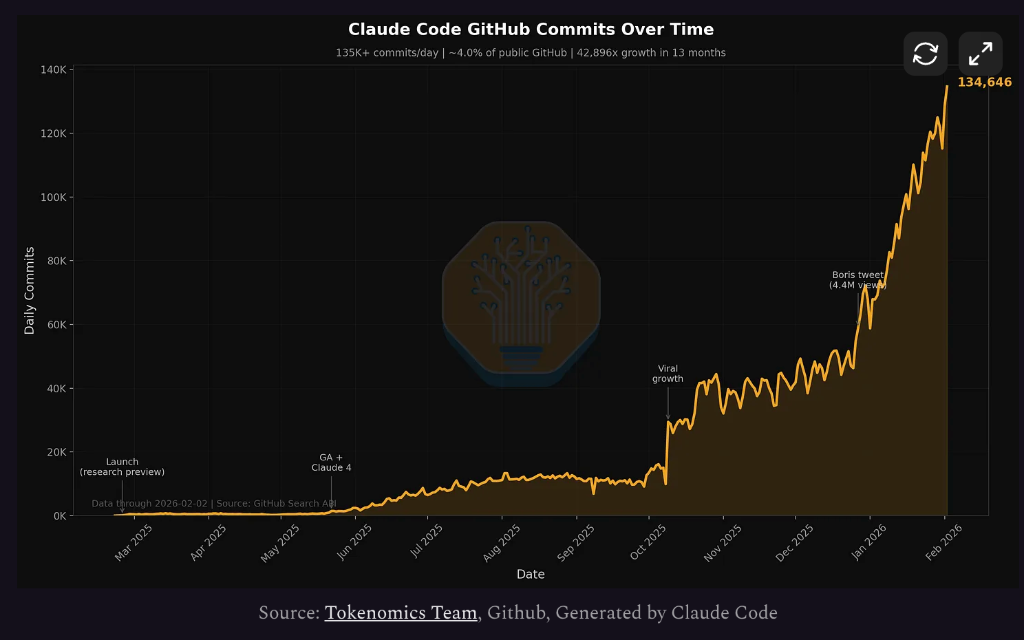
Core Insights - Claude Code, an AI programming tool by Anthropic, has captured 4% of public code submissions on GitHub and is projected to exceed 20% by the end of 2026, marking a pivotal moment for AI agents [1][3] - The emergence of Claude Code signifies a transformation in programming and indicates that AI agents will reshape the global information work market valued at approximately $15 trillion [3][9] - Anthropic's revenue growth, driven by Claude Code, has surpassed that of OpenAI, indicating a structural change in the competitive landscape of AI agents [3][16] Group 1: Impact on Programming and Workflows - Claude Code is redefining the role of programmers from code writers to task planners, showcasing its ability to autonomously execute complex tasks through a command-line interface [7][8] - The tool's effectiveness has led to a shift in the programming community, with notable figures acknowledging a decline in manual coding skills due to reliance on AI [8] - The introduction of Claude Code has initiated a broader automation trend across various sectors, extending its utility beyond programming to include document review and compliance tasks [9][12] Group 2: Economic Implications - The cost of AI tools like Claude Pro is significantly lower than traditional knowledge worker costs, creating strong economic incentives for large-scale deployment [11][12] - The rapid decline in intelligent costs is fundamentally reshaping the profit structure of the information industry, particularly impacting traditional SaaS models [11][12] - Companies are beginning to act on the cost-reduction potential of AI, with significant deployments in sectors like finance and life sciences [12] Group 3: Strategic Challenges for Tech Giants - Microsoft faces a strategic dilemma as it balances the growth of Azure, which supports AI companies, with the need to protect its core products like Office 365 from AI disruption [4][14] - The competitive landscape for AI products is intensifying, prompting Microsoft CEO Satya Nadella to become personally involved in AI product strategy [15] - The emergence of external innovations, such as "Claude for Excel," highlights the internal conflicts within Microsoft regarding its traditional software offerings [14][15] Group 4: Future of AI and Automation - The current phase of AI evolution is seen as a new critical point following the ChatGPT moment, with Claude Code representing a fundamental paradigm shift in AI capabilities [5][18] - The focus of AI competition is shifting from generating quality responses to delivering tangible outcomes, emphasizing task completion and system stability [18] - The automation capabilities of AI agents are expected to expand significantly, impacting various repetitive workflows across industries [12][10]

Anthropic步步紧逼OpenAI,大型SaaS却先崩盘
Di Yi Cai Jing· 2026-02-06 12:18
Core Insights - The competition between major AI model companies, particularly OpenAI and Anthropic, is intensifying as both firms release updates to their models aimed at enhancing task execution capabilities [1][4] - The market is experiencing a sell-off in the software sector due to fears that advancements in AI models could disrupt existing software companies, leading to a decline in stock prices for major tech firms [1][6] Group 1: Model Updates and Features - OpenAI's GPT-5.3-Codex and Anthropic's Claude Opus 4.6 have been launched with a focus on AI agents and engineering capabilities, marking a significant evolution in the AI model landscape [1][4] - GPT-5.3-Codex is touted as having the "best programming performance," with a task execution efficiency that consumes less than half the tokens compared to its predecessor [4] - Claude Opus 4.6 has improved programming skills and excels in financial analysis, document creation, and multi-tasking capabilities [4] Group 2: Market Reactions and Stock Performance - Following the announcements of new models, the U.S. stock market saw a decline, with major tech stocks like Microsoft, Amazon, and Nvidia experiencing significant drops [1][6] - The North American technology software index (IGV) has fallen approximately 25.8% since January, reflecting growing concerns about the impact of AI on software valuations [6] Group 3: Industry Perspectives and Future Outlook - Industry leaders express differing views on the impact of AI; Nvidia's CEO believes AI will enhance existing software rather than replace it, while others warn of potential profit margin pressures on software companies [7][8] - Major tech firms are significantly increasing their capital expenditure forecasts for 2026, with Amazon and Alphabet planning to invest $200 billion and $185 billion respectively, indicating a strong commitment to AI development [7]
Goldman Sachs builds AI agents with Anthropic to automate core banking work
Invezz· 2026-02-06 12:05
Core Insights - Goldman Sachs is intensifying its efforts in generative AI by collaborating with the AI startup Anthropic to develop autonomous agents aimed at automating labor-intensive processes within the bank [1] Group 1: Company Initiatives - The partnership with Anthropic signifies Goldman Sachs' commitment to leveraging advanced AI technologies to enhance operational efficiency [1] - The focus on automating process-heavy work indicates a strategic move to streamline operations and reduce costs [1] Group 2: Industry Trends - The collaboration reflects a broader trend in the financial services industry where firms are increasingly adopting AI solutions to improve productivity and service delivery [1] - Generative AI is becoming a critical component in transforming traditional banking operations, highlighting the industry's shift towards technology-driven solutions [1]


Google and Microsoft offer lucrative deals to promote AI, but even $500,000 won't sway some creators
CNBC· 2026-02-06 12:00
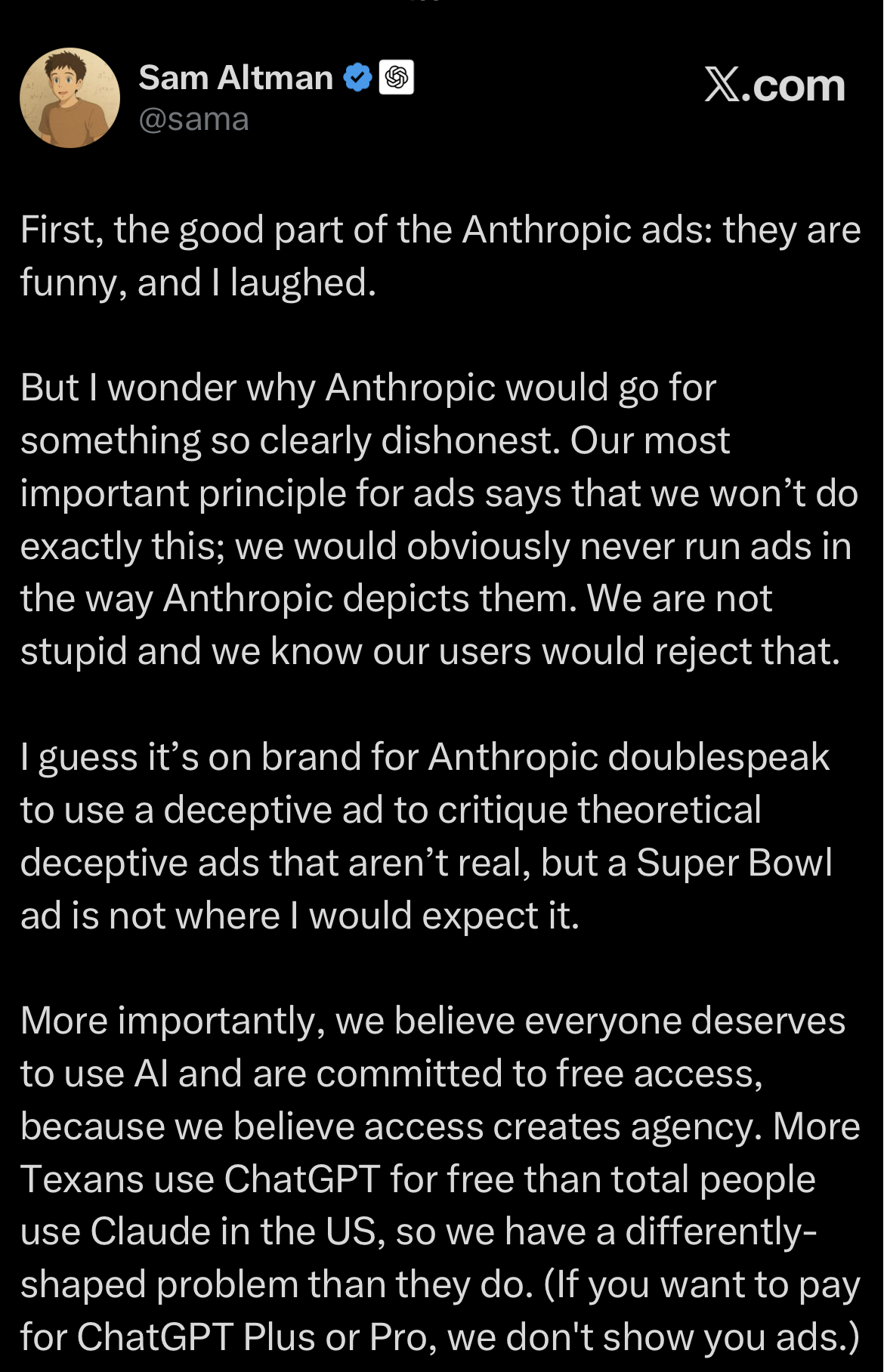
Core Insights - Tech companies are increasingly leveraging social media influencers to promote their AI services, similar to traditional marketing strategies [1][2] - The competition among AI companies for user engagement is intensifying, with influencer marketing emerging as a key strategy [3][9] Advertising Trends - AI companies have significantly increased their advertising expenditures, with generative AI platforms spending over $1 billion on digital ads in the U.S. in 2025, marking a 126% increase from the previous year [3] - Digital ad spending by Google and Microsoft for AI products surged approximately 495% last month compared to a year earlier, while OpenAI's digital ad spending increased more than tenfold in 2025 [13] Influencer Marketing - Influencers are being compensated substantially for promoting AI tools, with payments ranging from $5,000 to $30,000 per campaign, and long-term partnerships with companies like Microsoft and Google reaching between $400,000 and $600,000 [8][12] - AI companies are actively seeking to build authentic connections with users through influencer marketing, with a notable increase in interest from creators [9][10] Major Events and Campaigns - Anthropic is investing millions in advertising during major events, such as airing spots during the Super Bowl to counter OpenAI's ad strategy within ChatGPT [4] - Influencers are creating content across various platforms, including LinkedIn and Instagram, to showcase how to use AI tools effectively [5][11] Creator Concerns - Some creators are hesitant to engage in brand deals related to AI due to ethical concerns and potential backlash from their audiences, with approximately half of U.S. adults expressing more concern than excitement about AI [15][16] - Notable creators have turned down lucrative deals, citing the impact of AI on traditional jobs and artistic labor as a primary reason for their refusal [17][18]


AI将导致码农失业?资深程序员自述已不再手工写代码,拒绝AI很危险,职业将迎分化
Sou Hu Cai Jing· 2026-02-06 11:42
Core Viewpoint - The rapid evolution of AI programming models is reshaping the software development landscape, leading to concerns about job displacement among programmers [3][5][24]. Group 1: AI Programming Models Competition - OpenAI and Anthropic are in direct competition, with OpenAI recently launching GPT-5.3-Codex, claiming it to be the most powerful AI programming model [3][9]. - The competition has intensified as both companies focus on enhancing their programming capabilities, with significant updates being released in quick succession [4][8]. Group 2: Impact on Software Development - AI is transforming the way software development is conducted, with many developers reporting a shift from manual coding to AI-assisted coding, significantly increasing efficiency [16][18]. - The use of AI tools has led to a dramatic reduction in the time required for coding tasks, with some developers stating that projects can now be completed in a fraction of the time compared to traditional methods [16][22]. Group 3: Job Market and Employment Concerns - There is a growing concern that AI will lead to job losses in the programming sector, with predictions that up to 50% of entry-level jobs may disappear in the next few years [24][25]. - The employment rate for programmers in the U.S. has dropped by 27.5% over the past two years, with many layoffs attributed to the impact of AI [25][26]. Group 4: Changing Role of Programmers - The role of programmers is expected to evolve, with a shift towards overseeing AI tools rather than performing traditional coding tasks [30][28]. - Future software engineers may focus more on defining project requirements and guiding AI to execute tasks, rather than writing code themselves [29][30]. Group 5: Accessibility of Programming - AI is lowering the barriers to entry for programming, allowing individuals with little to no coding experience to develop applications by simply communicating their ideas to AI [19][20]. - While AI can handle many coding tasks, the ability to articulate clear project requirements remains a critical skill for success in the evolving landscape [21][22].