
光证资管

Search documents
拥抱大资管竞合时代
Shang Hai Zheng Quan Bao· 2025-12-11 18:40
Group 1 - The core viewpoint of the article highlights the ongoing competition and collaboration among asset management institutions, with a shift from traditional "fixed income" strategies to "fixed income + multi-asset multi-strategy" approaches [4][5][17] - The scale of bank wealth management products reached 32.13 trillion yuan by the end of September, marking a 4.76% increase from the second quarter [6] - The structural changes in the bank wealth management market are evident, with a significant shift towards multi-asset allocation as investors seek stable returns in a low-interest-rate environment [5][6] Group 2 - The implementation of new asset management regulations is reshaping the valuation practices of wealth management products, moving towards a more transparent net asset value system [7][9] - The demand for diversified wealth management solutions is increasing among residents, with 18.5% of individuals preferring to invest more, particularly in non-guaranteed bank wealth management products [9][10] - The collaboration between various financial institutions and insurance companies is intensifying, driven by the need for stable investment channels and the regulatory environment that encourages such partnerships [11][12][13] Group 3 - The public offering transformation of large collective products in the securities asset management industry is nearing completion, leading to a potential reshaping of the industry landscape [18][24] - The recent trend of "non-affiliated transfers" in public offering transformations indicates a shift from traditional internal transfers to collaborations with external public funds [20][21] - The competition for public fund licenses has become increasingly challenging, with many institutions withdrawing their applications, reflecting a saturated market [23][24]


卫光生物(002880) - 002880卫光生物投资者关系管理信息20251202
2025-12-02 13:44
Group 1: Company Control and Financing - The change in company control is pending approval from relevant authorities and has not yet occurred, ensuring no impact on future financing projects [2][3] - The company has committed that it will not take actions to change control or adjust fundraising projects without proper procedures [3] Group 2: Plasma Supply and Production Capacity - The company aims to build a 1,200-ton intelligent industrial base, with a projected compound annual growth rate (CAGR) of plasma collection at 8.67% from 2013 to 2024 [2] - By 2031, the annual plasma collection is expected to reach approximately 1,000 tons, and by 2033, it is projected to reach about 1,180 tons, which will meet the needs of the new industrial base [3] Group 3: Expansion of Plasma Stations - The company has received approvals to establish new plasma stations in multiple provinces, pending completion of all necessary regulatory procedures [3] Group 4: Market Competition and Product Development - The domestic blood product market still has significant growth potential despite competition from recombinant products, which currently serve as supplements to traditional blood products [3] - The company is actively enhancing its R&D capabilities and monitoring industry trends to expedite the launch of new products and technologies [3] Group 5: Research and Development Projects - Ongoing R&D projects include new intravenous immunoglobulin, fibrin adhesive, plasminogen, and antithrombin III, with updates available in the company's disclosed reports [3]

从“扎堆申报”到“主动撤回”,券商公募牌照申请为何退潮?
Sou Hu Cai Jing· 2025-12-02 08:38
Core Viewpoint - The approval process for public fund licenses has faced significant setbacks, with several asset management companies withdrawing their applications, leading to a complete failure for the group of broker asset management subsidiaries seeking public licenses [2][4]. Group 1: Policy Changes and Market Reactions - In May 2022, the China Securities Regulatory Commission (CSRC) announced a policy to relax the restrictions on public fund licenses, allowing broker asset management subsidiaries to apply for public licenses [1]. - By 2023, several broker asset management companies, including招商资管, 兴证资管, and others, began applying for public licenses, indicating a positive market response to the new policy [1]. - However, by late 2023, major applicants like广发资管 and光证资管 withdrew their applications, leaving only国金资管 in the running, which subsequently also withdrew, resulting in a total failure for the group [2][4]. Group 2: Industry Dynamics and Competition - The withdrawal of applications reflects a reassessment of the cost-benefit ratio by asset management firms amid stricter regulations and intense competition in the public fund industry [4]. - The "Matthew Effect" is evident in the public fund sector, where the top ten fund managers control 41.31% of the total market size, indicating a trend where resources are increasingly concentrated among the most competitive firms [4]. - The competitive landscape is further complicated by the presence of over 160 public fund management entities, making it challenging for new entrants to differentiate themselves and survive [6]. Group 3: Financial Performance of Asset Management Firms - As of September 2025, the top ten public fund managers had a combined net asset value of 15.06 trillion yuan, with significant increases in their market share [4]. - Financial data shows that华泰证券资管 leads in profitability with a net profit of 8.82 billion yuan, while中银证券 follows closely with a net profit of 9.06 billion yuan, highlighting the financial strength of these firms [9][10]. - Smaller firms are struggling, with many experiencing high turnover rates among experienced fund managers, indicating a challenging environment for mid-sized asset management companies [5][6]. Group 4: Future Outlook - The public fund license is seen as a critical pivot for brokerages transitioning from private to public fund management, enhancing their fundraising capabilities and product offerings [11]. - Even without public licenses, broker asset management firms may continue to leverage their strengths in fixed income and quantitative strategies, focusing on niche markets for differentiation [12].



券商资管参公 大集合改造将收官
Shen Zhen Shang Bao· 2025-12-01 16:48
Core Viewpoint - The transformation of brokerage asset management public collective investment schemes is nearing completion by the end of this year, with several brokerage firms announcing changes in management to public fund institutions [1] Group 1: Regulatory Changes - According to the asset management new regulations, existing collective asset management businesses must be transformed to align with public funds by December 31, 2020 [1] - Brokerages without public fund licenses must submit contract change applications to the China Securities Regulatory Commission (CSRC) after completing the public transformation, with a contract duration not exceeding three years [1] Group 2: Industry Developments - As of November 28, the CSRC reported that after Guangfa Asset Management, Guangzheng Asset Management, and Guozheng Asset Management, Guojin Asset Management has also withdrawn its application for a public fund license, leaving no brokerages in the queue for public fund licenses [1] - Over 20 brokerage firms and their asset management subsidiaries have announced changes in management for their collective investment products to either affiliated public fund managers or independent public fund companies, registering these products as public fund products [1]
券商资管大集合参公改造再添一例
Bei Jing Ri Bao Ke Hu Duan· 2025-12-01 16:18
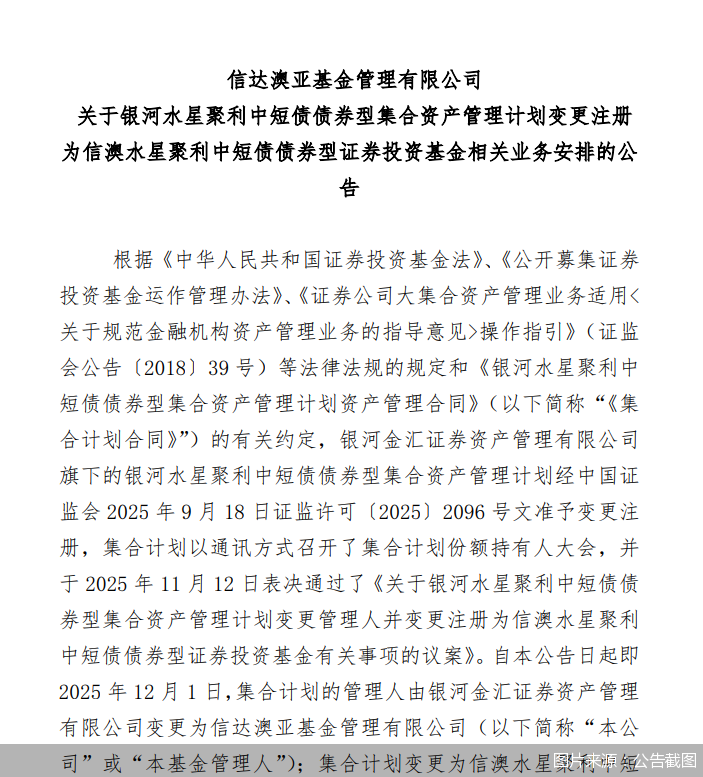
Core Viewpoint - The transformation of brokerage asset management collective products into public funds is accelerating as the deadline for regulatory compliance approaches, with an increasing number of products undergoing this transition [1][3]. Group 1: Regulatory Changes and Compliance - The management of the "Galaxy Mercury Juyi Short-term Bond Collective Asset Management Plan" has been transferred from Galaxy Jin Hui Securities Asset Management to Xinda Australia Fund, marking a significant step in the public fund transformation process [3]. - The deadline for the transformation of brokerage asset management collective products into public funds is set for the end of 2025, following regulatory requirements established in November 2018 [3][4]. - If the original management company does not obtain public fund qualifications, the products will be transferred to affiliated public fund companies or third-party public fund companies, or they may be terminated [3]. Group 2: Trends in Management Transfers - The first instance of a brokerage asset management product transitioning to public fund management occurred in August 2023, when the "Fangzheng Jin Lifang One-Year Holding Mixed Collective Asset Management Plan" was transferred to its affiliated public fund company [4]. - Several brokerage firms have transferred their collective products to affiliated public fund companies, such as CITIC Securities and GF Securities, while some firms are seeking public fund licenses to facilitate this transformation [4][6]. - Despite some firms withdrawing their applications for public fund licenses, the approval process for these applications has not been suspended [5][6]. Group 3: Benefits of Public Fund Transformation - The transformation of brokerage asset management collective products into public funds is expected to optimize resources and promote differentiated development within the industry [7]. - Public fund transformation will enhance the legal status and transparency of operations, allowing for more flexible and proactive performance marketing [7]. - The entry threshold for clients will significantly decrease post-transformation, potentially increasing the scale of assets under management and improving investment management standards [7].

进入冲刺期!券商资管大集合参公改造再添一例
Bei Jing Shang Bao· 2025-12-01 13:44
Core Viewpoint - The transformation of brokerage asset management large collective products into public offerings is accelerating as the deadline for regulatory compliance approaches, with significant changes in management and structure occurring across various firms [1][5][8]. Group 1: Regulatory Changes and Compliance - The deadline for the public offering transformation of brokerage asset management large collective products is set for the end of 2025, following regulatory requirements established in November 2018 [5]. - Firms are required to complete the transformation of existing large collective products to comply with new asset management regulations, with options for management transfer depending on the public offering qualifications of the original managers [5][6]. Group 2: Management Changes - On December 1, 2023, the management of the Galaxy Mercury Juhua Medium and Short Bond Collective Asset Management Plan was transferred from Galaxy Jin Hui Securities Asset Management to Xinda Australia Fund, marking a significant management change [4]. - There is a trend of transferring management to non-affiliated public fund companies, as seen with Wanlian Securities' transfer of its money market fund to Ping An Fund [7]. Group 3: Industry Trends and Implications - The public offering transformation is expected to optimize resources and promote differentiated development within the industry, enhancing transparency and legal status for the products [8]. - The transformation is anticipated to lower entry barriers for clients, potentially increasing the scale of assets under management and improving the investment management standards of the products [8].
最后一家,撤回申请!
Zhong Guo Ji Jin Bao· 2025-12-01 02:18
Core Viewpoint - The withdrawal of public fund license applications by Guojin Asset Management marks the end of the queue for securities asset management subsidiaries, indicating a significant shift in the industry landscape [1][5]. Group 1: License Application Trends - In 2023, there was a surge in applications for public fund licenses from securities asset management subsidiaries, driven by regulatory changes that eased restrictions [4]. - By the end of 2024, there were no approvals for public fund licenses, leading to a complete withdrawal of applications by various firms in 2025 [5]. Group 2: Industry Response to Regulatory Changes - The withdrawal of applications is linked to the 2018 asset management regulations, which require securities firms to complete the public offering transformation of their products by the end of 2025 [6]. - Many firms are transferring their public fund products to affiliated fund management companies as a common strategy to comply with the new regulations [6]. Group 3: Differentiation in the Market - The withdrawal of public fund license applications has led to a clear differentiation in the development paths of securities asset management firms, with only 14 out of 30 firms obtaining public fund qualifications [7]. - Firms with public fund licenses are encouraged to seek differentiation in a competitive market, while those without may focus on traditional strengths in private asset management [7]. - As of September 2025, the scale of private asset management products from securities firms reached 5.73 trillion yuan, reflecting a growth of approximately 270 billion yuan from the end of 2024 [7].

“最后独苗”离场,券商资管子公司公募牌照申请退潮
Shang Hai Zheng Quan Bao· 2025-11-30 06:51
Core Viewpoint - The recent announcement from the China Securities Regulatory Commission (CSRC) indicates that there are currently no brokerage asset management subsidiaries in the queue for public fund management qualifications, as Guojin Asset Management has withdrawn its application [1][4]. Group 1: Regulatory Changes and Market Dynamics - The CSRC's new regulations have allowed for a slight relaxation in the number of public fund licenses, leading to a surge in applications from brokerage asset management subsidiaries in 2023, with six institutions applying [4]. - Only two out of the six institutions, namely China Merchants Asset Management and Everbright Securities Asset Management, successfully obtained licenses, resulting in an approval rate of only one-third [4]. - As of late 2025, the approval pace has slowed, with several institutions, including Guojin Asset Management, withdrawing their applications, leading to a "zero" status for brokerage asset management subsidiaries in the application queue [4][8]. Group 2: Competitive Landscape - The public fund industry is experiencing intensified competition, with over 160 public fund management institutions currently operating in China, which has led to resource wastage [8]. - As of October 2025, the total net asset value of public funds managed by these institutions reached 36.96 trillion yuan, marking a historical high for seven consecutive months [8]. - The top ten institutions in the public fund industry account for nearly 40% of the market share, indicating a high concentration of management scale [8][9]. Group 3: Future Outlook - Guojin Asset Management has confirmed that the withdrawal of its public fund license application was a strategic decision based on current market conditions and future business planning, with the possibility of reapplying in the future [5][6]. - The barriers to entry for new applicants are high, particularly in areas like ETFs, where established firms dominate, making it challenging for new or smaller institutions to compete effectively [9].
年内4家申请全撤回 券商资管公募牌照排队清零
Zhong Guo Jing Ying Bao· 2025-11-29 06:36
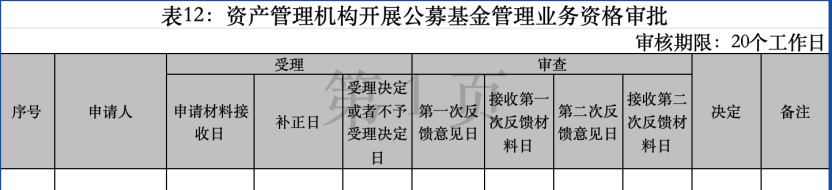
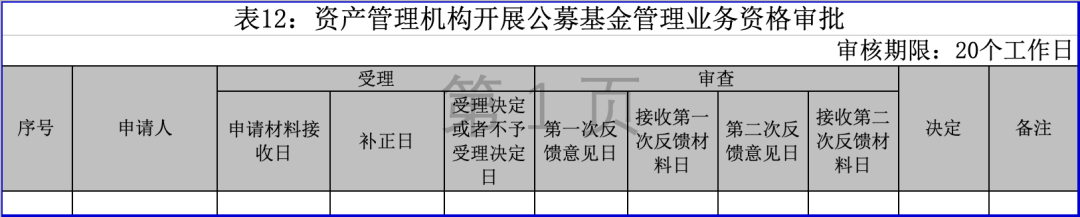
中经实习记者 孙小琴 记者 夏欣 北京报道 (编辑:罗辑 审核:夏欣 校对:燕郁霞) 11月28日,证监会最新发布的证券、基金经营机构行政许可申请受理及审核情况公示披露,在"资产管 理机构开展公募基金管理业务资格审批"栏中,已无任何券商资管在列申请公募牌照。 今年年初,申请公募业务牌照的有广发资管、光证资管、国证资管和国金资管4家券商资管子公司,而 进入11月,前3家已经撤销申请。就在一周前的11月21日,国金资管尚且还在列表中排队申请公募牌 照,目前也已经不在其中。 这一变化与2018年资管新规的要求密切相关。根据上述新规,券商参与的公募大集合产品需在2025年年 底前完成公募化改造。对于未取得公募牌照的券商及资管子公司,旗下相关产品到期后,可选择清盘、 延期或变更管理人这三种处理路径。 ...
全部撤回!券商资管申请公募牌照,排队队伍清零!
Zheng Quan Shi Bao· 2025-11-29 04:29
Core Viewpoint - The approval process for public fund management licenses for securities asset management subsidiaries has effectively come to a halt, with no firms currently in the queue for applications, indicating a significant shift in the regulatory landscape for the industry [1][2][3]. Group 1: License Application Status - As of November 28, no securities asset management firms are listed as pending for public fund management licenses, marking a complete withdrawal of applications from the previous week [2][3]. - The initial wave of applications for public licenses was driven by policy relaxations, particularly the "one participation, one control" policy introduced in May 2022, which allowed for a limited increase in the number of public licenses [2][3]. - In 2023, six securities asset management firms submitted applications for public licenses, but only two, China Merchants Asset Management and Everbright Securities Asset Management, were granted licenses [2][3]. Group 2: Regulatory Changes and Industry Impact - The 2018 asset management regulations mandated that securities asset management products transition to public fund management by the end of 2025, leading to a rush among firms to comply [4][5]. - With the deadline approaching, firms that have not obtained public licenses are exploring alternative paths, including changing management to public fund institutions, liquidating products, or transitioning to private fund management [4][5]. - Notably, some firms are transferring their public fund products to affiliated fund companies, while others are engaging in cross-industry management arrangements, which is becoming increasingly rare [5].