LPL Financial Holdings Inc.

Search documents
AI巨额投入引发市场担忧 亚马逊股价今年开局不利 华尔街仍视其为“被低估赢家”
智通财经网· 2026-02-19 00:03
Core Viewpoint - Amazon's stock has faced challenges this year, but some Wall Street analysts see the recent pullback as a potential buying opportunity for investors optimistic about long-term returns from artificial intelligence (AI) [1] Group 1: Stock Performance and Market Sentiment - Amazon's stock has declined by 9.2% over the past 12 months, underperforming the Nasdaq Composite Index, which has risen by approximately 13% during the same period [1] - Following the earnings report on February 5, the stock fell about 7.5% due to concerns over disappointing earnings and significant AI capital expenditure plans [1] - The stock's expected price-to-earnings ratio is currently around 25.8, significantly lower than its five-year average of 48.1 [1] Group 2: AWS and Growth Potential - Analysts, including Morgan Stanley's Brian Nowak, view Amazon Web Services (AWS) as a "market undervalued generative AI winner," highlighting that demand for cloud computing services is a key growth driver for the company [2] - Amazon's backlog of unfulfilled contracts has reached $244 billion, a 40% year-over-year increase, indicating strong future demand [2] - AWS is expected to see accelerated capital expenditure, which is necessary to expand data center capacity to meet growing demand [2] Group 3: Cash Flow and Investor Confidence - Amazon's free cash flow for the past 12 months was $11.2 billion, significantly lower than the $38.2 billion reported in the same period last year [3] - As AI capital expenditures become a long-term theme, investors are expected to pay closer attention to the company's guidance on free cash flow prospects [3] - Despite a recent stock price rebound, Berkshire Hathaway has reduced its Amazon holdings by approximately 80% to 2.3 million shares, although this news did not hinder the stock's short-term recovery [3]

Raymond James Recruits Another Big Ex-Commonwealth Team
Barrons· 2026-02-18 18:13
Group 1 - Raymond James has recruited a financial advisor team from LPL Financial, which managed approximately $682 million in client assets [1][1][1] - The recruited team was previously affiliated with Commonwealth Financial Network, an independent broker-dealer that was acquired by LPL Financial last year [1][1][1]


Simplicity Group and LPL Financial Form Strategic Relationship to Deliver Insurance Products, Operational Support, and Training to LPL Advisors
Prnewswire· 2026-02-18 14:00
Core Insights - LPL Financial and Simplicity Group have formed a strategic relationship to enhance insurance capabilities and support for LPL advisors, effective May 1, 2026 [1] - Simplicity will serve as LPL's preferred Brokerage General Agency, providing advanced technology and comprehensive insurance resources [1] - The partnership aims to improve service experiences for clients seeking protection solutions and offers a broad suite of offerings for high-net-worth clients [1] Company Overview - LPL Financial is a leading wealth management firm supporting over 32,000 financial advisors and approximately 1,200 financial institutions, managing around $2.4 trillion in brokerage and advisory assets for about 8 million Americans [1] - Simplicity Group is recognized as a leading partner for advisors and financial institutions, focusing on wealth accumulation and financial protection products [1] Strategic Benefits - The agreement allows LPL to transition its internal insurance business to Simplicity, creating a unified experience for advisors and clients [1] - This strategic shift enables LPL to reinvest in delivering greater value, flexibility, and improved features for advisors and institutions [1]



After Selloff, Wall Street Execs Double Down on AI
Yahoo Finance· 2026-02-17 05:03
Core Insights - The launch of Altruist's AI-powered tool on the Hazel platform has caused significant concern among investors, leading to a decline in wealth management stocks, with Charles Schwab's stock dropping nearly 11% and Morgan Stanley falling almost 5% [1] - Despite the sell-off, major wealth management firms are not retreating but are instead expanding their AI capabilities, indicating a belief that AI will reshape the industry [3][4] Industry Developments - AI is increasingly being utilized as a co-pilot for financial advisors, assisting with tasks such as taking meeting notes, drafting emails, and conducting research [4] - Major firms like Morgan Stanley are developing AI tools across three main functionalities: enhancing co-pilot features, creating an AI agent for client interaction, and building a portfolio construction engine [6] - Schwab is implementing AI in call centers to improve client response times and has identified over 200 potential use cases for AI across its operations [4]


Emerging Market Currencies Emerge as “Unusual Haven” Amid Weakening Dollar and Commodity Surge
Stock Market News· 2026-02-15 14:08
Core Insights - Emerging-market currencies and equities have become an unexpected haven for global investors in early 2026, driven by a weakening U.S. dollar, resilient commodity prices, and significant capital inflows into developing economies [2] Market Performance - The MSCI Emerging Markets Index (IEMG) has gained approximately 7% to 8% year-to-date, following a remarkable 33.5% return in 2025, while U.S. mega-cap technology stocks have started to lag as investors shift towards undervalued international markets [3][10] Dollar Dynamics - The U.S. Dollar Index (DXY) has softened, falling 1.4% in January 2026 after a nearly 10% decline in the previous year, which alleviates the burden of dollar-denominated debt for emerging nations and enhances the local-currency value of their exports [4][10] Commodity Influence - Strong commodity prices have provided a crucial support for resource-rich nations, with Latin American equities rising nearly 14% year-to-date, particularly highlighted by the performance of the iShares MSCI Peru ETF (EPU) and iShares MSCI Brazil ETF (EWZ) [6][10] Capital Inflows - Record capital inflows into emerging markets have been reported, with JPMorgan Chase noting significant weekly inflows, including over $6.5 billion into the iShares Core MSCI Emerging Markets ETF (IEMG) in January, contributing to a total of $20.6 billion for the month [8][10] Growth Projections - Emerging market earnings are expected to grow by 29% in 2026, significantly outpacing the 14% growth projected for the S&P 500, prompting global fund managers to rebalance portfolios towards emerging markets at a 40% valuation discount [9][10] Technical Outlook - The MSCI EM Index has cleared major resistance levels from its 2021 highs, indicating a constructive technical backdrop for the rally, with broad participation from countries like South Korea and Taiwan [11]

黑色星期四:AI没崩,但“卖AI的”先崩了
Sou Hu Cai Jing· 2026-02-14 20:03
Core Viewpoint - The recent market turmoil is driven by fears surrounding AI's potential to replace jobs, leading to significant declines in stock prices across various sectors, particularly in software, financial services, logistics, and commercial real estate [1][3][4][5][6]. Group 1: Market Reactions - The Dow Jones Industrial Average dropped over 660 points, and the Nasdaq fell by 2%, with Apple losing nearly 1.4 trillion RMB in market value [1]. - CBRE experienced a 26% decline in stock price, reminiscent of the 2008 financial crisis [1]. - The S&P 500 consumer staples sector reached a historical closing high, indicating a shift in investor sentiment towards stable companies like Coca-Cola and Walmart [9]. Group 2: Sector-Specific Impacts - **Software Sector**: The S&P 500 software and services index fell by 15% as companies that previously benefited from AI hype faced valuation corrections [4]. - **Financial Services and Logistics**: The introduction of AI tools led to significant stock drops for companies like Willis Towers Watson and C.H. Robinson, with declines of 7.4% and 14.5% respectively [5]. - **Commercial Real Estate**: Concerns about reduced office space demand due to AI's efficiency led to fears about the viability of high-rent office spaces in Manhattan [6]. Group 3: Investor Sentiment and Future Outlook - There is a notable shift in investment strategy from "buying the future" to "buying stability," as evidenced by the performance of consumer staples [9]. - Major tech companies are investing heavily in AI infrastructure, with combined capital expenditures reaching $650 billion, raising concerns about the return on these investments [10][11]. - The current market environment reflects a mix of anxiety and excitement about AI, with some companies experiencing significant funding and valuation increases despite broader market declines [12]. Group 4: Historical Context and Comparisons - The current situation is compared to the late 1990s tech bubble, where initial excitement about the internet led to market volatility when profitability questions arose [13]. - The narrative surrounding AI is shifting from grand promises to practical applications, causing investor panic as the technology matures [13][16]. - The survival of companies post-crisis will depend on their ability to adapt and effectively leverage AI, similar to how internet companies evolved after the 1999 downturn [19][20].

一个行业一个行业排队被枪毙
Xin Lang Cai Jing· 2026-02-14 17:22
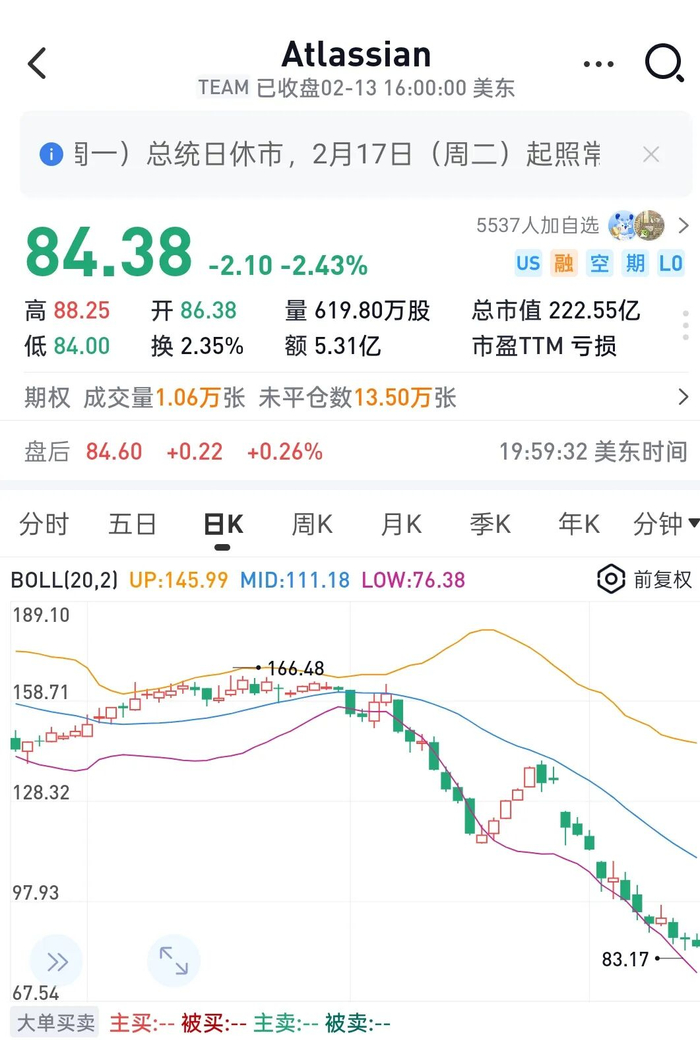
Group 1: Software Sector Impact - Software stocks have experienced significant declines, with Adobe down 25%, Atlassian down 47%, Intuit down 40%, Salesforce down approximately 30%, and Workday losing one-third of its market value [1][3]. Group 2: Insurance Brokerage Sector - The introduction of AI tools like Insurify has severely impacted insurance brokers, leading to declines in stock prices: Willis Towers Watson down 15%, Aon down 9%, and Arthur J. Gallagher down 15% [3][6]. Group 3: Wealth Management Sector - AI tools from Altruist have disrupted wealth management, causing stocks of firms like Charles Schwab, LPL Financial, and Raymond James to drop over 7% each [9]. Group 4: Logistics and Transportation Sector - Companies in logistics have faced stock declines, with CBRE down 20% over two days, JLL down around 20%, and Cushman & Wakefield experiencing a drop of 14% [11][12]. Group 5: Commercial Real Estate Sector - The expectation of layoffs and remote work due to AI advancements has led to a decline in demand for commercial real estate, negatively affecting companies like CBRE [14]. Group 6: Broader Market Impact - Other companies affected include Cisco down 12%, S&P Global down over 25%, and AppLovin down 20%, indicating a widespread concern about traditional sectors being threatened by AI [15]. Group 7: Future Employment Landscape - The article suggests that jobs reliant on information processing and standardization are at high risk of being replaced by AI, leading to potential large-scale unemployment while capital and technology flourish [16][17].
高盛推出“抗AI冲击”主题投资组合:做多算力与安全,做空可被替代的软件股35/64
美股IPO· 2026-02-14 04:12
高盛推出一项新的软件股多空组合,做多那些业务难以被人工智能取代、或直接受益于AI需求增长的公司,同时做空可能被自动化或被企业内部替代的 软件企业。此前随着Anthropic等公司推出面向法务和税务的AI工具,引发相关软件股大幅下跌,市场对生成式AI冲击商业模式的担忧正在加剧。 随后,这轮抛售继续扩大。一家知名度不高的初创公司Altruist推出了一款税务策略工具,在过去一周内导致Charles Schwab、LPL Financial等公司股 价下跌超过10%。 媒体称,华尔街对软件股的怀疑情绪已经积累了数月,但最近的市场态度已从谨慎转向明显防御。随着市场担心生成式AI可能侵蚀传统商业模式并压缩利 润率,投资者纷纷抛售整个行业的股票。 这轮抛售也重置了估值水平。一年前,软件股的市盈率大约为51倍,是股票市场中估值最高的行业。而如今,该行业的市盈率约为27倍。 在做多一侧,高盛看好那些将直接受益于AI采用率上升的企业,包括算力提供商、数据基础设施公司、可观测性工具、安全网络公司、超大规模云服务商 以及AI开发平台等。该组合纳入的公司包括Cloudflare、CrowdStrike、Palo Alto Netwo ...


Fed's Austan Goolsbee discusses interest rate outlook, how AI fears are spreading beyond software
Youtube· 2026-02-13 22:00
Market Overview - Stocks are higher due to cooler than expected inflation data, although there has been a recent sell-off [1][2] - The Nasdaq composite and S&P 500 are up, with real estate, healthcare, and utilities leading the gains as investors rotate away from tech [2] - Walmart reached an all-time high, while Visa, Nvidia, and Apple saw declines [3] Inflation and Economic Indicators - January's consumer price index (CPI) showed slower inflation, the lowest since May, with improvements in food and energy prices [6][7] - Services inflation remains high, indicating persistent inflationary pressures [7][22] - The unemployment rate dropped to 4.3%, with job growth concentrated in healthcare and social assistance sectors [9][10] Federal Reserve Outlook - Chicago Fed President Austin Goulby emphasizes the need for more progress on inflation before considering further rate cuts [28][29] - Core inflation is projected to remain around 3%, which is above the Fed's target [30][31] - The Fed is cautious about making premature rate cuts, focusing on actual inflation and employment data [21][26] Sector Performance - Semiconductor and software stocks are showing mixed performance after a recent sell-off [4][5] - Defensive sectors like consumer staples and utilities are gaining traction as investors seek stability amid market volatility [57] - AI disruption fears are impacting various industries, including transportation and real estate, as companies adapt to new technologies [51][52] Company Highlights - Rivian reported better-than-expected Q4 results, achieving its first annual gross profit and strong guidance for future vehicle deliveries [63][64] - Applied Materials, a major supplier of chipmaking equipment, has seen significant stock gains due to increased demand driven by AI investments [70][71] - American Superconductor is focusing on enhancing grid reliability and power quality to meet rising electricity demands [81][82]



From software to trucking, here are all the stock sectors that have been gripped by AI panic
Business Insider· 2026-02-13 15:53
Core Viewpoint - The stock market is experiencing significant turmoil due to fears surrounding AI technology, leading to a historic sell-off in various sectors, particularly software, which has seen a loss of $2 trillion in market capitalization [1][4]. Software Sector - A historic sell-off in the software sector resulted in the largest non-recessionary drawdown in 30 years, with $2 trillion in market cap erased in just a few days [4]. - The iShares Expanded Tech-Software Sector ETF is down 1% for the week and has plunged 20% year-to-date [5]. Insurance and Wealth Management - Stocks of insurers and wealth managers faced heavy selling pressure after the introduction of a new AI tool by Altruist, which could assist clients with tax planning [6]. - The iShares U.S. Broker-Dealers & Securities Exchanges ETF is down 6% this week due to fears that AI could impact margins in fiduciary services [6]. Real Estate Sector - Real estate firms began to sell off as investors considered the potential disruption AI could cause to client services offered by large firms [8]. Trucking Sector - The trucking sector experienced a significant decline after Algorhythm Holdings, a former karaoke machine maker, published a paper on its AI freight-scaling tool, which could enhance logistics efficiency [9]. - The iShares US Transportation ETF is down 3% for the week, while shares of Algorhythm spiked over 30%, trading around $1.25 [10].