华熙生物

Search documents
1.1万亿之上的竞逐:从“水涨船高”到“结构分化”
FBeauty未来迹· 2026-01-21 14:25
Core Insights - The Chinese cosmetics market has surpassed 1.1 trillion yuan, maintaining its position as the largest cosmetics consumer market globally [2][3] - The market share of domestic cosmetics has increased to 57.37%, solidifying its leading position [3][25] - Approximately 27,000 brands were eliminated in the past year, while over 60% of the top 500 brands achieved positive growth, indicating a shift from a broad growth phase to a deep transformation focused on structural optimization [3][19] Market Size and Growth - In 2025, the total transaction value of the Chinese cosmetics market is projected to be 1,104.25 billion yuan, with a year-on-year growth of 2.83%, indicating a stable development phase [8] - The growth rates for the years 2023, 2024, and 2025 are 3.61%, 2.80%, and 2.83% respectively, reflecting a new normal of single-digit growth [8] - The retail sales of cosmetics in 2025 are expected to reach 465.3 billion yuan, with a growth rate of 5.1%, outpacing the overall retail sales growth [11] Market Dynamics - The data from the China Cosmetics Association and the National Bureau of Statistics complement each other, presenting a comprehensive view of the market landscape [14] - The divergence in data is attributed to different statistical scopes, with the National Bureau focusing on larger enterprises while the Association includes a broader range of market players [14] - The market is experiencing a significant internal structural change, with resources concentrating on larger, compliant, and research-capable enterprises, while smaller firms face increasing survival pressures [15] Brand Performance - Over 60% of the top 500 brands achieved positive growth, while the number of brands with over 100 million yuan in sales increased from 746 in 2023 to 839 in 2025 [16] - The elimination of approximately 27,000 brands in 2025 signifies the end of competition based on traffic and homogenized products, marking an acceleration of the survival of the fittest [19] Channel Competition - Online channel transaction value grew by 4.45% in 2025, while offline channels remained stable, indicating the end of reliance on a single growth channel [22] - The shift towards comprehensive channel operations is becoming the new foundation for brand development [22] Rise of Domestic Brands - Domestic brands' market share has risen to 57.37%, marking a fundamental shift in market dynamics [25] - Successful domestic brands focus on niche markets, technological barriers, and unique brand cultures rather than just price competitiveness [28] - The victory of domestic brands reflects a new development model that emphasizes long-term value and systemic capabilities [31] Regulatory and Competitive Landscape - The modernization of the regulatory system during the 14th Five-Year Plan has clarified the direction for high-quality development [34] - The shift from marketing wars to technology and brand wars is reshaping competitive dynamics within the industry [35] - Continuous investment in R&D is evident, with the average R&D expense ratio for Chinese cosmetics companies increasing from 2.36% in 2020 to 3.24% in 2025 [35] Consumer Behavior and Market Trends - The market is witnessing a dual pursuit among consumers for both high-value basic products under 300 yuan and luxury products over 1,000 yuan, while mid-range products are declining [38] - Brands must clearly position their value propositions to succeed in this evolving market landscape [38] Global Market Expansion - Expanding into global markets is becoming essential for leading brands, with some achieving significant breakthroughs in mature markets [39] - The dual drivers of strong policy and active market dynamics are propelling the Chinese cosmetics industry towards a new era of high-quality development [40]


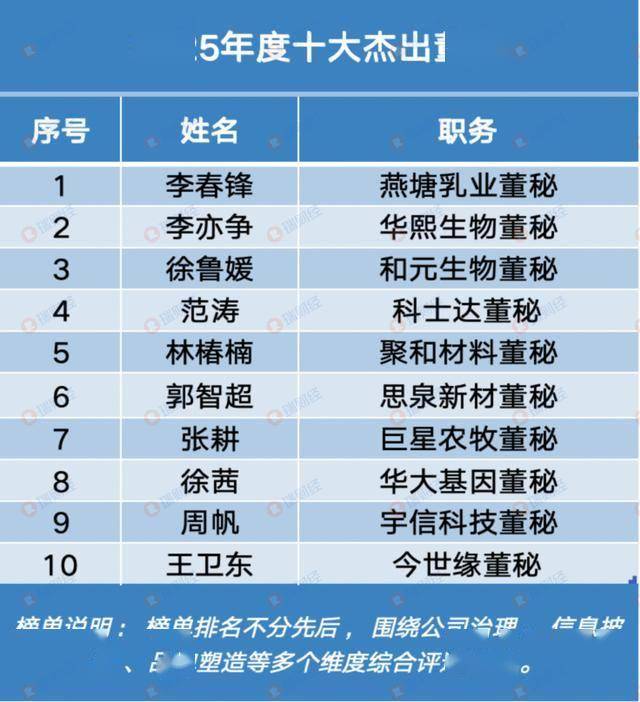
今世缘董秘王卫东入选“2025年度十大杰出董秘”
Sou Hu Cai Jing· 2026-01-21 10:00
瑞财经1月21日,由瑞财经推出的"2025年度十大杰出董秘"榜单揭晓,今世缘董秘王卫东入选。 "2025年度十大杰出董秘"榜单围绕公司治理、信息披露、品牌塑造等多个维度综合评选得出。 王卫东,公司董事、副总经理、总会计师及董事会秘书。河海大学工商管理专业硕士,高级经济师,高 级会计师。2013年12月起,兼任淮安市轻工业协会常务副会长;2015年3月起,兼任华泰瑞通投资管理 有限公司董事;2018年11月起,兼任江苏省上市公司协会财务专业委员会副主任委员;2019年11月起, 兼任江苏省会计学会理事;2023年11月起,兼任中国上市公司协会第三届董秘委员会委员。 2025年,王卫东在资本市场履职、公司经营策略调整、财务与数字化管理等多个领域均有亮眼表现,有 力支撑了公司在复杂市场环境中的稳定发展。 | 序号 | 。姓名 | 职务 。 | | --- | --- | --- | | 1 | 李春锋 | 燕塘乳业董秘 | | 02 | 李亦争。 | 华熙生物董秘 | | 3 | 徐鲁媛 | 和元生物董秘 | | 4 | 范涛 | 科士达董秘 | | 5 | 林椿楠 | 聚和材料董秘 | | 6 | 郭智韶 | 思 ...

免费领取!《2025中国合成生物制造产业发展白皮书》
synbio新材料· 2026-01-21 02:53
Core Viewpoint - The article emphasizes the rising importance of biomanufacturing as a strategic and innovative sector, which is seen as a new growth point that can drive industrial structure optimization and economic model transformation. The release of the "2025 China Synthetic Biomanufacturing Industry Development White Paper" highlights the current state and trends of biomanufacturing, analyzes the industry chain and key application directions, and provides insights into challenges and policy recommendations for the industry [1]. Group 1: Current State and Trends - The white paper outlines the development status and trends of biomanufacturing, including a comparative analysis of the biomanufacturing sectors in China and the United States [5]. - It discusses the key platform facilities in the global biomanufacturing industry, indicating the infrastructure necessary for growth [5]. - Future development trends in biomanufacturing are explored, suggesting potential directions for innovation and investment [5]. Group 2: Policy Landscape - The report details major policies affecting biomanufacturing both domestically and internationally, providing a comprehensive overview of regulatory environments [5]. - It categorizes foreign and domestic policies that impact the biomanufacturing industry, highlighting the importance of supportive regulations for growth [5]. Group 3: Industry Chain and Applications - An analysis of the biomanufacturing industry chain is presented, identifying key components and stakeholders involved in the sector [5]. - The report outlines several key application areas for biomanufacturing, including pharmaceuticals, food, personal care, agriculture, chemicals, materials, and energy, indicating the versatility of biomanufacturing technologies [5]. Group 4: Key Enterprises and Investment Landscape - The white paper identifies ten leading enterprises in China's biomanufacturing industry, showcasing significant players that are driving innovation and market growth [6]. - It also summarizes the strategic directions of 15 listed companies in synthetic biology, providing insights into their investment and development strategies [6]. - The investment and financing situation in the domestic synthetic biology sector for the period of 2024-2025 is discussed, indicating trends in capital flow and investment opportunities [6]. Group 5: Challenges and Recommendations - The report addresses the challenges faced by China's biomanufacturing industry, including technological, regulatory, and market-related issues that could hinder growth [6]. - Targeted policy recommendations are provided to address these challenges, aiming to foster a more conducive environment for the development of the biomanufacturing sector [6].

剑指2030年千亿美元市场 华熙生物以五星中试平台抢占产业先机
Jin Rong Jie· 2026-01-21 02:08
Core Insights - The Ministry of Industry and Information Technology has announced the first batch of "Biomanufacturing Pilot Capacity Construction Platform List," with Huaxi Biological Technology (Tianjin) Co., Ltd. being recognized for its leading synthetic biology pilot platform and awarded the highest "five-star" certification [1][2] - Huaxi Biological is one of only five companies in the country to receive this five-star rating, achieving the highest certification in three core areas: cosmetics, food additives, and biopharmaceuticals, marking a significant breakthrough in China's biomanufacturing infrastructure [1][2] Company Summary - Huaxi Biological's synthetic biology pilot transformation platform has a total investment exceeding 3 billion yuan, with a building area of 40,000 square meters and equipped with 64 pilot production lines [1] - The platform can simultaneously conduct large-scale transformation experiments for six categories of bioactive substances, serving multiple strategic emerging industries, including pharmaceuticals, health, and personal care [1] Industry Summary - The pilot platform is crucial for bridging the "valley of death" in the transformation of biomanufacturing research achievements, as China's technology achievement conversion rate is only about 10%, significantly lower than that of developed countries [1][2] - The platform innovatively creates a "cell factory" industrial debugging center, utilizing an intelligent central control system for real-time monitoring and early warning analysis of production processes, and employs a "flexible production line" design to quickly adapt to different pilot needs [2] - The establishment of this five-star certification is a significant signal of the national acceleration of biomanufacturing industry layout, with plans to cultivate over 20 biomanufacturing pilot platforms by 2027 [2]

2025年中国NMN行业研究报告
艾瑞咨询· 2026-01-21 00:07
Core Viewpoint - NMN (β-Nicotinamide Mononucleotide) is gaining attention in the global health industry for its potential anti-aging benefits and metabolic regulation, with significant regulatory advancements expected by 2025 [1][2]. Industry Overview - The NMN industry has transitioned from laboratory research to commercial viability, with major markets like the US, Japan, Canada, and Australia recognizing its legal status [1][2]. - China is currently the largest producer of NMN raw materials, with a focus on technological innovation and regulatory compliance as key drivers for industry growth [2]. NMN Definition and Function - NMN is a direct precursor to NAD+ (Nicotinamide Adenine Dinucleotide), crucial for various biological functions including energy metabolism and DNA repair [3][4]. - Supplementing NMN can enhance NAD+ levels, which decline with age, thereby playing a role in anti-aging and improving cardiovascular health [4][6]. Synthesis Pathways - NMN supplementation is more efficient than other NAD+ synthesis pathways, with no known adverse effects, making it a promising option for clinical applications [6][7]. Market Dynamics - The global NMN market is projected to exceed 30 billion yuan by 2025, driven by increasing demand from aging populations and younger consumers seeking anti-aging solutions [28]. - NMN's primary applications are in health supplements (90% market share) and cosmetics (10-20% market share), with potential expansion into pet nutrition and agricultural technology [24][28]. Regulatory Environment - The regulatory landscape for NMN is evolving, with significant milestones achieved in various countries, including China’s approval process for NMN as a health supplement [17][18]. - The "blue hat" certification in China represents the highest standard for NMN products, indicating safety and compliance [37]. Technological Innovations - Advances in synthesis methods, particularly the full enzyme method, are enhancing NMN production efficiency and purity, while also reducing costs [10][12]. - Innovations in delivery technologies are improving the bioavailability of NMN, ensuring better absorption and efficacy [22]. Competitive Landscape - Leading companies in the NMN sector are focusing on patenting innovative synthesis methods and expanding their product lines to establish competitive advantages [12][32]. - Companies like Gene Harbor and Kangying Hongmei are at the forefront of NMN production, leveraging technological advancements to enhance market presence [12][32]. Future Prospects - The NMN industry is expected to see significant growth as regulatory barriers are lowered and consumer awareness increases, particularly in the health and beauty sectors [44][51]. - The potential for NMN to penetrate new markets, such as pet nutrition and agricultural applications, presents additional growth opportunities [53][56].

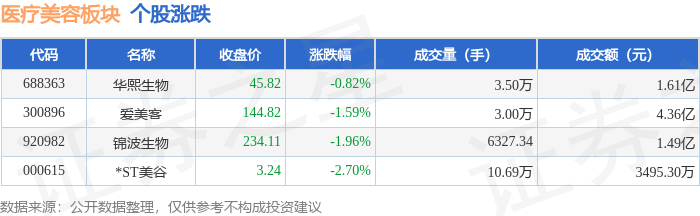
医疗美容板块1月20日跌1.35%,*ST美谷领跌,主力资金净流出1亿元
Zheng Xing Xing Ye Ri Bao· 2026-01-20 08:59
Market Overview - The medical beauty sector experienced a decline of 1.35% on January 20, with *ST Meigu leading the drop [1] - The Shanghai Composite Index closed at 4113.65, down 0.01%, while the Shenzhen Component Index closed at 14155.63, down 0.97% [1] Stock Performance - Key stocks in the medical beauty sector showed the following performance: - Huaxi Biological (688363) closed at 45.82, down 0.82% with a trading volume of 35,000 shares and a turnover of 161 million yuan [1] - Aimeike (300896) closed at 144.82, down 1.59% with a trading volume of 30,000 shares and a turnover of 436 million yuan [1] - Jinbo Biological (920982) closed at 234.11, down 1.96% with a trading volume of 6,327 shares and a turnover of 149 million yuan [1] - *ST Meigu (000615) closed at 3.24, down 2.70% with a trading volume of 106,900 shares and a turnover of 34.95 million yuan [1] Capital Flow - The medical beauty sector saw a net outflow of 100 million yuan from main funds, while retail investors contributed a net inflow of 74.88 million yuan [1] - Detailed capital flow for key stocks includes: - *ST Meigu: Main funds net outflow of 11.12 million yuan, retail net inflow of 6.93 million yuan [2] - Jinbo Biological: Main funds net outflow of 25.90 million yuan, retail net outflow of 1.30 million yuan [2] - Huaxi Biological: Main funds net outflow of 31.89 million yuan, retail net inflow of 22.38 million yuan [2] - Aimeike: Main funds net outflow of 57.26 million yuan, retail net inflow of 45.57 million yuan [2]


免费领取!《2025中国合成生物制造产业发展白皮书》
synbio新材料· 2026-01-20 08:47
Core Insights - The article emphasizes the rising importance of biomanufacturing as a strategic and innovative sector, which is seen as a new growth point that can help optimize industrial structures and transform economic models [1]. Group 1: Current State and Trends - The "2025 China Synthetic Biomanufacturing Industry Development White Paper" was officially released on August 1, highlighting the current status and trends in biomanufacturing [1]. - The report analyzes the global biomanufacturing industry, including key platform facilities and a comparative study of the US and China in this field [5]. Group 2: Policy Landscape - The white paper discusses major policies affecting biomanufacturing both domestically and internationally for the years 2024-2025 [5]. Group 3: Industry Map and Applications - It provides a comprehensive map of the Chinese biomanufacturing industry and analyzes the industry chain along with key application directions, including biomanufacturing in pharmaceuticals, food, personal care, agriculture, chemicals, materials, and energy [5]. Group 4: Key Enterprises - The report identifies ten leading enterprises in the Chinese biomanufacturing sector, detailing their contributions and roles within the industry [5][6]. Group 5: Company Strategies - It outlines the synthetic biology strategies of 15 listed companies, summarizing their development approaches and corresponding popular products [5][6]. Group 6: Investment and Challenges - The white paper reviews the investment and financing situation in domestic synthetic biology from 2024 to mid-2025 and discusses the challenges faced by the biomanufacturing industry in China, along with proposed countermeasures [5][6].




深度 | 美妆科学传播的下一个浪潮是什么?
FBeauty未来迹· 2026-01-19 12:34
Core Insights - The beauty science communication has shifted from a "one-way output of scientific strength" to a "temperature dialogue with consumers" over the past 25 years, focusing on social emotional insights rather than just scientific data [2][4] - The NUTE model (Need-Unique-Technology-Evidence) is introduced as a methodology for scientific communication, emphasizing the importance of translating hard science into relatable solutions for consumers [3][5] Evolution of Beauty Science Communication - The initial phase focused on creating market buzz through ingredient efficacy and scientific concepts [4] - The explosion of scientific content saw many beauty companies entering the field, but it lacked consumer focus [4] - The communication evolved to a consumer-centric approach, aiming for empathy and understanding [4] - The current phase emphasizes co-creation of brand trust, where consumers focus less on scientific data and more on brand reliability [4] Case Studies in Effective Communication - Natural Hall's "anti-fatigue" marketing effectively resonated with consumers by translating abstract concepts into relatable experiences, such as "post-overtime fatigue" [6] - Zhanmiya utilized cinematic storytelling to connect with the emotional expectations of consumers regarding "China's technological rise," showcasing the journey of artificial skin [8] - Brands like Zhenyan addressed information gaps in post-surgery care by prioritizing knowledge dissemination over direct product promotion [10] The Role of Social Emotion - Social emotion acts as a "translator" in scientific communication, transforming deep research into consumer-friendly language and practical solutions [12] - The understanding of consumer needs is crucial, as effective communication is not about what brands research but what consumers need to know [12] Unique Research Frameworks - Establishing a unique research framework is essential for brands to create an irreplaceable competitive edge, allowing them to transition from "ingredient followers" to "category definers" [13] - Brands must avoid merely showcasing single-point technologies and instead build comprehensive frameworks or focus on specialized breakthroughs [13][14] Challenges in Consumer Acceptance - Concepts like ECM (extracellular matrix) are difficult for consumers to grasp; thus, brands must create relatable scenarios to make advanced theories accessible [16][18] - Shiseido's innovative approach to anti-aging through "memory T cells" represents a reverse strategy in a market focused on collagen supplementation [19][22] Evidence-Based Communication - The beauty industry is adopting a structured evidence chain similar to that in clinical research, categorizing evidence into various levels to enhance credibility [34][36] - Brands like HBN are leading the way in establishing standardized guidelines for efficacy evidence, promoting transparency and scientific rigor [41] Visualizing Scientific Evidence - OLAY's use of 3D technology to visualize the effects of their products represents a shift towards making scientific evidence more comprehensible and relatable to consumers [42][44] - The focus is on reducing the complexity of scientific data to enhance consumer trust and understanding [45] Future Directions - The industry is moving towards a model where storytelling is used to explain science, fostering a two-way relationship between brands and consumers [47] - The expectation is for brands to create relatable narratives that connect scientific advancements with everyday consumer experiences, enhancing trust and engagement [47]

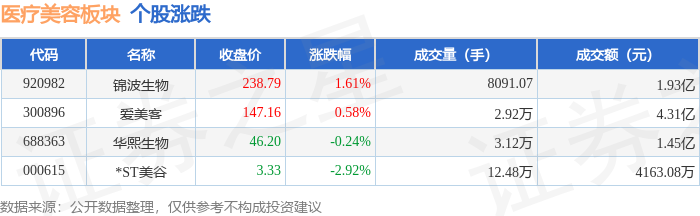
医疗美容板块1月19日涨0.06%,锦波生物领涨,主力资金净流出808.89万元
Zheng Xing Xing Ye Ri Bao· 2026-01-19 08:58
Group 1 - The medical beauty sector increased by 0.06% on January 19, with Jinbo Biological leading the gains [1] - The Shanghai Composite Index closed at 4114.0, up 0.29%, while the Shenzhen Component Index closed at 14294.05, up 0.09% [1] - Jinbo Biological's closing price was 238.79, with a rise of 1.61%, while other companies like Aimeike and Huaxi Biological showed mixed performance [1] Group 2 - The medical beauty sector experienced a net outflow of 808.89 million yuan from main funds, while retail investors saw a net inflow of 5.19 million yuan [1] - Aimeike had a main fund net inflow of 16.01 million yuan, but also faced significant outflows from retail and speculative funds [2] - Jinbo Biological saw a main fund net inflow of 10.08 million yuan, with a notable retail net inflow of 4.28 million yuan [2]
济南将争取国家“人工智能+工业软件”中试基地项目落地建设
Qi Lu Wan Bao· 2026-01-19 02:14
Core Viewpoint - Jinan aims to implement an industrial strong city strategy by 2026, focusing on building a modern industrial system Group 1: Strengthening Advantageous Industries - The city will focus on electronic information, automotive, high-end software, and modern medicine industries, aiming to enhance scale, extend chains, and grow enterprises [2] - In the electronic information sector, Jinan plans to achieve an industry scale of 240 billion yuan by accelerating the construction of semiconductor and micro-display projects [2] - The automotive industry aims for a scale of 180 billion yuan, supporting companies like BYD and Geely in introducing high-end models and promoting collaborative development [2] - The high-end software sector targets a scale of 130 billion yuan, emphasizing the development of industrial software and AI applications [2] - The modern medicine industry, relying on key enterprises, aims for a scale of 52 billion yuan by enhancing various pharmaceutical sectors [2] Group 2: Cultivating Characteristic Industries - Jinan will focus on high-end CNC machine tools, robotics, specialized equipment, steel, advanced materials, and food and bio-manufacturing, aiming to create competitive industrial clusters [4] - The high-end CNC machine tools and robotics sector targets a scale of 55 billion yuan, with key projects like the industrial mother machine park [4] - The specialized equipment industry aims for a scale of 115 billion yuan, with support for leading companies and project expansions [4] - The steel industry will focus on green low-carbon transformation, targeting a scale of 165 billion yuan by developing high-value products [4] - The advanced materials sector aims for a scale of 35 billion yuan, promoting innovation and expansion in chemical and metal materials [4] - The food and bio-manufacturing industry targets a scale of 77.5 billion yuan, supporting innovative development of key enterprises [4]