国盾量子

Search documents
板块迎来第600家上市公司科创板“硬科技”阵地积厚成势
Xin Lang Cai Jing· 2025-12-30 20:11
Core Insights - Strong One Co., Ltd. (688809.SH) officially listed on the Sci-Tech Innovation Board, becoming the 600th company, marking a significant milestone in the board's growth since its inception in 2019 [1] - The Sci-Tech Innovation Board has established itself as a key platform for empowering hard-tech enterprises, reflecting China's commitment to innovation-driven development and the cultivation of new productive forces [1] Financial Performance - In the first three quarters of 2025, companies on the Sci-Tech Innovation Board achieved a total operating revenue of 1,105.01 billion yuan, representing a year-on-year growth of 7.9% [2] - Net profit reached 49.27 billion yuan, with an 8.9% year-on-year increase, while the net profit after deducting non-recurring items was 31.97 billion yuan, up 5.5% [2] - R&D investment totaled 119.75 billion yuan, 2.4 times the net profit, with a median R&D intensity of 12.4%, indicating a strong focus on technological innovation [2] Industry Development - The Sci-Tech Innovation Board has formed a distinctive hard-tech industry cluster, particularly in the semiconductor sector, which includes over 100 companies, accounting for about 60% of the total in the A-share market [3] - Revenue in the integrated circuit industry grew by 25% year-on-year, with net profit increasing by 67% [3] - The biopharmaceutical sector saw the approval of nine Class 1 new drugs and potential total transaction amounts exceeding 13 billion USD from 16 outbound BD deals, enhancing industry competitiveness [3] Future Outlook - The emergence of the 600th company is seen as both a summary of past achievements and a starting point for future development [3] - The Sci-Tech Innovation Board aims to deepen reforms and enhance support for hard-tech enterprises, fostering the growth of high-quality tech companies through capital [3] - The board is expected to attract and cultivate more world-class technology enterprises, leading to the emergence of more innovative company stars in the future [3]


科创板上市公司数量达600家
Bei Jing Shang Bao· 2025-12-30 07:12
北京商报讯(记者 马换换 王蔓蕾)12月30日,伴随着强一股份(688809)上市,科创板上市公司数量 达到600家。 经统计,2025年科创板新股发行数量达19只,其中沐曦股份首日涨幅最高,达692.95%。 从600只科创板个股上市首日表现来看,纳微科技表现最好,公司于2021年6月23日登陆科创板,首日收 涨1273.98%,也系唯一一只首日涨超1000%的个股。首日表现排名第二、第三的分别是国盾量子、科德 数控,涨幅分别为923.91%、853.04%。 交易行情显示,强一股份上市首日大幅高开212.14%,开盘后保持高位震荡态势。截至当日收盘,公司 股价收涨165.61%,收于226.01元/股,总市值292.8亿元。 另外,经计算,600只科创板个股上市首日平均涨幅为129.08%。 ...
半导体设备国产替代提速,东芯股份涨超8%,科创100指数ETF(588030)午后翻红,盘中交投活跃
Xin Lang Cai Jing· 2025-12-30 05:37
Group 1 - The core viewpoint of the articles highlights the growth potential of the semiconductor manufacturing equipment market and the AI chip market in China, driven by increasing demand and investments in AI infrastructure [1][2]. - The global semiconductor manufacturing equipment market is projected to reach a record high of $133 billion in 2023, with a year-on-year growth of 13.7%, and is expected to further grow to $145 billion by 2026 [1]. - China's AI chip market is anticipated to surge from 142.54 billion yuan in 2024 to 1,336.79 billion yuan by 2029, indicating a significant expansion in this sector [2]. Group 2 - The latest size of the Sci-Tech Innovation 100 Index ETF has reached 6.432 billion yuan, marking a new high in the past month [2]. - The ETF has seen continuous net inflows over the past three days, with a maximum single-day net inflow of 244 million yuan, totaling 269 million yuan, and an average daily net inflow of 89.69 million yuan [2]. - The top ten weighted stocks in the Sci-Tech Innovation 100 Index account for 26.72% of the index, with notable companies including Huahong Semiconductor and East China Semiconductor [3].

蓄力破局 量子科技迎接产业化关键一跃
Zhong Guo Zheng Quan Bao· 2025-12-29 22:13
Core Insights - Quantum technology is positioned as a key component of national strategy and is becoming a focal point in global competition among major powers [2][3][4] - The next five to ten years are critical for the industrialization of quantum technology, with significant investments and strategic initiatives from countries like the US, UK, and Canada [2][3][4] Investment and Policy Landscape - The US plans to increase quantum research funding from $1.8 billion to $2.7 billion for the fiscal years 2025-2029, emphasizing practical applications [3] - The UK has allocated £10.13 billion for quantum technology over the next four years, continuing its investment since 2014 [3] - Canada has initiated the "Canadian Quantum Champions Program" with an investment of CAD 92 million to support local quantum computing firms [4] Technological Advancements - China has made significant strides in quantum communication and computing, achieving global leadership and entering a phase of scale expansion [6][7] - Quantum communication technology is being applied in major projects like the "Beijing-Shanghai trunk line" and national quantum secure communication networks [6] - The quantum computing sector is expected to exceed $800 billion by 2035, with ongoing developments in superconducting, ion trap, and photonic technologies [7] Challenges and Opportunities - The industry faces challenges such as talent shortages, insufficient application scenarios, and limited developer scale, which hinder the acceleration of industrialization [9] - There is a need for a more robust educational framework to produce the necessary interdisciplinary talent for quantum technology [9] - The lack of sufficient downstream companies for algorithm development and application exploration is a significant bottleneck [9] Future Outlook - The integration of quantum computing with artificial intelligence is anticipated to unlock new application spaces and drive further innovation [7][8] - The focus is shifting from merely increasing quantum bit counts to ensuring technology meets market demands and usability [8] - Building a collaborative ecosystem and fostering technological innovation are essential for quantum technology to become a new engine for high-quality economic development [10]
量子产业地标炼成记——合肥“量子大道”链起创新生态圈
Zhong Guo Zheng Quan Bao· 2025-12-29 22:06
Core Insights - Hefei's "Quantum Avenue" has become a global landmark for quantum technology, housing over 30 leading quantum enterprises and attracting one-third of the world's core quantum companies [1] - The city has implemented a comprehensive policy framework to support the long-term development of the quantum industry, emphasizing the importance of sustained capital and top-level design [2][3] - Hefei aims to cultivate two publicly listed companies and achieve a quantum industry scale of 5 billion by 2027, showcasing its commitment to building a robust quantum ecosystem [5] Policy and Support - Hefei has established a "policy toolbox" since 2020, including the "Hefei Quantum Information Industry Development Plan (2020-2030)" to accelerate the transformation of quantum technology from research to application [2] - The city has increased the risk tolerance for angel and seed funds to 40% and 50%, respectively, and introduced unique financial products to support the growth of small and medium-sized quantum enterprises [3] Application and Innovation - Hefei is actively creating a "city of all-domain scene innovation," providing extensive application scenarios for quantum technology, which serves as a catalyst for technological iteration [4] - The integration of quantum technology into various sectors, such as e-government and industrial applications, is evident, with significant projects like the first operational substation in China incorporating quantum measurement, communication, and computing technologies [4] Future Prospects - The strategic collaborations between quantum companies and industries such as biomedicine and intelligent driving are paving the way for new applications and breakthroughs in quantum computing [4] - Hefei's approach combines policy support, capital investment, and broad application scenarios to solidify its position as a leader in the quantum industry [5]
量子产业地标炼成记
Zhong Guo Zheng Quan Bao· 2025-12-29 21:13
Core Insights - Hefei's "Quantum Avenue" has become a global hub for quantum technology, housing over 30 leading quantum enterprises and attracting one-third of the world's core quantum companies [1][2] - The city has implemented a comprehensive policy framework to support the long-term development of the quantum industry, emphasizing sustained investment and support rather than short-term tax contributions [1][2] - Hefei aims to cultivate two publicly listed companies and achieve a quantum industry scale of 5 billion yuan by 2027, showcasing its commitment to building a robust quantum ecosystem [3] Policy and Support - Hefei has established a "policy toolbox" since 2020, including the "Hefei Quantum Information Industry Development Plan (2020-2030)" to accelerate the commercialization of quantum technology [1][2] - The city has increased the risk tolerance for angel and seed funds to 40% and 50%, respectively, and introduced unique financial products like "Spark Loan" and "USTC Alumni Entrepreneurship Loan" to support small and medium-sized quantum tech companies [2] - Nearly 10 billion yuan has been invested by Hefei's municipal finance to support quantum technology research, commercialization, and enterprise development [2] Application and Innovation - Hefei is actively creating an "all-domain scenario innovation city" to provide practical applications for quantum technology, integrating it into various sectors such as e-government and industrial power stations [2] - The Hefei quantum metropolitan area has been integrated into the electronic government external network, and a 220 kV substation is set to become the first operational substation in China to incorporate quantum measurement, communication, and computing technologies [2] - Strategic collaborations between quantum technology firms and industries like biomedicine and intelligent driving are accelerating the transition from laboratory research to practical applications [3] Future Prospects - By 2027, Hefei plans to nurture two publicly listed companies and achieve a quantum industry scale of 5 billion yuan, indicating a strong growth trajectory for the sector [3] - The integration of quantum technology into various fields is expected to open new avenues for innovation and application, enhancing the overall ecosystem [3]

蓄力破局量子科技迎接产业化关键一跃
Zhong Guo Zheng Quan Bao· 2025-12-29 21:13
Core Insights - Quantum technology is positioned as a key driver of future industries in China's 14th and 15th Five-Year Plans, indicating a strategic focus on its industrialization and application [1][2] - The global competition in quantum technology is intensifying, with major countries like the US, UK, and Canada significantly increasing their investments and policy support to secure leadership in this field [2][3] Investment and Funding - The US plans to increase quantum research funding from $1.8 billion to $2.7 billion for the fiscal years 2025-2029, emphasizing practical application development [2] - The UK has allocated £10.13 billion for quantum technology over the next four years, building on previous investments exceeding £1 billion since 2014 [3] - Canada has initiated the "Canadian Quantum Champions Program" with an investment of CAD 92 million to support local quantum computing firms [3] Technological Advancements - China has made significant strides in quantum communication and computing, achieving a leading position globally with projects like the "Micius" satellite and the "Zuchongzhi" superconducting quantum computer [3][4] - Quantum precision measurement is entering the commercialization phase, with the cold atom quantum gravity meter being a notable example of practical application [5][6] Market Potential - The global quantum computing market is projected to exceed $800 billion by 2035, driven by advancements in quantum technology and its integration with artificial intelligence [6] - The development of specialized quantum computers is progressing, with companies like Boson Quantum delivering the first 1000-qubit coherent optical quantum computer [6] Challenges and Bottlenecks - The industry faces challenges such as a shortage of skilled talent, insufficient application scenarios, and limited developer scale, which hinder the acceleration of quantum technology commercialization [7][8] - The lack of downstream companies for algorithm development and application exploration is a significant barrier to creating a positive feedback loop for technology iteration [8] Ecosystem Development - The successful industrialization of quantum technology requires a collaborative ecosystem that fosters innovation and addresses market needs, emphasizing the importance of patience and strategic investment in talent and infrastructure [8]
国家创投引导基金启动,科创100指数ETF(588030)盘中反弹上涨,机构:看好科技成长主线
Xin Lang Cai Jing· 2025-12-29 02:54
Group 1 - The core viewpoint of the news is that the recent performance of the Sci-Tech Innovation Board 100 Index and its ETF indicates a positive trend, driven by strong policy support and improving market conditions [1][2] - As of December 29, 2025, the Sci-Tech Innovation Board 100 Index rose by 0.19%, with notable individual stock performances, including Fushen Eagle up by 6.81% and Yuntian Lifi up by 6.28% [1] - The Sci-Tech 100 Index ETF has seen a significant increase in trading volume and liquidity, with a recent turnover of 0.59% and a total transaction value of 36.25 million yuan [1][3] Group 2 - The latest size of the Sci-Tech 100 Index ETF reached 6.18 billion yuan, marking a one-month high, with a notable increase of 18 million shares in the past week [3] - The net inflow of funds into the Sci-Tech 100 Index ETF was 16.54 million yuan, with a total of 149 million yuan accumulated over the last ten trading days [3] - The top ten weighted stocks in the Sci-Tech 100 Index account for 26.72% of the index, including companies like Huahong Semiconductor and East China Semiconductor [3]
合肥,又将诞生一个明星IPO
投中网· 2025-12-28 07:01
Core Viewpoint - The article highlights the rapid growth and potential of the quantum technology industry in Hefei, China, particularly focusing on the success of Guoyi Quantum, which has achieved a valuation exceeding 9.5 billion yuan and is preparing for an IPO [7][12][16]. Group 1: Company Overview - Guoyi Quantum, founded by the 90s entrepreneur He Yu, has developed a complete industrial chain in quantum technology, covering quantum communication, computing, and measurement [7][8]. - The company has successfully launched several groundbreaking products, including the first domestically produced commercial X-band electron paramagnetic resonance spectrometer, breaking foreign monopolies [11][14]. - Guoyi Quantum has delivered over a thousand high-end scientific instruments to prestigious clients, including Tsinghua University and Oxford University, establishing itself as a leading unicorn in Hefei [11][14]. Group 2: Investment and Valuation - The company has attracted significant investment from notable firms such as Hillhouse Capital and IDG, reflecting strong confidence in its potential within the quantum technology sector [12][13]. - As of May 2025, Guoyi Quantum's valuation is calculated at over 9.5 billion yuan based on a share transfer price of 328.13 yuan, with He Yu holding more than 8.18% of the company [16][15]. Group 3: Industry Context - Hefei is emerging as a hub for quantum technology, with over 80 companies in the sector and a notable "Quantum Avenue" that symbolizes its growth [18][19]. - The city is home to the "Quantum Three Musketeers"—Guoyi Quantum, Guandun Quantum, and Benyuan Quantum—each focusing on different segments of the quantum industry [18][19]. - The development of quantum technology in Hefei is supported by significant policy backing and a strong academic foundation from institutions like the University of Science and Technology of China [19].


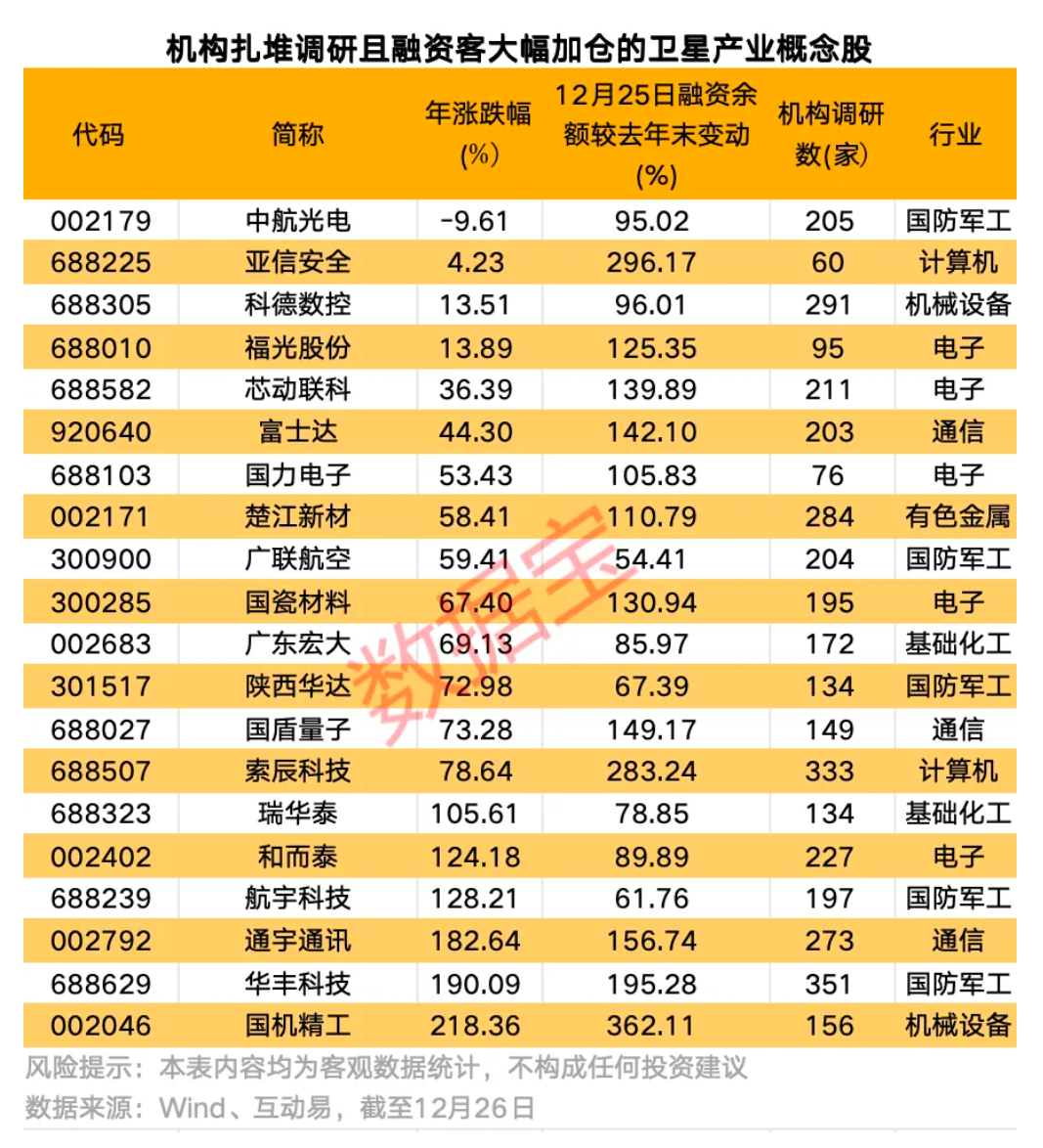
卫星产业链公司出炉 20只机构扎堆调研个股获融资客大幅加仓
Zheng Quan Shi Bao Wang· 2025-12-27 05:14
Core Insights - A-share listed companies are actively investing in the satellite industry chain and collaborating with domestic rocket companies, with 95 companies disclosing their involvement since November [1] - These 95 companies have seen a significant increase in financing, with a total financing balance of 69.055 billion yuan as of December 25, representing an increase of over 45% compared to the end of last year [1] - More than 30 companies within this group have experienced financing balance increases exceeding 100%, including companies like Aerospace Huanyu, Shunhao Co., and Guoji Precision [1] Financing and Institutional Research - Among the 95 companies, 20 have received over 50 institutional research inquiries this year, with leading companies in terms of institutional inquiries being Huafeng Technology, Suochen Technology, and Kede CNC [1] - As of December 25, the financing balance of these companies increased by over 50% compared to the end of last year [1] Performance of Key Companies - Notable companies with significant financing balance changes include: - Guoji Precision: 362.11% increase in financing balance [2] - Huafeng Technology: 195.28% increase in financing balance [2] - Aerospace Huanyu: 95.02% increase in financing balance [2] - The year-to-date performance of some companies includes: - Tongyu Communications: 182.64% increase [2] - Guocai Materials: 67.40% increase [2] - Xindong Lian Ke: 36.39% increase [2]