星展银行

Search documents
外资大行增聘、中资加薪留人 港股IPO热潮引爆金融人才争夺战
智通财经网· 2025-09-25 06:11
智通财经APP获悉,据媒体消息,为满足日益增长的银行和理财服务需求,多家国际大型银行已将高层 管理人员调派至香港,德银、摩根大通、渣打、花旗集团、星展银行等已开始在香港增聘人手。中金公 司、中信证券等中资券商最近亦出招挽留人才。另外,猎头公司Links International的金融服务主管指, 与去年相比,今年收到委托填补的职位数量增加30%至40%,主因是香港IPO及并购活动增加。 而早年减薪的内地金融券商,市传最近为留住人才,亦出招挽留人才。中金公司为高级投资银行家增设 新职级,新增职位包括高级董事总经理及总监。另中信证券则拟为旗下香港附属公司中信里昂证券职员 增薪,部分初级助理月薪加幅15至30%。 今年以来,港股IPO市场认购盛况空前,"超额认购王"纪录屡创新高。德勤预计,今年前三季度,香港 将迎来66只新股上市,集资总额达1823亿港元。新股数量较去年同期的45只增长47%,集资额较去年同 期的556亿港元大幅上升228%。德勤在报告中指出,预计今年最后一个季度,香港新股市场将延续强劲 势头,2025年全年香港将迎来超过80宗新股上市,总集资额介于2500亿至2800亿港元之间。 德勤中国华南区 ...


实探美元存款利率调整:有银行月内已两度下调
Mei Ri Jing Ji Xin Wen· 2025-09-24 12:52
Core Viewpoint - The Federal Reserve announced its first interest rate cut since December 2024, lowering rates by 25 basis points, prompting renewed focus on various dollar-denominated assets [1] Summary by Sections Interest Rate Adjustments - Several foreign banks have adjusted their dollar deposit rates following the Fed's rate cut, with HSBC reducing rates by 10 to 20 basis points for new funds on September 22 [1][2] - DBS Bank has lowered its dollar deposit rates twice in September, with current rates for various terms being 3.1% for 1 month and 2.9% for 1 year [3] - East Asia Bank has also reduced its dollar deposit rates, offering competitive rates for new customers [4] Comparison of Foreign and Domestic Banks - Foreign banks generally offer higher dollar deposit rates compared to major domestic banks, which have not yet adjusted their rates significantly [1][6] - Major state-owned banks have a maximum rate of 2.8% for 1-year dollar deposits, while some city commercial banks offer more attractive rates, such as 3.8% for 3-month deposits [6][7] Market Reactions and Future Expectations - The market had anticipated the Fed's rate cut, leading some foreign banks to preemptively adjust their rates [2][8] - Analysts suggest that banks adjust rates based on various factors, including the Fed's policies and market conditions, with foreign banks being more responsive to international financial market changes [8] Customer Considerations - Customers are advised to consider factors such as exchange rate fluctuations, potential interest rate declines, and opportunity costs when choosing dollar deposits [9]
第三届招商局C Star青年创新创业计划圆满结班
人民网-国际频道 原创稿· 2025-09-24 02:41
Group 1 - The C Star program has been included in the China-Africa Cooperation Forum - Beijing Action Plan (2025-2027) and the concept document for the 2026 "China-Africa Cultural Exchange Year" [4] - The program aims to build a friendship bridge for youth collaboration between China and Africa, promoting the concept of "business for good, mutual benefit, and win-win" [4] - The program is designed to empower African youth in various fields such as technology, agriculture, and culture, encouraging them to tackle local challenges [4][5] Group 2 - The C Star program has established a special fund to provide financial support, resource connections, and growth guidance for aspiring young entrepreneurs [7] - The program has successfully hosted three sessions, exploring the dual empowerment of the investment group and global youth innovation and entrepreneurship [11] - Participants visited multiple cities in China, engaging with enterprises, renowned universities, and government organizations to foster collaboration and resource sharing [11]



美联储重启降息后 实探美元存款利率调整:有银行已两度下调 优惠利率仍在“3字头”
Mei Ri Jing Ji Xin Wen· 2025-09-23 19:52
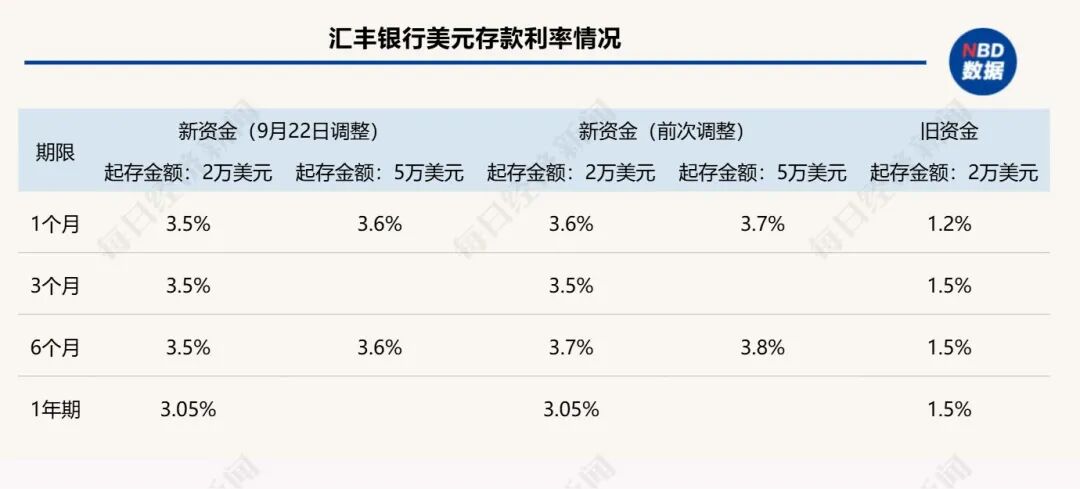
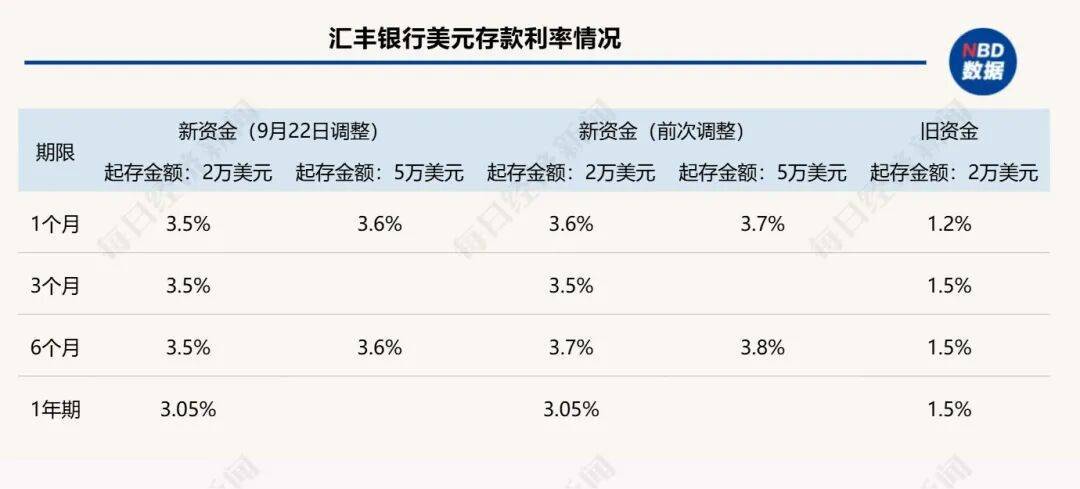
Core Viewpoint - The Federal Reserve has restarted interest rate cuts after nine months, prompting a reevaluation of dollar deposit rates across various banks, with foreign banks adjusting their rates more frequently than domestic banks [1][12]. Group 1: Foreign Banks' Dollar Deposit Rates - Several foreign banks have lowered their dollar deposit rates following the Fed's rate cut, with HSBC adjusting rates on September 22, 2023, for new funds: 1-month, 3-month, and 6-month rates at 3.5%, and 12-month at 3.05% for a minimum deposit of $20,000 [2][3]. - DBS Bank has also reduced its dollar deposit rates twice in September, with current rates for general accounts at 1-month 3.1%, 3-month 3.3%, and 1-year 2.9% [4][6]. - East Asia Bank offers promotional rates for new customers, with 1-month and 3-month rates at 3.15% and 3.55%, respectively, for deposits between $10,000 and $50,000 [7]. Group 2: Domestic Banks' Dollar Deposit Rates - Most domestic banks have not adjusted their dollar deposit rates, with state-owned banks offering a maximum rate of 2.8% for 1-year deposits, with minimum deposit amounts varying [8][10]. - For example, Bank of Communications and China Construction Bank both offer 1-month rates at 2.2% and 1-year rates at 2.8% for a minimum deposit of $5,000 [10][11]. - Some smaller banks, like Beijing Bank, offer more attractive rates, with 6-month rates at 2.7% and 1-year rates at 3% for a minimum deposit of $5,000 [11]. Group 3: Market Dynamics and Future Expectations - The adjustments in dollar deposit rates reflect banks' responses to market fluctuations and the Fed's monetary policy, with foreign banks typically more responsive to international market changes [12]. - Analysts suggest that the current dollar deposit rates remain higher than equivalent RMB deposit rates, attracting more savers, but caution that future rate cuts may occur as the Fed continues its easing cycle [13].
星展银行周邦贵:解码全球变局下的财富传承之道
财富FORTUNE· 2025-09-23 14:03
Core Viewpoint - The global economy is at a critical juncture, with geopolitical uncertainties affecting capital flows and increasing market volatility, indicating a more intense game of opportunities and risks than ever before [1][3]. Group 1: Wealth Management Trends - High-net-worth individuals (HNWIs) are increasingly anxious, with 51% citing "global economic recession" as their primary concern, and 45% wary of "asset price revaluation due to interest rate fluctuations" [3]. - The current economic turning point is reshaping asset price logic, leading to a shift in wealth management needs and philosophies among HNWIs [3][6]. - The traditional low-risk investment products are under pressure as the yield declines due to the Federal Reserve's interest rate cuts, highlighting the need for wealth preservation [6]. Group 2: Structural Opportunities - Despite challenges, there are structural opportunities in sectors like technology, communication services, and healthcare, which maintain long-term growth potential due to innovation and resilient market demand [6]. - The focus should be on balancing risk exposure with potential returns, moving away from blindly chasing high yields to capturing certain opportunities while managing risks [6]. Group 3: Generational Shifts in Wealth Management - The rise of the "second-generation entrepreneurs" (创二代) is reshaping wealth management, as they embody both "heirs" and "innovators," redefining the boundaries and essence of wealth management [7][8]. - This group is more receptive to new economic trends and emphasizes sustainable development and resource conservation, with "business for good" becoming a core consensus [7]. Group 4: Evolving Client Needs - HNWIs' demands are expanding beyond wealth growth to include family protection, children's education, retirement planning, and asset inheritance, with a significant rise in cross-border asset allocation needs [9][10]. - The wealth management industry is becoming increasingly competitive, requiring banks to innovate service models to meet changing client preferences and investment structures [9]. Group 5: Comprehensive Service Framework - The service framework of the bank covers five major goals: family protection, children's education, retirement planning, asset inheritance, and wealth growth, providing a one-stop solution through various financial tools [10]. - The bank leverages Singapore's status as a global wealth management hub to offer a dual platform of "global resource connection + local service implementation" for Chinese HNWIs [10]. Group 6: Digital Transformation and Value Transmission - The wealth management industry is accelerating digital transformation, with a focus on utilizing big data and AI to enhance service efficiency and client demand analysis [11]. - True wealth transmission goes beyond mere asset transfer; it involves the continuation of family values, business vision, and social responsibility across generations [11]. Group 7: Future Outlook - The demand for diversified global asset allocation among Chinese HNWIs is expected to be a long-term trend, driven by deep insights into global economic patterns and investor philosophies [14]. - The bank aims to deepen its roots in China while enhancing international market connectivity to better serve the evolving needs of its clients [14].

美联储重启降息后,实探美元存款利率调整
Mei Ri Jing Ji Xin Wen· 2025-09-23 10:59
Core Viewpoint - The Federal Reserve has restarted interest rate cuts after nine months, prompting a reevaluation of dollar deposit rates across various banks, with foreign banks adjusting their rates more frequently than domestic banks [1][12]. Group 1: Foreign Bank Adjustments - Several foreign banks have lowered their dollar deposit rates, with HSBC adjusting rates on September 22, 2023, for new funds, with 1-month and 6-month rates down by 10 and 20 basis points respectively [2][3]. - HSBC's new rates for new funds starting from $20,000 are 1-month at 3.5%, 3-month at 3.5%, 6-month at 3.5%, and 12-month at 3.05% [2][3]. - DBS Bank has also reduced its dollar deposit rates twice in September, with current rates for 1-month at 3.1% and 1-year at 2.9% [4][6]. Group 2: Domestic Bank Stability - Most domestic banks have not adjusted their dollar deposit rates, with major state-owned banks offering a maximum rate of 2.8% for 1-year deposits [8][10]. - The rates for major domestic banks like Bank of Communications and China Construction Bank are consistent, with 1-month at 2.2% and 3-month at 2.3% [10][11]. - Some smaller banks, such as Beijing Bank and Blue Ocean Bank, offer more attractive rates, with Blue Ocean Bank providing 3-month rates at 3.8% [11]. Group 3: Market Dynamics and Future Expectations - The adjustments in deposit rates are influenced by various factors including the Federal Reserve's policies, market liquidity, and competitive positioning among banks [12]. - Analysts expect further rate cuts from the Federal Reserve, which may lead to additional adjustments in bank deposit rates [12][13]. - The current dollar deposit rates remain higher than corresponding RMB deposit rates, attracting more savers to dollar deposits [13].
美联储重启降息后,实探美元存款利率调整:有银行已两度下调,优惠利率仍在“3字头”
Sou Hu Cai Jing· 2025-09-23 09:58
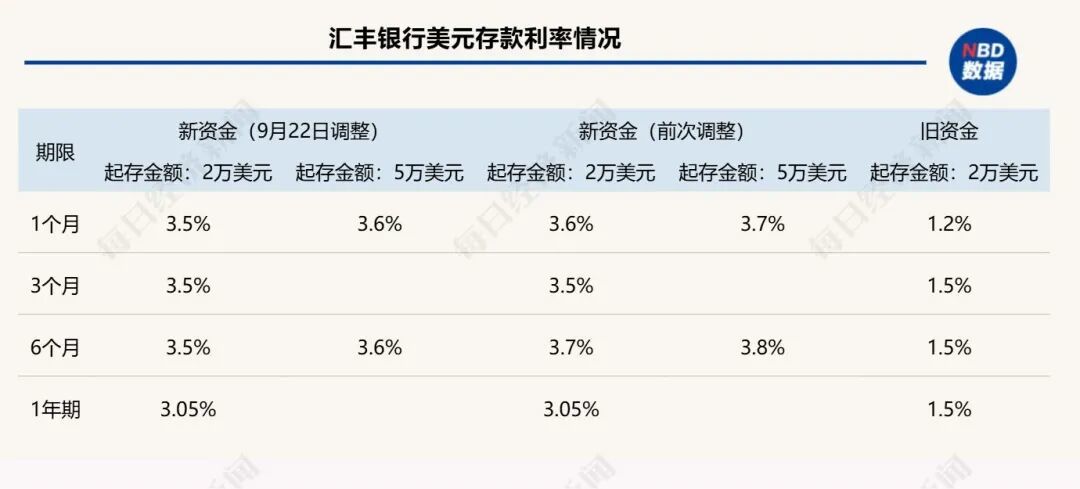
Core Viewpoint - The Federal Reserve has restarted interest rate cuts after nine months, prompting a renewed focus on various dollar-denominated assets, particularly dollar deposits at banks [1]. Group 1: Interest Rate Adjustments - Several foreign banks have adjusted their dollar deposit rates following the Fed's rate cut, with HSBC lowering rates by 10 to 20 basis points on September 22 [2][3]. - HSBC's new rates for new funds starting from $20,000 are 3.5% for 1-month, 3-month, and 6-month deposits, and 3.05% for 12-month deposits, reflecting a decrease from previous rates [2][3]. - DBS Bank has also reduced its dollar deposit rates twice in September, with current rates for general accounts at 3.1% for 1-month and 2.9% for 1-year deposits [4][5]. Group 2: Comparison of Rates - Foreign banks generally offer higher dollar deposit rates compared to major domestic banks, which have not yet adjusted their rates significantly [1][9]. - Major state-owned banks have a maximum rate of 2.8% for 1-year dollar deposits, while some city commercial banks and private banks offer more attractive rates, such as 3.8% for 3-month deposits at Blue Ocean Bank [9][12]. Group 3: Market Reactions and Future Expectations - The adjustments in dollar deposit rates are influenced by the Fed's monetary policy, with expectations of further rate cuts in the near future [13]. - Banks are expected to continue monitoring market conditions and may adjust rates accordingly, with some banks indicating potential further reductions in October [8][9].
北大汇丰王小愚:中国AI投资具备三大优势,首要挑战在核心技术依赖与硬件短板
Xin Lang Cai Jing· 2025-09-22 02:02
Core Viewpoint - The central financial work conference emphasizes the importance of technology finance, green finance, inclusive finance, pension finance, and digital finance for promoting high-quality financial development. The integration of 5G, AI, and blockchain is reshaping the financial infrastructure and service landscape, presenting both opportunities and challenges for the banking industry [1][3]. Group 1: Technological Integration in Finance - The collaboration of 5G, AI, and blockchain is fundamentally restructuring the architecture and operational logic of financial systems, enhancing payment systems, investment management, and supply chain finance [3][4][5]. - Payment and settlement systems can achieve real-time and trustworthy transactions, with 5G enabling millisecond-level latency and blockchain ensuring transaction immutability and traceability [3][4]. - AI enhances investment advisory and asset management by analyzing user preferences and market data, leading to more personalized and transparent investment strategies [4][5]. Group 2: Challenges of Technological Integration - The integration of these technologies may increase complexity and systemic risks within the financial system, such as compatibility issues between distributed ledgers and centralized AI frameworks [2][7]. - Performance bottlenecks exist between blockchain's low transaction per second (TPS) capabilities and the high throughput demands of 5G [6][7]. - The potential for AI algorithm resonance could amplify market volatility, leading to systemic risks if similar AI models are widely adopted [7]. Group 3: Key Players in the Ecosystem - Two types of companies are likely to dominate the "5G + AI + blockchain" ecosystem: technology giants with integration capabilities and specialized financial technology service providers [7][8]. - Technology giants can leverage their vast user bases and data resources to create efficient technology linkages, while specialized firms can focus on specific industry needs, enhancing their competitive edge [8]. Group 4: Future Directions in AI Investment - AI investment in China is driven by scenario-based applications, policy support, and engineering efficiency, with key challenges including reliance on core technologies and hardware limitations [9][12]. - The future of AI in finance will focus on multi-agent systems for decision-making, democratization of investment through asset tokenization, and seamless cross-border payment solutions [9][10][11]. - The evolution of AI technology is expected to shift from large models to intelligent agents capable of autonomous decision-making, enhancing operational efficiency in various sectors [12]. Group 5: Current Trends and Risks in Blockchain Investment - The current blockchain investment landscape is characterized by a mix of technological innovation and speculative behavior, leading to a phenomenon where "bad money drives out good" [14][17]. - Regulatory actions have targeted misleading cryptocurrency investment practices, indicating a need for clearer distinctions between genuine technological advancements and speculative projects [17][18]. - The differentiation between technological innovation and speculative behavior is crucial, with a focus on projects that do not promise financial returns and adhere to regulatory standards [18].
星展银行:美联储降息幅度将低于市场预期
Xin Hua Cai Jing· 2025-09-18 06:51
Core Viewpoint - The chief economist of DBS Bank, Taimur Baig, predicts that the Federal Reserve will only lower interest rates twice in 2025 and once in 2026, contrary to market expectations of three rate cuts in both years [1] Economic Factors - U.S. tariff policies and immigration controls are tightening the labor market, contributing to inflation risks [1] - Strong financial conditions for households and businesses, along with a surge in AI-related energy demand, are also factors driving inflation [1] - The ongoing rise in the stock market is expected to further exacerbate inflationary pressures [1] Interest Rate Outlook - The current rate-cutting cycle is anticipated to stall after a cumulative reduction of 100 basis points [1] - The mainstream view of a terminal rate of 3.5% by the Federal Open Market Committee (FOMC) is unlikely to be shaken due to heightened inflation pressures compared to a year ago [1]
纳斯达克证券代币化提案:SEC审批概率、时间线与全球资本市场重构
Sou Hu Cai Jing· 2025-09-15 11:13
Group 1 - Nasdaq's proposal to the SEC marks a significant shift from the "electronic bookkeeping era" to the "on-chain settlement era" in global capital markets [3] - The proposal aims to allow stocks and ETFs to trade in both traditional digital and tokenized forms, potentially rewriting the rules of global capital flow and efficiency [3][4] - The core objectives of the proposal include enhancing efficiency with T+0 real-time settlement, expanding trading hours to 24/7, and lowering barriers for small investors through tokenization [4] Group 2 - The technical design of the proposal focuses on compatibility with traditional systems while embedding blockchain technology, ensuring that tokenized securities share the same rights as traditional securities [5] - The regulatory framework does not break existing rules but integrates blockchain tools within the traditional system, maintaining compliance with AML and KYC processes [5] Group 3 - Institutional investors have shown positive feedback towards the proposal, with major firms like Goldman Sachs and Morgan Stanley initiating tokenized securities trading simulations [6] - A survey indicated that 62% of U.S. retail investors are willing to try tokenized stock trading, attracted by real-time settlement and 24/7 trading capabilities [6] Group 4 - The SEC's historical approval logic has shifted from risk-averse prohibition to compliance-guided openness, as evidenced by the approval of Bitcoin ETFs after a lengthy denial period [9][10] - The SEC's 2025 policy shift under new leadership has created a favorable regulatory environment for Nasdaq's proposal, emphasizing support for tokenization as a natural evolution of financial innovation [11][12] Group 5 - The approval timeline for Nasdaq's proposal is projected to conclude by mid-2026, with a high probability of approval exceeding 80% based on current policy support and market demand [15][8] - The anticipated impact on global capital markets includes a significant increase in trading volume and liquidity, with estimates suggesting a potential daily trading volume exceeding $3 billion upon launch [16][17] Group 6 - The tokenization of securities is expected to reinforce the dominance of the U.S. dollar in global capital flows, with the use of dollar-pegged stablecoins facilitating cross-border transactions [19] - Global exchanges are likely to engage in a digitalization race, with Nasdaq's initiative prompting other markets, such as Hong Kong and the EU, to accelerate their own tokenization efforts [20] Group 7 - Emerging markets may face increased capital outflow pressures as tokenization lowers barriers for investors seeking to access U.S. markets, potentially exacerbating regulatory challenges [22] - Developed countries will experience competitive pressures in their capital markets, necessitating rapid advancements in their own tokenization processes to retain investor interest [23] Group 8 - The impact on China's capital markets includes potential capital outflow risks and intensified competition for technology company listings, as U.S. tokenization may attract Chinese firms seeking better financing opportunities [24][25] - Hong Kong's capital markets may face challenges in maintaining their status as an international financial hub, with the risk of capital diversion to tokenized U.S. securities [28][29]