
柯力传感

Search documents
柯力传感:9月17日将举行2025年半年度业绩说明会
Zheng Quan Ri Bao· 2025-09-05 11:38
Core Viewpoint - The company, Keli Sensor, announced that it will hold a half-year performance briefing on September 17, 2025, from 13:00 to 14:45 [2] Summary by Relevant Sections - **Company Announcement** - Keli Sensor plans to conduct a performance briefing to discuss its half-year results for 2025 [2] - The event is scheduled for September 17, 2025, during the afternoon [2]

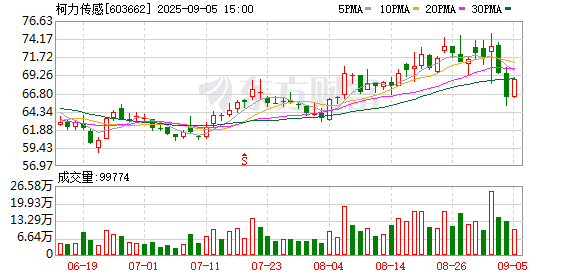
柯力传感(603662.SH):和特斯拉尚未合作

Ge Long Hui· 2025-09-05 08:33
Group 1 - The core point of the article is that KeLi Sensor (603662.SH) has stated that it has not yet collaborated with Tesla [1] Group 2 - The company has communicated this information through its investor interaction platform [1]
柯力传感(603662.SH):已取得部分协作机器人客户的批量订单
Ge Long Hui· 2025-09-05 08:27
Group 1 - The company has received bulk orders from some collaborative robot customers, but these orders represent a small proportion of the company's revenue for the first half of 2025 [1]
柯力传感(603662) - 柯力传感关于召开2025年半年度业绩说明会的公告
2025-09-05 07:45
证券代码:603662 证券简称:柯力传感 公告编号:2025-036 宁波柯力传感科技股份有限公司 关于召开 2025 年半年度业绩说明会的公告 本公司董事会及全体董事保证本公告内容不存在任何虚假记载、误导性陈 述或者重大遗漏,并对其内容的真实性、准确性和完整性承担法律责任。 重要内容提示: (二)会议召开地点:上海证券交易所上证路演中心 投资者可于 2025 年 9 月 10 日 (星期三) 至 9 月 16 日 (星期二)16: 00 前登录上证路演中心网站首页点击"提问预征集"栏目或通过公司邮箱 dmb@kelichina.com 进行提问。公司将在说明会上对投资者普遍关注的问题进行 回答。 宁波柯力传感科技股份有限公司(以下简称"公司")已于 2025 年 8 月 29 日发布公司 2025 年半年度报告,为便于广大投资者更全面深入地了解公司 2025 年半年度经营成果、财务状况,公司计划于 2025 年 9 月 17 日 (星期三) 13:00-14:45 举行 2025 年半年度业绩说明会,就投资者关心的问题进行交流。 一、说明会类型 本次投资者说明会以视频结合网络互动方式召开,公司将针对 20 ...
AI与人形机器人深度融合:商业化路径逐清晰
3 6 Ke· 2025-09-05 00:02
Group 1: AI Applications - The year 2025 is seen as a pivotal point for AI applications, transitioning from technical concepts to deep industry integration, with the global AI market expected to reach $221.87 billion, growing at a CAGR of approximately 26.2% [1] - AI applications are expanding across all fields, with high-value sectors leading the way; for instance, Wanjun Technology achieved AI-native application revenue of 60 million yuan, with a 200% increase in paid users [2] - Despite challenges such as data privacy issues and the inability of 54% of companies to quantify AI investment returns, AI is evolving from an auxiliary tool to a business partner, particularly in data-intensive sectors like finance and healthcare [3] Group 2: Humanoid Robots - 2025 is marked as the "commercialization year" for humanoid robots, supported by government policies and market dynamics, with significant advancements in core component localization, such as a 25% localization rate for harmonic reducers [4] - Major manufacturers like Estun and Midea are making strides in the humanoid robot market, with Estun capturing 23% market share in medical exoskeletons and Midea integrating robots into standard operations [5] - Despite progress, challenges remain, including reliance on imported high-end sensors and the high cost of humanoid robots, which is around 199,000 yuan, making them unaffordable for most households [5] Group 3: Integration and Breakthroughs - The deep integration of AI and humanoid robots is seen as a key driver for industry breakthroughs, with AI models enhancing decision-making capabilities and humanoid robots providing physical interaction with the environment [6] - The localization of core components is crucial, with current localization rates for key parts like harmonic reducers at 25% and expectations to reach over 50% by 2027 [6] - The focus on industrial applications is evident, as they offer clear ROI, with Midea's robots demonstrating value in equipment maintenance and material handling [7] Group 4: Future Outlook - The global humanoid robot market is projected to grow significantly, with Goldman Sachs forecasting a CAGR of 94% from 2025 to 2035, contingent on achieving large-scale production [7] - The integration of AI and humanoid robots is expected to create new business models and industry ecosystems, with predictions of the global humanoid robot market reaching between $38 billion and $154 billion by 2035 [7][8] - Investors are encouraged to focus on companies that are quickly commercializing AI models and those involved in the supply chains of key component manufacturers [8]

人形机器人+华为+小米概念:最正宗的15家公司(附名单)
Sou Hu Cai Jing· 2025-09-04 15:11
Core Viewpoint - The year 2025 is identified as the "Year of Robot Mass Production," with major tech companies like Huawei and Xiaomi accelerating their investments in humanoid robots, leading to an explosive growth phase in the industry. Group 1: Key Companies and Their Contributions - **Wolong Electric Drive**: A global leader in electric motors, providing high-torque servo motors for Xiaomi's CyberOne, and collaborating with Huawei on bionic joint actuators for low-power, high-precision control [3][4]. - **Zhuhai Guanyu**: A core battery supplier in Xiaomi's ecosystem, developing custom solid-state battery modules for CyberOne with an energy density of 400Wh/kg, enabling 12 hours of continuous operation [5]. - **Hanwei Technology**: Supplies tactile and temperature sensors to Huawei's supply chain, contributing to the "Huawei Xiaoyi" with multi-modal perception modules for adaptive environmental interaction [6]. - **Keli Sensor**: A core supplier of six-dimensional force sensors, completing Huawei prototype tests to optimize robot joint force feedback [8]. - **Zhongke Chuangda**: A key partner in Huawei's "Hongmeng + Ascend" ecosystem, developing robot operating systems and providing voice recognition and NLP algorithm optimization for Xiaomi's CyberOne [10]. Group 2: Technological Innovations - **Wolong Electric Drive**: Achieved motor efficiency exceeding 92% and reduced weight by 30% compared to traditional products, meeting the lightweight requirements of humanoid robots [4]. - **Zhuhai Guanyu**: Developed a hot-swappable battery system in collaboration with Huawei to address robot endurance challenges [5]. - **Hanwei Technology**: Flexible pressure sensors with a precision of 0.1N and a response time of less than 10ms, surpassing industry averages [7]. - **Keli Sensor**: Provides force control solutions for various applications, including industrial assembly and home services [9]. - **Fenda Technology**: Collaborates with Huawei on dexterous hand joint control systems, achieving precision of 0.01mm for millimeter-level control of grasping actions [12]. Group 3: Market Position and Future Prospects - **Zhuhai Guanyu**: Ranked among the top three in global consumer-grade lithium batteries, with a significant first-mover advantage in humanoid robot batteries [5]. - **Lansi Technology**: A strategic partner in Xiaomi's ecosystem, providing integrated solutions for facial display screens and developing electronic skin sensors, with the electronic skin market expected to exceed 5 billion yuan by 2025 [16][17]. - **Lingyi Zhizao**: A core manufacturer for Xiaomi's robots, with an automation rate of 90% in production lines and a planned annual production capacity of 500,000 units by 2025 [18][19]. - **Dazhu Laser**: Supplies core equipment for Huawei's humanoid robot production line, ensuring processing precision of 0.01mm for joint components [20]. - **Yinlun Technology**: Develops liquid cooling systems for Huawei's 5G modules, reducing volume by 60% compared to traditional air cooling systems and tripling cooling efficiency [22][23].


人形机器人产业的中场答卷:谁赚钱,谁落地,谁在探索下注?
Zhong Guo Ji Jin Bao· 2025-09-04 09:13
Core Insights - The humanoid robot industry is experiencing significant growth, with a doubling of exhibited robots and a strong performance in the capital market, where nearly 70 out of 172 concept stocks have seen price increases of over 50% this year [2][4]. Group 1: Financial Performance - Over 60% of humanoid robot concept stocks reported improved performance, with companies like Aobo Zhongguang and Keli Sensor achieving profitability, marking the first wave of industry dividends [4][6]. - Among the 172 concept stocks, 114 companies saw a year-on-year increase in net profit, with 25 companies exceeding 100% growth and 38 companies over 50% growth [6]. - Aobo Zhongguang reported a revenue of 435 million yuan, a 104% increase year-on-year, and a net profit of 60.19 million yuan, marking a turnaround with over 200% growth [7][8]. Group 2: Key Players and Contracts - Leading companies in the supply chain, such as Keli Sensor and Green Harmonic, are experiencing significant growth, with Keli Sensor achieving a revenue of 685 million yuan and a net profit of 173 million yuan, reflecting year-on-year growth of 23.4% and 47.9% respectively [8]. - UBTECH Robotics secured a record-breaking humanoid robot contract worth 250 million yuan, further establishing its position in the market [9][10]. - The humanoid robot sector has seen over 83 disclosed projects in the first half of 2025, with a total contract value of nearly 330 million yuan, indicating a substantial increase from the previous year [13]. Group 3: Market Dynamics and New Entrants - Traditional automotive parts manufacturers are entering the humanoid robot market, with companies like Top Group and Junpu Intelligent actively developing humanoid robot technologies [14]. - New players are rapidly emerging in the humanoid robot sector, with companies like Tianqi and Evergrande also establishing dedicated divisions for humanoid robotics [14][15]. - The number of companies entering the humanoid robot concept stock category is increasing, reflecting the growing interest and investment in this field [15].



人形机器人产业的中场答卷:谁赚钱,谁落地,谁在探索下注?
中国基金报· 2025-09-04 09:11
Core Viewpoint - The humanoid robot industry is experiencing significant growth, with a notable increase in the number of concept stocks and a strong performance in the capital market, indicating a promising investment landscape [2][4]. Group 1: Market Performance - As of September 4, 2023, there are 172 humanoid robot concept stocks in the A-share market, with only 12 experiencing a decline in stock price this year. Nearly 70 stocks have increased by over 50%, and 25 have doubled in value, showcasing a strong upward trend [2]. - Over 60% of the concept stocks reported improved performance in their semi-annual reports, with companies like Aobo Zhongguang, Keli Sensor, and Lide Xiebo achieving profitability, marking the first wave of industry benefits [4][5]. Group 2: Profitability and Key Players - The year 2025 is anticipated to be the "year of mass production" for humanoid robots, with upstream companies providing essential components and sensors being the primary beneficiaries rather than the front-line manufacturers [7]. - Among the 172 humanoid robot concept stocks, 114 reported a year-on-year increase in net profit, with 25 companies exceeding 100% growth and 38 surpassing 50% growth, particularly in sectors like reducers, controllers, and servo motors [8]. - Aobo Zhongguang reported a revenue of 435 million yuan, a 104% increase year-on-year, and a net profit of 60.19 million yuan, marking a turnaround with over 200% growth [9]. - Keli Sensor achieved a revenue of 685 million yuan and a net profit of 173 million yuan, reflecting year-on-year growth of 23.4% and 47.9%, respectively [10]. - Lide Xiebo's revenue reached 251 million yuan, with a net profit of 53.42 million yuan, both showing nearly 46% growth [10]. Group 3: Major Contracts and Developments - Leading manufacturers like Ubtech have secured significant contracts, including a nearly 1 billion yuan order and a 250 million yuan contract for humanoid robot products, indicating a shift from concept to commercial application [11][12]. - In the first half of 2025, over 83 humanoid robot projects were disclosed in China, with total contract amounts nearing 330 million yuan, a significant increase from the previous year [14]. Group 4: New Entrants and Industry Expansion - The humanoid robot sector is attracting new players, with traditional automotive parts companies like Top Group and Junpu Intelligent entering the market, leveraging their existing business advantages [16][17]. - Tianqi Co. has established a humanoid robot division and signed an investment agreement to advance the development of humanoid robots in industrial applications [17]. - The number of companies entering the humanoid robot concept stock category is rapidly increasing, reflecting growing interest and investment in this sector [18].

柯力传感(603662)2025年中报点评:业绩增速表现亮眼 聚焦机器人传感器领域
Xin Lang Cai Jing· 2025-09-04 06:38
Core Viewpoint - The company reported strong revenue and profit growth in the first half of 2025, driven by the consolidation of new subsidiaries and active investment in the robotics sensor sector [1][2]. Financial Performance - In the first half of 2025, the company achieved revenue of 685 million yuan, a year-on-year increase of 23.40% - The net profit attributable to shareholders was 173 million yuan, reflecting a year-on-year growth of 47.93% - Basic earnings per share (EPS) stood at 0.61 yuan [1] - For Q2 2025, revenue reached 370 million yuan, up 20.41% year-on-year, with net profit of 97 million yuan, an increase of 31.66% [2] - The company's gross margin and net margin were 44.04% and 28.48%, respectively, up 0.61 percentage points and 4.93 percentage points from the same period last year [2] - The period expense ratio increased by 2.15 percentage points to 25.65% compared to the previous year [2] Business Development - The company made significant progress in expanding its robotics sensor business, sending samples to over 50 domestic humanoid, collaborative, and industrial robot companies [3] - Key components include six-dimensional force/moment sensors and joint torque sensors, with nearly 1,000 units of six-dimensional force sensors shipped, and some clients moving from sample validation to small batch orders [3] - Strategic investments were completed in companies such as Kepler Humanoid Robotics and others, achieving full coverage from robot bodies to underlying key mechanical sensing components [3] Research and Development - The company has mastered key technologies related to six-dimensional force sensors, including structural decoupling, algorithm decoupling, and high-speed sampling and communication [4] - Newly purchased automated testing and machining equipment has been put into use, enhancing product precision, consistency, and production efficiency [4] - Ongoing research focuses on MEMS silicon-based six-dimensional force/torsion sensors, aiming for upgrades in miniaturization, high-frequency response, and embedded force control algorithm integration [4] Profit Forecast - Under a neutral scenario, the company expects revenues of 1.527 billion, 1.823 billion, and 2.196 billion yuan for 2025-2027, with corresponding net profits of 326 million, 394 million, and 482 million yuan, and EPS of 1.16, 1.40, and 1.72 yuan respectively [5]
柯力传感多元布局净利增47.93% 拟1.22亿增持华虹科技45%股权
Chang Jiang Shang Bao· 2025-09-03 23:58
Group 1 - The core viewpoint of the news is that Keli Sensor is actively optimizing its resource allocation by acquiring a controlling stake in its subsidiary, Huahong Technology, to enhance operational efficiency and decision-making speed [1][2][3] - Keli Sensor plans to acquire 45% of Huahong Technology's shares for 122 million yuan, increasing its ownership from 51% to 96%, thereby strengthening its control over the subsidiary [2] - Huahong Technology, engaged in geophysical exploration technology and industrial IoT, has shown strong financial performance with revenues of 125 million yuan and 43.88 million yuan for 2024 and the first half of 2025, respectively [2] Group 2 - Keli Sensor is transitioning from a single physical quantity sensor to a multi-physical quantity sensor, expanding its product offerings through both internal development and external acquisitions [3] - The company reported strong performance in the first half of 2025, achieving revenues of 685 million yuan, a year-on-year increase of 23.40%, and a net profit of 173 million yuan, up 47.93% [3] - Keli Sensor has established four major business segments, including smart industrial measurement and control, smart logistics equipment, energy and environmental measurement, and robotics, with a strategic focus on the robotics sector [3][4]