
沪农商行

Search documents
按揭、信用卡、消费贷与经营贷深度:深度银行四大零售资产的风险分析框架
ZHONGTAI SECURITIES· 2026-01-07 11:17
Investment Rating - The report maintains an "Overweight" rating for the banking sector [2] Core Insights - The four categories of retail loans (mortgages, credit cards, consumer loans, and business loans) collectively constitute household liabilities, each with distinct collateral types, duration structures, and policy influences. The report aims to establish a risk framework for these retail assets and assess their impact on banking operations in the future [2][4] - Under stress testing, the non-performing loan (NPL) ratios for mortgages, credit cards, and consumer loans are projected to increase by 11, 12, and 20 basis points respectively in 2026, while the growth in non-performing amounts remains manageable. The overall quality of corporate assets is expected to continue improving, indicating a stable banking sector [2][4] - Retail asset risks are deemed controllable, with policies expected to maintain stability in the near term [2] Summary by Sections Retail Asset Analysis Framework: Collateral Types + Duration Structure + Policy Impact - The overall NPL ratio for retail loans of listed banks is estimated at 1.27% in the first half of 2025, slightly above the corporate NPL ratio of 1.26%, but the increase in NPL ratios is stabilizing. The composition of existing NPLs is 63% corporate and 37% retail, with business loans and mortgages showing higher proportions of both existing and newly added NPLs [2][12] - The report establishes a risk analysis framework for retail assets, highlighting the differences in collateral types, duration structures, and policy impacts among the four categories of retail loans [2][4] Consumer Loans: "High-Risk" Assets - The relationship between consumer loans and consumption trends is closely aligned, with notable deviations occurring during strict property purchase restrictions and regulatory cycles for online loans. The market structure for consumer credit (excluding credit cards and mortgages) shows that listed banks hold over 51.5% of the market, while non-listed banks account for 17% and other players for 31% [2][4] - The risk logic for consumer credit indicates that risk pricing is primarily determined by interest rates, which can be categorized into four tiers based on risk levels. The report estimates that 4.4% of consumer loans fall into the "high-risk" category, with commercial banks' high-risk consumer loans representing only 0.6% of their total consumer loans [2][4] Mortgage Loans: Risk Sources and International Comparisons - The primary sources of mortgage risk include negative cash flow and high loan-to-value (LTV) ratios, with 1.2% of respondents reporting monthly incomes below their mortgage payments. The report anticipates that the current high LTV portion, which constitutes 2.9% of total mortgage balances, will not necessarily lead to increased NPLs [2][4] - International comparisons indicate that mortgage NPL ratios in most countries remain below 2%, suggesting that the risks in the domestic market are manageable [2][4] Business Loans: High-Risk Assets - The report estimates that approximately 2 trillion yuan of high-risk business loans were outstanding at the end of 2021, with nearly one-third of these high-risk assets already exposed. The peak of risk exposure is expected in 2024 and the first half of 2025, with NPL ratios projected to rise by 18 basis points to 1.96% under stress testing conditions [2][4] Credit Cards: Early NPL Exposure - Credit cards have historically shown early exposure to NPLs, with the NPL ratio at 2.44% in the first half of 2025. The report notes that the net increase in credit card NPLs has significantly decreased, indicating that credit cards are not currently a major pressure point for banks [2][4] Investment Recommendations - The report suggests two main investment lines for bank stocks: focusing on regional banks with strong certainty and advantages, particularly in areas like Jiangsu, Shanghai, Chengdu, Shandong, and Fujian, and recommending large banks with high dividend yields such as Agricultural Bank, Construction Bank, and Industrial and Commercial Bank [2][4]





1月7日晚间重要公告一览
Xi Niu Cai Jing· 2026-01-07 10:12
Group 1 - Zhongke Lanyun expects a net profit of 1.4 billion to 1.43 billion yuan for 2025, representing a year-on-year increase of 366.51% to 376.51% due to significant gains from investments in Moer Thread and Muxi shares [1] - Chuanjinnuo anticipates a net profit of 430 million to 480 million yuan for 2025, reflecting a year-on-year growth of 144.24% to 172.64% [2] - Guangqi Technology signed contracts for mass production of metamaterials totaling 264 million yuan with four clients [4] Group 2 - Daqin Railway reported a cumulative freight volume of 390 million tons for 2025, a decrease of 0.54% year-on-year [5] - Nanjing Panda clarified that it has no related business in the brain-computer interface sector and has not generated any sales revenue from it [6] - Tianhe Magnetic Materials announced that shareholder Nantong Yuanlong plans to reduce its stake by up to 3% [7] Group 3 - Yili Group's chairman plans to reduce his stake by up to 0.98% within a specified timeframe [12] - Ankai Bus reported a 46.8% year-on-year increase in bus sales for 2025, with total sales reaching 8,569 units [13] - Giant Star Agriculture reported a December 2025 pig sales volume of 666,400 heads, a year-on-year increase of 118.23% [22] Group 4 - China Nuclear Power's cumulative commercial power generation for 2025 is expected to grow by 12.98% year-on-year, reaching 244.43 billion kWh [38] - Weili Medical anticipates a net profit of 75 million to 95 million yuan for 2025, a decrease of 66% to 57% year-on-year [39] - Aonong Biological reported a December 2025 pig sales volume of 162,300 heads, a year-on-year increase of 28.39% [40]
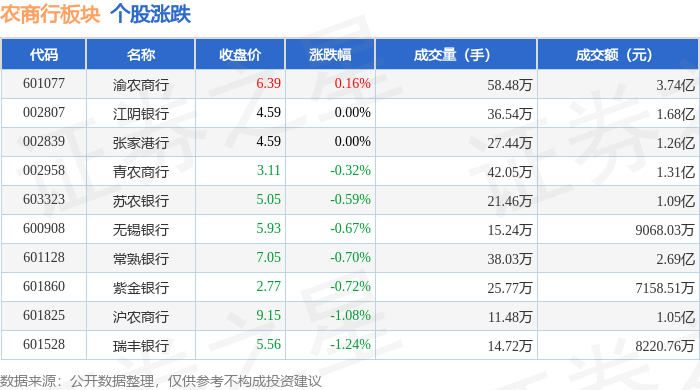
农商行板块1月7日跌0.57%,瑞丰银行领跌,主力资金净流入5042.72万元
Zheng Xing Xing Ye Ri Bao· 2026-01-07 08:58
Core Viewpoint - The rural commercial bank sector experienced a decline of 0.57% on January 7, with Ruifeng Bank leading the drop, while the Shanghai Composite Index rose by 0.05% and the Shenzhen Component Index increased by 0.06% [1] Group 1: Market Performance - The closing prices and performance of key rural commercial banks on January 7 are as follows: - Yunnan Rural Commercial Bank (601077) closed at 6.39, up by 0.16% - Jiangyin Bank (002807) closed at 4.59, unchanged - Zhangjiagang Bank (002839) closed at 4.59, unchanged - Qingnong Bank (002958) closed at 3.11, down by 0.32% - Sunan Bank (603323) closed at 5.05, down by 0.59% - Wuxi Bank (600908) closed at 5.93, down by 0.67% - Changshu Bank (601128) closed at 7.05, down by 0.70% - Zijin Bank (601860) closed at 2.77, down by 0.72% - Hunan Rural Commercial Bank (601825) closed at 9.15, down by 1.08% - Ruifeng Bank (601528) closed at 5.56, down by 1.24% [1] Group 2: Capital Flow - On January 7, the rural commercial bank sector saw a net inflow of 50.43 million yuan from main funds, while retail investors experienced a net outflow of 84.63 million yuan [1] - The capital flow for individual banks is as follows: - Zhangjiagang Bank (002839) had a main fund net inflow of 13.66 million yuan, but a retail net outflow of 13.84 million yuan - Changshu Bank (601128) had a main fund net inflow of 13.25 million yuan, with a retail net outflow of 22.78 million yuan - Qingnong Bank (002958) had a main fund net inflow of 12.24 million yuan, but a retail net outflow of 8.34 million yuan - Wuxi Bank (600908) had a main fund net inflow of 9.53 million yuan, with a retail net outflow of 6.99 million yuan [2]





沪农商行(601825) - 上海农村商业银行股份有限公司关于董事任职资格获监管机构核准的公告
2026-01-07 08:00
证券代码:601825 证券简称:沪农商行 公告编号:2026-001 梁晓丽女士、储晓明先生的简历请参见公司于 2025 年 11 月 5 日 披露于上海证券交易所网站(www.sse.com.cn)的《上海农村商业银 行股份有限公司 2025 年第一次临时股东会会议材料》。 特此公告。 上海农村商业银行股份有限公司董事会 2026 年 1 月 8 日 上海农村商业银行股份有限公司 关于董事任职资格获监管机构核准的公告 本公司董事会及全体董事保证本公告内容不存在任何虚假记载、 误导性陈述或者重大遗漏,并对其内容的真实性、准确性和完整性承 担法律责任。 上海农村商业银行股份有限公司(以下简称"公司")近日收到 《国家金融监督管理总局上海监管局关于梁晓丽上海农村商业银行 股份有限公司董事任职资格的批复》(沪金复〔2025〕875 号)、《国 家金融监督管理总局上海监管局关于储晓明上海农村商业银行股份 有限公司独立董事任职资格的批复》(沪金复〔2025〕878 号),国 家金融监督管理总局上海监管局已核准梁晓丽女士的公司董事任职 资格、储晓明先生的公司独立董事任职资格。 ...
沪农商行:董事任职资格获监管机构核准
Xin Lang Cai Jing· 2026-01-07 07:40
Group 1 - The company, Hu Nong Commercial Bank (601825.SH), announced that it has received approval from the Shanghai Regulatory Bureau of the National Financial Supervision Administration for the appointment qualifications of Liang Xiaoli as a company director and Chu Xiaoming as an independent director [1]
“技术流”风险评估助力科技金融发展
Jin Rong Jie· 2026-01-07 04:05
作者:金融界研究院院长陈国汪 发展新质生产力,推动科技金融发展,需要适应科创企业自身特点,开创新的风险评估模式。技术流风 险评估是银行针对科创企业"轻资产、重技术、高成长"特征,以"创新能力与成长性"为核心,替代传 统"抵押物+财务指标"的差异化风控范式,通过量化技术要素、构建多维模型、联动外部数据,实现对 科创企业全生命周期风险的精准评估与动态管理。这种模式与传统现金流评估模式存在较大差异,需要 不断探索与实践。 两种模式的异同点及融合趋势 银行对科创企业的技术流评估与对传统企业的现金流评估,是两种适配不同客群风险特征的授信评估范 式,核心差异在于评估导向(未来成长 vs 历史业绩),但底层目标、风控逻辑存在共性。 (一)两种评估模式的主要差异 技术流评估模式,针对科创企业 "轻资产、重技术、高成长、弱现金流" 的特征,以技术创新能力、成 长性、商业化潜力为核心,通过量化专利、研发投入、团队实力、技术成熟度等 "非财务指标",评估 企业未来价值与信贷风险的评估模式。核心逻辑是 "以未来成长能力覆盖信贷风险"。 现金流评估模式,针对传统企业 "重资产、稳现金流、低成长" 的特征,以历史财务表现、现金流稳定 性 ...
城农商行2025年收罚单超千张、罚没金额8.75亿元,信贷与反洗钱成违规“重灾区”
Xin Lang Cai Jing· 2026-01-06 11:17
Core Viewpoint - In 2025, a total of 6,521 fines were issued to 1,097 banking institutions in China, with a total penalty amount of 2.641 billion yuan, indicating a continued trend of stricter regulatory oversight in the financial sector [2][12]. Group 1: Penalty Statistics - Agricultural commercial banks received the highest number of fines, totaling 738, with Shenzhen Rural Commercial Bank receiving the largest fine among them [2][12]. - City commercial banks were issued 276 fines, with Shanghai Bank leading in the amount of fines [2][12]. - The total number of fines for both agricultural and city commercial banks accounted for 15.55% of the total fines, amounting to 875 million yuan [2][12]. Group 2: Reasons for Penalties - The top three reasons for penalties included violations in credit business (1,209 fines), inadequate internal control systems (752 fines), and violations of anti-money laundering regulations (697 fines) [2][12]. - Other reasons for penalties included violations in payment settlement, data reporting and governance, and inadequate employee behavior management [2][12]. Group 3: Major Fines in City Commercial Banks - Among 80 city commercial banks, Shanghai Bank, Beijing Bank, and Chongqing Three Gorges Bank had the highest penalty amounts, with fines of 37.31 million yuan, 35.40 million yuan, and 14.49 million yuan respectively [3][13]. - Shanghai Bank was penalized for multiple violations, including account management and anti-money laundering regulations, resulting in a total fine of 28.748 million yuan [4][14]. - Beijing Bank faced penalties for similar violations, with a total fine of 25.2685 million yuan [5][15]. Group 4: Major Fines in Agricultural Commercial Banks - In the agricultural commercial bank sector, Shenzhen Rural Commercial Bank, Chongqing Rural Commercial Bank, and Beijing Rural Commercial Bank received the largest fines, amounting to 12.84 million yuan, 11.65 million yuan, and 10.87 million yuan respectively [6][16]. - Shenzhen Rural Commercial Bank was fined for failing to comply with customer identity verification regulations and other violations, leading to a fine of 12.844 million yuan [7][17]. - Other banks, such as Foshan Rural Commercial Bank, also faced significant penalties for various violations, with fines reaching up to 8.8 million yuan [8][18]. Group 5: Regulatory Implications - The increasing number of fines highlights the need for city and agricultural commercial banks to strengthen internal management and compliance awareness to avoid future violations [9][19]. - Regulatory authorities are demonstrating a firm commitment to enhancing financial safety through stringent oversight [9][19].


成都农商行挤入万亿俱乐部,59岁王晖要全力冲刺IPO了
Xin Lang Cai Jing· 2026-01-06 11:17
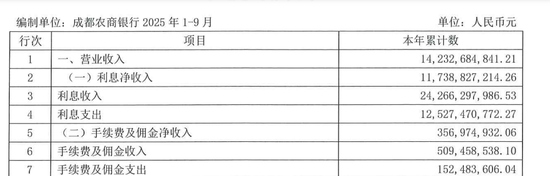
Group 1 - Chengdu Rural Commercial Bank's chairman, Wang Hui, is actively engaged in strategic partnerships, as evidenced by a recent signing ceremony with the Qionglai Municipal Government [1][17] - The market is curious about the future development of Chengdu Rural Commercial Bank following the leadership change with Chengdu Bank [2][18] - Wang Hui, who has extensive management experience, previously led Chengdu Bank to significant growth and was instrumental in its IPO [3][20] Group 2 - Chengdu Rural Commercial Bank has surpassed 1 trillion yuan in total assets, becoming the fifth rural commercial bank to join the trillion-yuan club [6][22] - The bank is currently pursuing an IPO, having initiated the process in December 2022, but has not made significant progress in three years [7][25] - Despite its size, Chengdu Rural Commercial Bank's profitability lags behind peers like Chongqing and Shanghai Rural Commercial Banks, with a net profit of 6.009 billion yuan in the first three quarters of 2025, reflecting a growth of 7.20% [11][27] Group 3 - The bank has been expanding its revenue streams, including the merger of six village banks in July 2025 [13][29] - Chengdu Rural Commercial Bank has outlined its investment plans for 2026, which will be discussed in an upcoming shareholders' meeting [15][31] - The bank's net profit growth has slowed compared to previous years, with growth rates of 16.89%, 15.25%, 11.87%, and 11.46% from 2021 to 2024 [11][28]
农商行板块1月6日跌0.31%,沪农商行领跌,主力资金净流入8461.81万元
Zheng Xing Xing Ye Ri Bao· 2026-01-06 09:00
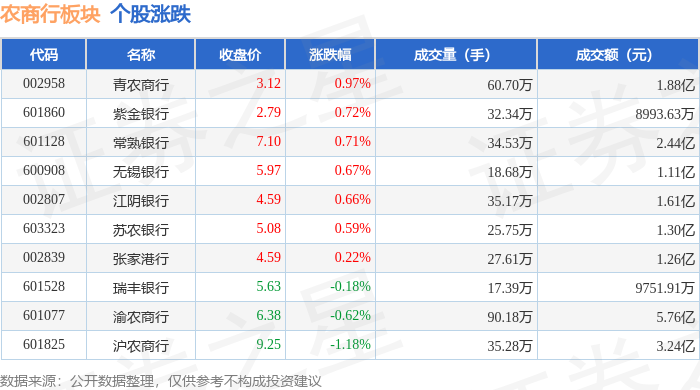
Core Viewpoint - The agricultural commercial bank sector experienced a decline of 0.31% on January 6, with the Shanghai Agricultural Commercial Bank leading the drop, while the overall Shanghai Composite Index rose by 1.5% [1] Group 1: Market Performance - The Shanghai Composite Index closed at 4083.67, up 1.5% [1] - The Shenzhen Component Index closed at 14022.55, up 1.4% [1] - The agricultural commercial bank sector's individual stock performance varied, with 青农商行 (Qingnong Bank) increasing by 0.97% to a closing price of 3.12 [1] Group 2: Trading Volume and Value - 青农商行 had a trading volume of 607,000 shares and a transaction value of 1.88 billion yuan [1] - 紫金银行 (Zijin Bank) recorded a trading volume of 323,400 shares with a transaction value of 89.93 million yuan [1] - 常熟银行 (Changshu Bank) had a trading volume of 345,300 shares and a transaction value of 244 million yuan [1] Group 3: Capital Flow - The agricultural commercial bank sector saw a net inflow of 84.62 million yuan from institutional investors, while retail investors experienced a net outflow of 87.57 million yuan [1] - The main capital inflow for 沪农商行 (Shanghai Agricultural Commercial Bank) was 39.95 million yuan, accounting for 12.31% of its trading [2] - 无锡银行 (Wuxi Bank) had a net inflow of 17.62 million yuan from institutional investors, representing 15.88% of its trading [2]
疯狂的银行企微考核:“一天要加十几个,完不成会通报”
Mei Ri Jing Ji Xin Wen· 2026-01-05 13:51
Core Viewpoint - The banking industry is increasingly focusing on the use of corporate WeChat (企微) as a tool for customer relationship management, driven by performance metrics that require employees to add a specific number of clients to their corporate WeChat accounts. This shift reflects the industry's struggle with retail business performance and the need for innovative customer engagement strategies [1][12]. Group 1: Performance Metrics and Employee Pressure - Many banks have implemented strict KPIs for corporate WeChat additions, with requirements such as adding 50 clients per month, leading to financial penalties for underperformance [2][5]. - Employees are sharing their corporate WeChat QR codes on social media to meet these targets, often incentivized by rewards like cash bonuses for high performance [1][2]. - The pressure to meet these metrics has led to a culture of "mutual assistance" among bank employees, where they help each other add clients to fulfill their quotas [1][2]. Group 2: Challenges and Limitations - There are significant challenges in achieving these targets, including restrictions on the types of clients that can be added and the requirement for clients to complete real-name authentication [3][4]. - Some employees have resorted to purchasing client contacts from online platforms, indicating a potential loophole in the system [3][4]. - The effectiveness of corporate WeChat in enhancing customer engagement is questioned, as many employees focus on merely completing tasks rather than fostering genuine client relationships [10][11]. Group 3: Strategic Importance of Corporate WeChat - The push for corporate WeChat is partly to prevent "client privatization," ensuring that customer relationships remain with the bank rather than individual employees [5][6]. - Corporate WeChat is seen as a vital tool for managing customer interactions and data, allowing banks to analyze client behavior and preferences more effectively [5][6]. - The banking sector views corporate WeChat as essential for addressing the challenges of declining retail business performance, with the potential to enhance customer insights and operational efficiency [12][14]. Group 4: Success Stories and Outcomes - Some banks have reported positive outcomes from their corporate WeChat initiatives, such as increased customer engagement and higher transaction volumes [15]. - For instance, a bank in Dongying achieved over 234,900 corporate WeChat friend additions, with a significant portion completing authentication, leading to improved customer activity [15]. - Another bank has successfully provided financial services to nearly a million clients through corporate WeChat, demonstrating its potential as a customer engagement platform [15].


