
Neuralink

Search documents
脑机接口概念股拉升 微创脑科学涨超8% 南京熊猫电子股份涨超7%
Zhi Tong Cai Jing· 2026-01-12 06:47
Core Viewpoint - The brain-computer interface (BCI) sector is experiencing significant stock price increases, driven by strong market interest and recent developments in the industry [1] Group 1: Stock Performance - Micron Brain Science (02172) rose by 8.15%, reaching HKD 13.53 [1] - Nanjing Panda Electronics (00553) increased by 7.38%, trading at HKD 6.26 [1] - Lens Technology (06613) saw a rise of 5.07%, priced at HKD 30.26 [1] Group 2: Market Developments - Strong Brain Technology has confidentially submitted an IPO application in Hong Kong after securing approximately CNY 2 billion in funding, marking the second-largest financing record in the BCI field globally, after Neuralink [1] - Elon Musk announced plans to commence large-scale production of BCI devices in 2026, alongside the development of fully automated surgical solutions, expressing confidence in aiding paralysis patients to regain full functionality [1] Group 3: Market Size and Growth Projections - According to Precedence Research, the global BCI market is projected to reach USD 2.62 billion in 2024, increasing to USD 2.94 billion by 2025, and potentially growing to USD 12.4 billion by 2034, with a compound annual growth rate (CAGR) of 17.35% over the next decade [1] - The Chinese BCI market is expected to reach CNY 3.2 billion in 2024, with projections of CNY 6.14 billion by 2028 [1] - The Central Committee of the Communist Party of China emphasizes the development of future industries, including BCI, as new economic growth points, aiming to create a new high-tech industry in China over the next decade [1]


新股消息 | 传强脑科技以保密形式提交港股IPO申请
智通财经网· 2026-01-12 06:47
Core Viewpoint - Qiangnao Technology, one of the "Six Little Dragons" in Hangzhou, has submitted a confidential IPO application for the Hong Kong stock market, following a significant strategic financing round of approximately 2 billion yuan [1] Group 1: Company Overview - Qiangnao Technology has focused on non-invasive brain-computer interface technology since its establishment in 2015 [1] - The company has developed a "super sensor" that captures weak brain electrical signals with high precision and converts them into control commands [1] - Qiangnao Technology has launched products such as smart bionic hands and brain-machine sleep instruments, with the smart bionic hand being the first non-invasive brain-computer interface device in China to receive FDA certification [1] Group 2: Financing and Investment - Recently, Qiangnao Technology completed a strategic financing round of about 2 billion yuan, attracting participation from several top international venture capital firms and industry capital in the consumer electronics sector [1] - This financing round is the second largest single round in the global brain-computer interface field, only behind Elon Musk's Neuralink [1] - The company has a history of financing, having completed angel and Pre-A rounds in 2016, a 400 million USD A round in 2019, and subsequent Pre-B and B rounds in 2025, raising 30 million USD and 20 million USD respectively [1]
脑机接口行业报告:产业发展迎来黄金期,蓝海市场广阔
CMS· 2026-01-12 06:05
Investment Rating - The report maintains a positive investment rating for the brain-computer interface (BCI) industry, highlighting significant investment opportunities expected in 2026 [2]. Core Insights - The brain-computer interface industry is entering a golden period of development, with a broad blue ocean market. Global strategic layouts are being actively pursued by the US, EU, Japan, and other regions, leading to a growing number of companies and active investment activities [1]. - The BCI technology is at a critical stage of transitioning from technological breakthroughs to practical applications, with the market expected to grow significantly over the next decade. The global BCI market is projected to reach approximately $2.94 billion by 2025 and grow to about $12.4 billion by 2034, with a compound annual growth rate (CAGR) of 17.35% from 2025 to 2034 [6][20]. - The report emphasizes the importance of policy support and technological advancements in driving the growth of the BCI industry, with significant investments and initiatives from various governments [20][30]. Industry Overview - The BCI technology has evolved through three stages: the initial stage (1.0), the development stage (2.0), and the current intelligent and integrated stage (3.0) [20]. - The BCI market is characterized by diverse applications, with at least 30 identified use cases across medical, consumer, and industrial sectors. Medical applications currently dominate, accounting for 56% of the industry, while non-medical applications are rapidly expanding [18][19]. Market Size and Growth - The BCI market is expected to experience accelerated growth in the next decade, driven by the increasing adoption of BCI technologies across various sectors. The report forecasts a significant rise in market size, with a focus on the rapid development of non-invasive BCI technologies [6][20]. - The report highlights that the US and China are leading the global BCI technology and industry development, with major companies like Neuralink and Qiang Brain Technology making significant advancements [6][20]. Investment Recommendations - The report recommends focusing on companies involved in BCI technology, particularly those with strong market positions such as Dao Technology (which has a stake in Qiang Brain Technology) and other related firms in the flexible sensor sector [6][20]. - It also suggests monitoring developments in the medical device sector related to BCI technologies, emphasizing the importance of medical-grade BCI products [6][20].
脑机接口或步入规模量产阶段,机构称游戏作为重要应用场景,有望持续受益
Mei Ri Jing Ji Xin Wen· 2026-01-12 05:55
Group 1 - Shanghai Brain Tiger Technology launched China's first fully implanted, fully wireless brain-computer interface product, marking a significant breakthrough in core technology and positioning the country among the top international players [1] - The first paralyzed subject after surgery has shown good recovery, able to control electronic devices through thoughts for daily activities like watching videos and playing games [1] - Musk plans to mass-produce Neuralink brain-computer interface chips by 2026, with a streamlined and nearly fully automated surgical process for implantation [1] Group 2 - Hardware mass production and simplified implantation processes are expected to accelerate the maturity of various application scenarios in gaming and healthcare [1] - The development of brain-computer interfaces is anticipated to create new interactive experiences in gaming, fostering new growth points for the industry [1] - Gaming companies are actively investing in related fields, such as 37 Interactive Entertainment's investment in Strong Brain Technology, which is the first unicorn in China's brain-computer interface sector [1] - Century Huatong established a research center with Zhejiang University in 2020, focusing on emerging fields like brain-computer integration [1] - Talking Tom plans to collaborate with Zhejiang University and Ruijin Hospital in 2024 to advance research in brain-computer interfaces and digital game therapy [1] Group 3 - The gaming sector is experiencing multiple catalysts for transformation, including AI, content, and commercialization model changes [2] - The largest gaming ETF tracks the China Securities Animation and Gaming Index, reflecting the overall performance of A-share listed companies in the animation and gaming industry [2] - There are investment opportunities in gaming ETFs that should be monitored [2]
脑机接口、AI医疗引爆,港股通医疗主题指数开年7连涨!T+0投资利器来袭,159137上市交易,实时成交逾亿元
Xin Lang Cai Jing· 2026-01-12 03:09
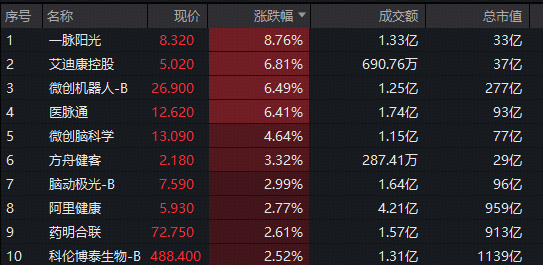
Group 1 - The Hong Kong stock market's medical sector remains active, with brain-computer interface and AI medical concepts leading the gains, as evidenced by significant stock price increases for companies like MicroPort Robotics and Alibaba Health [1][8] - The Hong Kong Stock Connect Medical Theme Index has seen a continuous rise for seven days since the beginning of 2026, indicating strong investor interest in the sector [1][8] - The newly launched Hong Kong Stock Connect Medical ETF (Huabao, 159137) is actively trading and aims to passively track the medical theme index, reflecting the growing interest in medical investment tools [1][8] Group 2 - The Hong Kong Stock Connect Medical ETF is anchored on medical innovation, covering key sectors such as CXO, AI medical, medical devices, and innovative drugs, including popular themes like brain-computer interfaces and AI medical [3][11] - The medical theme index has shown high elasticity and volatility, with a maximum increase of over 148% during the last medical bull market, significantly outperforming comparable indices [3][11] Group 3 - Recent developments in the brain-computer interface and AI medical fields have led to increased attention in the medical sector, with notable advancements from companies like Neuralink and research achievements from Tsinghua University [5][13] - Policy initiatives, such as the National Medical Products Administration's plans for standards related to brain-computer interface medical devices, and Beijing's action plan for AI in healthcare, are expected to further stimulate the sector [5][13] Group 4 - Institutional analysis indicates that major overseas pharmaceutical companies are increasing their focus on innovative medical devices in China, suggesting a favorable market environment similar to the previous year's innovative drug sector [6][13] - The A-share medical investment tools, particularly the largest medical ETF (512170), cover a significant portion of AI medical and brain-computer interface stocks, indicating a strong investment opportunity [6][14]

华创证券:政策加码、临床加速 脑机接口产业化进入关键阶段
智通财经网· 2026-01-12 01:57
Core Insights - The commercialization of brain-computer interfaces (BCIs) is steadily advancing, presenting vast market opportunities in China, where competition is still in its early stages with most companies being small and not yet in a saturated market [1] - Invasive BCIs have significant advantages in signal quality, while non-invasive BCIs offer high safety and ease of use, serving as a complement to invasive types [1] - The current focus of the industry is on the medical field, with potential future expansion into non-medical areas [1] Group 1: Global Developments - Neuralink, a global leader in BCIs, is expected to enter the commercialization phase by 2026, with 12 patients having successfully implanted devices as of September 2025 [2] - Neuralink plans to increase the number of electrodes in its devices to over 30,000 by 2028, aiming for comprehensive brain connectivity [2] - The company has outlined three core product lines: Telepathy for motor disabilities, Blindsight for visual impairments, and Deep for neurological disorders [2] Group 2: Competitive Barriers - Key competitive advantages for Neuralink include flexible electrode arrays, precise implantation robots, and low-power intracranial signal processing systems [3] - The development of a closed-loop technical system through interdisciplinary research and clinical collaboration is essential for domestic companies [3] Group 3: Industry Trends in China - National strategies are guiding the BCI industry, with policies expected to be released in 2025 to support development [4] - Clinical advancements are accelerating, with significant breakthroughs in invasive and semi-invasive BCI systems reported in 2025 [4] - The financing market for BCIs is thriving, with 24 financing events recorded in 2025, marking a 30% increase year-on-year [4] - The supporting industrial chain for BCIs is rapidly forming, with pilot implementations in medical and everyday scenarios [4]
【华创医药】华创医疗器械求索系列11:脑机接口行业——政策加码,临床加速,产业化进入关键阶段
华创医药组公众平台· 2026-01-12 00:51
Core Viewpoint - The article discusses the development and commercialization of brain-computer interface (BCI) technology, highlighting its market potential, competitive landscape, and various applications, particularly in the medical field [3][5]. Group 1: Brain-Computer Interface Overview - BCI technology establishes a direct communication pathway between the brain and external devices, with steady progress in commercialization leading to vast market opportunities [3]. - The competitive landscape in China's BCI sector is still in its early stages, with most companies being small and not yet in a saturated market [3]. - There are two main types of BCI products: invasive BCIs, which offer significant signal quality advantages, and non-invasive BCIs, which are safer and easier to operate, serving as a complement to invasive types [3]. - Current applications are primarily in the medical field, with future potential to expand into non-medical areas [3]. - The industry chain has high technological barriers at the upstream level, while the mid and downstream sectors exhibit strong agglomeration effects [3]. Group 2: Global Leader Neuralink's Path to Industrialization - Neuralink, a global pioneer in BCI, is expected to enter the industrial application phase by 2025, with 12 patients having successfully implanted devices [4]. - The company plans to scale production of BCI devices starting in 2026, transitioning from laboratory research to large-scale manufacturing [4]. - Neuralink has outlined a three-step technology iteration plan, aiming to increase the number of electrodes in implants significantly by 2028 to enable comprehensive brain connectivity [4]. - The company has identified three core product lines: Telepathy for motor function recovery, Blindsight for visual perception restoration, and Deep for neurological function recovery [4]. - Neuralink's competitive advantages include advanced electrode technology, precise implantation robotics, and low-power signal processing systems [4]. - The development of Neuralink offers insights for domestic companies, emphasizing the importance of interdisciplinary research, clinical collaboration, and gradual commercialization [4]. Group 3: Factors Driving BCI Industrialization in China - National strategies are guiding the BCI sector, with local policies being introduced to support its development [5]. - Clinical advancements are accelerating, with significant breakthroughs in various BCI applications, including invasive and semi-invasive systems [5][6]. - The financing market for BCI is thriving, with 24 financing events recorded in 2025, marking a 30% year-on-year increase [5]. - The supporting industry chain for BCI technology is rapidly forming, facilitating the practical application of BCI in medical, production, and daily life scenarios [6]. Group 4: Key Companies in the BCI Sector - Notable companies in the BCI field include: - Xinwei Medical (interventional BCI) - Maipu Medical (neurosurgical consumables) - Kefu Medical (bionic implant BCIs) - Meihua Medical (upstream BCI industry) - Sanbo Brain Science (neurological specialty medical group) - Weisi Medical (rehabilitation BCIs) - Mailande (rehabilitation BCIs) - Xiangyu Medical (rehabilitation BCIs) - Chengyitong (comprehensive BCIs) - Aipeng Medical (neuro-regulation BCIs) - Chuangxin Medical (exoskeleton BCIs) [11].
机构:政策持续加码 关注脑机接口板块投资机会
Zheng Quan Shi Bao Wang· 2026-01-12 00:40
Group 1 - The National Medical Products Administration has publicly announced the formulation plan for two recommended industry standards related to brain-computer interface (BCI) invasive devices and their reliability verification methods [1] - Guosen Securities believes that the BCI industry has entered a critical phase of transitioning from technological breakthroughs to commercialization, driven by policies, technology, and application scenarios [1] - The global market for BCIs is expected to experience explosive growth due to favorable policies, including the "14th Five-Year Plan," medical insurance coding, and the implementation of medical device standards, alongside the anticipated mass production of Neuralink and breakthroughs in domestic clinical applications [1] Group 2 - Dongguan Securities reports that Elon Musk's Neuralink plans to begin large-scale production of BCI devices in 2026, with a focus on highly automated surgical procedures [2] - A significant breakthrough involves the electrode wires penetrating the dura mater without the need for removal, which is expected to enhance the BCI sector and boost the overall pharmaceutical and biotechnology market [2] - The BCI industry is identified as a future industry clearly outlined in the "14th Five-Year Plan," with ongoing policy support, suggesting investment opportunities in the BCI sector [2]
多重利好叠加释放 脑机接口板块“带飞”持仓基金净值
Zheng Quan Shi Bao· 2026-01-11 16:55
板块热度飙升 Wind数据显示,上周,万得脑机接口概念指数(8841700)大涨18.95%。相关概念股中,创新医疗收获 涨停五连板,南京熊猫、普利特分别录得涨停四连板,美好医疗、三博脑科等也连续4个交易日大涨。 脑机接口板块大涨的背后,是政策、技术、产业与资本的多重利好叠加释放。 2026年开年,脑机接口一跃成为全球科技与资本市场的焦点之一。 近日,特斯拉CEO马斯克宣布,旗下Neuralink公司将于2026年启动脑机接口设备的"大规模生产",并将 转向"更加精简和几乎完全自动化的外科手术流程",这一表态也迅速点燃了市场热情。几乎前后脚,国 内脑机接口独角兽企业强脑科技宣布完成了约20亿元融资,规模位居全球第二。 在海外量产预期、国内政策支持与临床突破的多重共振下,A股脑机接口板块掀起了涨停潮。在板块大 涨的这波行情中,提前埋伏其中的基金也明显受益,净值大幅攀升。 脑机接口,这个一度只存在于科幻作品中的概念,正加速走进现实。 政策、技术与资本共振 1月5日,华银健康生活主题灵活配置单日涨幅达11.8%,领跑全市场基金;长城消费增值混合、国泰创 新医疗混合等单日涨幅也超过10%,位居市场前十。根据2025年 ...
医药行业周报:创新出海迎来开门红-20260111
Huaxin Securities· 2026-01-11 13:03
Investment Rating - The report maintains a "Recommended" rating for the pharmaceutical industry as of January 11, 2026 [3] Core Insights - 2025 marked a significant year for Chinese innovative drugs going overseas, with total transaction amounts reaching $135.655 billion, including $7 billion in upfront payments and 157 deals, setting historical highs [4] - The innovative drug index saw a 35.31% increase in 2025, outperforming the CSI 300 index by 17.65% [4] - The trend of Chinese innovative drugs going global is expected to strengthen in 2026, with significant deals such as the one between Yilian Biotech and Roche for the YL201 project, which includes a $570 million upfront payment [4] - The small nucleic acid drug sector is experiencing breakthroughs, with GSK's Bepirovirsen showing positive results in Phase III trials for chronic hepatitis B, potentially becoming the first drug to achieve functional cure [5] - The report highlights the importance of oral autoimmune drugs, with Takeda's TYK2 inhibitor showing promising results in treating moderate to severe plaque psoriasis [6] - The brain-computer interface technology is entering a critical industrialization phase, with companies like Neuralink set to produce devices in 2026, supported by favorable policies and clinical trials in China [8] - The ZAP-X radiotherapy device is expected to capture a significant market opportunity in China, with the non-invasive tumor radiotherapy market projected to grow from RMB 27.2 billion in 2018 to RMB 59.4 billion by 2024 [10] Summary by Sections 1. Pharmaceutical Market Tracking - The pharmaceutical industry index underperformed the CSI 300 index by 2.13% over the past week, ranking 25th among 31 industry indices [28] - Over the past month, the pharmaceutical industry index also lagged behind the CSI 300 by 5.42%, ranking 27th [29] 2. Pharmaceutical Sector Trends and Valuation - The current PE (TTM) for the pharmaceutical industry index is 36.95, above the five-year historical average of 31.12 [52] 3. Recent Research Achievements - The report includes various deep-dive studies on topics such as the growth of biological agents and oral drugs, and the impact of policy support on the inhalation drug industry [55] 4. Important Industry Policies and News - Recent policies include the issuance of the fourth batch of encouraged generic drug directories by the National Medical Products Administration [57] - Significant news includes GSK's announcement of positive Phase III results for Bepirovirsen and Yilian Biotech's licensing agreement with Roche [58][59]


