中国卫星

Search documents
万亿级市场!低空经济,迈向场景化应用元年
Xin Lang Cai Jing· 2026-01-29 03:47
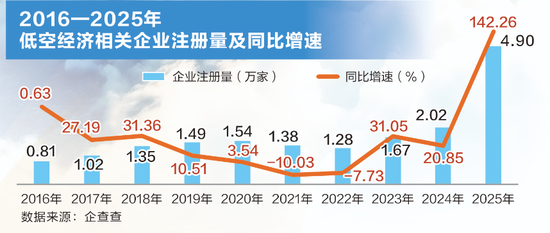
Core Insights - The low-altitude economy is projected to reach a market size of 1.5 trillion yuan by 2025 and 3.5 trillion yuan by 2035, becoming a core track for cultivating new productive forces and emerging industries [4][26] - The year 2026 is seen as a pivotal year for the low-altitude economy, marking the transition from concept validation to scenario application [2][24] - The Chinese government has elevated the low-altitude economy to a strategic emerging industry, with multiple policies and frameworks established to support its development [6][28] Market Potential - The low-altitude economy market in China surpassed 500 billion yuan in 2023, reaching 505.95 billion yuan, with a projected growth of 32.5% to 670.25 billion yuan in 2024 [4][26] - The number of registered low-altitude economy-related enterprises increased significantly, with a forecast of 49,000 registrations by 2025, marking a year-on-year growth of 142.26% [2][24] Policy Support - The low-altitude economy was included in national planning for the first time in February 2021, and it has been recognized as a strategic emerging industry in subsequent government reports [6][28] - The establishment of the Low Altitude Economy Development Department by the National Development and Reform Commission aims to coordinate the advancement of the low-altitude economy [6][28] Industry Structure - The low-altitude economy industry is concentrated in three major economic zones: the Greater Bay Area, Yangtze River Delta, and Beijing-Tianjin-Hebei, which together form the leading tier of development [7][29] - As of January 2023, there were approximately 163,000 active low-altitude economy-related enterprises in China, with significant concentrations in East and South China [7][29] Technological Advancements - The low-altitude economy has developed a complete industrial chain encompassing low-altitude manufacturing, operation, infrastructure, and information services [10][32] - China leads globally in drone research and design, with over 77,000 drone R&D companies, including major players like DJI [10][32] Investment Trends - Investment in the low-altitude economy is on the rise, with 143 financing events recorded in the first half of 2025, a 120% increase year-on-year [15][37] - The stock market has seen significant interest, with 17 concept stocks doubling in price since 2024, indicating strong investor confidence [15][37] Application Scenarios - The low-altitude logistics market is expected to grow rapidly, with projections of reaching 120 to 150 billion yuan by 2025 and 450 to 605 billion yuan by 2035 [11][33] - Companies like WanFeng Aviation are developing comprehensive applications for fixed-wing aircraft, eVTOL, and drones, covering various transportation scenarios [12][34] Challenges Ahead - The low-altitude economy faces challenges in infrastructure development, regulatory frameworks, and technological breakthroughs, which are essential for scaling operations [40][41] - Key issues include the reliance on imported components, high operational costs, and the need for a stable business model to ensure sustainable growth [40][41]

中国准备太空采矿
财联社· 2026-01-29 03:39
Core Viewpoint - The China Aerospace Science and Technology Corporation plans to promote the development of new fields such as space tourism, space digital infrastructure, space resource development, and space traffic management during the 14th Five-Year Plan period [1] Group 1: Space Tourism - Accelerate the iteration of suborbital and orbital space tourism vehicles, complete relevant unmanned or manned flight verification, and establish a comprehensive space tourism operation system to achieve regular suborbital space tourism flights and gradually develop orbital space tourism [2] Group 2: Space Digital Infrastructure - Build gigawatt-level space digital infrastructure, create a new type of space system architecture that integrates cloud, edge, and terminal, and achieve deep integration of computing power, storage capacity, and transportation capacity, enabling "sky computing on sky," "ground computing on sky," and "joint computing of sky and ground" [3] Group 3: Space Resource Development - Conduct major project demonstrations for "Heavenly Works and Material," establish a comprehensive experimental and ground support system for space resource development, and focus on breakthroughs in key technologies such as small celestial body resource exploration, intelligent autonomous mining, low-cost transfer and transportation, and in-orbit processing [4] Group 4: Space Traffic Management - Carry out key technology research on space debris monitoring, early warning, and removal, laying a solid foundation for China to gain initiative in the formulation of international rules for space traffic management and ensuring the safe operation of space infrastructure [5]


中国商业航天火箭卫星将加速升级
第一财经· 2026-01-29 03:22
Group 1 - The core viewpoint of the articles emphasizes the enhancement of China's commercial space capabilities through various engineering projects aimed at developing competitive commercial launch vehicles and satellite systems [1][2][3] Group 2 - The China Aerospace Science and Technology Corporation plans to implement a commercial launch capacity enhancement project, focusing on developing reusable rockets capable of carrying 20 tons to low Earth orbit and heavy launch vehicles with a capacity of 100 tons [1] - The company will also advance a commercial satellite efficiency leap project, which includes the development of new satellite types and advanced payloads, as well as the construction of satellite constellations for national satellite internet and various new applications [1] - Infrastructure improvements will be made in the commercial space industry, including the construction of new launch sites and recovery systems to address gaps in launch, recovery, and control operations [2] - A comprehensive commercial launch site system will be established, integrating launch and recovery functions, production, and testing capabilities to meet the demands of larger satellite constellations [2] - The company aims to create an integrated space application data system and a satellite application service cloud platform to provide comprehensive information services and promote large-scale applications [2][3]

中国卫星涨2.05%,成交额33.95亿元,主力资金净流入5380.72万元
Xin Lang Cai Jing· 2026-01-29 03:21
Core Viewpoint - China Satellite has shown significant stock performance with a year-to-date increase of 0.46% and a remarkable 123.34% rise over the past 60 days, indicating strong market interest and potential growth in the aerospace sector [1][2]. Group 1: Stock Performance - On January 29, China Satellite's stock rose by 2.05%, reaching 95.39 CNY per share, with a trading volume of 3.395 billion CNY and a turnover rate of 3.06%, resulting in a total market capitalization of 112.798 billion CNY [1]. - The stock has experienced a net inflow of 53.8072 million CNY from major funds, with significant buying activity from large orders, indicating strong investor interest [1]. - Over the past 20 days, the stock price has increased by 10.51%, while it has decreased by 3.65% in the last 5 trading days [1]. Group 2: Financial Performance - For the period from January to September 2025, China Satellite reported a revenue of 3.102 billion CNY, reflecting a year-on-year growth of 85.28%, and a net profit attributable to shareholders of 14.8114 million CNY, which is a 200.48% increase compared to the previous year [2]. - The company has distributed a total of 1.383 billion CNY in dividends since its A-share listing, with 148 million CNY distributed over the last three years [3]. Group 3: Shareholder Structure - As of September 30, 2025, the number of shareholders for China Satellite reached 160,500, an increase of 27.12% from the previous period, while the average number of tradable shares per shareholder decreased by 21.33% [2]. - The top circulating shareholders include various ETFs, with notable changes in holdings, such as an increase in shares held by the Fortune China Defense ETF and a decrease in shares held by the Southern China 500 ETF [3].
中国商业航天火箭卫星将加速升级,开发更多应用场景
Xin Lang Cai Jing· 2026-01-29 03:16
同时还将实施商业卫星效能跃升工程,研制新型卫星及先进载荷,开展卫星星座建设。星座建设方面, 开展国家卫星互联网星座、千帆星座、各类新型应用卫星星座建设。新型卫星研制方面,研发一批世界 一流的标志性载荷产品,发展新一代平板卫星、软件定义卫星、算力卫星、超低轨卫星等新型卫星。先 进制造能力建设方面,推进增材制造、超精密加工、一体化成型等先进制造技术应用,提升柔性化、智 能化、规模化生产水平,全面满足大规模星座建设需要。(央视新闻) 记者今天(29日)从中国航天科技集团获悉,未来集团将实施商业运载能力提升工程,就是要研制具备 国际竞争力的商业运载火箭,实现航班化运输。可重复使用商业火箭方面,形成近地轨道20吨级重复使 用状态运载能力,实现重复使用火箭规模化、商业化成熟应用。重型运载火箭方面,完成重型运载火箭 研制和相关重复使用试验,具备近地轨道百吨级入轨能力。 ...
中国商业航天产业基础设施将补强,开发更多应用场景
Xin Lang Cai Jing· 2026-01-29 03:16
在开发新场景方面,将面向低轨卫星互联网,培育手机直连、航空互联网、车联网等大众服务。开展低 空航域航线规划、飞行管控等智慧应用。统筹利用低空无人机、临空无人机、超低轨卫星等新型基础设 施,开发新场景。培育空间环境应用、太空计算、太空垃圾清除等新型应用服务。(央视新闻) 此外,中国航天科技集团还将实施空间应用产业拓展工程。加强应用技术攻关,构建"感通算用"融合的 一体化空天地信息网络;在应用技术攻关方面,研究高中低轨捷变自适应卫星通信、高精度导航信号处 理及导航增强、多源数据融合与智能分析等技术,实现空天信息体系新概念、新原理和新方法的原始创 新;在构建服务体系方面,构建开放共享的空间应用数据体系,建设卫星应用数智服务云平台,打造泛 在智能的空天信息服务体系,汇聚天空地、通导遥等多源时空信息,为用户提供系统解决方案及综合信 息服务,促进规模化应用。 记者今天(29日)从中国航天科技集团获悉,中国商业航天将实施产业基础设施补强工程。补齐发射、 回收、测运控等环节的短板。开展海南、东部沿海、酒泉等地商业发射新工位或新发射场建设,形成互 补协同的商业发射场体系。建设智能化陆上、海上着陆场和搜救回收力量。聚焦后续更大规 ...
商业航天概念震荡拉升 航天科技直线涨停
Jing Ji Guan Cha Wang· 2026-01-29 03:04
经济观察网商业航天概念震荡拉升,航天科技(000901)直线涨停,航天科技、巨力索具(002342)、 中国卫星(600118)、航天机电(600151)、航天工程(603698)跟涨。 ...

东吴证券:商业航天迎多重共振 聚焦火箭端卫星端等四大赛道
Zhi Tong Cai Jing· 2026-01-29 02:44
智通财经APP获悉,东吴证券发布研报称,长期以来,我国商业航天的核心痛点在于"星多箭少"——海 量卫星组网需求受制于极度稀缺的投送能力。2025年12月3日,朱雀三号遥一成功入轨,标志着国产商 业火箭成熟的大规模入轨能力。建议关注SpaceX相关标的、火箭端卫星端、以及太空算力/太空光伏四 大赛道。 东吴证券主要观点如下: 太空算力与太空光伏(前瞻赛道):太空算力:顺灏股份;太空光伏设备:晶盛机电、高测股份、捷佳 伟创、连城数控、宇晶股份、双良节能、拉普拉斯;太空光伏产品:云南锗业、中来股份、乾照光电、 东方日升、钧达股份、明阳智能、上海港湾、琏升科技、天合光能、晶科能源、蓝思科技、凯盛科技。 风险提示:技术验证不及预期、订单兑现不及预期、地缘政治波动风险、市场波动风险等。 战略重要性:发星保轨、防御升维与地外矿权 当前商业航天的竞争本质上是一场关于空间主权与资源份额的"圈地运动"。(1)发星保轨:受限于 ITU"先到先得"的分配准则,近地轨道相位与频谱资源正被星链等超大规模星座迅速挤占,加速提升发 射通量已成为捍卫中国空间生存权的底线。(2)军事维度:商业航天已演变为地月态势感知与天基防 御体系的核心底座, ...

卫星ETF鹏华(563790)涨近1%,国内首个商业航天共性试验平台建设中
Xin Lang Cai Jing· 2026-01-29 02:22
Group 1 - The China Academy of Launch Vehicle Technology announced the establishment of the country's first commercial aerospace common test platform, aiming to drive the development of the commercial aerospace industry through "technological breakthroughs + full-chain service guarantees" [1] - According to Huolong Securities, the global space race will enter a heated "new space race" era by 2025, with 2026 expected to be a breakout year for the commercial aerospace industry due to a combination of policy, technology, and industry catalysts [1] - The China Satellite Industry Index (931594) rose by 1.04% as of January 29, 2026, with component stocks such as Hailanxin up by 4.12% and Guobo Electronics up by 3.40% [1] Group 2 - As of December 31, 2025, the top ten weighted stocks in the China Satellite Industry Index (931594) include China Satellite, Aerospace Electronics, China Satcom, and others, collectively accounting for 63.64% of the index [2]



商业航天为何会成为2026年的主线?
Soochow Securities· 2026-01-29 00:20
Investment Rating - The report maintains an "Overweight" rating for the commercial aerospace industry, indicating a positive outlook for the sector in the coming months [1]. Core Insights - The commercial aerospace industry is expected to undergo a significant transformation by 2026, driven by advancements in launch capabilities and the successful deployment of domestic rockets, which will remove previous constraints on industry growth [8][9]. - The competition in commercial aerospace is fundamentally a "land grab" for space sovereignty and resource allocation, emphasizing the need for increased launch frequency to secure China's position in low Earth orbit [10]. - The report highlights the strategic importance of commercial aerospace in national defense and resource acquisition, particularly in the context of lunar resources like Helium-3, which could reshape global energy dynamics [12]. - Key catalysts for the industry include domestic policy support and capital market developments, with significant IPOs expected from leading aerospace companies in 2026 [13][15]. Summary by Sections 1. Why has the domestic commercial aerospace industry reached a qualitative change? - The industry has transitioned from a limited payload capacity to a robust launch capability, marked by the successful launch of the Zhuque-3 rocket, which signifies a shift from speculative themes to a narrative driven by operational capacity [8]. 2. How to understand the importance of commercial aerospace? - The scarcity of low Earth orbit resources has made the commercial aerospace race a critical national strategy, with the need to enhance launch frequency to secure space assets and maintain competitive advantages [10][11]. 3. What subsequent catalysts are worth paying attention to in commercial aerospace? 3.1. Domestic: Accelerated release of policy and capital dividends - The report anticipates significant policy support and capital market activity, with major aerospace companies expected to enter the IPO market in 2026, reflecting the strategic importance of the sector [13]. 3.2. International: Clear policy framework and tight planning timeline - The U.S. has shifted from a public to a private ownership model for space resources, establishing a legal framework that encourages commercial investment in space resource development [15][16]. 4. Investment Recommendations 4.1. SpaceX Concept - Companies that could potentially enter the SpaceX supply chain are highlighted, indicating a strong future in commercial aerospace [17]. 4.2. Rocket Sector: "Many Stars, Few Rockets" Expected to Breakthrough - The report suggests that advancements in large-capacity reusable rocket technology will lead to significant changes and valuation adjustments in the sector [19]. 4.3. Satellite Sector: Certainty in Implementation - The urgency to secure low Earth orbit resources is driving domestic satellite constellations from planning to large-scale deployment [20]. 4.4. Space Computing and Space Photovoltaics: Next-Generation Core Tracks - The report identifies space computing and space photovoltaics as critical future sectors, emphasizing their role in supporting lunar economies and global intelligence ecosystems [22].