新赛股份

Search documents
农林牧渔行业上市公司财务总监观察:登海种业邓丽薪酬最低 仅15万元
Xin Lang Zheng Quan· 2025-08-08 07:10
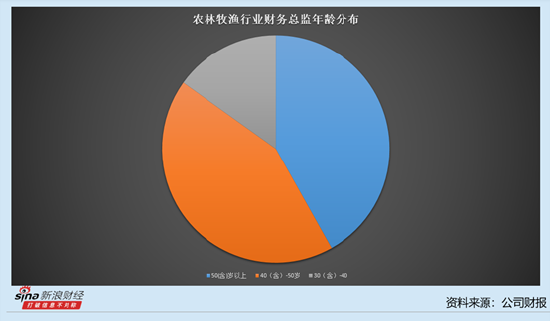
Summary of Key Points Core Viewpoint - The report highlights the salary trends and demographic characteristics of CFOs in A-share listed companies for 2024, indicating a total salary scale of 4.27 billion yuan and an average annual salary of 814,800 yuan. Group 1: Salary Overview - The total salary of CFOs in A-share listed companies reached 4.27 billion yuan, with an average annual salary of 814,800 yuan [1] - The highest salary recorded was 4.26 million yuan for Yang Shaolin, CFO of Haida Group, with a significant increase of 2.27 million yuan from the previous year [6] - 67% of CFOs experienced salary increases last year, while 28% saw declines [8] Group 2: Industry Breakdown - In the agriculture, forestry, animal husbandry, and fishery sector, the average salary for CFOs was 787,100 yuan, which is below the market average [1] - Among 22 CFOs in the agriculture, forestry, animal husbandry, and fishery sector, 5 had salaries exceeding 1 million yuan [6] - Companies with revenue exceeding 100 billion yuan had CFOs with higher salaries, while smaller companies had lower compensation [6] Group 3: Demographics - The majority of CFOs are aged between 40 and 50 years, accounting for 43% of the total [1] - The educational background shows that 48% of CFOs hold a bachelor's degree, while 37% have a master's degree [3] - The youngest CFO is 32 years old, while the oldest is 63 years old [1] Group 4: Salary Distribution - The most common salary range for CFOs is between 500,000 and 1 million yuan, making up 31% of the total [5] - There are 4 CFOs with salaries exceeding 2 million yuan, representing 5% of the total [5] - The lowest salary recorded was 150,000 yuan for a CFO in the agriculture sector [6]





农林牧渔行业上市公司财务总监观察:金龙鱼财务总监陆玟妤年薪高达400万元 排第三
Xin Lang Zheng Quan· 2025-08-08 07:09
Summary of Key Points Core Viewpoint - The report highlights the salary trends and demographics of CFOs in A-share listed companies for 2024, indicating a total salary scale of 4.27 billion yuan and an average annual salary of 814,800 yuan for CFOs in the A-share market. Group 1: Salary Overview - The total salary for CFOs in A-share listed companies reached 4.27 billion yuan, with an average annual salary of 814,800 yuan [1] - The highest salary recorded was 4.26 million yuan for Yang Shaolin, CFO of Haida Group, with a significant increase of 2.27 million yuan from the previous year [6] - 67% of CFOs experienced salary increases last year, while 28% saw declines [8] Group 2: Industry Breakdown - In the agriculture, forestry, animal husbandry, and fishery sector, the average salary for CFOs was 787,100 yuan, which is below the market average [1] - Among 22 CFOs in the agriculture, forestry, animal husbandry, and fishery sector, 5 had salaries exceeding 1 million yuan, with some companies generating over 100 billion yuan in revenue [6] Group 3: Demographics - The majority of CFOs are aged between 40 and 50 years, accounting for 43% of the total, while those aged 50 and above make up 42% [1] - The educational background shows that 48% of CFOs hold a bachelor's degree, 37% have a master's degree, and 16% have an associate degree [3] Group 4: Salary Distribution - The most common salary range for CFOs is between 500,000 and 1 million yuan, comprising 31% of the total [5] - There are 4 CFOs with salaries exceeding 2 million yuan, representing 5% of the total [5] - The lowest salary recorded was 150,000 yuan for Deng Li, CFO of Denghai Seeds [6] Group 5: Performance and Salary Changes - Companies like Tianbang Food and Yong'an Forestry saw revenue and net profit declines, yet their CFOs received salary increases [8] - In the planting industry, CFOs generally received lower salaries, with Zhang Xingtai from Xin Sai Co. earning only 280,000 yuan [8]


农林牧渔行业上市公司财务总监观察:温氏股份财务总监林建兴年薪高达416.98万元 上涨153.22万元
Xin Lang Zheng Quan· 2025-08-08 07:02
Core Insights - The report highlights the significant role and compensation of CFOs in A-share listed companies, with a total salary scale of 4.27 billion yuan and an average annual salary of 814,800 yuan for 2024 [3] Salary Distribution - The highest-paid CFO is Yang Shaolin from Haida Group, earning 4.26 million yuan, followed by Lin Jianxing from Wens Foodstuffs at 4.17 million yuan and Lu Wenyu from Jinlongyu at 4 million yuan [7] - 67% of CFOs saw salary increases last year, with the largest increase being 2.27 million yuan for Yang Shaolin [9] - 28% of CFOs experienced salary declines, with the most significant drop being 1.61 million yuan for Wang Yonghong from Zhengbang Technology [10] Age and Education Demographics - The majority of CFOs are aged between 40 and 50 years, accounting for 43% of the total, while those over 50 years make up 42% [3] - Educationally, 48% of CFOs hold a bachelor's degree, 37% have a master's degree, and 16% have an associate degree [5] Industry Insights - In the agriculture, forestry, animal husbandry, and fishery sector, the average salary for CFOs is 787,100 yuan, which is below the market average [3] - Among 22 CFOs in the agriculture sector earning over 1 million yuan, five companies have revenue exceeding 100 billion yuan [7] - Companies like KQ Bio and Shenghua Biotech reported revenue declines while their CFOs' salaries remained relatively high, indicating potential misalignment between performance and compensation [10]
SH月报:近端现货价格为锚情绪推拉难移格局-20250804
Zhe Shang Qi Huo· 2025-08-04 02:26
Report Industry Investment Rating No relevant content provided. Core Viewpoints of the Report - The upper - space of caustic soda is limited, and there is pressure at the 2800 price level. The recent supply - demand remains loose. With the return of previously overhauled devices, supply pressure persists, and downstream demand remains dull with no obvious positive factors. The market mainly weighs the possible negative feedback on the operating rate caused by the decline in liquid chlorine prices and the potential impact of domestic exports. Considering the approaching delivery of the near - end contract, the upper - space of the near - end is expected to be limited without obvious event shocks [3]. Summary According to the Table of Contents 1. Market Review - In July, domestic caustic soda futures showed a trend of rising from a low level and strengthening with fluctuations. Taking the main contract SE2509 as an example, it rebounded from the June low of 2207 yuan/ton to the intra - cycle high of 2757 yuan/ton, with a rise of 28.23%. The strong performance of caustic soda futures in the cycle was related to the near - end spot pattern and July policy expectations. The near - end spot strengthened as the previous pessimistic expectations were gradually corrected. The market's discussion on the comprehensive profit, inventory, and possible production cuts of upstream chlor - alkali enterprises heated up due to the rapid decline in the price of associated liquid chlorine. Upstream enterprises raised the price of liquid caustic soda, and downstream alumina enterprises also increased their procurement prices. In addition, the "anti - involution" series of policies in July boosted the commodity sentiment, and the caustic soda market showed an upward trend [15]. 2. Spot Prices - **32% caustic soda**: The prices in different regions such as Shandong, Jiangsu, Inner Mongolia, and Henan are presented, with specific price data and trends shown in the figures [18][22]. - **50% caustic soda**: The prices in regions like Jiangsu, Shandong, Henan, and Inner Mongolia are provided, along with their price trends [24]. - **99% flake caustic soda**: The prices in Shandong, Shaanxi, Inner Mongolia, and Xinjiang are given, and the price trends are also shown [25]. 3. Price Spreads - **Model price spreads**: The price spreads between 50% caustic soda and 32% caustic soda in Zhejiang, Jiangsu, Shandong, and Shaanxi, as well as the spreads between 99% flake caustic soda and 32% caustic soda in Shaanxi, Inner Mongolia, and Shandong, are analyzed, with specific data and trends presented [33]. - **Regional price spreads**: The price spreads of 32% caustic soda and 50% caustic soda between different regions are studied, including the spreads between Zhejiang - Shandong, Jiangsu - Shandong, etc., and the corresponding data and trends are shown [33][34]. 4. Supply Side - **Overall supply situation**: China's caustic soda production capacity is mainly concentrated in North China, Northwest China, and East China, accounting for 80% of the total national capacity. The production capacity in Southwest, South, and Northeast China is relatively low. In June, the domestic caustic soda production (in 100% equivalent) was 3.5122 million tons, with a month - on - month decrease of 4.38%. In July, the expected domestic caustic soda production (in 100% equivalent) was 3.6178 million tons, with an expected month - on - month decrease of 2.98%. The operating rate of domestic chlor - alkali enterprises in July was 58.01%, a month - on - month increase of 2.41% compared to June (83.01%) [50]. - **Operating rate**: The weekly operating rates of liquid caustic soda and flake caustic soda are presented, along with their trends [51]. - **Overhaul situation**: A list of chlor - alkali device overhauls is provided, including long - term shutdown capacities and overhauls in July. Some enterprises have completed overhauls and resumed production, while others have planned overhauls in August and September [57]. - **Flake caustic soda device operation**: The operating conditions of flake caustic soda devices of various manufacturers are described, including overhauls, normal operations, and planned overhauls [61]. 5. Import and Export - In June 2025, China's liquid caustic soda imports were 48,011 tons, a year - on - year decrease of 40.62% and a month - on - month decrease of 113.00%. The cumulative imports from January to June were 181,468 tons, a year - on - year decrease of 97.03%. Exports of liquid caustic soda were 291,000 tons, a year - on - year increase of 32.31% and a month - on - month increase of 13.70%. The cumulative exports from January to June were 1.7255 million tons, a year - on - year increase of 52.79%. Imports of solid caustic soda were 862.84 tons, a month - on - month decrease of 63.99% and a year - on - year decrease of 44.67%. Exports of solid caustic soda were 59,500 tons, a month - on - month increase of 79.32% and a year - on - year increase of 79.82% [65][68]. 6. Demand Side - **Alumina demand**: In July, the operating capacity of alumina enterprises was at a relatively high level. Although the supply - demand fundamentals had a certain negative impact on prices, the procurement demand from some downstream enterprises in the southern region and the short - term overhauls of some calcination devices in some enterprises led to a tight supply of spot goods in some areas, driving up the alumina price. The alumina market was also affected by macro - policies, but the actual impact on existing capacities was limited [73]. - **Viscose staple fiber demand**: In July, the domestic viscose staple fiber market was stable with fluctuations. The average monthly price was 12,800 yuan/ton, a decrease of 84 yuan/ton compared to the previous month, a decline of 0.63%. The cost side weakened as the prices of raw materials decreased. The industry's supply increased as some previously shut - down or reduced - production devices resumed production. The inventory decreased, and the downstream demand increased slightly, resulting in more stable quotes from manufacturers and an increase in the number of signed contracts [74]. 7. Inventory - In July, the overall inventory of domestic liquid caustic soda factories maintained a high - level oscillation, while the inventory of flake caustic soda continued to decline. There were differences among different manufacturers in Shandong. Enterprises with low inventory pressure had a strong willingness to raise prices, while those with moderate inventory adjusted prices according to market conditions. As of August 1, 2025, the inventory of domestic liquid caustic soda factories was 266,300 tons, basically unchanged compared to June 27, 2025 (266,600 tons). The inventory of domestic flake caustic soda factories was 19,100 tons, a month - on - month decrease of 43.49% compared to May 2, 2025 [97]. 8. Valuation - The processing cost of caustic soda mainly comes from raw salt and electricity. Each ton of caustic soda production requires 1.51 tons of raw salt, accounting for about 12% - 18% of the total cost, and the power consumption per ton is about 2300 - 2400 kWh, accounting for about 60% of the total cost. In July, the cost side weakened, while the spot price of caustic soda strengthened, and the comprehensive profit of chlor - alkali showed a recovery [103]. 9. Chlorine - consuming Downstream - The report presents data on the PVC benchmark spot price, PVC powder weekly operating rate, and the comprehensive profit of the calcium carbide method in the northwest integrated chlor - alkali industry. It also shows the production capacity utilization rate and production profit of products such as epoxy propane, epichlorohydrin, dichloromethane, and trichloromethane [115]. 10. Supply - Demand Balance Sheet - The report provides data on the total production, cumulative production, export volume, net export volume, cumulative net export volume, apparent consumption, cumulative apparent consumption, consumption, cumulative consumption, and inventory changes of caustic soda from 2024 to 2025, along with their year - on - year growth rates [142].
新赛股份(600540)8月1日主力资金净流出1941.80万元
Sou Hu Cai Jing· 2025-08-02 02:10
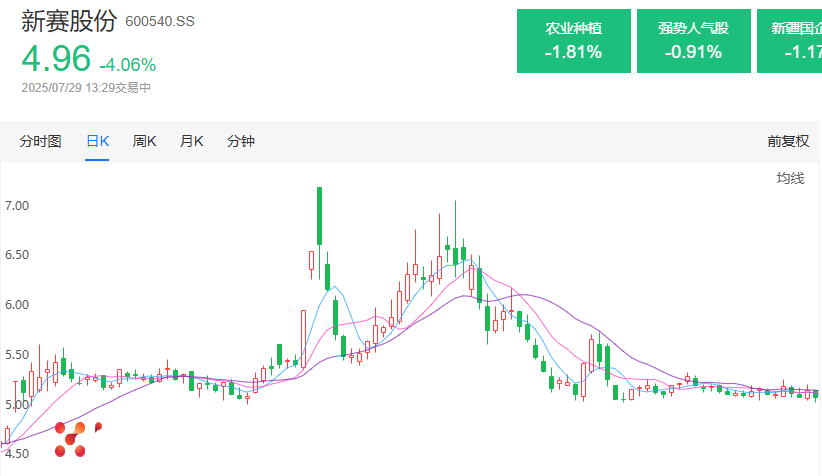
Group 1 - The core point of the article highlights the recent performance and financial metrics of Xinjiang Sailimu Modern Agriculture Co., Ltd. (新赛股份), including a stock price of 4.82 yuan, a decline of 0.62%, and a trading volume of 15.29 million shares with a transaction value of 74.08 million yuan [1] - The company reported a total operating revenue of 1.215 billion yuan for the first quarter of 2025, representing a year-on-year growth of 312.03%, and a net profit attributable to shareholders of 18.19 million yuan, up 315.74% year-on-year [1] - The company's liquidity ratios include a current ratio of 0.922 and a quick ratio of 0.411, with a debt-to-asset ratio of 90.87% [1] Group 2 - Xinjiang Sailimu Modern Agriculture Co., Ltd. has made investments in 39 enterprises and participated in 98 bidding projects, indicating active engagement in business expansion [2] - The company holds 42 trademark registrations and 3 patents, along with 3 administrative licenses, showcasing its commitment to intellectual property and regulatory compliance [2]
新疆国企改革板块8月1日涨2.15%,天富能源领涨,主力资金净流出4.41亿元


Sou Hu Cai Jing· 2025-08-01 08:50
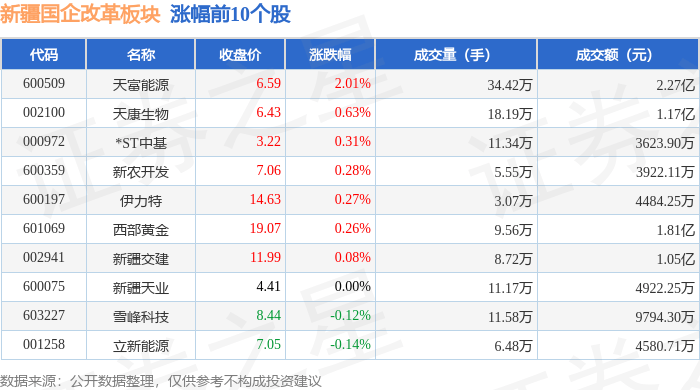
Market Overview - On August 1, the Xinjiang state-owned enterprise reform sector rose by 2.15%, led by Tianfu Energy [1] - The Shanghai Composite Index closed at 3559.95, down 0.37%, while the Shenzhen Component Index closed at 10991.32, down 0.17% [1] Stock Performance - Tianfu Energy (600509) closed at 6.59 with a gain of 2.01%, trading volume of 344,200 shares and a turnover of 227 million yuan [1] - Other notable stocks included Tiankang Biological (002100) with a 0.63% increase, and ST Zhongji (000972) with a 0.31% increase [1] - The overall performance of the Xinjiang state-owned enterprise reform sector showed mixed results, with some stocks experiencing slight declines [1] Capital Flow - The Xinjiang state-owned enterprise reform sector saw a net outflow of 441 million yuan from institutional investors, while retail investors contributed a net inflow of 214 million yuan [2] - The sector's capital flow indicates a divergence in investor sentiment, with institutional investors pulling back while retail investors remained active [2] Individual Stock Capital Flow - Qing Song Jian Hua (600425) had a net inflow of 14.21 million yuan from institutional investors, while Tianfu Energy (600509) saw a net inflow of 9.14 million yuan [3] - Conversely, stocks like Yili Te (600197) and Tiankang Biological (002100) experienced net outflows from institutional investors, indicating varying levels of confidence among different stocks [3]
新赛股份(600540)7月31日主力资金净流出2804.80万元
Sou Hu Cai Jing· 2025-07-31 13:37
Group 1 - The core point of the article highlights the recent performance and financial metrics of Xinjiang Sailimu Modern Agriculture Co., Ltd. (New Sai Co.), including a stock price drop and significant revenue growth [1][3] - As of July 31, 2025, New Sai Co. reported a stock price of 4.85 yuan, down 3.19%, with a trading volume of 22.18 million shares and a transaction amount of 1.09 billion yuan [1] - The company experienced a net outflow of main funds amounting to 28.05 million yuan, representing 25.79% of the transaction amount, with significant outflows from large orders [1] Group 2 - For the first quarter of 2025, New Sai Co. reported total operating revenue of 1.215 billion yuan, a year-on-year increase of 312.03%, and a net profit attributable to shareholders of 18.19 million yuan, up 315.74% [1] - The company has a current ratio of 0.922, a quick ratio of 0.411, and a debt-to-asset ratio of 90.87% [1] - Xinjiang Sailimu Modern Agriculture Co., Ltd. was established in 1999 and primarily engages in the textile industry, with a registered capital of 581.38 million yuan [1][2] Group 3 - The company has made investments in 39 enterprises and participated in 98 bidding projects, indicating active engagement in business expansion [2] - New Sai Co. holds 42 trademark registrations and 3 patents, along with 3 administrative licenses, showcasing its commitment to intellectual property [2]
低辐射玻璃(Low-E)概念下跌3.07%,主力资金净流出11股
Zheng Quan Shi Bao Wang· 2025-07-31 08:47
Core Viewpoint - The Low-E glass concept sector experienced a decline of 3.07%, ranking among the top losers in the market, with companies like Hainan Development, Yamaton, and Hebang Bio leading the declines [1] Group 1: Market Performance - The Low-E glass concept sector saw a net outflow of 179 million yuan in principal funds, with 11 stocks experiencing net outflows, and 8 stocks seeing outflows exceeding 10 million yuan [2] - Hainan Development had the highest net outflow of 32.23 million yuan, followed by Qibin Group, New Sai Co., and Jinjing Technology with net outflows of 26.50 million yuan, 23.93 million yuan, and 22.82 million yuan respectively [2] Group 2: Individual Stock Performance - Hainan Development's stock price fell by 5.14% with a turnover rate of 6.20% and a principal fund outflow of 32.23 million yuan [2] - Qibin Group's stock decreased by 2.96% with a turnover rate of 2.55% and a principal fund outflow of 26.50 million yuan [2] - New Sai Co. saw a decline of 3.19% with a turnover rate of 3.82% and a principal fund outflow of 23.93 million yuan [2] - Jinjing Technology's stock dropped by 3.24% with a turnover rate of 2.14% and a principal fund outflow of 22.82 million yuan [2] - Yamaton experienced a decline of 3.97% with a turnover rate of 6.56% and a principal fund outflow of 19.39 million yuan [2]


种植业板块7月31日跌1.86%,神农种业领跌,主力资金净流出3.62亿元
Zheng Xing Xing Ye Ri Bao· 2025-07-31 08:37
Market Overview - The planting industry sector experienced a decline of 1.86% on July 31, with Shennong Seed Industry leading the drop [1] - The Shanghai Composite Index closed at 3573.21, down 1.18%, while the Shenzhen Component Index closed at 11009.77, down 1.73% [1] Individual Stock Performance - Shennong Seed Industry (code: 681006) closed at 4.75, down 3.85% with a trading volume of 1.5589 million shares and a transaction value of 7.471 billion [1] - Kangnong Seed Industry (code: 837403) closed at 24.71, down 3.63% with a trading volume of 36,100 shares and a transaction value of 90.4238 million [1] - New Sai Co., Ltd. (code: 600540) closed at 4.85, down 3.19% with a trading volume of 221,800 shares and a transaction value of 109 million [1] - Other notable declines include Qiule Seed Industry (down 2.99%), Xuecheng Biological (down 2.64%), and New Agricultural Development (down 2.63%) [1] Capital Flow Analysis - The planting industry sector saw a net outflow of 362 million from main funds, while retail investors contributed a net inflow of 265 million [3] - Notable capital movements include: - Honghui Fruits and Vegetables (code: 603336) saw a main fund net inflow of over 3.7874 million [3] - Wanxiang Denong (code: 600371) experienced a main fund net outflow of 7.3007 million [3] - New Agricultural Development (code: 600359) had a significant main fund net outflow of 13.2779 million, with a retail net inflow of 11.8843 million [3]


一带一路重磅会议8月召开,或聚集安全合作等议题
Xuan Gu Bao· 2025-07-29 07:58
Group 1 - The Shanghai Cooperation Organization (SCO) summit will be held in Tianjin from August 31 to September 1, marking the largest summit in the organization's history with over 20 national leaders and 10 international organization heads attending [1] - Since its establishment in 2001, the SCO has expanded from 6 member countries to 26, becoming the largest regional international organization in terms of area and population [1] - China has designed over 110 important activities under its presidency, including various ministerial meetings and forums, focusing on security, economic cooperation, and cultural exchanges [1][2] Group 2 - The summit will emphasize security cooperation, addressing traditional threats like border and maritime security, as well as emerging non-traditional security issues such as cybersecurity and economic security [2] - Economic cooperation and cultural exchanges will also be prioritized, with discussions on digital economy and green technology aimed at injecting new momentum into member countries' development [2] - Companies involved in logistics and transportation in Tianjin, such as Tianjin Port, Tiensun Co., HNA Technology, and China Storage Co., are positioned to benefit from the summit and related initiatives [3][6]