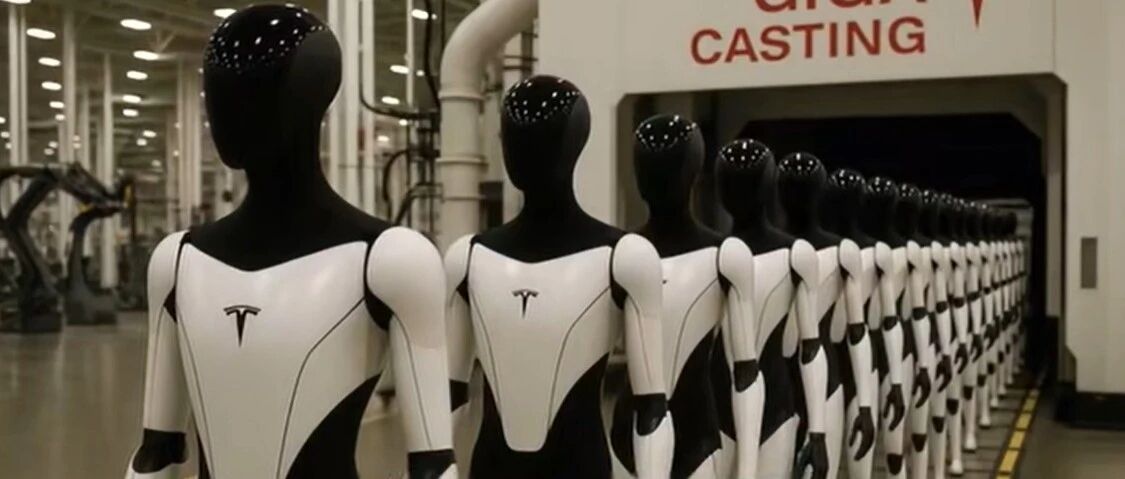
Figure AI

Search documents
优必选邓峰:颠覆性的科技需要适当的泡沫作为催化剂
Feng Huang Wang Cai Jing· 2025-09-23 11:50
Group 1 - The "Phoenix Bay Area Finance Forum 2025" was held in Guangzhou on September 23-24, focusing on the theme "New Pattern, New Path" and gathering global political, business, and academic elites to explore development opportunities [1] Group 2 - Deng Feng, Executive Director and Vice President of Shenzhen Youbixun Technology Co., Ltd., shared insights on AI and humanoid robots during a closed-door session on "Synergy and Win-Win: Thematic Exchange on Enterprises Going Abroad" [3] - Deng Feng commented on the $1 billion funding received by the American robotics company Figure AI, which achieved a post-investment valuation of $39 billion, noting that there is a gap in technological depth and commercialization compared to leading domestic robotics manufacturers [3] - He expressed that disruptive technology requires a certain level of bubble as a catalyst and emphasized the need for patience and tolerance in pioneering research, advocating for the transition of technology from the lab to large-scale application [3]


超越资本狂热:具身智能的死亡之谷与真实拐点
3 6 Ke· 2025-09-23 11:32
过去这段时间,关于"具身智能"的讨论和投入几乎达到了前所未有的"疯狂"状态。头部企业重仓下注,创投圈高频出手,产业巨头与创业公司同台竞技, 一时间"具身智能"成了资本和媒体的宠儿。市场上,更是频频涌现出数十亿级的融资大单,产业链上下游如火如荼,仿佛谁慢一步就要错失时代红利。 然而,热潮之下,冷静的声音并未消失。 正如《经济日报》所言,别再搞一哄而上的"人工智能+"。这句警语不仅点中了中国AI产业的"成长烦恼",也为当下这场全球范围内的具身智能竞赛敲响 了警钟。 它不仅是AI从虚拟世界走向物理世界的里程碑,更被视作"下一个通用技术平台"。但如果我们只停留在融资排行榜、Demo视频和PPT故事之中,忽视了 创新的可持续性、技术的现实边界、产业的生态健康以及社会的伦理责任,所谓的"热潮"很快就会像以往的技术泡沫一样退去,甚至带来更大失望和资源 浪费。 因此,本文希望跳出"资本狂热"和"赛道爆发"的表层逻辑,将目光转向技术创新、产业落地、责任治理、社会价值等更具深度与可持续性的议题。 让我一起从热闹的背后去反思:热潮之下还有哪些值得思考的创新命题?在资本和技术之外,我们需要怎样的产业耐心和培育机制?只有这样,这场AI ...
特斯拉 - 特斯拉、Meta、Figure AI 光子竞赛
2025-09-23 02:37
Summary of Key Points from the Conference Call Industry and Company Involved - **Company**: Tesla Inc (TSLA) - **Industry**: Automotive and AI Robotics Core Insights and Arguments 1. **Vision Data Importance**: The development of Vision Language Action (VLA) models for AI robots is heavily reliant on high-quality vision data, which is becoming increasingly sought after by developers in the AI and robotics sectors [1][2][4] 2. **Shift to Vision-Only Training**: Tesla is reportedly moving towards a 'vision-only' approach for training its Optimus robot, transitioning from teleoperators to using videos of human tasks as training data [2][4] 3. **Market Value of Vision Data**: The analogy of catching a bluefin tuna illustrates that without the means to capture and process visual data, its value is effectively zero. However, with the right technology, the potential value of this data increases significantly [2] 4. **Partnerships for Data Collection**: Brookfield Corporation is collaborating with Figure AI to gather extensive training data for humanoid robots, leveraging its vast real estate portfolio [7] 5. **Meta's Role in Data Collection**: Meta's wearable technology, particularly glasses with ultra-high-definition cameras, is positioned as a tool for capturing real-world data, which could be used to train AI models [8] Additional Important Content 1. **Tesla's Financial Metrics**: As of September 19, 2025, Tesla's stock price was $426.07, with a market cap of approximately $1.5 trillion. The projected EPS for the fiscal year ending December 2026 is $2.69 [4] 2. **Investment Ratings**: Morgan Stanley has rated Tesla as "Overweight" with a price target of $410, indicating a positive outlook on the stock's performance relative to its peers [4] 3. **Future of AI Robotics**: The integration of AI in robotics is expected to disrupt various sectors, with companies like Tesla and Meta leading the charge in data collection and model training [2][8] 4. **Risks and Challenges**: Potential risks for Tesla include competition from legacy OEMs and execution risks related to factory ramp-ups and new model introductions [24] This summary encapsulates the key points discussed in the conference call, highlighting the strategic direction of Tesla and the broader implications for the automotive and AI robotics industries.
计算机行业“一周解码”:荣威上车豆包大模型,智能座舱进入深度思考时代
Bank of China Securities· 2025-09-23 00:35
Investment Rating - The industry investment rating is "Outperform the Market," indicating that the industry index is expected to perform better than the benchmark index over the next 6-12 months [33]. Core Insights - The launch of the SAIC Roewe M7 DMH, which features the Doubao deep thinking model, marks a significant advancement in smart cockpit technology, redefining human-vehicle interaction from command-based to natural interaction [11][12]. - Figure AI has raised over $1 billion in Series C funding, achieving a post-money valuation of $39 billion, highlighting the growing interest in humanoid robotics and its potential applications in both domestic and commercial settings [13][15]. - NVIDIA is pushing for the development of a new microchannel liquid cooling plate (MLCP) technology due to the high power consumption of new AI platforms, which could become a strategic material in the industry [16][18]. Summary by Sections Smart Cockpit - The SAIC Roewe M7 DMH integrates the Doubao deep thinking model, enhancing its ability to understand ambiguous commands and execute complex vehicle control tasks, thus improving user experience significantly compared to conventional models [11][12]. - The smart cockpit is evolving from a simple command execution system to a more intuitive and emotionally engaging partner for users, indicating a shift in the automotive industry's competitive landscape towards data, computing power, and algorithm capabilities [12][11]. Humanoid Robotics - Figure AI's recent funding round reflects strong market confidence in humanoid robots, with plans to expand their production and deployment capabilities for both household and commercial applications [13][15]. - Despite the high valuation, concerns remain regarding Figure AI's ability to convert demonstration capabilities into actual delivery and operational success in real-world scenarios [14][15]. Cooling Technology - NVIDIA's MLCP technology is expected to address the cooling challenges posed by high-power AI platforms, with costs projected to be 3 to 5 times higher than traditional cooling solutions, indicating a shift in the cooling technology landscape [16][18]. - The introduction of MLCP is seen as a necessary evolution in the industry, as traditional cooling methods are becoming inadequate for the increasing power demands of AI hardware [17][18].


7 AI Startups Backed by Jeff Bezos — Should You Invest?
Yahoo Finance· 2025-09-22 15:00
Group 1: Investment Focus - Jeff Bezos has invested in nine AI startups in 2024, with four focused on autonomous robotics [2] - The investment strategy reflects Bezos's history of identifying transformative opportunities in technology [1] Group 2: Specific Startups - Swiss-Mile received a $22 million funding round co-led by Bezos, developing delivery robots resembling headless dogs on wheels [3] - Figure AI is creating humanoid robots for various industries, potentially integrating with Amazon's logistics system [4] - Skild AI is focused on developing AI systems for robots to learn and adapt, aiming for artificial general intelligence [5] - Physical Intelligence is working on robots for dangerous tasks in sectors like mining and construction [6] - Perplexity AI is an AI-powered search engine that competes with Google, indicating Bezos's interest in potential disruptors [7] - Tenstorrent is a chip design company aiming to challenge Nvidia's dominance in AI hardware, providing affordable alternatives [8] - Outgo is a fintech company that offers tools for managing payments and cash flow in logistics, aligning with Bezos's interests in financial infrastructure [9][10]
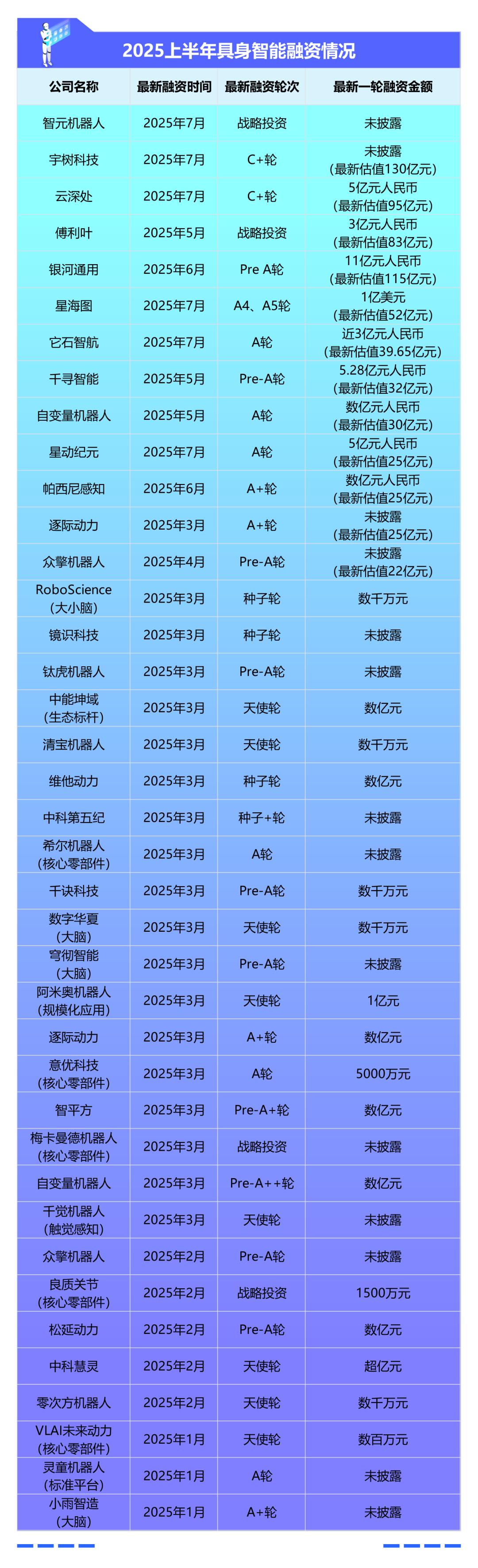
头部具身智能人形机器人公司最新估值/市值
自动驾驶之心· 2025-09-21 23:32
编辑丨具身智能之心 点击下方 卡片 ,关注" 具身智能之心 "公众号 >> 点击进入→ 具身 智能之心 技术交流群 更多干货,欢迎加入国内首个具身智能全栈学习社区 : 具身智能之心知识星球 (戳我) , 这里包含所有 你想要的。 头部具身智能人形机器人公司最新估值或市值一览。除了已上市公司外,这里展示的都是已完成或 正在交割的真实估值,未经实际交割、未获交易确认的估值均未列入,单位为人民币。注意,各公 司成立时间和融资阶段差异大。估值高低与技术、商业化水平不能简单划等号。 以下数字仅做参考,如有不足或者遗漏,欢迎后台留言。 Figure AI 2736亿 乐聚机器人 80亿 优必选 555亿 Sklid AI 324亿 Physical Intelligence 170亿 宇树科技 160亿 智元机器人 150亿 Apptronik 144亿 Field AI 144亿 Agility Robotics 126亿 云深处机器人 80亿 傅利叶机器人 80亿 World labs 70亿 Sanctuary AI 70亿 Boston Dynamics 70亿 银河通用 70亿 星海图 70亿 自变量 60亿 ...
软硬件场景多维共振 具身智能产业发展提速
Zhong Guo Zheng Quan Bao· 2025-09-21 20:17
Core Insights - The embodied intelligence industry is experiencing rapid development in both hardware and software, with expanding application scenarios, particularly in humanoid robots, which are expected to reshape industrial ecosystems over the next 5 to 10 years [1] Company Developments - Junsheng Electronics held a product launch on September 18, introducing an AI head assembly for robots, a universal controller based on NVIDIA's Jetson Thor chip, and a new generation of energy management products [1] - Hikvision Robotics launched three new products focused on industrial logistics automation on September 21, addressing challenges in non-standard scene adaptation and high simulation costs [2] - Tesla aims to scale up production of its Optimus humanoid robot, targeting an annual output of 1 million units within five years, with the next version, Optimus 3, expected to launch by the end of 2025 [3] - Figure AI completed a Series C funding round, raising over $1 billion to enhance its robot's capabilities in household and commercial settings [3] - 1X Technologies introduced the Neo Gamma humanoid robot, designed for household tasks, with plans for early testing in homes by the end of 2025 [4] Industry Trends - The humanoid robot sector is accelerating, with significant advancements in technology and production capabilities, particularly among leading companies and startups [4][5] - The industry is entering a critical phase, with increased competition and a focus on launching new products to attract consumer attention [4] - The application of humanoid robots in industrial settings is becoming a well-established trend, with companies like Zhiyuan Robotics collaborating with manufacturers for large-scale deployments [6] - The use of humanoid robots in sports science is being explored, with robots conducting performance tests for athletic gear, significantly reducing testing time [7] Government Initiatives - The Ministry of Industry and Information Technology aims to achieve breakthroughs in over 100 innovative robotic applications by 2025, focusing on ten key application areas [8] - The government emphasizes strengthening the entire supply chain for humanoid robots, including advancements in high-performance chips and multi-modal algorithms [8]


新能源+AI周报:固态电池进展超预期,重视储能等领域的高成长-20250921
Tai Ping Yang· 2025-09-21 13:41
Investment Rating - The report does not provide specific ratings for sub-industries such as power station equipment, electrical equipment, power supply equipment, and new energy power [3]. Core Insights - The overall strategy for the industry emphasizes the unexpected progress in solid-state batteries and highlights the high growth potential in energy storage and related fields. It suggests focusing on leading new energy companies during this layout window, with a preference for sectors like energy storage and lithium batteries, while remaining flexible in selecting areas like AI+ and solid-state technologies [4]. Summary by Sections New Energy and AI - The development of solid-state batteries is resonating positively both domestically and internationally, benefiting companies like CATL, Xiamen Tungsten, and Putailai. Notable advancements include the operationalization of a 430Wh/kg solid-state silicon-based battery production line by Zhongxin Innovation, and the delivery of the first batch of sulfide solid-state batteries by Funeng Technology by the end of the year [4][24]. - The lithium battery market is showing favorable conditions, with companies like EVE Energy and Longpan Technology expected to benefit from recent developments, including EVE's entry into the Xiaopeng MONA supply chain [5]. Energy Storage Industry - The energy storage sector is experiencing unexpected growth, with companies like Tesla, Sungrow, and Haibo Si Chuang benefiting. The IRENA report indicates that "solar + storage" will become the most economical green energy solution, with significant increases in domestic energy storage bidding and installation scales [6][7]. - The report highlights a substantial increase in the bidding scale for new energy storage, with a 60% year-on-year growth to 33.8GWh in August 2025, and a projected installed capacity of over 180 million kilowatts by 2027 [6][27]. AI and New Energy - The integration of AI with new energy technologies is entering a critical phase, with companies like Zhenyu Technology and Keda Li benefiting from advancements in humanoid robots and related technologies. Notably, Figure AI has secured over $1 billion in funding, aiming to deliver 100,000 robots in the next four years [8][24]. - The wind power sector is also expected to exceed expectations, with major procurement projects indicating strong demand. In August 2025, 30 wind turbine procurement projects were opened, totaling approximately 15.39GW [8][23]. Price Trends - Recent trends show a continuous increase in silicon material prices, with the latest transaction price range for n-type granular silicon at 49,000 to 50,000 yuan per ton, averaging 49,500 yuan per ton [7][12]. - The report notes that the price of lithium carbonate has remained stable, while the price of cobalt has increased, reflecting broader trends in the battery materials market [11][17].




行业深度 | 人形机器人系列深度四:特斯拉引领 迈向具身智能新纪元【民生汽车 崔琰团队】
汽车琰究· 2025-09-21 11:47
Core Insights - The article emphasizes the rapid advancements in humanoid robots, particularly focusing on Tesla's Optimus and various leading companies in the sector, indicating a new era of embodied intelligence in robotics [2][4][28]. Group 1: Development of Humanoid Robots - The humanoid robot industry has evolved through four distinct stages: exploratory, integrated, high-dynamic, and intelligent development, with significant advancements in perception, decision-making, and execution capabilities [7][11][41]. - The current intelligent development phase is characterized by the integration of large language models, enhancing robots' perception, interaction, and decision-making abilities [14][43]. Group 2: Tesla's Optimus Progress - Tesla's Optimus is set to achieve significant software and hardware breakthroughs, with capabilities for heavy lifting, dynamic grasping, and autonomous movement in complex terrains expected by 2025 [8][45]. - The Optimus 3 is anticipated to launch by the end of 2025, with mass production starting in 2026, aiming for an annual production target of 1 million units within five years [8][56]. Group 3: Competitive Landscape - Leading companies in the humanoid robot sector include Figure AI, Boston Dynamics, and 1X Technologies, each making strides in commercialization and technological advancements [9][28]. - The competitive landscape is marked by significant investments from tech giants like Google, Microsoft, and Amazon, focusing on internal development, strategic partnerships, and external investments to enhance their capabilities in humanoid robotics [28][43]. Group 4: Investment Opportunities - The article suggests focusing on automotive parts companies with strong production capabilities and connections to the robotics supply chain, as they are well-positioned to support the growing humanoid robot market [4][36]. - Specific companies recommended for investment include Top Group, Junsheng Electronics, and New Spring Shares, which are expected to benefit from the increasing demand for humanoid robots [4][56]. Group 5: Application Scenarios - Key application areas for humanoid robots include industrial manufacturing, logistics sorting, and household services, with companies like Figure AI and Agility Robotics leading the way in these sectors [35][36][39]. - The logistics sector is particularly highlighted for its potential, with advancements in flexible operations and zero-sample learning capabilities for package sorting [36][39].

特斯拉、宇树、Figure、智元等,产业链上市公司周速递
Robot猎场备忘录· 2025-09-21 00:02
Core Insights - The article discusses the volatile performance of the robotics sector, particularly influenced by Tesla and its Optimus project, which has led to significant fluctuations in stock prices within the industry [2][4][24] Group 1: Market Performance - The robotics sector experienced a "roller coaster" market performance, with significant gains driven by positive news from Tesla and its Optimus project [2] - On September 15, the sector saw a major surge, particularly among Tier 1 suppliers, following Tesla's stock price increase and optimistic production guidance for Optimus [3][4] - By September 16, the sector continued to rise dramatically, with many stocks reaching their daily limits [5][7] Group 2: Key Events and Catalysts - A major catalyst was Elon Musk's purchase of over 2.5 million Tesla shares, valued at approximately $1 billion, which boosted market sentiment [8] - The announcement of significant orders and production meetings related to Optimus further fueled investor interest [8][24] - On September 18, the market reacted to news of a potential order for 10,000 units of Optimus Gen3, although this was later clarified as merely an intention rather than a confirmed order [15][17] Group 3: Stock Reactions and Trends - Following the initial surge, the market faced a correction, with many stocks experiencing declines due to profit-taking and external market pressures [14][18] - Despite the fluctuations, key players in the Tier 1 supply chain maintained substantial gains, indicating strong underlying demand [14][24] - New potential Tier 1 suppliers emerged, such as companies providing IMU sensor testing equipment and harmonic reducers, highlighting ongoing innovation in the sector [3][10] Group 4: Future Outlook - The article suggests that while the robotics sector is currently experiencing volatility, there are expectations for further developments and potential catalysts in the upcoming quarter [24] - The ongoing evaluation of Tesla's supply chain and the emergence of new players are critical factors to watch in the near future [24]